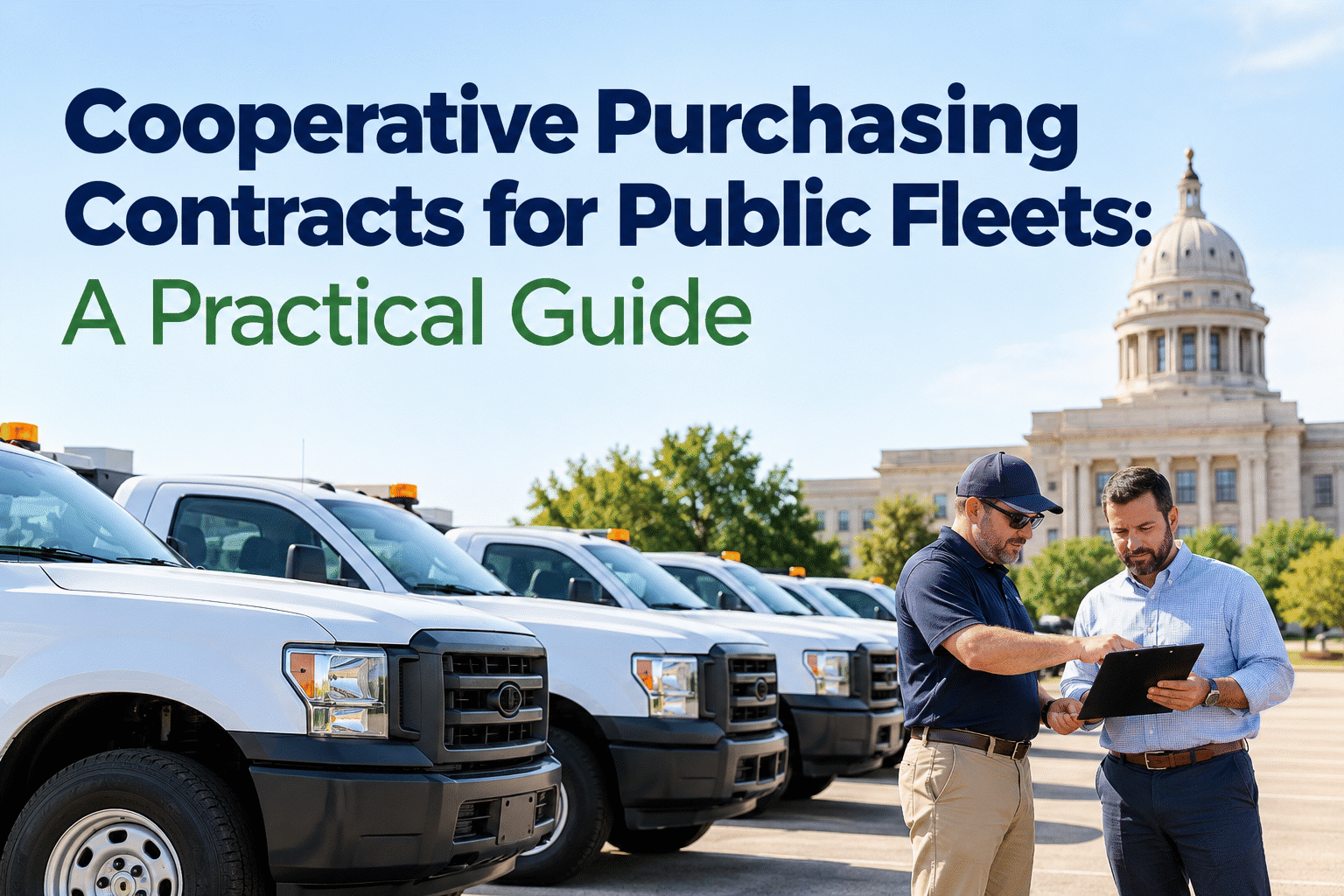
You need eight new units before the budget cycle closes, and a full sealed bid can eat four to six months you don't have. That's the gap cooperative purchasing contracts close: your public fleet buys off a contract a lead agency already solicited and awarded, so you skip the RFP while still meeting competitive-procurement rules. Done right it's fast and audit-clean; done without the paper trail, it's a finding waiting to happen. Book a demo to keep procurement records audit-ready from the first PO.
Cooperative Purchasing Contracts: The Faster, Still-Competitive Way to Buy
Why run a full bid from scratch when a lead agency already did? Here's the time you save — without giving up the competitive, auditable record your auditors expect.
- Write & advertise the RFP
- Pre-bid, Q&A, protest window
- Evaluate & score every response
- Award, then order
- Use an already-awarded contract
- Confirm eligibility & fit
- Get a quote on the contract line
- Issue PO, keep the records
The time saving is real, but it isn't a free pass. A cooperative contract only protects you if you use it correctly and keep the record that proves you did. Below is how these contracts actually work, who can use them, the due-diligence steps auditors look for, and where a purchase-management system keeps the whole thing defensible.
How it workscooperative purchasing contracts, step by step
A cooperative purchasing contract is a contract a lead agency or purchasing cooperative solicits and awards competitively on behalf of its members. Once it exists, any eligible agency can buy off it — the heavy competitive-bidding work is already done. The flow for a public fleet looks like this.
-
1
Register with the cooperative
Join a co-op such as Sourcewell, OMNIA Partners or a state/regional program. Registration is typically free with no obligation to buy.
-
2
Find the awarded contract
Search by product type for a contract covering the vehicles or equipment you need, and confirm it's currently active.
-
3
Confirm eligibility & spec the unit
Verify your agency qualifies, then match the contract's vehicle specifications to your actual duty cycle — don't over- or under-spec.
-
4
Get a quote on the contract
Contact the awarded supplier or local dealer using the contract number and your account number to finalize contract pricing.
-
5
Issue the PO and keep the record
Approve and issue the purchase order, then file the contract number, quote and approvals — the audit trail that proves it was competitive.
Steps 1 through 4 save you the months a sealed bid would take. Step 5 is the one agencies underestimate — and it's the one an auditor actually inspects. Keeping the contract reference, the quote and the approval chain attached to every purchase is exactly what HVI's purchase management is built for. Book a demo to see the full PO-to-record trail on a cooperative buy.
"Is this even allowed?"clearing up what cooperative purchasing is and isn't
The biggest hesitation public fleet buyers have is whether skipping their own bid is defensible. It is — when the conditions are met. Here's the reality behind the four most common worries.
"Using a co-op contract means we skipped competition."
The contract was competitively solicited and awarded by the lead agency — the competition happened, just not by you.
"Any organization can buy off these contracts."
Eligibility is usually limited to government and education entities (some include nonprofits). For-profit businesses generally can't.
"The co-op handles compliance, so we don't have to."
Your agency still owns due diligence and compliance with your own federal, state and local rules — confirm with counsel.
"There's no paperwork since we didn't run a bid."
You need more records, not fewer — the contract reference and approvals are what prove the purchase was legitimate.
That last point is the whole game. A cooperative purchase that can't be reconstructed from your records is as risky as no competition at all. HVI already serves this exact buyer profile — see how agencies buy through TIPS cooperative purchasing or an OMNIA Partners agreement for the software itself. Sign up free and start logging procurement records the way auditors want them.
The due-diligence checklistwhat to confirm before you buy off a cooperative contract
Before you issue the PO, run the purchase through this. Every box you can tick — and document — is one less question when the auditor or council asks how you spent public money. Treat it as the record, not just a memory check.
- Contract is active and not expired
- It was competitively solicited & awarded
- Your agency type is eligible to use it
- Your state/local rules permit co-op buys
- Legal counsel sign-off where required
- Vehicle spec matches real duty cycle
- Contract pricing confirmed in writing
- Quote references the contract number
- Internal approvals captured & dated
- All of the above filed against the PO
The left column is the legitimacy test; the right column is the paper trail that proves it. Miss the documentation and even a perfectly legal purchase looks questionable in review. HVI lets you attach the contract reference, quote and approvals directly to each purchase order and vehicle record, so this checklist becomes your stored audit file, not a one-time form. Book a demo to see the due-diligence record built into the PO.
Where HVI fitspurchase management for public fleet procurement
Cooperative contracts handle the competitive sourcing. What they don't do is manage your side: approving the PO, recording the vendor, tracking the spend against budget, and keeping it all audit-ready. That's where a purchase system built for public fleets earns its keep.
Route every purchase through the right approvers and capture each sign-off with a timestamp — no more chasing email approvals.
Store the cooperative contract number, supplier and quote against the PO, so the competitive basis is always on file.
Track procurement against budget and roll it into analytics & reporting for council and audit summaries.
On delivery the PO ties to the vehicle record, so cost, warranty and PM history all trace back to the buy.
Put together, that's a procurement record a public fleet can stand behind in any review — fast to create, impossible to lose. Book a demo to walk a cooperative purchase end to end, from contract lookup to the linked asset record.
From a municipal procurement officer
Cooperative contracts cut our acquisition time from months to weeks, which everyone loves — until the annual audit, when "where's the competitive basis for this purchase?" comes up. The contract number and approvals used to live in three different inboxes. Now they're attached to the PO the moment it's issued, so when the auditor asks, I pull one record and we move on. That alone pays for the system.
Cooperative purchasing contracts — FAQs
What is a cooperative purchasing contract?
It's a contract that a lead agency or purchasing cooperative solicits and awards competitively on behalf of its members. Eligible agencies can then buy vehicles or equipment directly off that awarded contract, skipping their own full bid while still relying on a competitively established price.
Is cooperative purchasing legal for public fleets?
Yes, where your own state and local rules allow it. The contract satisfies the competitive requirement because the lead agency already bid it out. Your agency still owns due diligence and compliance with its own laws and funding rules, so confirm with legal counsel before relying on one.
Who is eligible to use cooperative contracts?
Eligibility is typically limited to government and education entities, and some cooperatives include nonprofits. For-profit businesses and private buyers generally aren't eligible. Registration with the cooperative is usually free and carries no obligation to buy — but confirm eligibility with the co-op directly.
What records should I keep for a cooperative purchase?
Keep the cooperative contract number, the supplier quote referencing that contract, the vehicle specification, and your internal approvals — all filed against the purchase order. These prove the purchase was competitively based and properly authorized if it's ever reviewed in an audit.
How does HVI help with cooperative purchasing?
HVI Purchase Management captures the PO, vendor, cooperative contract reference, quote and approvals in one record, then links it to the vehicle on delivery. That turns the due-diligence checklist into a stored, audit-ready file instead of scattered paperwork across inboxes.
Make every cooperative purchase audit-ready from the first PO
HVI Purchase Management keeps the contract reference, quote, approvals and spend against the vehicle they bought — so your public fleet moves fast on acquisition and stays clean in review. Live on your fleet in under two weeks.
No credit card · No hardware · Purchase records ready on day one