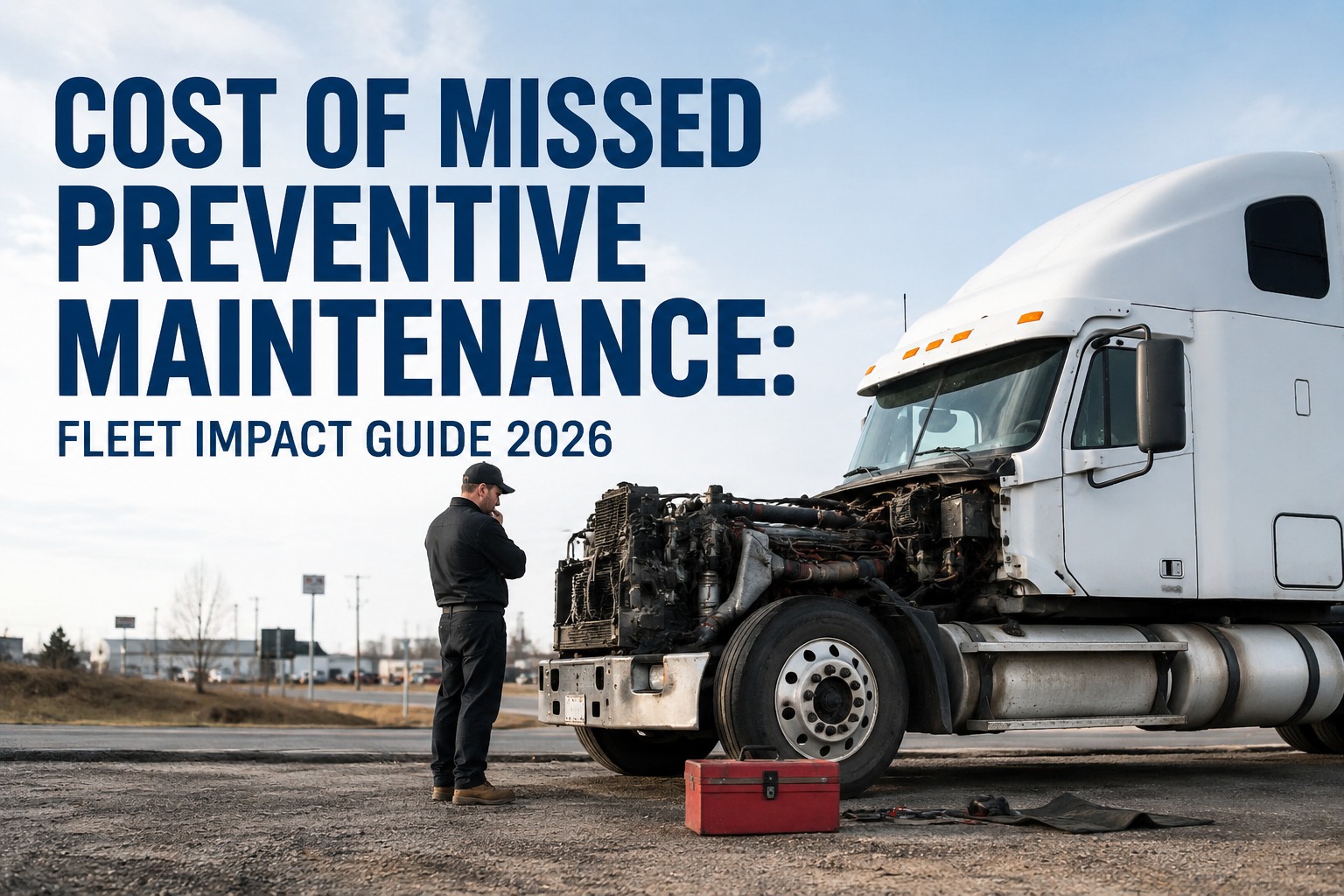
Skipping a scheduled preventive maintenance service saves the invoice today — and can multiply the cost when the deferred condition eventually surfaces. Reactive repairs commonly run 3–5 times the cost of the equivalent planned service once emergency labor, expedited parts, downtime, and secondary damage are counted; catastrophic failures push higher. This 2026 guide walks the failure chain from a missed PM to a mid-shift breakdown, the illustrative math per asset class, and the backlog-visibility discipline that keeps fleets on the planned-work side of the ledger. Book a demo .
The Cost of Missed PM — Two Paths From the Same Starting Point
Illustrative Class 8 brake service scenario. Actual costs vary by fleet, asset, lane, and operating conditions.
Illustrative scenario. Aligns with US Department of Energy and industry findings that reactive maintenance commonly costs 3–5x the equivalent planned service across sectors.
The cost of missed preventive maintenance is one of the most consistently underestimated numbers in fleet operations. The scheduled service that was skipped shows up on nobody's report; the emergency breakdown that results shows up as a maintenance line item nobody links back to the skipped PM. That accounting gap is why fleets running at 60% PM compliance often can't explain why their per-vehicle maintenance cost runs materially higher than fleets at 90%. The math isn't complicated when the underlying pattern is visible: the reactive version of any maintenance event typically costs 3–5 times the planned version, and the gap widens when downtime, secondary damage, and operational disruption are counted honestly.
The failure chain — how a skipped PM becomes a shop invoiceSix stages, each with a shrinking window to intervene at planned cost
The failure chain from skipped PM to emergency repair follows a predictable sequence. Every stage has a lower intervention cost than the next; every stage that goes unaddressed narrows the reversal window. Book a demo to see PM overdue alerts in HVI
Interval hits (calendar, meter, or condition). Work order not created, not assigned, or not completed. Vehicle continues in service. Intervention cost: the original PM invoice.
Lubricant contamination, wear accumulation, seal degradation, coolant chemistry drift. Component operates outside its design envelope. Intervention cost: PM plus modest additional labor.
Operator reports noise, vibration, pull, warning light, reduced performance. Pre-trip may or may not catch it depending on template quality. Intervention cost: targeted repair with some collateral service.
Primary failure cascades into adjacent components. Scored drum, damaged bearing, contaminated hydraulic circuit, blown seal chain. Intervention cost: multi-component repair, extended shop time.
Component fails in service. Mid-shift breakdown, potentially roadside OOS, potentially causing incident. Intervention cost: emergency response plus all downstream disruption.
Tow, mobile diagnostics, emergency parts, premium labor, substitute equipment, customer relationship impact, potential CSA implication if defect met OOSC threshold. Intervention cost: the full cascade.
Cost profile varies dramatically by asset classSame failure chain; different absolute dollars depending on what the asset does and what it costs when parked
Missed PM cost isn't uniform across asset types. A skipped oil change on a light-duty service pickup and a skipped inframe overhaul PM on a Class 8 tractor operate on the same failure chain but at very different absolute scales.
Asset-varying cost math is why one-size-fits-all PM scheduling breaks down — each class needs its own interval logic, alert thresholds, and backlog treatment. Book a demo to see meter/calendar/condition-based PM scheduling in HVI or start a free trial to try it on your fleet.
The maintenance backlog — three categories with three cost profilesNot every overdue task carries the same risk. The categorization is the management tool.
Fleet leaders who treat "overdue PM" as one bucket lose the ability to prioritize. Three categories separate the exposure meaningfully — and the cost pattern differs materially across them.
The category split is what turns "we have overdue PMs" into an actionable risk-prioritization discussion. Book a demo to see backlog visibility with silent-skip detection in HVI
Warranty context — where missed PM affects coverageThe nuanced answer that isn't "voids the whole warranty"
OEM warranty terms typically require the fleet to follow the manufacturer-recommended maintenance schedule and retain records demonstrating compliance. Missed maintenance doesn't automatically void the entire warranty — but it can affect specific claims where the manufacturer can trace the failure to inadequate maintenance.
From a maintenance director on measuring what actually gets prevented
We used to track maintenance spend as one line item. Emergency repairs got recorded when they happened, but nobody connected them back to the PM that didn't happen 30 or 60 days earlier. Our per-unit cost was well above industry benchmarks for our fleet size and age — and we couldn't explain why.
When we split spend into planned vs unplanned in the CMMS and started tracking overdue PM as a KPI, the picture was obvious. Roughly 22% of our unplanned repairs traced back to a PM that had slipped past its interval. On per-unit cost that was over $180,000 a year on a 140-tractor fleet — work we were paying reactive premium for on services we would have done anyway. Twelve months of tighter overdue-PM discipline and unplanned spend dropped by roughly a third. Same trucks, same drivers — different measurement.
Frequently asked questions
What is the cost of missed preventive maintenance?
The cost of missed preventive maintenance is the combined cost of downstream repair, downtime, and operational disruption that follows when a scheduled service isn't performed and the underlying condition eventually causes failure. Industry research consistently shows reactive repairs cost 3–5 times the equivalent planned service across sectors (US Department of Energy and multiple industry studies), with catastrophic failures exceeding that range. Real cost categories include: emergency labor at premium rates; expedited parts at 5–10x standard shipping cost; tow or roadside recovery; unplanned downtime revenue loss; secondary damage repair on adjacent components; substitute equipment or missed delivery impact; and where applicable, potential CSA scoring effect if the failure met an OOSC threshold. Actual cost depends on the specific asset, missed task, operating conditions, and how long the maintenance was deferred. One missed oil change on a light-duty pickup may not surface for months; a missed brake service on a Class 8 tractor may surface as a roadside OOS in weeks. The math consistently favors keeping the PM on schedule.
How much more do reactive repairs cost than preventive maintenance?
The typical multiplier documented across fleet, manufacturing, and industrial sources is 3–5 times the planned cost per repair event, with some sources citing ranges up to 3–9x depending on failure severity and asset class. The gap comes from several factors that combine on emergency events: labor at overtime or premium rates rather than standard shop rates; parts at expedited freight cost (commonly 5–10x normal shipping) and sometimes at secondary-market pricing when standard sources are unavailable; secondary damage to adjacent components that would not have been affected if the primary component was serviced on schedule; unplanned downtime cost (lost revenue from a sidelined asset, driver detention pay, customer detention fees, substitute equipment); and operational disruption that pulls maintenance team capacity away from other scheduled work. On light-duty vehicles a $200 planned part often becomes a $600–$1,000 emergency event; on Class 8 tractors a $1,200 planned brake service commonly becomes a $3,600–$6,000 roadside event once all costs are included. Individual fleet numbers vary; the multiplier direction does not.
Does missed PM void a truck warranty?
Not automatically. Warranty outcomes depend on the specific coverage terms, the fleet's maintenance records, and the cause of the failure being claimed. OEM warranties typically require the fleet to follow the manufacturer-recommended maintenance schedule and retain records demonstrating compliance. If a claimed failure is traceable to inadequate maintenance — for example, an engine failure where oil analysis or condition indicates skipped oil changes contributed — the manufacturer may deny that specific claim. Other unrelated warranty coverage typically remains in effect. One missed service does not automatically void the entire warranty, but the burden of demonstrating maintenance compliance sits with the fleet, and missing records complicate any claim regardless of whether the failure was maintenance-related. Beyond warranty, complete PM records also support 15–25% higher trade or resale values on Class 8 tractors and other commercial assets — the documentation itself is a cash asset at disposal, and consistent record-keeping is what makes both warranty and residual value defensible.
How do fleets track maintenance backlog and overdue PM?
Effective backlog management separates overdue PM into three categories with different risk profiles. Intentionally deferred: documented management decision to defer with justification (parts availability, planned unit retirement, seasonal pull), risk assessment, and revised schedule — managed exposure with a planned re-entry point. Overdue PM (unaddressed): past the scheduled window with no documented decision and no active plan — the vehicle is still operating with undocumented failure-chain exposure. Silent skip: task closed as "completed" but not actually performed, or a reporting gap that hides the miss — the highest-risk category because management has no visibility. Fleet CMMS platforms typically track PM schedules by meter, calendar, or condition triggers; alert before intervals hit; automatically create work orders; and provide fleet-wide backlog visibility with prioritization by asset criticality, safety impact, regulatory risk, and downtime exposure. World-class fleet operations target 80% planned work and 20% reactive; fleets with 85%+ PM compliance consistently spend materially less per vehicle than fleets operating reactively.
Does HVI help track preventive maintenance and overdue PM?
Yes. HVI supports the PM scheduling, work order, and backlog-visibility layer that keeps preventive services on schedule. Features include PM scheduling by meter reading, calendar interval, or condition trigger; automated alerts before intervals hit and after they pass; automatic work order generation from due PMs with parts and labor tracking; fleet-wide overdue backlog visibility with prioritization; completion records tied to specific assets for warranty and audit defense; searchable multi-year maintenance history per asset; and planned-vs-reactive spend analytics. HVI is not a repair provider, OEM technical support service, warranty adjudication service, insurance broker, or predictive analytics AI platform. Repair execution, warranty claims handling, OEM technical guidance, and specialized diagnostics remain with respective providers. What HVI provides is the scheduling and documentation layer that keeps PMs from slipping silently, catches overdue backlog before it becomes an emergency invoice, and produces the maintenance records that support warranty claims, residual value, and audit response.
The $1,200 planned service or the $6,000 emergency event — the fleet chooses which one hits the P&L
Every PM that slips past its interval quietly is a reactive-premium invoice waiting to land. HVI catches the slip before the failure chain starts — PM scheduling, overdue alerts, automatic work orders, fleet-wide backlog visibility.
No credit card · No hardware · Setup in minutes