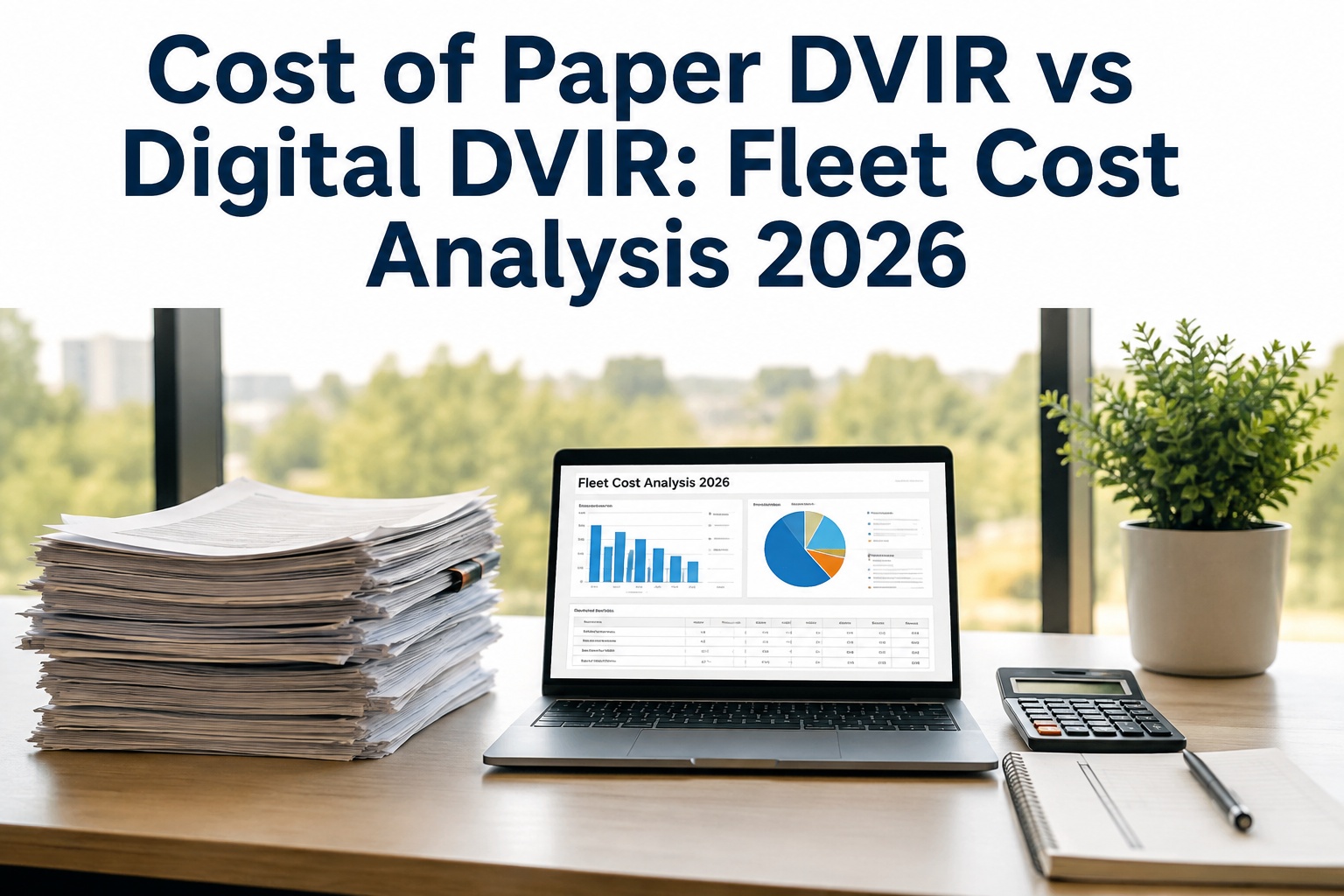
Paper DVIRs look cheap because the form costs pennies. The workflow around it is where the real cost sits: driver completion time (8–15 minutes on paper vs 3–6 minutes digital), office data entry, filing, retrieval, defect chasing, and audit prep. Multiplied across 2 inspections per vehicle per day and 250 working days, the annual paper-DVIR bill on a 100-vehicle fleet commonly runs into the mid-six figures — before any defect-follow-up cost. This 2026 guide walks the workflow math per fleet size. Book a demo .
Paper DVIR vs Digital DVIR — Where the Hours Actually Go
Per-inspection time comparison across the full workflow. Illustrative; actual fleet numbers depend on labor rate, volume, and existing process.
Assumes 2 inspections/vehicle/day, 250 working days/year, 9 min saved per inspection, $25/hr fully loaded driver labor. Adjust to your fleet's actual numbers.
The cost comparison between paper and digital DVIRs is one of the cleanest ROI calculations in fleet operations — because both workflows produce the same regulatory output (a compliant 49 CFR 396.11 DVIR), but the labor to get there varies by roughly 3–5x. What makes the paper number so consistently underestimated is that most fleets tracking cost look only at driver time on the form itself, missing the downstream time in collection, data entry, filing, and retrieval that isn't attributed to "DVIR" as a line item. Once the full workflow is counted, a 100-vehicle fleet running paper DVIRs commonly spends 7,000+ labor hours per year on inspection administration — a mid-six-figure cost line that digital reduces to a fraction of that number for a small monthly software subscription.
The compliance context — what actually changed in 2026Paper is still legal; digital just got regulatory tailwind
The regulatory picture matters for CFOs weighing the switch, because the framing "paper is fine, digital is optional" understates where the FMCSA is signaling the industry to go. Book a demo to see 49 CFR 396.11 and 396.13 workflows in HVI
Electronic creation, maintenance, digital signatures, and cloud storage of DVIRs became explicitly compliant. Fleets could adopt digital DVIR from this point without regulatory risk.
Effective March 23, 2026. Adds explicit electronic DVIR language to 49 CFR 396.11 and 396.13. Removes any remaining ambiguity for carriers that hesitated without explicit regulatory affirmation. FMCSA actively encourages carriers to adopt electronic methods.
The 2026 CSA overhaul creates a separate Vehicle Maintenance — Driver Observed category. Roadside violations attributable to items drivers should catch during walk-around (lights, tires, coupling, reflective tape) are scored separately — making DVIR quality directly visible in BASIC scoring.
Build your own paper DVIR cost numberThe five variables that determine fleet-specific annual cost — and how to plug in your own inputs
Universal benchmarks don't survive CFO scrutiny for a reason: every fleet's paper DVIR cost depends on its own labor rate, inspection volume, and workflow. The formula is straightforward; the inputs are what matter.
The framework holds because it's math, not marketing — the outputs move with the fleet's actual inputs. Book a demo to walk through your fleet's specific numbers
Beyond labor — where digital DVIR value shows up in operationsSix workflow gains that the time-only comparison undercounts
Time saved per inspection is the easy math. The larger operational value often comes from the workflow improvements around the DVIR — defect capture quality, response speed, records retrieval, and audit readiness. Start a free trial to try the full workflow on your fleet.
These six workflow gains are where digital DVIR economics really lands — the labor-time comparison is the floor, not the ceiling. Book a demo to see the full defect-to-repair workflow in HVI
From a fleet director on the paper cost that wasn't on the P&L
We had paper DVIRs for years and never really tracked the cost. The forms were cheap — a few hundred dollars a year across our 68 tractors. Nobody flagged it as a spend problem. When we finally did the math on driver time + supervisor collection + office data entry + retrieval requests, we were burning roughly 4,700 labor hours a year on the workflow. That's over $115,000 fully loaded — on paperwork we thought was free.
We switched to digital in about three weeks. Total software cost was under $20,000 in year one including setup. Driver time on inspections dropped by roughly 60%, defect-to-shop response time went from average 6 hours to under 15 minutes, and our last DOT audit prep took about 40 minutes instead of the two days we'd budgeted. The switch paid for itself in the first quarter — and the operational gains after that were larger than the labor savings.
Frequently asked questions
How much does a paper DVIR cost a fleet?
The paper form itself costs pennies; the workflow around it commonly costs mid-five figures to mid-six figures annually for typical commercial fleets. The full workflow cost includes driver completion time (typically 8–15 minutes per inspection on paper), supervisor collection at end of shift, office data entry or scanning, physical filing for the 90-day retention required under 49 CFR 396.11(a)(4), record retrieval on request, defect communication delays, and audit preparation. The formula: vehicles × DVIRs per vehicle per day × working days per year × total workflow minutes × fully loaded labor rate per minute. Example for a 100-vehicle fleet running 2 inspections/day, 250 working days, 15-minute full workflow, and $25/hr driver loaded rate: approximately $315,000 per year in DVIR labor cost. Individual fleet numbers vary significantly based on labor rate in the market, actual current workflow time, inspection volume, and multi-yard fragmentation. These are illustrative estimates; plug in your fleet's own inputs to get a defensible number.
Is paper DVIR still legal under FMCSA rules?
Yes. Paper DVIRs remain fully legal under 49 CFR 396.11 and 396.13. The switch to digital is an operational and economic decision, not a compliance-forced one. That said, the regulatory picture has moved. Under 49 CFR 390.32, electronic DVIR records have been explicitly permitted since 2018 with equivalent legal standing to paper. FMCSA's February 2026 final rule (Docket FMCSA-2025-0115, effective March 23, 2026) added explicit electronic DVIR language directly into 396.11 and 396.13, removing any lingering ambiguity for carriers that hesitated to switch without explicit regulatory affirmation. FMCSA actively encourages carriers to adopt electronic methods. Separately, the 2026 CSA methodology overhaul creates a "Driver Observed" split within the Vehicle Maintenance BASIC, scoring separately those violations that drivers should catch during walk-around. DVIR quality — not just DVIR existence — is now directly visible in BASIC scoring, which increases the operational value of guided digital templates that prevent inspection skips.
How much time does digital DVIR save vs paper?
Time savings per inspection commonly run 5–12 minutes depending on the paper workflow being replaced. Paper DVIRs typically take 8–15 minutes per inspection for the driver alone; digital DVIRs with guided walk-around templates typically run 3–6 minutes. Additional time is recovered downstream: paper requires supervisor collection at end of shift, office data entry or scanning, filing, and retrieval on request — typically another 4–8 minutes per inspection across the full workflow. Digital removes all of those downstream steps because submission is automatic, storage is cloud-based, and retrieval is search-driven. On a 100-vehicle fleet running 2 inspections per vehicle per day and 250 working days per year with 9 minutes saved per inspection, the annual time recovery is approximately 7,500 driver labor hours — worth roughly $188,000 at $25/hr fully loaded. Actual savings depend on the specific fleet's paper workflow inefficiency, current labor rate, and inspection volume. These are illustrative estimates rather than universal fleet benchmarks.
What's the ROI on digital DVIR software?
Digital DVIR software typically ranges $10–30 per vehicle per month depending on features, implementation complexity, and platform. On a 100-vehicle fleet at $20 per vehicle per month, annual software cost is approximately $24,000. Against illustrative labor savings of $188,000 per year on the same fleet (9 min saved per inspection, 2 inspections/day, 250 working days, $25/hr), the software cost represents roughly 13% of the labor savings — producing an illustrative net saving in the $164,000 range annually before counting defect-workflow, retrieval, or compliance benefits. Break-even payback commonly falls in 1–3 months for mid-sized fleets with typical paper workflows. Break-even is faster on fleets with higher labor rates, more inspections per vehicle per day, multi-yard operations with high paper fragmentation cost, or existing inefficient paper workflow. Break-even is slower for very small fleets, fleets with unusually efficient paper workflows, or fleets with low labor rates. Individual fleet ROI depends on the specific inputs; the framework holds regardless of the numbers plugged in.
Does HVI provide digital DVIR software?
Yes. HVI provides the digital DVIR and mobile inspection layer that replaces paper DVIR workflows across commercial fleets. Features include mobile-completed pre-trip and post-trip inspections with guided walk-around templates covering all 11 FMCSA-required categories; photo capture with GPS and timestamp per defect; electronic signatures compliant with 49 CFR 396.11 and 396.13 including automated 3-signature chain (driver reports → carrier certifies repair → next driver acknowledges) as clarified in FMCSA-2025-0115; defect capture that auto-routes to maintenance dashboard the moment the driver submits; work order generation from flagged defects; cloud storage of DVIRs meeting the 90-day retention requirement under 396.11(a)(4); and searchable per-asset multi-year DVIR + repair history for audit retrieval, warranty defense, and BASIC trend analysis. HVI is not a hardware provider, mobile connectivity carrier, insurance broker, DataQs challenge service, or DOT audit representation service. Fleet-specific savings depend on the fleet's own labor rates, inspection volume, existing paper workflow, and market conditions. HVI provides the digital DVIR platform; the fleet's operational and economic outcomes depend on its specific implementation and inputs.
Paper looks free until you count the hours — digital pays back in weeks, not years
A 100-vehicle fleet running paper DVIRs commonly burns 7,000+ labor hours per year on the workflow around the form. HVI replaces that with 5-minute guided digital inspections, auto-routing, and 60-second audit retrieval — for a small monthly subscription per vehicle.
No credit card · No hardware · Setup in minutes