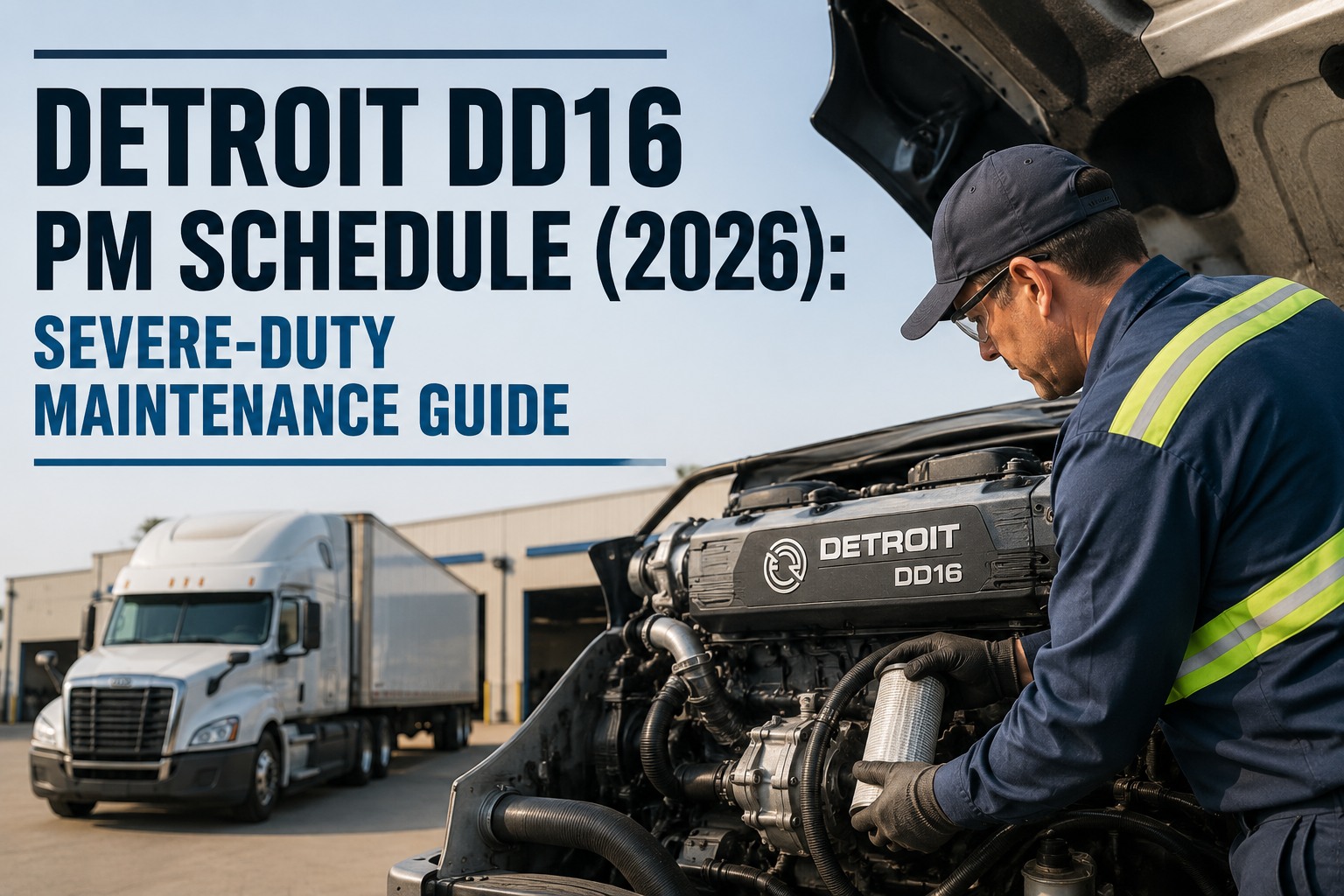
The Detroit DD16 engine PM schedule hinges on one question most fleets answer wrong: which duty cycle is the truck actually on? A DD16 averaging under 5 MPG in heavy-haul belongs on a 35,000-mile / 750-hour oil cycle — not the 55,000-mile highway interval that generic software defaults to. This guide maps every DD16 PM interval across all three Detroit-defined duty tiers, explains why engine hours matter more than miles on severe-duty trucks, and shows how to automate the whole program. Book a demo to see it live.
Detroit DD16 PM Schedule: Severe-Duty Intervals That Actually Match Your Operation
Three duty cycles. Three oil intervals. Know which one your truck is actually on.
Most DD16 trucks live in the severe-duty tier — that's what the engine was designed for. Below is how to read the full schedule for each tier, what the DD16's unique design features mean for PM, and the severe-duty traps that catch fleets running on highway-calibrated intervals.
The DD16 at a Glancebuilt for the hardest jobs, maintained differently than everything else
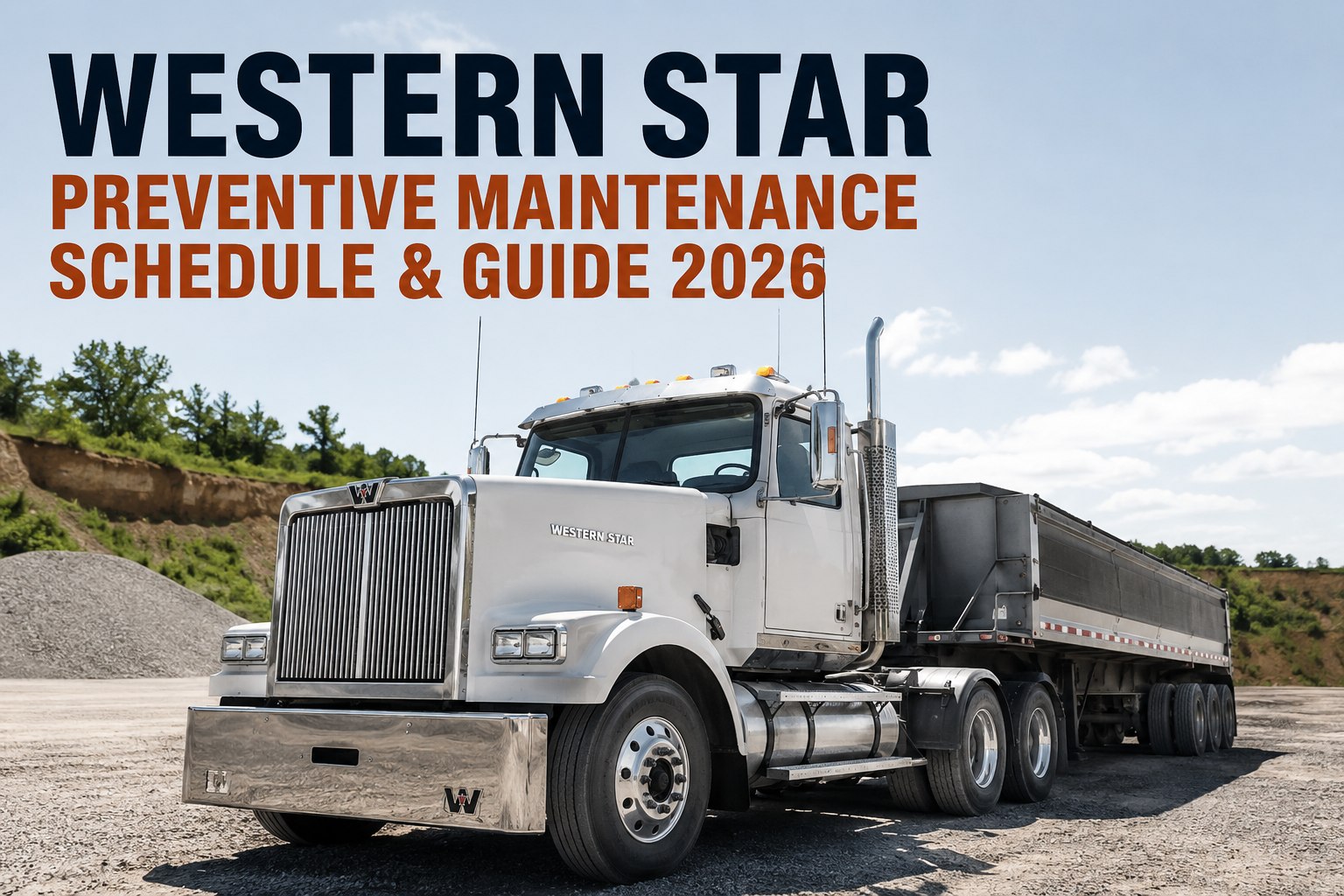
The DD16 is Detroit's flagship heavy-duty engine — the largest on-highway diesel they build. It powers Freightliner Cascadia heavy-haul configurations and Western Star 4900 and 57X vocational trucks in applications where maximum pulling power and low-RPM torque matter more than fuel economy: heavy-haul, logging, mining, oilfield, oversized/overweight permits, and extreme-grade operations.
The DD16 features dual overhead camshafts with four valves per cylinder, an Amplified Common Rail System (ACRS) delivering fuel injection pressures up to 38,000 PSI, turbo compounding that recovers exhaust heat as bonus power, and an integrated Jacobs engine brake with three braking levels. The engine's wide, flat torque curve pulls strong below 1,000 RPM — exactly where severe-duty trucks spend most of their operating time. That low-RPM bias is also what makes the DD16's PM schedule different from highway engines: the engine works harder per mile, burns more fuel per mile, and loads its aftertreatment system differently than a DD15 cruising at 65 MPH. Book a demo to see how HVI builds DD16-specific PM templates
The Complete DD16 PM Scheduleevery interval by duty cycle
Detroit defines three service categories for the DD16, based on annual mileage and average fuel economy. The definitions are specific and measurable — not subjective. Getting the category wrong by even one tier means your trucks are being serviced 5,000 to 20,000 miles too late on every oil drain.
| System / Component | Severe (<5 MPG) | Short-Haul (5.1–5.9) | Long-Haul (>7 MPG) |
|---|---|---|---|
| Engine oil + filter | 35,000 mi / 750 hrs | 40,000 mi / 1,000 hrs | 55,000 mi |
| Fuel filter | 35,000 mi / 750 hrs | 40,000 mi / 1,000 hrs | 55,000 mi |
| Air cleaner element | By restriction gauge | By restriction gauge | By restriction gauge |
| Coolant (ELC) | Test every 25,000 mi | Test every 25,000 mi | Test every 25,000 mi |
| Valve lash adjustment | 100,000 mi → 500,000 mi → every 500,000 mi thereafter | ||
| DPF ash cleaning | 500,000–550,000 mi (check engine light indicates when ash removal needed) | ||
| Chassis lubrication | 10,000–15,000 mi | 15,000–25,000 mi | 25,000 mi |
| Brake inspection | 10,000–15,000 mi | 15,000–25,000 mi | 25,000 mi |
| Serpentine belt inspect | At each oil drain | At each oil drain | At each oil drain |
| Air compressor inspect | At each oil drain | At each oil drain | At each oil drain |
| DT12 trans fluid (if equipped) | 250,000 mi | 500,000 mi | 500,000 mi |
Scroll right on mobile · Oil spec: DFS 93K222 (CK-4) or 93K223 (FA-4)
The engine-hours trigger is critical on the DD16 because severe-duty trucks accumulate hours far faster than miles. A Western Star hauling oversize loads at 35 MPH averages roughly 2 engine hours per 70 miles — meaning it hits 750 hours at around 26,000 miles, well before the 35,000-mile odometer trigger. If you're tracking oil changes by mileage alone on a slow-speed, heavy-load DD16, you're servicing late on every drain. Start free — set dual-trigger PM (miles + hours) per truck in HVI
What Makes Severe Duty "Severe"Detroit's definition — and why most DD16 trucks qualify
Detroit defines severe duty as any operation where the truck averages under 5 MPG or travels fewer than 30,000 miles per year. But the DD16's typical applications go beyond that baseline. Here are the conditions that push a DD16 into severe-duty territory — and most DD16 trucks check multiple boxes.
Waiting at job sites, queueing for loads, PTO operations. Oil degrades faster; DPF regeneration cycles are disrupted.
Heavy-haul, overweight permits, loaded trailers on grades. Engine runs near peak output continuously, accelerating all wear patterns.
Dust, mud, extreme heat or cold, salt-air. Air filter plugs faster; coolant works harder; electrical connectors corrode.
Construction-site shuttles, quarry runs. Engine never reaches sustained operating temperature, preventing complete DPF regeneration. Book a demo
Only one of these conditions is enough to classify the truck as severe duty. Most DD16 applications meet two or three. If your fleet is running DD16-powered trucks on a 40,000 or 55,000-mile oil interval without verifying the duty-cycle classification, you're almost certainly servicing too late.
DPF, DEF, and Aftertreatmentwhat the DD16's severe-duty bias means for emissions maintenance
The DD16's aftertreatment system uses Detroit's one-box design integrating the DOC, DPF, and SCR. The DPF ash cleaning interval is rated at 500,000 to 550,000 miles under normal conditions — but the engine's severe-duty reality affects that number significantly.
Normal interval: 500,000 to 550,000 miles. The truck's check engine light illuminates when ash removal is needed. In severe-duty operation, lower exhaust temperatures and higher soot loading mean the DPF works harder. Active regeneration frequency increases, and ash accumulation may trigger the light earlier. A DPF cleaning runs $500 to $1,500; replacement can exceed $5,000.
DEF consumption runs roughly 2 to 3% of diesel fuel consumed. At the DD16's fuel consumption rates (4 to 6 MPG in severe duty), a truck running 80,000 miles per year burns 13,000 to 20,000 gallons of diesel and uses 260 to 600 gallons of DEF. Inspect DEF supply lines, injector, and tank heater at every major PM service. Contaminated DEF is the most common cause of SCR faults. Book a demo — HVI tracks DEF and aftertreatment health per truck
The DD16's turbo compounding unit recovers exhaust energy as mechanical power — a feature unique to this engine in the Detroit lineup. This system has its own oil supply and cooling requirements. Inspect turbo compounding seals and connections at each oil drain; oil leaks from this system are often mistakenly attributed to the main turbocharger.
5 Severe-Duty PM Mistakesthe errors that cost DD16 fleets the most
A DD16 averaging 4.2 MPG is on the 35,000-mile / 750-hour severe cycle. Applying the 55,000-mile long-haul interval means running 20,000 miles past when the oil should have been changed — nearly 60% beyond the correct interval.
A DD16 hauling at 35 MPH hits 750 engine hours at roughly 26,000 miles — 9,000 miles before the 35,000-mile trigger. Without an hours-based trigger, the engine runs on degraded oil for thousands of extra miles.
The DD16's first valve lash adjustment is at 100,000 miles — earlier than many other Detroit engines. This accounts for initial wear-in on the valve train. Skipping it leads to progressive power loss, increased fuel consumption, and potential valve damage. The second adjustment isn't until 500,000 miles. Book a demo — HVI flags milestone PMs like valve lash automatically
The DD16's coolant system works significantly harder in heavy-haul applications. Extended low-speed, high-load operation generates more heat per mile. Test coolant every 25,000 miles; don't wait for the standard long-haul interval. Cavitation erosion and additive depletion happen faster on severe-duty engines.
The DD16 is the only engine in the Detroit lineup with turbo compounding. It has its own maintenance requirements that don't appear in generic DD-series PM checklists. Oil leaks, seal degradation, and connection failures at the turbo compound unit need inspection at every oil service.
From a heavy-haul fleet manager running DD16-powered Western Stars
We have 16 Western Star 4900s with DD16s doing oversize/overweight on mountain grades in the Pacific Northwest. Average speed is about 32 MPH, fuel economy is 3.8 to 4.4 MPG. When we first set up PM, we used the 40,000-mile short-haul schedule because that's what our software defaulted to for the DD16. Three trucks hit turbo issues within 18 months.
When we moved to 35,000 miles with a 750-hour backstop, our oil samples came back dramatically cleaner. But the real fix was adding the hours trigger — at our average speed, 750 hours hits at about 24,000 miles, not 35,000. We were servicing 11,000 miles late even on the "right" schedule. Now we change oil when the hour meter says so, not the odometer.
Automating DD16 PM with HVIthe workflow that matches the engine's complexity
Register each DD16 unit with its actual duty cycle: severe (<5 MPG, heavy-haul), short-haul, or long-haul. HVI applies the correct interval template — 35K/750hr for severe, 40K/1000hr for short-haul, 55K for long-haul.
The DD16's ECM tracks fuel consumed, engine hours, and distance. HVI mirrors all three and triggers on whichever comes first. For heavy-haul trucks, hours almost always trigger before mileage.
Valve lash at 100K and 500K. DPF ash check by engine light or mileage. Coolant test every 25K. Each milestone runs independently from the recurring oil cycle. Start free — set up DD16 milestone PMs in minutes
When a trigger fires, HVI generates the work order with the correct DD16 task list. Assign to your shop or dealer. Tech completes the inspection on mobile. Log parts. Close out. Counter resets automatically.
Frequently asked questions
What is the oil change interval for the Detroit DD16?
The Detroit DD16 oil change interval depends on duty cycle and fuel economy. For severe-duty applications (under 5 MPG, under 30,000 annual miles), the interval is 35,000 miles or 750 engine hours, whichever comes first. For short-haul operations (5.1 to 5.9 MPG, 30,000 to 60,000 annual miles), it's 40,000 miles or 1,000 engine hours. For efficient long-haul (over 7 MPG, over 60,000 annual miles), it's 55,000 miles. All intervals require Detroit-approved oils meeting DFS 93K222 (CK-4) or 93K223 (FA-4) specifications with ultra-low sulfur diesel fuel. Because most DD16 trucks operate in severe-duty applications, the 35,000-mile / 750-hour interval is the most commonly applicable.
When should DPF maintenance be performed on a DD16?
The DD16's DPF ash cleaning interval is 500,000 to 550,000 miles under normal conditions. The truck's check engine light will illuminate when ash accumulation requires removal. In severe-duty operation, lower average exhaust temperatures and higher soot production may cause the light to trigger earlier. DPF cleaning typically costs $500 to $1,500, while a full replacement can exceed $5,000. Monitor active regeneration frequency through your telematics or maintenance platform — increasing regen frequency and longer regen durations are early indicators that ash is building toward the service threshold. Regular oil changes at the correct interval directly affect DPF health by reducing soot and ash entering the aftertreatment system.
What is considered severe-duty operation for the DD16?
Detroit defines severe-duty operation as any truck averaging under 5 miles per gallon or traveling fewer than 30,000 miles per year. Additional severe-duty conditions include idle time exceeding 40%, load factor above 55%, operation on extremely poor roads or under heavy dust accumulation, constant exposure to extreme hot, cold, or salt-air climates, frequent short-distance travel, and construction-site or farm operation. Only one of these conditions is sufficient to classify the truck as severe duty. Most DD16 applications — heavy-haul, logging, mining, oilfield, oversized loads — meet multiple severe-duty criteria simultaneously, making the 35,000-mile / 750-hour oil interval the appropriate default for the majority of DD16 fleets.
When should valve lash be adjusted on the DD16?
The Detroit DD16 requires valve lash adjustment at 100,000 miles, then at 500,000 miles, and every 500,000 miles thereafter. The first adjustment at 100,000 miles is critical because it accounts for initial wear-in of the valve train components. Skipping this adjustment can lead to progressive power loss, increased fuel consumption, and eventually valve or injector damage. The gap between the first and second adjustment (400,000 miles) means the initial one is the most important — and the one most likely to be missed on trucks that are relatively new to the fleet. Use a milestone-based PM trigger in your CMMS so the work order generates automatically as the truck approaches 100,000 miles.
Can I use a CMMS to automate Detroit DD16 PM scheduling?
Yes, and for heavy-haul and vocational fleets running DD16 engines, a CMMS is the most reliable way to manage the schedule's complexity. The DD16's ECM tracks three service parameters — fuel consumed, engine hours, and vehicle distance — and the PM schedule changes significantly by duty cycle. A platform like HVI (Heavy Vehicle Inspection) lets you configure per-truck PM profiles based on actual duty cycle, set dual triggers (miles plus hours) so whichever threshold hits first generates the work order, set milestone alerts for one-time events like the valve lash at 100,000 miles, track DD16-specific items like turbo compounding inspections that don't appear in generic checklists, and maintain audit-ready service records for warranty compliance. HVI works with Detroit Connect telematics and supports mixed-engine fleets.
Your DD16 fleet, maintained on the schedule the engine actually needs
Configure severe-duty and highway PM templates. Track mileage, engine hours, and fuel consumed per truck. Auto-generate work orders with DD16-specific checklists. Flag valve lash milestones. Maintain warranty-ready records. Live in under two weeks.
No credit card · No hardware required · Works with Detroit Connect and any telematics