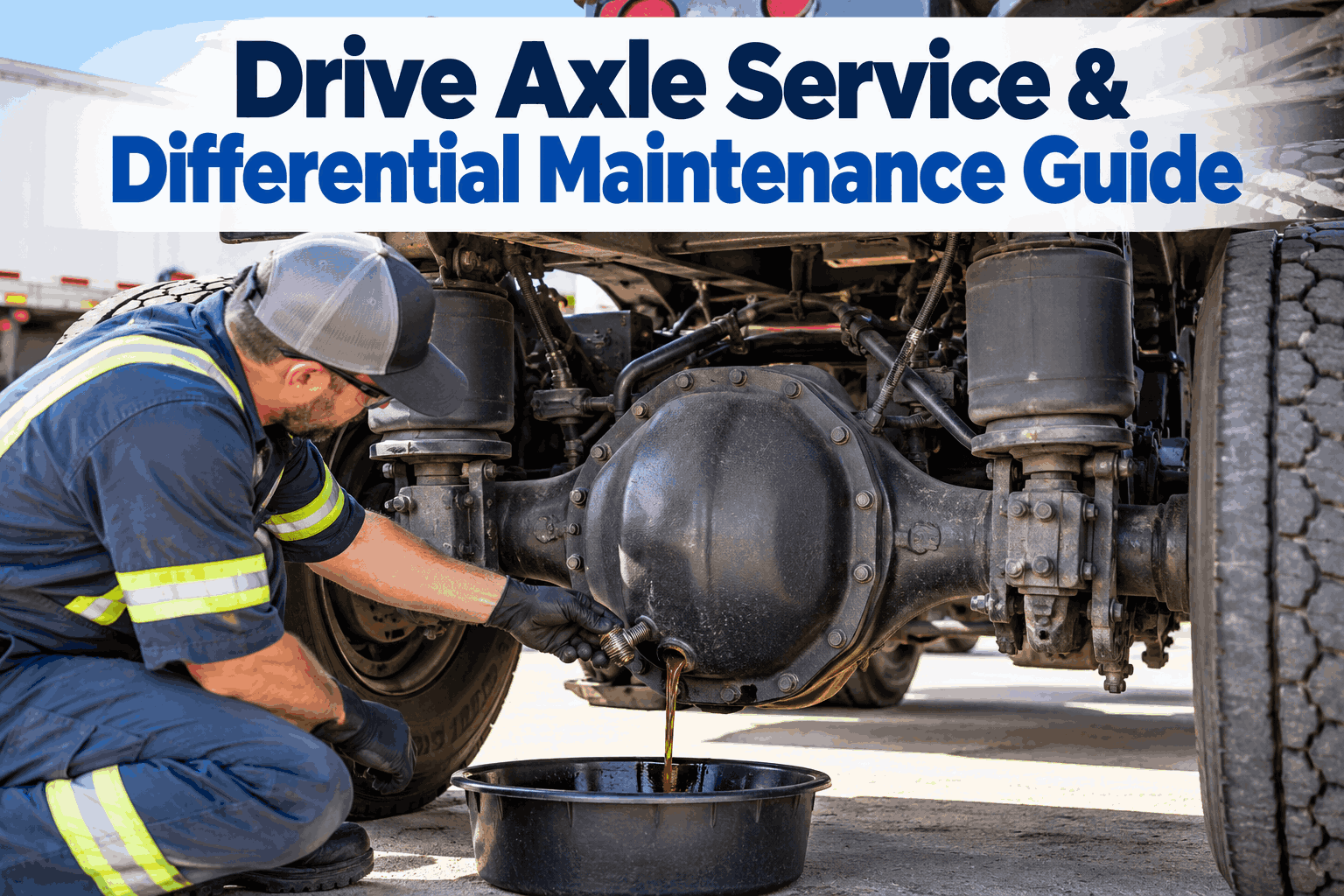
A truck's drive axle carries the whole load and every pound of torque the engine makes — yet it's a sealed box most fleets never look inside until it's whining. The good news for drive axle service is that you don't have to open it: the gear oil, the running temperature, and an oil-analysis sample tell you almost everything about the gears and bearings inside. Read those right and you catch a failing differential months before it strands a truck. Book a demo to see axle PM and oil analysis tracked by asset.
The Differential Tells You Everything — Through Its Oil
You don't open a drive axle to inspect it. Three reads — fluid condition, an oil-analysis sample, and running temperature — are the window into every gear and bearing inside. Learn to read them and a failing differential shows up months early, not on the shoulder.
The drive axle is the drivetrain's endpoint: everything the engine and transmission produce funnels through the differential's ring-and-pinion and out to the wheels. It runs immersed in gear oil, it runs hot, and it's slow and costly to rebuild. That's exactly why a read-it-don't-open-it approach wins — catching a problem in an oil sample costs a fraction of catching it as a roadside failure.
Why You Read a Differential Instead of Opening It
The first shift in mindset for good drive axle service is that the differential is a condition-monitored system, not a scheduled-teardown one. You don't pull the diff cover to "have a look" — you read the signals it gives off while it runs.
Run it till it whines
Wait for a gear whine, a growl, or metal on the magnetic plug, and by then the ring-and-pinion or a bearing is already damaged. A reactive rebuild is days of downtime and thousands in parts and labor — the most expensive way to find out.
Watch the oil and the heat
Check fluid condition and level, pull an oil sample on interval, and watch running temperature. Wear shows up as metal in the sample and a creeping temperature long before it's an audible fault — caught while it's still a fluid change, not a rebuild.
This is why the differential belongs on a maintenance schedule, not a hope-it-holds list. The signals are all there — you just have to be looking at them on an interval, and logging them so a slow trend is visible. Unplanned drivetrain failures are among the most expensive breakdowns a fleet absorbs, and the differential is one of the priciest to put right.
The Breather: The Cheapest Part That Kills Axles
If one item in drive axle service is missed more than any other and causes more damage than its size suggests, it's the axle breather. It's a few-dollar part, and a plugged one can destroy a differential.
The breather vents the pressure that builds as the axle heats up. Caked in mud, paint, or road grime, it seals shut.
With nowhere to vent, hot expanding air pressurizes the axle housing every time the truck runs.
That pressure forces gear oil out through the pinion and wheel seals — the seals didn't fail, the pressure beat them.
Now the axle runs low on oil and open to water and dirt. Gears and bearings starve and fail — from a blocked vent.
The lesson techs learn the hard way: when you find gear oil weeping from a pinion or wheel seal, check the breather before you condemn the seal. Replacing the seal without clearing the breather just blows the new one out too. A thirty-second breather check on every axle service prevents a chain that ends in a rebuild. Start free and put the breather check on your axle template.
Gear Oil: Spec, Level, and Change Interval
The gear oil is the differential's lifeblood, and getting it right is the core of differential service. Three things matter: the right spec, the right level, and the right interval.
The right lubricant, not just any gear oil
Use the axle maker's specified lubricant — the correct viscosity and GL rating for the gearset. The wrong oil, or one without the right additive package, wears the ring-and-pinion faster and can void axle warranty. Synthetic and conventional carry different intervals, so match the oil to the schedule.
Level checked at the fill plug
Check the level at the fill plug, cold, on level ground — oil should be right at the bottom of the hole. Low level means a leak to chase; over-full can foam and run hot. It's a two-minute check that catches a slow leak before it starves the gears.
Change on the OEM interval
Follow the axle OEM's drain interval, which varies by oil type and duty — severe service and heavy loads shorten it. Track it as a recurring PM by meter reading, and drain the magnetic plug's metal as a data point, not just a cleanup.
The spec point trips up more fleets than any other: a differential filled with the wrong gear oil looks perfectly serviced and quietly wears itself out. Matching the exact lubricant spec to each axle, and holding the OEM interval, is the difference between an axle that goes the distance and one that comes back early. Book a demo to see the correct oil spec attached to each axle.
Oil Analysis: Reading Wear Before It's Noise
The single most powerful tool in modern differential maintenance is oil analysis — a small sample sent to a lab that reads the wear metals suspended in the oil. It turns the differential from a black box into a readable trend.
The value isn't one sample — it's the trend. A single reading is a snapshot; three or four over time show whether iron is climbing, and how fast. That trend lets you plan a rebuild on your terms, in the shop, on a slow week — instead of a tow and an emergency teardown. It's only useful stored where you can see the history, which is what a maintenance records system is for.
Seals, Leaks, and Temperature
Between oil samples, the axle gives you two more signals you can read on any inspection: where it's leaking, and how hot it's running. Both are early warnings if you're watching for them.
Pinion, axle & wheel seals
Check the pinion seal at the yoke, the axle seals, and the wheel seals for weeping. A leak isn't just a mess — it's lube leaving the axle. Left alone it runs the differential low and can contaminate brakes at the wheel end.
Running temperature
An axle running hotter than its mates — by hand-feel on a walkaround, or by sensor where fitted — is doing more friction than it should. Rising temperature is one of the earliest signs of low lube or a wearing bearing.
Housing & magnetic plug
Scan the housing for cracks and impact damage, and read the magnetic drain plug at every change. A light fuzz is normal; chips or a heavy paste is gear or bearing material and a reason to sample and investigate.
Cross-linking these signals is what makes a diagnosis: a leak plus a low level plus a rising temperature is a differential telling you clearly it's in trouble. Read together and logged against the axle, they turn "sounds a bit off" into a documented, actionable finding. A leaking wheel seal also ties into the wheel-end inspection, so the two checks reinforce each other. Book a demo to see leaks and temperature logged with photos.
The Power Divider on a Tandem Axle
On a tandem drive axle, there's an extra component that needs its own attention in any drive axle service: the power divider, or inter-axle differential, that splits torque between the forward and rear drive axles.
It has its own lube and wear
The power divider shares the forward axle's oil and carries its own gears and bearings that wear and show up in oil analysis. It gets the same fluid, spec, and interval discipline as the main differential — it's not a sealed-forever part.
The power divider lock — used right
The PD lock ties the two axles together for traction on loose or slippery ground. It's engaged before you lose traction, with the wheels not spinning — and never left locked on dry pavement, which winds up the driveline and damages the unit. Confirm the lock engages and releases cleanly.
The power divider is where a lot of tandem-axle problems actually live, and it's easy to overlook because it hides between the axles. Servicing it as its own item — its oil, its wear metals, its lock function — catches faults that a main-differential-only service would miss entirely.
How HVI Turns the Axle Into a Managed Asset
Every part of drive axle service comes back to the same discipline: set the interval, read the signals, log them so trends are visible. Three capabilities make the differential a managed asset instead of a sealed gamble.
Gear-oil PM by meter or calendar
Schedule the differential and power-divider oil change on the OEM interval — by mileage or calendar — with the correct lubricant spec attached to each axle, so the right oil goes in on time, every time.
Oil-analysis & temperature trends
Store each oil-analysis result and temperature reading against the axle so wear metals trend over time — turning a black box into a curve you can plan a rebuild around.
Leak, defect & work-order records
Log a weeping seal, a plugged breather, or metal on the plug with a photo and turn it into a work order — with the full service and defect history kept on the axle asset.
The result is a drive axle managed the way its cost deserves: serviced with the right oil on the right interval, read through fluid, analysis and temperature, and documented so a slow trend becomes an early, planned repair. The sealed box that used to fail without warning becomes the asset you saw coming. Book a demo to see it on your fleet.
From a maintenance manager who trends the oil
We started sampling diff oil on our line-haul tandems and one truck kept creeping up on iron — nothing you'd hear yet. We pulled it on a slow Saturday and the pinion bearing was on its way out. A planned rebuild in our own shop instead of a tow off the interstate. The sample cost almost nothing; the failure it caught would've cost us a weekend and a customer. Now every drive axle gets sampled on interval, logged against the unit.
Key takeaways
Good drive axle service is condition monitoring, not teardown: match the exact gear-oil spec to each axle, hold the OEM change interval, and read the three signals the differential gives off — fluid, oil analysis, and temperature. Never condemn a leaking seal without checking the breather first, and give a tandem's power divider its own oil, wear-metal, and lock-function attention. Do that on a schedule and log it, and the most expensive box in the drivetrain becomes the one you catch early.
Frequently asked questions
How often should you change differential fluid on a truck?
On the axle manufacturer's specified drain interval, which varies by lubricant type and duty cycle — synthetic gear oils typically carry longer intervals than conventional, and severe service, heavy loads, or high heat shorten them. There's no single universal number, so follow the OEM schedule for your specific axle and track it as a recurring preventive-maintenance task by meter reading. At each change, read the magnetic drain plug: a light metallic fuzz is normal, but chips or a heavy paste indicate gear or bearing wear worth investigating with an oil sample.
Why is the axle breather so important?
The breather vents the pressure that builds inside the axle housing as the gear oil heats up and the air expands. If it plugs with mud, paint, or road grime, that pressure has nowhere to go — so it forces gear oil out past the pinion and wheel seals. The seals didn't fail; the pressure beat them. The axle then runs low on lube and open to water and dirt, which destroys gears and bearings. That's why, when you find oil weeping from a seal, you check and clear the breather before replacing the seal — otherwise the new seal blows out too.
What does oil analysis tell you about a differential?
An oil-analysis sample reads the wear metals suspended in the gear oil, which point to what's wearing inside without opening the axle. Rising iron usually indicates ring-and-pinion or gear wear; copper or bronze points to bushings or thrust washers; water or coolant signals contamination, often from a bad breather or seal; and silicon means dirt is getting in past a seal. The real value is the trend across several samples — a climbing iron level over time lets you plan a rebuild in your own shop on your schedule, rather than reacting to a roadside failure.
What is a power divider and does it need service?
The power divider, or inter-axle differential, sits on a tandem drive axle and splits engine torque between the forward and rear drive axles. Yes, it needs service: it carries its own gears and bearings, shares the forward axle's gear oil, and shows its own wear metals in oil analysis, so it gets the same fluid spec and change interval as the main differential. It also has a lock that ties the axles together for traction — engage it before losing traction with the wheels not spinning, and never leave it locked on dry pavement, which winds up the driveline and damages the unit.
What are the signs a truck differential is failing?
The clearest early signs come from the oil and temperature, not sound: rising wear metals in an oil sample, a differential running hotter than its mates, gear oil weeping from the pinion or wheel seals, a dropping oil level, and metal chips on the magnetic drain plug. Audible symptoms — a gear whine that changes with speed, a growl, or a clunk on acceleration and deceleration — usually mean damage is already advanced. That's the whole case for condition monitoring: the fluid, analysis, and temperature warn you months before the noise does.
Catch the Differential in a Sample, Not on the Shoulder
Schedule the gear-oil change on the OEM interval with the right spec per axle, trend every oil-analysis result and temperature reading, and turn a plugged breather or weeping seal into a logged defect and a work order — so the most expensive box in the drivetrain is the one you see coming. Live in under two weeks, trusted by 25,000+ users worldwide.
No credit card · No hardware · Axle PM templates ready on day one