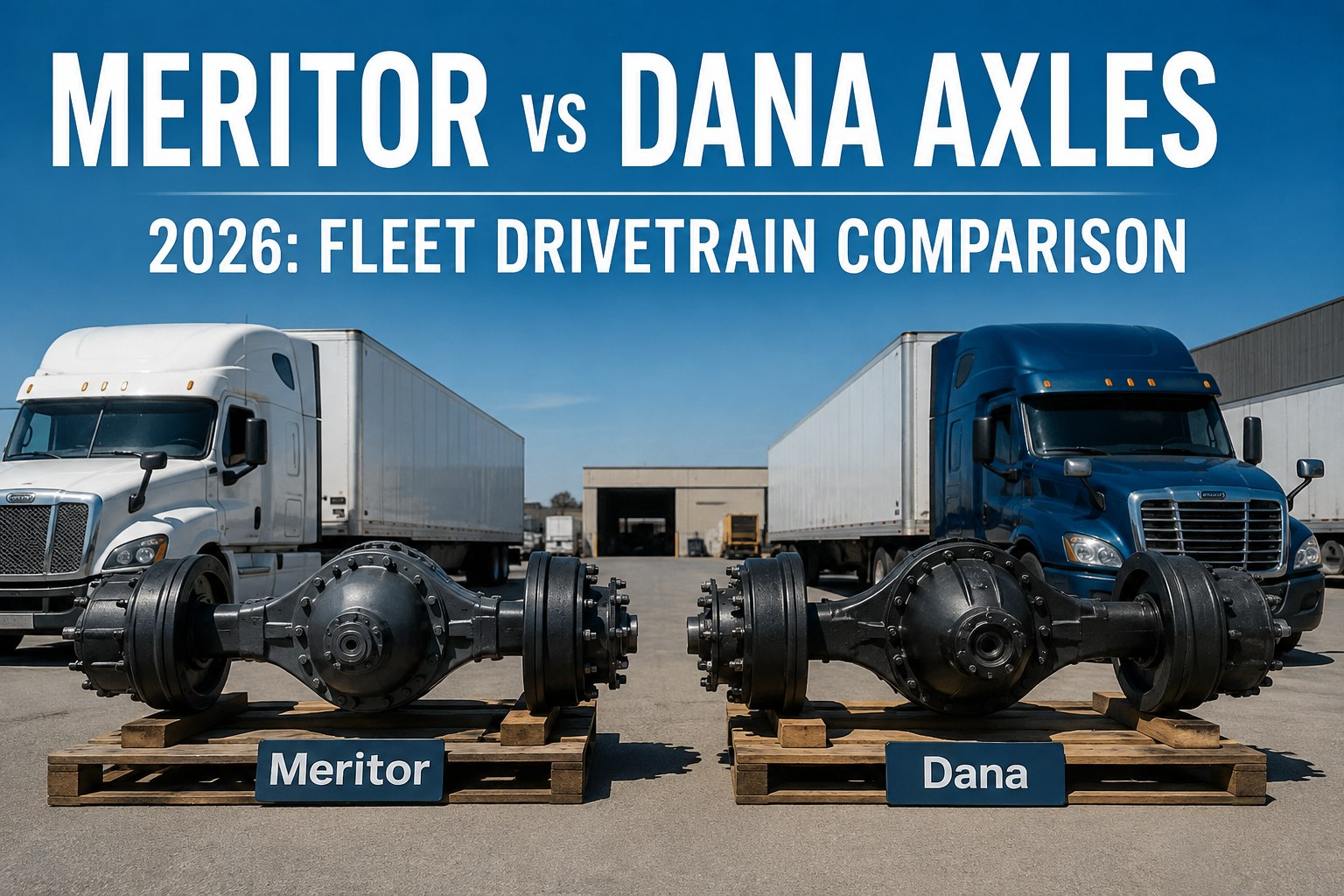
Spec'ing a new tractor and the order sheet asks one question that follows you for 800,000 miles: Meritor or Dana axles? It feels like a checkbox. It isn't. The drive axle you pick decides your lubricant spec, your PM intervals, which parts your shop stocks, how a ring-and-pinion job gets sourced, and what the drivetrain costs to keep alive over its life. This Meritor vs Dana axles comparison sticks to verified manufacturer specs and matched applications — not brand loyalty — so you spec the right axle the first time. Book a demo to track axle lifecycle cost in HVI.
Meritor vs Dana Axles: The Spec That Sets Your Drivetrain Cost
Match the axle to the application — then let lubricant, PM, and parts support decide the rest.
- Amboid single-reduction linehaul
- Industry's widest ratio range
- Optional Lube Management System
- Heavy-vocational single & dual-reduction
- AdvanTek gearing for efficiency
- 500k linehaul lube drain program
Before anyone quotes you a ratio, understand this: the most-searched matchup — Meritor MT-14X vs Dana D46-170P — isn't actually apples-to-apples. One is a 40,000 lb linehaul axle built for fuel economy; the other is a 46,000 lb heavy-vocational axle built for logging and oilfields. Comparing them straight would steer you wrong. So this guide compares Meritor and Dana the way a fleet engineer actually should: by matched application.
Read this firstwhy MT-14X vs D46-170P is a trap comparison
It's the search everyone types, so let's clear it up honestly. These two axles live in different weight classes and different duty cycles. Line them up side by side and the numbers make one look "weaker" when it's really just built for a different job.
40k linehaul, efficiency-first
A 40,000 lb tandem built for over-the-road tractors. Single-reduction Amboid gearing, fast downspeeding ratios, and up to 30 lb of weight savings in the HE version. Its whole design goal is fuel economy on the highway, not survival in a quarry.
46k vocational, durability-first
A 46,000 lb GAWR tandem engineered for construction, heavy-haul, logging, oilfield, and refuse. Extra-wide face-width gearing, high-capacity bearings, and options like integral welded suspension brackets. Built to take abuse, not to shave grams.
The takeaway isn't that one brand wins — it's that you compare within a weight-and-duty class, never across it. Get that wrong on the spec sheet and you either overpay for vocational iron you don't need, or underspec an axle that grenades under load. Book a demo to see how HVI tags each unit's exact axle model and duty cycle
Matched: linehaul tandemsMeritor 14X vs Dana D-172 / AdvanTek
This is the real fight for most on-highway fleets: two ~40,000 lb fuel-economy tandems. Here's the honest side-by-side for a linehaul truck drive axle comparison. Figures reflect published manufacturer specs; confirm the exact build code in your own quote.
| Spec that matters | Meritor 14X (linehaul) | Dana D-172 / AdvanTek |
|---|---|---|
| Typical rating | 40,000 lb tandem | 40,000 lb class tandem |
| Gear design | Amboid single-reduction | AdvanTek hypoid single-reduction |
| Ratio range | ~2.15–7.17 (fast downspeed) | Broad range incl. fast ratios |
| Design focus | Fuel economy, light weight | Fuel economy, reduced weight |
| Efficiency feature | Meritor Lube Mgmt System (opt.) | Passive/low-churn lube design |
| Extended lube drain | Up to 500k w/ pump & filter | Up to 500k linehaul program |
| Recommended lube | 75W-90 synthetic (HE) | Spicer FE/XFE 75W-90 synthetic |
At the linehaul level these two are genuinely close. Both chase the same downsped, low-churn, synthetic-lubed efficiency. The deciders become ratio availability for your engine, your OEM's standard offering, and — the part fleets underweight — which brand your regional service network stocks parts for. Start free on HVI and log which ratio and lube each truck actually runs, instead of guessing at rebuild time.
Matched: vocational tandemsMeritor RT series vs Dana D46-170
Now the heavy stuff — construction, refuse, logging, oilfield. Here durability and traction beat grams, and the D46-170P finally has a fair opponent in Meritor's RT-series vocational axles.
- Ratings scaling into the 40k–46k+ vocational range
- Driver-controlled diff lock (DCDL) for traction in mud and grade
- Extended lube drain on select RT-P pump-equipped models
- Deep Meritor parts and reman carrier availability
- 46,000 lb GAWR, built for demanding vocations
- Extra-wide face-width gearing for durability under shock load
- Vocational lube drain commonly ~180k miles or 3 years
- Optional lockers and traction packages for off-road
In severe duty, the decision leans on traction options, how the axle survives shock loading, and rebuild economics when — not if — a gear set wears out. One rule holds for both brands: a vocational axle converted out of its original duty cycle can void the drivetrain warranty. Book a demo to keep duty-cycle and warranty status attached to every asset record
Lubricant & PM realitythere is no single "axle oil change interval"
Here's where fleets bleed money quietly: applying one rear axle oil change interval to every truck. For both Meritor and Dana, the drive axle maintenance interval depends on the lubricant, the axle model, and the duty cycle — not the brand on the housing.
- 1Lubricant type
Standard drain is short; approved synthetic extends the drive axle oil change to 100k miles.
- 2Pump & filter
Axles with a pump-and-filter system can reach up to 500k on Schedule III, filter changed at 100k.
- 3Diff lock / no-spin
No-spin or traction-equalizer axles can require shorter, more frequent changes.
- 4Approved lube only
Must meet Meritor spec (e.g. 75W-90 for HE); wrong oil risks warranty and life.
- 1Linehaul vs vocational
Linehaul on approved synthetic can run a 500k drain; vocational commonly ~180k or 3 years.
- 2Approved synthetic required
Extended drain and extended warranty both hinge on Dana-approved synthetic (SHAES-256).
- 3No mixing
Don't mix mineral and synthetic, or grades — top-off must stay on the approved lube.
- 4Daily leak checks
Dana calls for pre-trip drivetrain inspection; catch a seal leak before it starves a gear set.
Notice the pattern: both brands reward approved synthetic with dramatically longer intervals, and both punish the wrong lube with lost warranty. The operational risk isn't the brand — it's a shop that services a 500k-capable axle on a 40k mineral-oil habit, or vice versa. Start free and let the system hold the right interval per axle so nobody's working from memory. Or book a demo to see it live
The fleet decision frameworksix questions before you tick the box
Brand loyalty is the most expensive way to spec an axle. Run every drivetrain decision through these six lenses instead — they map directly to total cost of ownership.
Linehaul, regional, or severe vocational? This alone rules out half the catalog and sets the weight class.
Downspeed ratio for fuel economy, or deep ratio for grade and traction? Confirm availability for your powertrain.
Which synthetic, what drain interval, pump-and-filter or not? This is a recurring cost, not a one-time spec.
Who stocks ring-and-pinion, carriers, and reman units near your lanes? Availability is uptime.
Confirm the coverage fits the real vocation — and that your lube choice keeps it intact.
Add spec, lube, PM labor, parts, downtime, and rebuild over the axle's life — then compare.
Do this and the "Meritor vs Dana axles" question answers itself per application, backed by numbers instead of habit. The catch: you can only run this framework if you're actually capturing axle data by unit — model, ratio, lube, services, parts, and cost. That's the gap HVI closes.
From a maintenance director who specs both
I stopped caring about the badge years ago. My linehaul trucks run whatever downsped 40k tandem the OEM ships clean, and half are Meritor, half are Dana. What actually bites me is lube discipline — a tech topping off a 500k synthetic axle with the wrong oil quietly kills the warranty.
Where the brands split for me is vocational parts. In my region I can get a Dana vocational carrier faster, so my refuse fleet leans that way. It's not loyalty, it's lead time. The day I could see rebuild cost per axle model side by side was the day I stopped guessing.
The bottom line on Meritor vs Dana axles
There's no universal winner in the Meritor vs Dana axles debate, and the popular MT-14X vs D46-170P face-off is a mismatch to begin with. Compare within a weight-and-duty class and the truth emerges: at linehaul, Meritor's 14X and Dana's D-172/AdvanTek are close rivals chasing the same synthetic-lubed efficiency. In severe vocational duty, Meritor's RT series and Dana's D46-170 both bring the durability — and your decision turns on traction options, regional parts support, and rebuild economics.
What matters more than the badge is what you do after the spec: hold the right lubricant interval per axle, keep warranty and duty cycle attached to each unit, and measure real drivetrain cost instead of trusting a generic interval. That's the whole point of tracking axle maintenance in HVI — PM by model, lubricant services, defects, parts, and lifecycle cost by component. Book a demo and see your drivetrain data in one place.
Frequently asked questions
Is the Meritor MT-14X directly comparable to the Dana D46-170P?
Not directly — and this is the single most important thing to understand before comparing them. The Meritor MT-14X is a 40,000 lb tandem drive axle engineered for on-highway linehaul, with a single-reduction Amboid design focused on fuel economy, light weight, and fast downspeeding ratios. The Dana D46-170P is a 46,000 lb GAWR tandem built for demanding vocational work — construction, heavy-haul, logging, oilfield, and refuse — with extra-wide face-width gearing prioritizing durability under shock loads. They sit in different weight classes and different duty cycles, so a straight head-to-head makes one look weaker when it's simply built for a different job. The fair comparisons are Meritor 14X versus Dana's linehaul D-172/AdvanTek tandem, and Dana D46-170 versus Meritor's RT-series vocational axles. Always match weight rating and duty cycle before drawing conclusions.
What is the drive axle oil change interval for Meritor and Dana axles?
There is no single universal interval — it depends on the lubricant, the specific axle model, and the duty cycle. On Meritor axles, using approved synthetic lubricant extends the change interval to 100,000 miles, and axles equipped with a pump-and-filter system can reach up to 500,000 miles on qualifying schedules, with the filter changed at 100,000 miles. Axles with no-spin or traction-equalizer differentials may require shorter, more frequent changes. On Dana Spicer axles, linehaul applications running approved synthetic can qualify for a 500,000-mile drain interval, while vocational applications commonly run around 180,000 miles or three years, whichever comes first. Both brands require using their approved synthetic lubricants to keep extended drain intervals and extended warranties valid. Always confirm the interval for your exact axle model, lubricant, and application against current manufacturer documentation rather than applying one blanket number across a mixed fleet.
What lubricant do Meritor and Dana drive axles require?
Both require manufacturer-approved gear lubricants, and the exact viscosity depends on the axle and operating temperature range. Meritor's high-efficiency (HE) axles recommend a 75W-90 synthetic, with other approved grades like 80W-140 and 75W-140 available depending on ambient temperature; Meritor axles must be filled only with Meritor-specified lubricants meeting their O-94/O-95 specifications. Dana promotes its Spicer FE 75W-90 and XFE fuel-efficient synthetics, which qualify axles for the extended drain program and, when registered, extended warranty coverage. Critical rules for both: never mix mineral and synthetic lubricants or different grades, keep any top-off oil on the same approved lubricant, and remember that extended warranties are contingent on using the correct approved synthetic. Using an unapproved or incorrect oil can shorten axle life and void coverage, so verify the spec against the axle's fill-plug tag and the current lubricant bulletin before servicing.
Which brand has better parts availability and rebuild support?
Neither brand is universally ahead — parts availability is largely regional, and that's exactly why it belongs in your decision framework rather than being assumed. Both Meritor and Dana have deep, mature aftermarket networks with genuine and reman carriers, ring-and-pinion sets, and service kits widely available across North America. In practice, many fleets find one brand's vocational carriers or specific gear sets are stocked faster by their local distributors and dealers, which directly affects downtime when an axle needs a rebuild. The practical move is to check, for your actual lanes and service points, who stocks the carriers, ring-and-pinion sets, and reman units you'd need — because a slightly cheaper axle that takes a week to source parts for costs far more in downtime than it saves on the spec sheet. Tracking parts usage and repair history by axle model over time gives you real data on which brand your operation can actually support fastest.
How can fleet software help manage drive axle maintenance and cost?
A CMMS like HVI turns axle maintenance from a generic checklist into measured, per-component management. Instead of applying one blanket PM interval across trucks with different axle models, lubricants, and duty cycles, HVI schedules lubricant services and inspections by the exact axle configuration — so a 500,000-mile synthetic pump-and-filter axle and a 180,000-mile vocational axle are each serviced on their correct interval. It captures inspection points and defects, tracks parts usage and repairs, records lubricant services, and rolls drivetrain cost up by vehicle and component. That lets a fleet measure real drivetrain lifecycle performance — which axle models actually cost less to keep running, where downtime concentrates, and whether Meritor or Dana is the better spec for a given application in your operation — rather than relying on brand assumptions or one-size-fits-all intervals. You can start free and connect inspections, PM, parts, and cost analytics in one platform.
Track every axle by model, lubricant, PM, parts, and lifecycle cost
HVI schedules axle lube services by exact model and spec, logs inspections and defects, tracks parts and repairs, and reports drivetrain cost by vehicle and component — so you measure real lifecycle performance instead of trusting a generic interval. One connected platform, mobile-first for the shop, live in under two weeks.
No credit card · Works across mixed Meritor & Dana fleets · Drivetrain analytics on day one