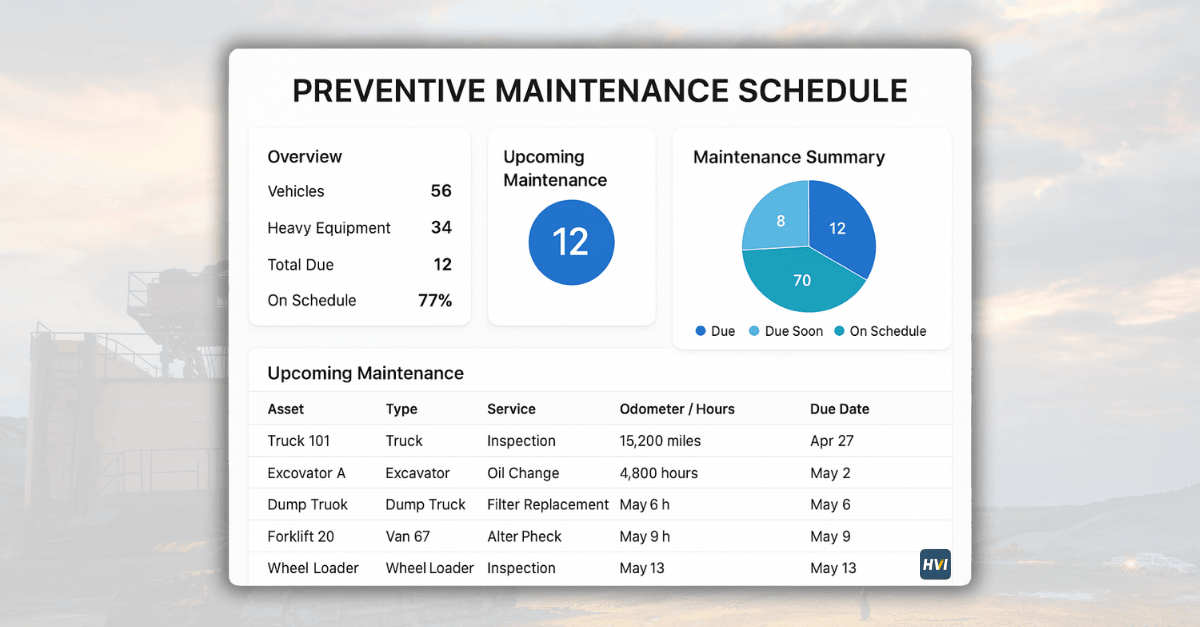
Fleet preventive maintenance intervals in 2026 are one of the most consequential operational decisions a fleet manager makes — and one of the most quietly outdated on most fleets. The default 15,000-mile oil change and 100,000-mile major service intervals many fleets still run were designed for the trucks and duty cycles of a decade ago, not for modern engines with tighter tolerances, better lubricants, and telematics-derived duty cycle data available at every ECM. Getting intervals wrong in either direction costs real money: too-frequent PMs waste labor and parts on services that weren't needed yet; too-infrequent PMs invite breakdowns that could have been prevented. This fleet preventive maintenance intervals guide walks the four interval-setting methods used across the industry, how duty cycle adjusts optimal intervals for different fleet types, the 5-step optimization workflow to move from OEM defaults to duty-cycle-tuned intervals, and the five recurring mistakes fleets make when setting PM schedules. Book a demo after you see how interval optimization runs on the HVI dashboard.
4 Ways to Set Fleet PM Intervals in 2026
Every method has a use case. The best-in-class approach uses more than one — and adjusts for duty cycle. Here's how each stacks up.
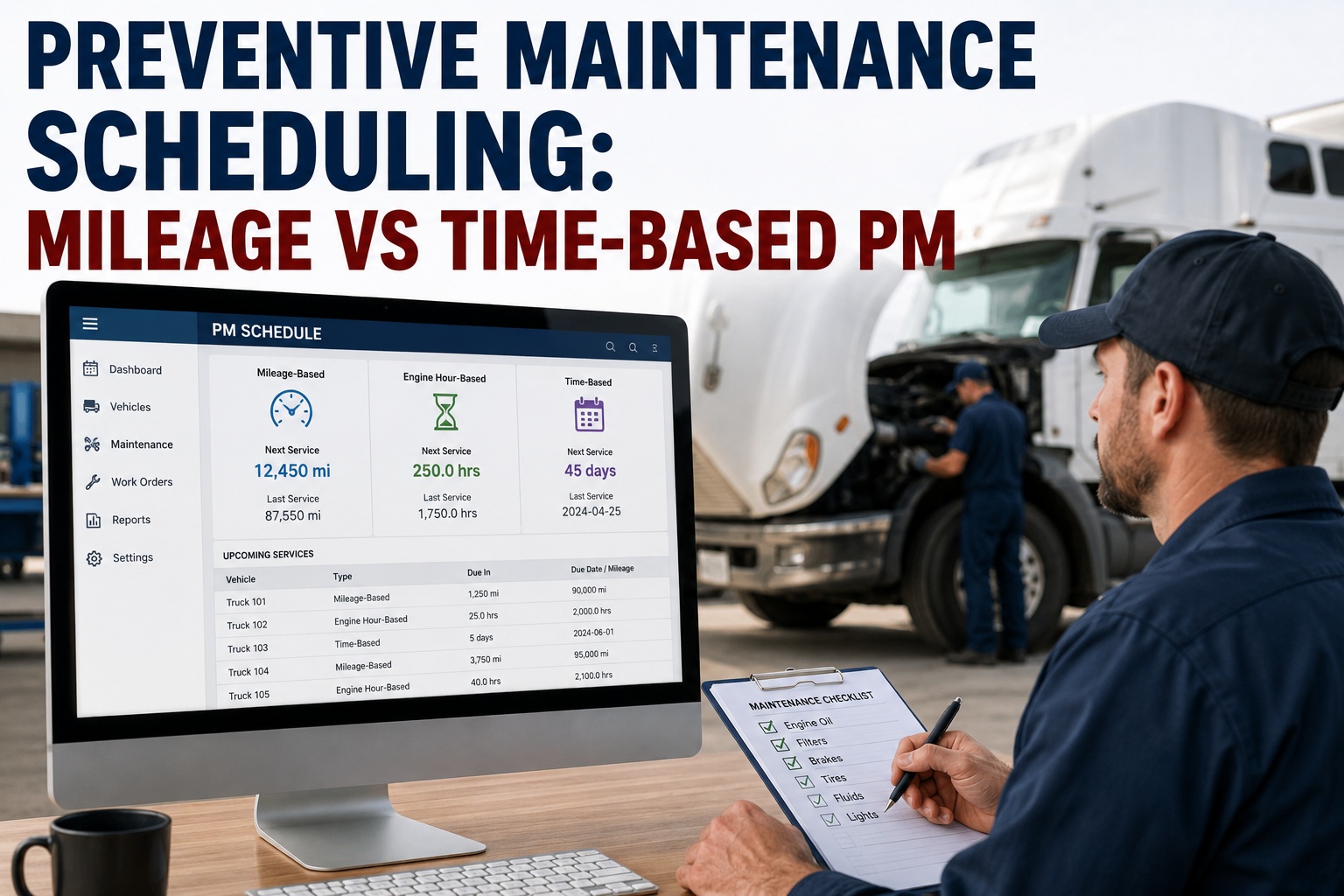
Mileage-based
PM triggered by miles driven — typically 15K, 25K, 50K, and 100K service intervals.
Engine hour-based
PM triggered by ECM-reported engine hours — typically 250, 500, or 1,000 hour intervals.
OEM-recommended
Follow the manufacturer's factory service schedule as published in the truck's operator manual.
Telematics-driven
ECM + telematics data adjusts intervals for actual idle %, load, DPF regens, and oil life sensor readings.
The four methods above are the universe of interval-setting approaches. Below is how duty cycle changes optimal intervals across fleet types, the 5-step optimization workflow to tune your intervals, and the five recurring mistakes that leave fleets running outdated schedules.
How duty cycle changes optimal PM intervals by fleet type
The same truck spec runs meaningfully different PM intervals depending on duty cycle. A long-haul tractor doing 100,000 highway miles a year with 3% idle wears very differently from a regional truck doing 65,000 miles with 25% idle. Setting the same interval for both wastes money on one and invites breakdowns on the other.
Vocational fleets run twice the PM cadence of long-haul because engine hours accumulate faster than miles. A vocational truck may only rack up 40,000 miles annually but log 2,500 engine hours — equivalent duty to a long-haul tractor doing 150,000 miles. Same wear, different measurement unit. Book a demo to see per-truck duty cycle scoring
5-step workflow to optimize your fleet PM intervals
Moving from OEM-default intervals to duty-cycle-tuned intervals is a systematic process, not a one-time decision. Below is the sequence best-in-class fleets follow to lock in optimization.
Baseline current interval performance
Pull 12–24 months of PM records. Calculate: PM cost per truck per year, breakdown events between PMs, and % of PMs that revealed no meaningful wear (over-servicing signal).
Segment fleet by duty cycle
Group trucks by duty pattern using telematics data on idle %, average speed, load, and route type. Long-haul, regional, and vocational segments each need distinct interval sets — not one universal schedule.
Layer in ECM + oil analysis data
Oil life sensors and oil sample analysis reveal actual wear vs the interval assumption. Fleets that layer oil analysis on top of mileage-based scheduling frequently find they can safely extend oil intervals 25–50% on well-behaved trucks.
Pilot the adjusted intervals on 10–20% of the fleet
Roll new intervals to a pilot cohort. Monitor breakdown rate, cost per truck, and shop capacity impact for 6 months before rolling fleet-wide. Baseline metrics from Step 1 are the reference.
Roll out fleet-wide + monitor quarterly
Full deployment with quarterly review of the same KPIs. Intervals aren't permanent — they should adjust as fleet composition, duty cycles, and OEM recommendations evolve.
The 5-step workflow typically takes 9–12 months from baseline to full fleet-wide deployment. Fleets that skip Step 4 (pilot cohort) and go straight to fleet-wide rollout are the ones that experience unexpected breakdown spikes 60–90 days after interval extension — and the ones that end up rolling intervals back conservatively even when the wear data supported the extension. Book a demo to see the workflow automated — or start free and baseline your intervals this month .
5 mistakes fleets make with PM intervals
Every fleet that runs suboptimal PM intervals traces the issue to one of five recurring mistakes. All five are preventable with the 5-step workflow above and duty-cycle-aware scheduling.
Running OEM intervals as gospel without duty cycle adjustment
Fleet follows OEM 25K oil change interval on every truck regardless of whether the truck runs long-haul highway or urban regional stop-and-go. Long-haul trucks get over-serviced; urban trucks under-serviced. Both cost money.
Running mileage-only intervals on vocational fleets
Construction fleet running 40,000 miles a year but 2,500 engine hours schedules PMs by miles. Engine wear is happening at long-haul rates but the truck rarely triggers the mileage threshold. Breakdowns start showing up unexpectedly.
Skipping oil analysis when extending intervals
Fleet extends oil interval from 25K to 35K based on "we can probably go longer" intuition. No oil sampling to confirm. Six months later engine wear metrics jump on trucks that were actually running dirty oil past the safe threshold.
One interval schedule for the whole fleet
Fleet runs a single PM schedule regardless of duty cycle segment. Downtown delivery trucks get the same intervals as long-haul tractors. Neither is optimal. Both are over- or under-serviced depending on the direction.
Setting intervals once and never revisiting them
Intervals were set 5 years ago based on the fleet composition at that time. Fleet has since added new engine platforms, changed duty cycle mix, and adopted new lubricants. Nobody re-optimizes. Intervals drift out of relevance silently.
Every mistake above compounds silently into wasted labor, wasted parts, or unexpected breakdowns. Get the interval discipline right, and PM programs pay for themselves multiple times over — before you even factor in the downtime avoidance. Book a demo to see interval optimization built into workflow — or start free and audit your current intervals this week .
From a maintenance director who ran the interval audit
We were running OEM-default 15,000-mile oil changes on 64 tractors across mixed long-haul and regional routes. Total PM spend was $612,000 a year. Nobody had questioned the interval since the fleet was standardized on the current engine platform four years ago.
We ran the 5-step workflow. Long-haul tractors extended to 30K on oil, regional stayed at 20K. Oil analysis on the pilot cohort confirmed it was safe. Fleet-wide PM visits dropped from 4.8/truck/year to 3.2/truck/year. Annual PM spend dropped to $415,000. Downtime metrics stayed flat. The audit paid for itself in three months and keeps paying every year since.
Frequently asked questions
What are typical preventive maintenance intervals for commercial fleets?
Typical intervals vary by service and duty cycle. For a long-haul Class 8 tractor at moderate loads and low idle, oil changes run 25,000–35,000 miles, fuel filters 50,000–75,000 miles, air filters 50,000 miles or annually, coolant service every 250,000–300,000 miles, and 4–5 comprehensive PM visits per year. Regional distribution fleets running stop-and-go with higher idle typically pull intervals back 25–30%: oil changes at 18,000–25,000 miles, fuel filters at 40,000–60,000, and 3–4 comprehensive PM visits per year. Vocational fleets (construction, refuse, off-highway) typically use engine hour intervals rather than miles because idle time and load produce more wear per mile: oil changes at 250–400 engine hours, fuel filters at 500–750 hours, air filters at 500 hours, and 6–8 PM visits per year. OEM recommendations serve as baseline but should always be adjusted for actual duty cycle.
Should I use mileage or engine hours for PM scheduling?
Both, with the primary trigger set by duty cycle. Long-haul highway fleets should schedule PMs primarily by mileage because most engine wear correlates with miles at moderate loads and low idle. Vocational, construction, and refuse fleets should schedule primarily by engine hours because their wear-per-mile is much higher due to heavy loads, low speeds, and high idle percentages. Regional fleets sit in between and typically use whichever trigger fires first — a "mileage OR hours" rule. As a rough conversion, one engine hour equals roughly 25–40 miles depending on average speed and duty cycle: highway operation converts near 40 mph, urban delivery converts near 25 mph, off-highway vocational may run at 15–20 mph average when the machine is actually moving. Modern telematics-integrated PM software automatically applies whichever trigger fires first per truck, eliminating the manual decision.
How can I extend PM intervals safely without risking breakdowns?
Follow a structured 5-step workflow rather than making one-time interval extension decisions. First, baseline your current interval performance with 12–24 months of PM records and breakdown data. Second, segment fleet by duty cycle so the extension applies to the right trucks. Third, layer in ECM data and oil sample analysis on a pilot cohort to confirm the extension is supported by actual wear data. Fourth, pilot the extended intervals on 10–20% of the fleet for 6 months, monitoring breakdown rates against baseline. Fifth, roll fleet-wide only after the pilot confirms safety, and set a quarterly review cadence to catch drift. Fleets that skip the pilot cohort and go straight to fleet-wide extension are the ones that experience unexpected breakdown spikes 60–90 days later and roll intervals back reactively. Extension is safe when the data supports it and dangerous when the extension is based on intuition alone. Oil analysis costs $20–$40 per sample — trivial versus the cost of engine damage from running dirty oil past its useful life.
What is telematics-driven PM scheduling?
Telematics-driven PM scheduling uses continuous data from the truck's ECM and telematics platform to adjust PM intervals based on actual operating conditions rather than a fixed mileage or engine hour threshold. Signals used include idle percentage (high idle accelerates oil degradation and DPF stress), average load (heavy loads accelerate driveline wear), DPF regeneration frequency (frequent regens signal driveline or emissions issues), engine oil life sensor readings (direct wear measurement), and fault code history (specific components approaching failure). Each signal adjusts the PM interval for the individual truck — two identical trucks in the same fleet may end up with different PM cadences based on how they've been actually operated. The approach is emerging best-in-class in 2026 because it optimizes intervals at the truck level rather than the fleet level, capturing the cost savings of over-serviced trucks while ensuring under-serviced trucks get attention earlier. It requires integrated fleet software connecting the telematics feed to the PM scheduling engine — capability standard in modern CMMS platforms.
How much can PM interval optimization save a fleet?
A typical 100-tractor fleet moving from OEM-default intervals to duty-cycle-tuned intervals recovers $150,000–$300,000 annually in reduced PM labor and parts spend, without increasing breakdown risk. The math: reactive-heavy or under-tuned fleets often average 4–5 PM visits per truck per year at $2,000–$2,500 per visit. Optimized fleets typically run 3–4 visits per truck per year with the same or lower breakdown rates. On 100 trucks that's roughly $200,000–$250,000 in direct PM cost savings, plus reduced shop capacity requirements, better technician time allocation, and fewer trucks tied up in the shop unnecessarily. Vocational fleets typically see even larger optimization benefits because their higher-frequency PM schedules amplify the impact of each interval adjustment. The savings sustain year-over-year because interval optimization is a structural change, not a one-time cost recovery. The 5-step workflow investment (data audit, segmentation, oil analysis, pilot testing) typically pays back within 4–6 months of full deployment.
Move from OEM-default to duty-cycle-tuned PM intervals in 90 days
HVI captures PM history, segments the fleet by duty cycle, tracks oil analysis and ECM signals against interval assumptions, and schedules PMs at the optimized cadence per segment. Trucks running outside their optimal cadence get flagged automatically. Live in under two weeks — typical fleets recover $150,000–$300,000/year on 100-truck fleets through interval optimization alone.
No credit card · No hardware · Interval optimization dashboard ready day one