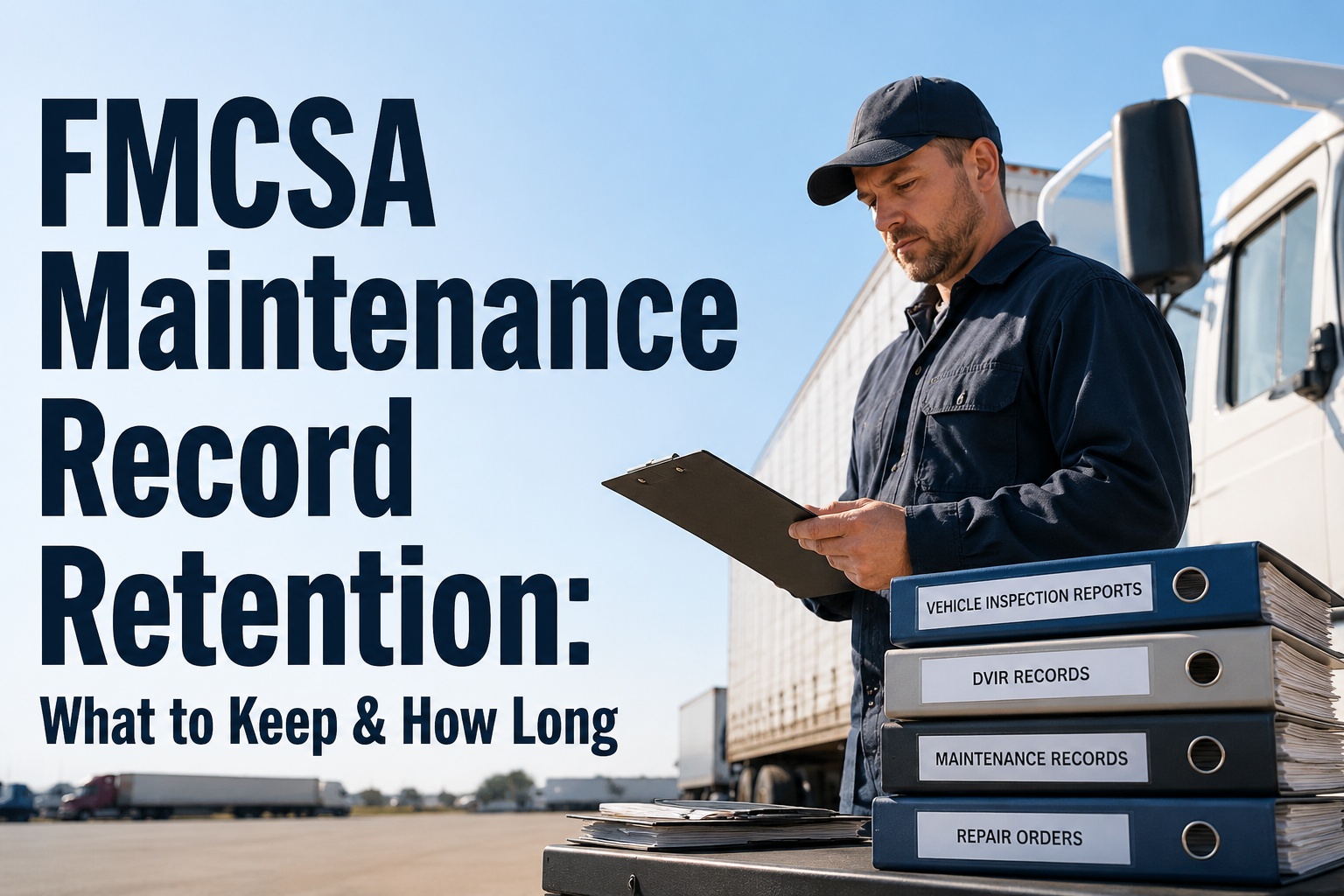
FMCSA maintenance record retention runs on four different clocks. §396.11 DVIRs: 3 months. §396.9 roadside inspection reports: 12 months. §396.21 annual periodic inspection reports: 14 months. §396.3 general maintenance files: 1 year while vehicle is under control, plus 6 months after. Mix them up and a routine audit becomes a $1,544-per-day recordkeeping violation on top of any safety findings — book a demo to see audit-ready digital maintenance records in HVI.
The 4 FMCSA Retention Clocks — Different Documents, Different Duration, One Audit
Every maintenance document runs on its own timer. Missing any one on demand is treated the same as a missed repair.
DVIRs
Driver Vehicle Inspection Reports + repair certifications + driver review certification
Roadside inspections
Roadside inspection reports + evidence of any repairs required, with carrier official signature
Annual inspection
Periodic annual inspection reports required every 12 months per §396.17, plus 2-month audit overlap
Maintenance files
All inspection, repair, PM, service records + identifying vehicle info + schedule
All four retention rules apply simultaneously to every commercial vehicle you control for 30+ days. Records must be produced on demand at the vehicle's home location. Recordkeeping violations run $1,544 per day per FMCSA post-December-2024 fine schedule.
The rest of this page walks exactly what belongs in each retention bucket, the audit questions FMCSA asks that trip up paper-based systems, the digital-record standards that FMCSA explicitly permits, and how mixed-media record archives (some paper, some digital, scattered across yards) become the single largest audit failure point for otherwise well-run fleets. Book a 30-minute demo to see per-unit audit-ready maintenance record archives in HVI.
What belongs in each retention bucket — the document type map
The four retention clocks map to specific document types under 49 CFR Part 396. Miscategorizing a document (treating a DVIR like a maintenance file, or an annual inspection like a roadside report) produces the exact audit failures FMCSA investigators are trained to look for. This is the definitive document-to-bucket assignment based on the CFR sections.
| Bucket | Documents included | Retention rule |
|---|---|---|
| DVIRs (§396.11) | Driver Vehicle Inspection Reports with defects noted, repair certifications proving defects were addressed, driver review-and-sign-off certifications | 3 months (90 days) from date report prepared |
| Roadside inspection reports (§396.9) | State-issued roadside inspection forms transmitted by driver within 24 hours, plus carrier-signed evidence of any repairs made for reported defects | 12 months from date of roadside inspection |
| Annual periodic inspection reports (§396.21) | Signed report from qualified inspector per §396.19, covering all items in 49 CFR 396 Appendix A, with inspector name, motor carrier name, date, vehicle ID, components inspected | 14 months from date of inspection report |
| Maintenance files (§396.3) | Vehicle identifying info (make, VIN, year, tire size, company number), maintenance schedule with last-serviced and next-due dates, complete records of all inspections, lubrication, repairs, and upcoming maintenance | 1 year while under carrier control + 6 months after vehicle leaves via sale, trade, or lease-end |
| Bus emergency-equipment tests | Test records for push-out windows, emergency doors, and marking lights on buses | Part of maintenance file (1 year + 6 months) |
Two document categories that fleets frequently confuse deserve extra attention. First: the annual inspection report and the general maintenance file are not the same thing. The annual is a specific document under §396.21 with 14-month retention; general PM service tickets from a shop live in the §396.3 maintenance file with 1-year retention plus the 6-month tail. Second: the §396.3 6-month post-control retention applies to the whole vehicle history. Selling a truck does not release the maintenance file — it starts the 6-month clock. Book a demo to see per-vehicle records organized by CFR retention bucket in HVI.
The four audit failure modes that catch well-run fleets
FMCSA investigators do not audit the physical condition of the truck first. They audit the records first, because record gaps predict maintenance gaps. Four failure modes account for the majority of recordkeeping violations issued in the last 24 months of audit data. Each one has a specific structural cause and a specific fix.
Records at the wrong location
FMCSA requires records be produced on demand at the location where the vehicle is garaged and maintained. Fleets with centralized paper archives at HQ but trucks running from regional yards routinely fail this check when the auditor visits a regional yard. Digital records solve this by definition.
Missing 6-month post-control tail
Fleet sells a truck; maintenance file gets purged from active records. Auditor asks for a maintenance file on that unit for the 6-month window; nothing there. Fine on record retention violation even though the vehicle is gone. Automated retention rules prevent premature deletion.
DVIR-to-repair chain broken
DVIR shows a defect on Monday; the repair happens Tuesday; the repair certification and driver review sign-off get separated from the original DVIR by Thursday. Auditor sees a DVIR with a defect and no closing evidence. Written up as an incomplete chain regardless of whether the actual repair was done.
Annual inspection retention overlap gap
Fleets store the previous annual and purge when the new one arrives, then the auditor asks for both consecutive years to verify inspection continuity. The 14-month retention on §396.21 exists specifically so the prior report is still there when the new one comes due. Keeping only the most recent is a documented violation.
All four failure modes are structurally identical: the record physically exists somewhere but is not producible at the moment and location the auditor asks. This is what "digital, audit-ready records" actually means — not "we scanned everything" but "any document is retrievable in seconds from any location by any authorized user for the full retention window of the specific CFR bucket." Paper archives fail this test roughly 40% of the time in field audits; well-implemented digital systems fail it under 5%. Book a demo to see any vehicle's full maintenance record archive on demand in HVI.
Digital records under FMCSA — what the regulation actually permits
FMCSA explicitly permits electronic recordkeeping for maintenance files, DVIRs, inspection reports, and all other records covered under 49 CFR Part 396, provided the digital files meet the same standards as paper for integrity, accuracy, and accessibility. Four standards define what "meets the same standards as paper" means in practice, and they are the standards good digital systems architect around from day one.
Integrity — tamper-evident
- Records cannot be silently altered after signing
- Every edit creates an audit-trail entry
- Original signatures preserved with time-stamp
- Cryptographic or database-level immutability
Accuracy — source-of-truth
- Digital record matches what was signed at capture
- No transcription errors from paper-to-digital
- Direct capture at inspection point (mobile app)
- OCR/scanned records require verification workflow
Accessibility — on demand
- Retrievable in seconds by authorized users
- Available at every vehicle-housing location
- Search by VIN, date, document type
- Export for auditor review in standard formats
Retention — automatic clock
- Each document type held for its correct CFR window
- Automatic purge only after retention expires
- Post-control 6-month tail tracked automatically
- No manual retention math for maintenance staff
Well-designed digital maintenance record systems make all four standards structural properties of the system rather than optional compliance tasks. The auditor asks for a specific DVIR from 74 days ago on truck 4407, and either it comes up in seconds from any workstation or phone at any yard the fleet operates from, or it does not. There is no middle ground where "we probably have it in the file room at HQ" counts as compliance. The compliance win with digital systems is not that they replace paper — it's that the retention math, location distribution, and audit-trail integrity happen automatically. Start a free HVI trial to see automatic per-CFR-bucket retention applied to every maintenance document.
A compliance manager on rebuilding record retention after a $47K FMCSA finding
We're a 96-tractor construction and hauling fleet operating across five states in the upper Midwest. Passed 15 years of clean FMCSA safety audits before the 2024 audit that changed how we run records. The auditor's on-site day at our northern yard, three hours in, asks for DVIRs on eight specific tractors covering the prior 60 days. Six of the eight were retrievable within reasonable time from the yard binders. Two were at our HQ 180 miles south. The auditor did not care that the records existed; they were not producible at the location the vehicle was housed.
The finding was 14 recordkeeping violations across the audit sample. Fines totaled roughly $47,000 across the recordkeeping and downstream findings, but the bigger cost was the safety rating downgrade that hit our insurance premium at the next renewal. Roughly $180K of first-year cost from records that physically existed but were in the wrong building.
We went digital across the entire fleet in Q1 2025. All DVIRs captured on driver mobile apps, roadside inspection reports scanned at the yard within 24 hours of receipt, annual inspection reports uploaded by the shop the same day, maintenance file docs attached to the work order that generated them. Retention rules automatic. Any record from any yard retrievable in seconds by anyone with access. Two subsequent FMCSA compliance reviews, both clean on records — the auditor asks, you type the VIN, everything is there. The 4-clock retention system is a solved problem once the paper is gone. What matters after that is discipline: capture at source, sign at source, upload same-day.
Frequently asked questions
How long do I have to keep FMCSA maintenance records?
Retention runs on four different clocks under 49 CFR Part 396. First, DVIRs (Driver Vehicle Inspection Reports) under §396.11 must be kept for 3 months (90 days) from the date the report was prepared, along with the associated repair certification and driver review sign-off. Second, roadside inspection reports under §396.9 must be kept for 12 months from the date of the roadside inspection, including any evidence of repairs made in response to violations noted on the report. Third, annual periodic inspection reports under §396.21 (required every 12 months per §396.17) must be kept for 14 months from the date of the inspection report — the extra 2 months over the 12-month inspection cycle ensures the previous year's report is still on file when the next annual comes due, giving auditors two consecutive years of continuity to review. Fourth, general maintenance files under §396.3 must be kept for 1 year while the vehicle is under the carrier's control (owned or leased for 30+ days) plus 6 months after the vehicle leaves the fleet through sale, trade, or lease-end. All four clocks apply simultaneously to every commercial motor vehicle the carrier controls for 30 days or more. Records must be produced on demand at the location where the vehicle is housed and maintained — central archives at HQ do not satisfy the on-site production requirement if vehicles are garaged at regional yards.
Why is annual inspection retention 14 months instead of 12?
The annual periodic inspection itself is required every 12 months under §396.17, but the report must be retained for 14 months from the inspection date under §396.21. The extra 2 months exist so that when the next annual inspection comes due, the previous report is still on file and available for an auditor to review the complete inspection history without a gap. During any FMCSA compliance review or safety audit, the investigator typically wants to see the current annual report plus the immediately prior annual report to verify continuity — both should be retrievable per unit. Fleets that store only the most recent annual and purge the previous one as soon as the new one arrives commit a documented recordkeeping violation, even if the underlying vehicle inspections themselves were performed correctly. The 14-month rule is deliberately designed to overlap with the 12-month inspection cycle to prevent this exact failure mode. Set retention rules to hold every annual report for 14 months from the inspection date, and the overlap window handles itself.
Do drivers have to file a DVIR if there are no defects?
No, not under FMCSA regulations. FMCSA eliminated the no-defect DVIR requirement for property-carrying commercial motor vehicles in December 2014; property-carrying CMV drivers were never required to file no-defect reports before that ruling. FMCSA subsequently eliminated the no-defect DVIR requirement for passenger-carrying CMVs in interstate commerce as well. Under current regulations, drivers are required to prepare a written DVIR at the end of each day's work only when defects or deficiencies are found that would affect safe operation of the vehicle or could result in a mechanical breakdown. When a defect is reported, the carrier must retain the original DVIR, the repair certification confirming defects were addressed, and the driver's review certification for 3 months from the date the report was prepared. That said, individual carriers are free to require no-defect DVIRs as company policy, and many fleets choose to do so because it builds a stronger documentation trail and preserves the daily inspection habit for drivers. Digital DVIR systems make no-defect logging effectively frictionless (a driver checks a "no defects" button on a mobile app), so the record exists without adding paperwork burden. Whether the fleet requires them or not is a policy choice; the FMCSA baseline requirement is defect-only.
Can maintenance records be kept electronically or must they be on paper?
FMCSA explicitly permits electronic recordkeeping for maintenance files, DVIRs, inspection reports, and all other records covered under 49 CFR Part 396, provided the digital files meet the same standards as paper for integrity (records cannot be silently altered after creation), accuracy (the digital record matches what was signed at capture with no transcription errors), and accessibility (records are producible on demand from the location where the vehicle is housed). Well-designed digital maintenance systems typically exceed paper on all three dimensions: tamper-evident audit trails preserve every edit, direct capture at the inspection point (via mobile app) eliminates paper-to-digital transcription errors, and cloud-based access makes any record retrievable in seconds from any workstation or phone at any yard the fleet operates from. The compliance win with digital records is not just that paper is eliminated — it's that the retention math (holding each document type for its correct CFR window and purging only after retention expires), location distribution (any record available at every vehicle-housing location), and audit-trail integrity all become structural properties of the system rather than optional compliance tasks maintenance staff have to remember. Field audit data indicates paper-based archives fail the on-demand production test in roughly 40% of FMCSA inspections; well-implemented digital systems fail it under 5%.
What are the fines for FMCSA recordkeeping violations?
FMCSA increased civil penalty schedules in December 2024 across the board, and recordkeeping violations now carry substantial daily fines. Recordkeeping violations under 49 CFR Part 396 (maintenance records, DVIRs, inspection reports) can be assessed at up to $1,544 per day per violation depending on severity and pattern. Beyond the direct fines, the more significant financial exposure typically comes from the downstream consequences: a compliance review that produces multiple recordkeeping findings can trigger a safety rating downgrade from Satisfactory to Conditional or Unsatisfactory, which affects insurance premiums (commonly 15-40% increase at next renewal), shipper contract eligibility (some customers require Satisfactory rating in their carrier agreements), and CVSA/roadside inspection scrutiny going forward (fleets with conditional ratings are inspected more frequently). Serious out-of-service violations tied to unaddressed defects — where records show a defect was reported but not documented as repaired — can run up to $23,048 per incident under the December 2024 schedule. The compounding math is where the real cost lives: $47,000 in direct fines from an audit finding routinely produces $150K-$300K of first-year total cost when insurance premium increases and contract impacts are added. The disproportionate cost of recordkeeping failures relative to their difficulty to prevent is why compliance teams generally treat digital record retention as the highest-ROI investment in the fleet safety program.
Four retention clocks. Zero manual math. Every audit ready before it starts.
HVI applies the correct FMCSA retention rule to every maintenance document automatically. DVIRs at 3 months, roadside reports at 12 months, annual inspections at 14 months, maintenance files at 1 year plus the 6-month post-control tail. Every record retrievable in seconds from any location by any authorized user. The audit becomes a search, not a scramble. Live in under two weeks.
Trusted by DOT-regulated fleets across the USA · Ready on day one