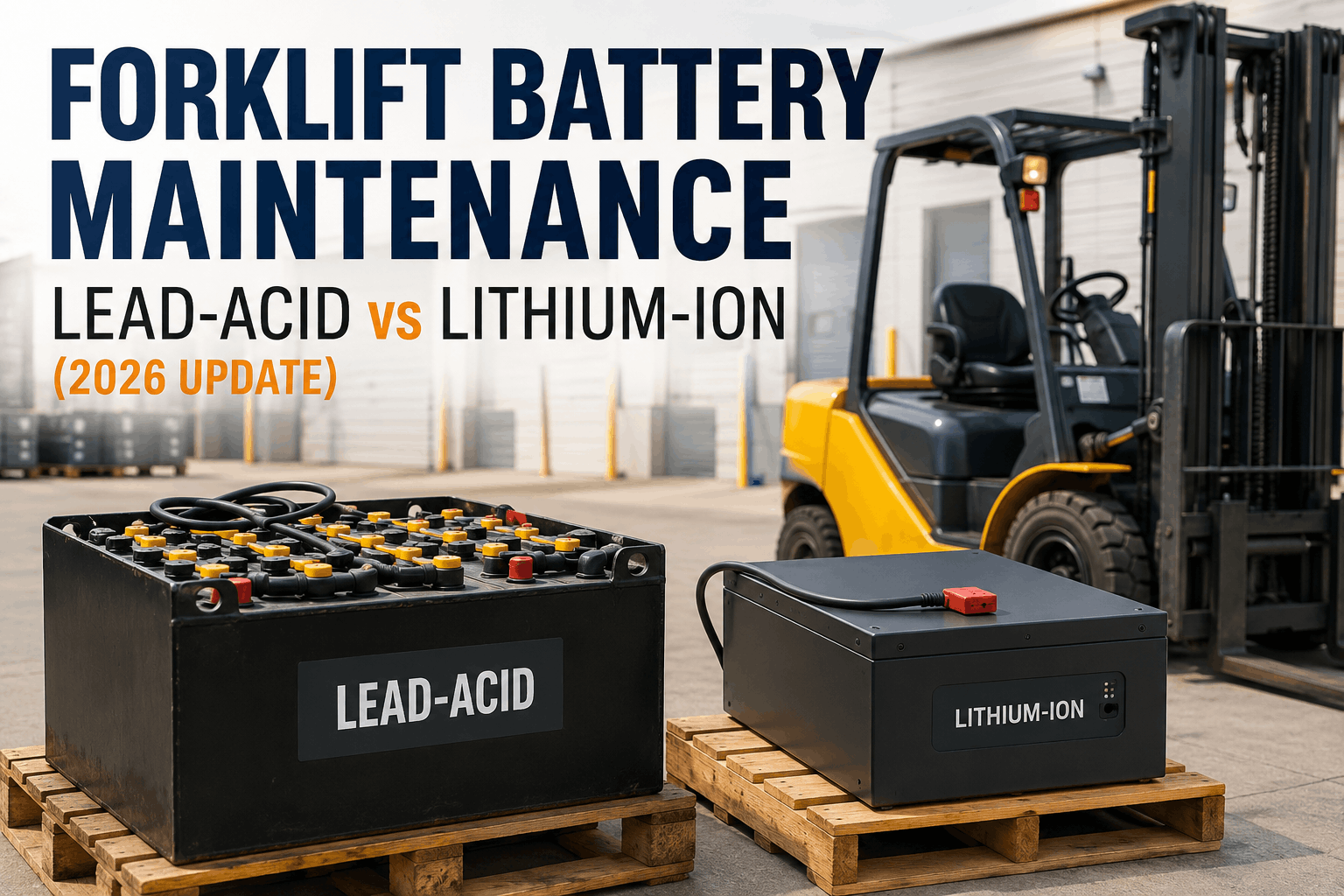
The forklift battery decision is the most expensive maintenance choice a warehouse manager makes — and the one most often decided on the wrong number. Lead-acid wins the sticker-price comparison every time: $3,000–$6,000 versus $7,000–$15,000 for lithium-ion. But the sticker price is roughly 30% of the real cost. The other 70% hides in watering labor, equalization downtime, battery-swapping, energy losses, cooling rooms, and replacement cycles that lead-acid demands and lithium-ion eliminates. Over a 5–8 year horizon, the total cost of ownership for lithium-ion runs 30–50% lower for high-use multi-shift fleets — and up to 60% lower over a full decade. Yet lead-acid is not obsolete: for single-shift operations with an existing charging infrastructure and tight capital budgets, it still makes financial sense. This guide gives warehouse managers the maintenance reality of both chemistries — the lead-acid watering schedule and equalization protocol, the lithium-ion care requirements, the temperature and safety differences, and the total-cost-of-ownership comparison that should drive the decision rather than the purchase-order line item. HVI's inspection & maintenance software tracks battery maintenance for both chemistries — watering schedules and equalization logs for lead-acid, BMS health and charge-cycle tracking for lithium — so whichever you run, the maintenance never slips.
Track Forklift Battery Maintenance — Whichever Chemistry You Run
HVI schedules and logs lead-acid watering and equalization, tracks lithium BMS health and charge cycles, and flags overdue maintenance before a battery fails. One platform for mixed-chemistry warehouse fleets.
The 30-Second Verdict
Before the deep comparison, here is the answer most warehouse managers are looking for — based on shift pattern, which is the single biggest decision factor.
LEAD-ACID
Best for:
Single-shift operations, tight capital budgets, existing charging infrastructure, low-frequency use
$3,000 – $6,000 upfront
LITHIUM-ION
Best for:
Multi-shift operations, high-frequency use, cold storage, labor-cost reduction, lowest 5-year TCO
$7,000 – $15,000 upfront
Side-by-Side: The Full Comparison
Every dimension that matters for a warehouse manager's decision, lead-acid versus lithium-ion, measured on the same scale.
Dimension
Lead-Acid
Lithium-Ion
Upfront Cost
$3,000 – $6,000
$7,000 – $15,000
Routine Maintenance
Weekly watering + equalization
Virtually maintenance-free
Charge Time
8 hours + cooldown
1 – 2 hours, opportunity charge
Cycle Life
1,000 – 1,500 cycles
3,500 – 6,000 cycles
Energy Efficiency
~80%
95 – 98%
Voltage Under Load
Sags below 30% charge
Constant to near-empty
Multi-Shift Capability
Needs swap + spare batteries
One battery, all shifts
Cold Performance
Loses 50% at 0 degrees F
Works to -4 degrees F
Charging Room
Ventilation required (off-gassing)
No special ventilation
5-Year TCO (high use)
Higher (hidden costs)
30 – 50% lower
Lead-Acid Maintenance: The Weekly Reality
Lead-acid is not "buy and forget." It is a daily-to-weekly maintenance commitment that, if skipped, destroys the battery and the warranty. Here is the actual maintenance schedule warehouse managers must staff and enforce.
EVERY 5–10 DAYS
Watering
Top off every cell with distilled water to maintain electrolyte levels. 15–30 minutes per battery. Skipping this is the #1 cause of premature lead-acid failure. Watering systems (e.g. Flow-Rite) cut this to under a minute.
WEEKLY
Equalization Charge
Controlled overcharge to de-sulfate plates and balance cell voltage. 4–8 hours of forklift downtime. Without it, cells drift out of balance and capacity drops permanently.
WEEKLY
Terminal Cleaning
Remove corrosive acid residue from terminals and connections. Corrosion increases resistance, slows charging, and creates fire and arc risk.
WEEKLY
Specific Gravity Check
Hydrometer reading per cell to verify state of charge and detect failing cells early. A single weak cell drags down the whole battery.
PER CHARGE
Avoid Opportunity Charging
Improper partial charging can cut lead-acid lifespan by up to 40%. Charge fully, then allow cooldown. Discharge no deeper than 80% DoD to protect plate life.
ONGOING
Temperature Management
Every 15 degrees F above 77 degrees F cuts lead-acid life by 50%. Cold storage below 0 degrees F may require a heated battery room ($5,000–$10,000 install, $1,000–$2,000/year).
Lead-acid maintenance is roughly $1,200/year per battery in labor and supplies — before counting equalization downtime. HVI schedules each task, logs completion, and flags overdue watering before the battery suffers.
Start free with HVI.
Lithium-Ion Care: The "Set and Forget" Caveats
Lithium-ion is marketed as maintenance-free — and for routine purposes it is. No watering, no equalization, no acid. But "maintenance-free" is not "ignore-free." Four care practices protect the investment and the warranty.
Monitor the BMS
The Battery Management System is the brain. Check its SOC/SOH data and fault logs periodically. A failing BMS — not the cells — is the most common lithium failure point. Opt for UL-certified packs.
Cold-Charge Caution
Lithium operates from -4 degrees F to 113 degrees F, but charging below 0 degrees C (32 degrees F) requires a heated cabinet to protect the cells. Discharge in cold is fine; charging in cold is not.
Opportunity Charge Freely
Unlike lead-acid, lithium thrives on partial charging. Plug in during breaks and shift changes. No memory effect, no plate damage. This is what enables single-battery multi-shift operation.
Add Ballast for Stability
Lithium packs are lighter than lead-acid. Forklifts rely on battery weight for counterbalance — a lithium retrofit often needs added ballast to maintain safe lift capacity. Verify with the OEM.
The Hidden Cost Stack — Where Lead-Acid's Savings Disappear
The sticker price favors lead-acid by $4,000–$9,000. Then the hidden costs arrive. Here is the per-battery annual cost stack that the purchase order never shows.
Hidden Cost Factor
Lead-Acid
Lithium-Ion
Watering & equalization labor
$1,200/yr
$0
Equalization downtime (4–8 hrs/wk)
High
None
Energy losses (efficiency gap)
$50–$225/yr
Baseline
Battery swapping (multi-shift)
Spare battery + labor
$0
Heated/ventilated battery room
$5K–$10K + $1K–$2K/yr
Usually none
Replacement frequency
Every 1,000–1,500 cycles
3,500–6,000 cycles
THE MULTI-SHIFT MATH
For a 10-forklift fleet running 3 shifts, lithium-ion can save roughly 21,900 hours per year in eliminated charging downtime and battery swaps — equivalent to over $328,500 in labor at $15/hour. This single factor often justifies the lithium premium in the first year for high-use operations.
The Decision Framework
Five questions that determine the right chemistry for your specific warehouse. Answer them honestly and the choice becomes clear.
Q1
How many shifts per day?
1 shift → lead-acid viable. 2–3 shifts → lithium-ion (eliminates swaps and charging downtime).
Q2
What is your planning horizon?
Under 3 years → lead-acid TCO competitive. 5–10 years → lithium-ion 30–60% lower TCO.
Q3
Do you operate in cold storage?
Yes → lithium-ion (lead-acid loses 50% capacity at 0 degrees F and needs heated rooms).
Q4
Is labor availability a constraint?
Yes → lithium-ion (zero watering/equalization labor). No → lead-acid maintenance manageable.
Q5
Do you have charging infrastructure already?
Existing lead-acid chargers + single shift → lead-acid leverages sunk cost. New facility → lithium-ion from the start.
Decide on TCO, Maintain on Schedule
The forklift battery decision is not lead-acid versus lithium-ion in the abstract — it is a decision driven by shift count, planning horizon, temperature environment, labor availability, and existing infrastructure. Single-shift operations with tight budgets and existing chargers still get genuine value from lead-acid. Multi-shift, high-frequency, cold-storage, or labor-constrained operations almost always come out ahead with lithium-ion over a 5-year horizon, where TCO runs 30–50% lower and the multi-shift labor savings alone can exceed the price premium in year one. Whichever chemistry you run, the maintenance is what determines whether you reach the rated lifespan or fail early. Lead-acid that skips watering and equalization dies at a fraction of its cycle life; lithium-ion that ignores BMS health and cold-charging rules voids warranties and risks thermal events. HVI's inspection & maintenance software handles both: scheduled watering and equalization logging with overdue alerts for lead-acid, BMS health and charge-cycle tracking for lithium-ion, and one unified maintenance dashboard across a mixed-chemistry fleet. The chemistry decision sets your ceiling; disciplined maintenance is how you actually reach it. Start free today or book a 30-minute demo to see HVI's battery maintenance tracking live on your fleet.
Never Miss a Battery Maintenance Task with HVI
Lead-acid watering & equalization scheduling. Lithium BMS health tracking. Charge-cycle logging. Overdue alerts. Mixed-chemistry dashboard. Photo verification. Trusted by 25,000+ users worldwide.
Frequently Asked Questions
Q: How often do lead-acid forklift batteries need watering?
Every 5–10 operating days — weekly is the common standard. Top off every cell with distilled water to maintain electrolyte levels above the plates. Each watering takes 15–30 minutes per battery manually, or under a minute with a single-point watering system. Skipping watering is the single most common cause of premature lead-acid failure and warranty voiding.
Q: What is an equalization charge and why does it matter?
An equalization charge is a controlled overcharge applied weekly to lead-acid batteries that de-sulfates the plates and balances voltage across all cells. It takes 4–8 hours of forklift downtime. Without it, cells drift out of balance, sulfation builds up, and battery capacity drops permanently. Lithium-ion batteries require no equalization — the BMS handles cell balancing automatically.
Start free with HVI.
Q: Is lithium-ion really maintenance-free?
For routine purposes, yes — no watering, no equalization, no acid cleaning. But "maintenance-free" is not "ignore-free." Best practice includes periodic BMS health monitoring, avoiding charging below freezing without a heated cabinet, and verifying ballast for counterbalance after a retrofit. The BMS is the most common failure point, so UL-certified packs with quality BMS are worth the premium.
Book a demo.
Q: When does lithium-ion actually pay for itself?
For multi-shift, high-frequency operations, often within the first year — the eliminated charging downtime and battery-swap labor can exceed the price premium. For a 10-forklift 3-shift fleet, lithium can save roughly 21,900 hours/year (over $328,500 in labor at $15/hour). For single-shift operations, the payback stretches to 3–5 years, and lead-acid may remain the better financial choice if infrastructure already exists.
Q: Which battery is better for cold storage warehouses?
Lithium-ion, clearly. Lead-acid loses about 50% capacity at 0 degrees F and typically requires a heated battery room ($5,000–$10,000 to install, $1,000–$2,000/year to run). Lithium-ion operates efficiently from -4 degrees F to 113 degrees F — though charging below freezing requires a heated cabinet to protect the cells. For freezer and cold-chain operations, lithium eliminates the heated-room infrastructure cost entirely.
Q: How does HVI help with battery maintenance?
HVI schedules and tracks every battery maintenance task by chemistry: lead-acid watering intervals, equalization charges, terminal cleaning, and specific-gravity checks with overdue alerts; lithium-ion BMS health checks and charge-cycle logging. For mixed-chemistry fleets, one dashboard shows the maintenance status of every battery. Overdue tasks flag before a battery fails, and the full log supports warranty claims.
Start free today.