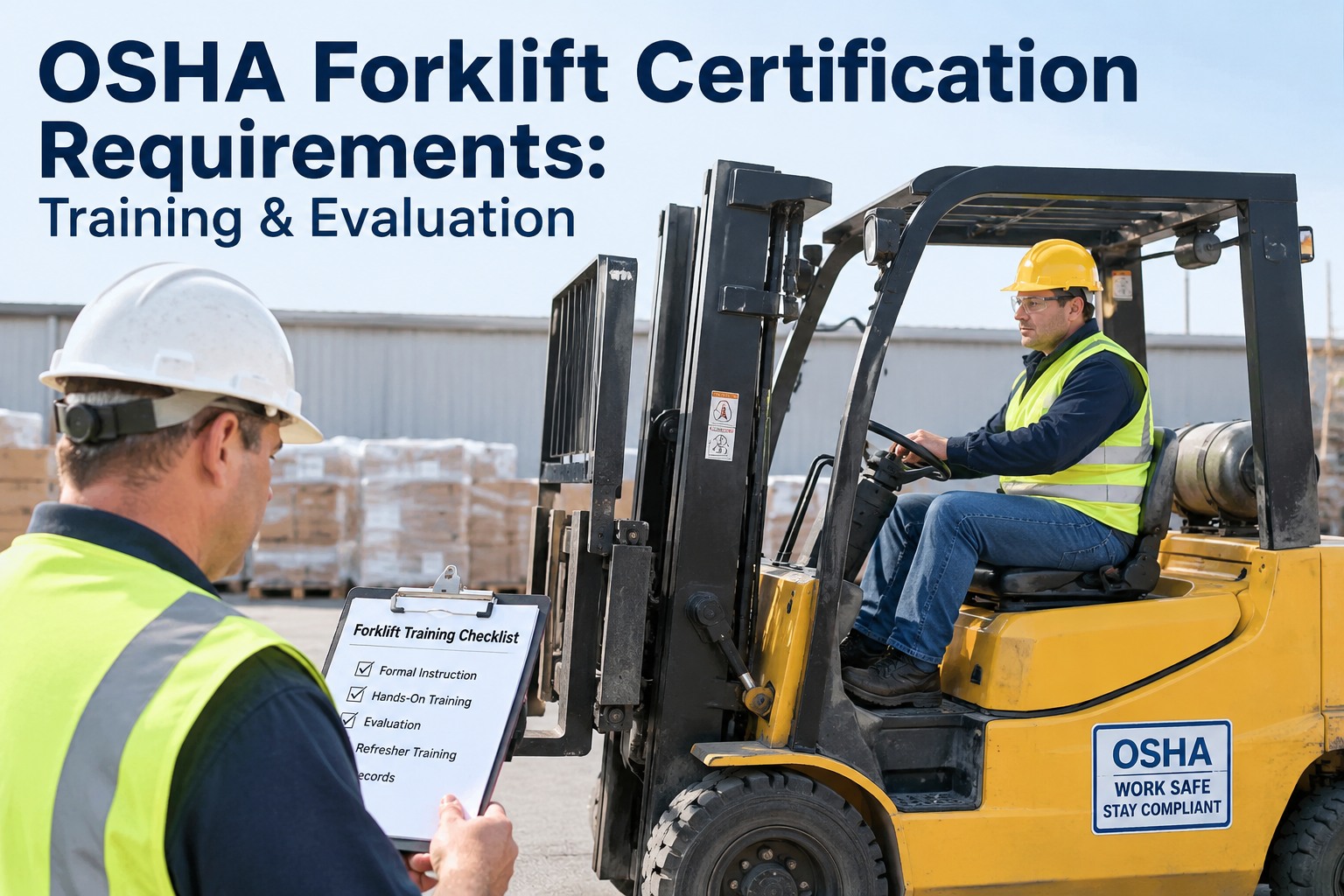
Ask ten warehouse managers about OSHA forklift certification and you'll get the same wrong answer: that operators need an "OSHA license." There's no such thing. OSHA doesn't issue a forklift license, doesn't run a card, and doesn't certify anyone — the employer does. What the standard requires under 1910.178(l) is formal instruction, hands-on training, a workplace evaluation, and a written certification record you keep. This guide clears up the myth and walks what the rule demands, who can train, and why the records matter most. Book a demo to see operator qualification records tracked in HVI.
OSHA Forklift Certification Requirements & Training
There's no OSHA forklift license. There's a training-and-evaluation standard the employer certifies — and a records trail that decides whether you pass an inspection.
Educational overview of OSHA 1910.178(l) — not OSHA compliance advice or certification. HVI tracks records; it does not deliver training.
Forklift operator certification is one of the most misunderstood corners of OSHA compliance, and the confusion starts with the word "license." Powered industrial truck operator training under 29 CFR 1910.178(l) isn't a card you buy or a test the government administers. It's a program the employer runs and certifies — and operator training is consistently one of the most-cited parts of the whole standard, precisely because so many employers misunderstand what it requires. Let's replace the myth with what the rule actually says.
There is no "OSHA forklift license"
This is the single most important thing to get straight, because it reframes everything else. OSHA does not issue, recognize, or require a forklift license. What it requires is that the employer certify each operator has been trained and evaluated.
OSHA issues no forklift license and recognizes no national card. Any wallet card an operator carries is just a convenient proof the employer chose to print — not an OSHA credential.
Under 1910.178(l)(6), the employer certifies that each operator has been trained and evaluated. "Certification" here means the employer's own written attestation, not a third-party license.
Federal OSHA has no requirement that a forklift operator hold a motor-vehicle driver's license. What's required is truck- and workplace-specific training and a qualified evaluation.
Because there's no license, the certification record is your evidence of compliance — and it's the first thing an OSHA compliance officer asks to see after an incident.
Once you drop the license myth, the whole requirement gets clearer: your job isn't to send operators off to get a card, it's to run a compliant training-and-evaluation program and document it. That documentation is where compliance actually lives — and, honestly, where a lot of otherwise well-trained operations fall down, because the training happened but the record proving it didn't. Book a demo to keep every operator's certification record complete and retrievable
What training actually requires: three parts
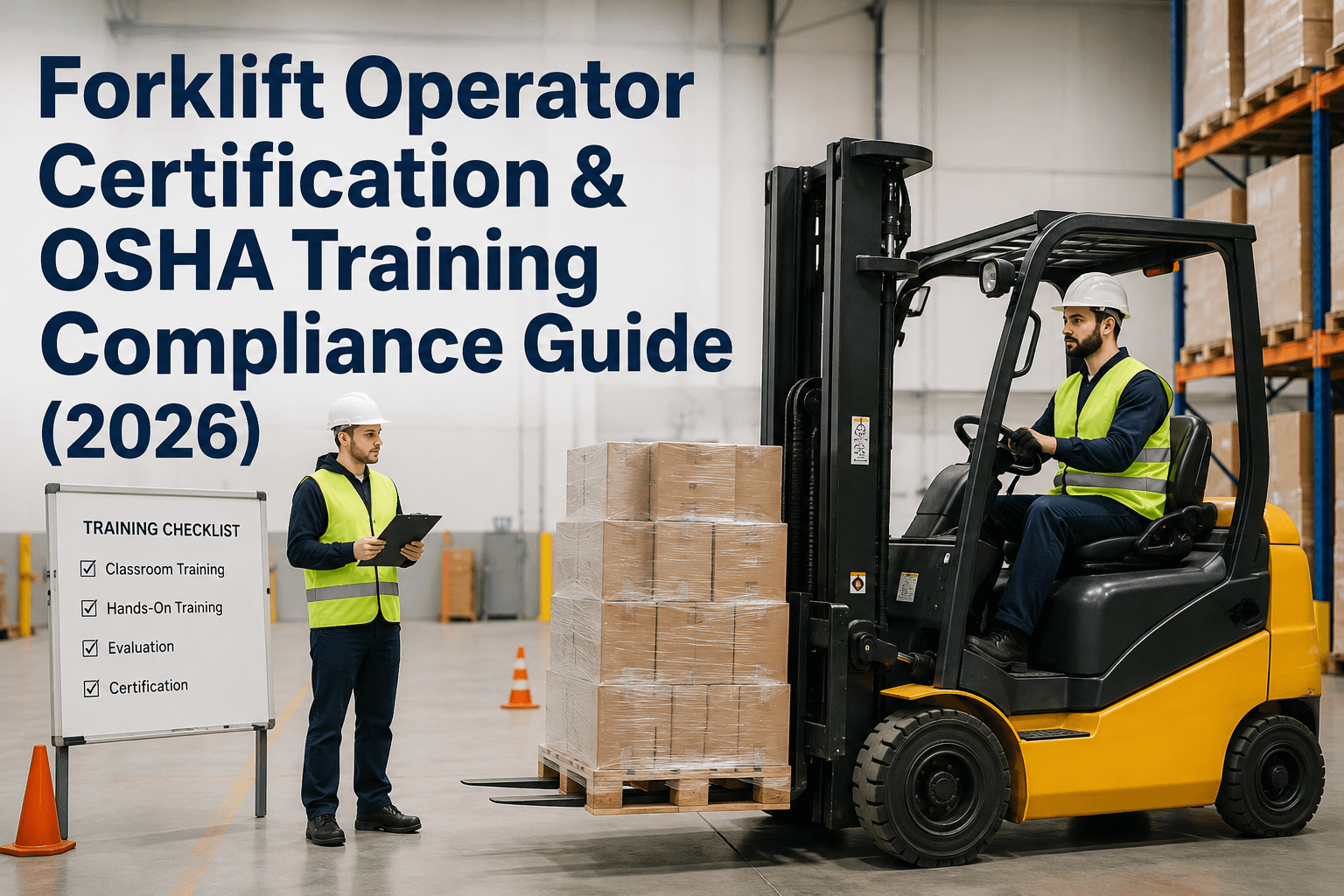
The standard is specific about what "trained" means. It's not a video, and it's not an online quiz alone — it's a combination of three components, and skipping any one of them leaves the certification non-compliant.
Lecture, discussion, written materials, video, or interactive computer learning covering the safety topics and operating principles. This is the part an online course can satisfy.
Demonstrations by the trainer plus hands-on exercises performed by the trainee on the actual truck type. This can't be done through a screen — it happens on the equipment.
A qualified person observes the operator running the truck in the actual workplace and confirms they can do it safely. This is the step that ties training to real competence.
Notice how the three parts build on each other: instruction gives the knowledge, practical training applies it, and evaluation proves it stuck. A certification that's missing the practical or evaluation step isn't just incomplete on paper — it means no one has actually confirmed the operator can run that truck safely, which is the entire point. This is also why HVI's role is holding the record of all three, not delivering the training itself. Start free on HVI to record training, practical, and evaluation completion per operator.
Who can train and evaluate operators
Another common misconception is that you need an outside trainer or an "OSHA-certified" instructor. Neither exists in the standard. The rule on who may train and evaluate is refreshingly plain.
Under 1910.178(l)(2)(iii), all training and evaluation must be conducted by persons who have the knowledge, training, and experience to train operators and evaluate their competence. In practice that's often an experienced supervisor or safety lead who competently operates the relevant truck classes.
There is no "OSHA-certified trainer" credential — OSHA doesn't issue one. No mandatory third-party trainer, no specific license or degree. A train-the-trainer course can help demonstrate the required knowledge, but it isn't itself an OSHA certification.
The practical takeaway: a qualified in-house employee can absolutely train, evaluate, and let the employer certify your operators, as long as that person genuinely has the knowledge, training, and experience the rule describes. It's wise to designate that person in writing. The employer carries the responsibility for the trainer's competence, so "qualified" has to be real, not nominal — and the record should capture who trained and evaluated each operator, and when.
The certification record: four required fields
Because the employer's certification is the proof of compliance, the standard is explicit about what that record must contain. Under 1910.178(l)(6), the certification includes four specific fields — miss any of them and the record is incomplete.
Who was trained and evaluated.
When the training was completed.
When the workplace performance evaluation occurred.
The name of the person(s) who performed the training or evaluation.
These four fields are deceptively easy to get wrong in practice — a certificate that names the operator and the date but not who evaluated them, or a training date with no corresponding evaluation date, is a gap an auditor will spot. A complete record makes it possible to answer, for any operator: were they trained, when, on what, and by whom. That's exactly the record HVI is built to hold and keep retrievable. Start free to capture all four certification fields for every operator.
The three-year evaluation — and the triggers that override it
Here's where the most damaging myth lives: that OSHA requires operators to be fully "re-certified" every three years on a fixed calendar. That's not what the standard says, and building your program around the myth causes both wasted effort and missed obligations.
Under 1910.178(l)(4)(iii), each operator's performance must be evaluated at least once every three years. Note the word: an evaluation — confirming the operator still runs the truck safely — not automatic full re-training on a timer. The standard sets no hard expiration date; this recurring evaluation is what people mean by the "three-year certification."
But the three-year clock isn't the whole rule. Specific events require refresher training and re-evaluation before the three years are up — and these triggers override the calendar entirely.
So the honest summary is: evaluate at least every three years, and retrain-plus-re-evaluate whenever a trigger fires, whichever comes first. An operator who has a near-miss in month six doesn't wait until year three — the event resets the obligation. Programs built around the real evaluation-and-trigger structure stay both compliant and sensible, instead of chasing a calendar myth while missing the events that actually matter. Book a demo to track evaluation due-dates and trigger-driven refreshers together
Certification is truck-type and workplace specific
A final point that trips up a lot of operations: being trained on one forklift doesn't automatically qualify an operator for every powered industrial truck. Certification is tied to the truck type and the workplace, not the person in the abstract.
Moving an operator from a sit-down counterbalance to a stand-up reach truck or an order picker changes controls, visibility, stability, and fall exposure — that's new training, not a formality.
The training and evaluation are meant to reflect the actual workplace. A significant change in the environment can itself be a refresher trigger, because the safe-operation picture changed.
Training must cover the truck- and workplace-related topics that apply; an employer can omit topics it can demonstrate aren't relevant to safe operation in its workplace.
This is why a records system that tracks which truck types each operator is certified on matters as much as tracking dates. "Certified" isn't a single yes/no — it's per operator, per truck class, in your workplace, current as of the last evaluation. Keeping that matrix straight across a crew is a documentation problem, and it's precisely the kind of thing that's painful on paper and simple in a system. Book a demo to track certification by operator and truck type
From a safety manager who failed an audit on paperwork
Every one of our operators was trained. Genuinely — good hands-on program, experienced trainer, the works. But when OSHA showed up after a minor incident, the first thing they asked for was the certification records, and ours were a mess: some had a training date but no evaluation date, a couple didn't say who evaluated them, and we couldn't quickly prove which guys were signed off on the reach trucks versus the sit-downs.
We got cited not because the training was bad but because we couldn't prove it. Now every operator's record has all four fields, the truck types they're cleared on, and an alert before the three-year evaluation comes due. Same training program — but now the paperwork actually backs it up.
Train well, but prove it — the records are the requirement
OSHA forklift certification isn't a license and isn't a card; it's an employer-run program under 29 CFR 1910.178(l). The requirement is concrete: formal instruction, practical hands-on training, and a workplace evaluation, all conducted by someone with the knowledge, training, and experience to do it, followed by a written certification recording the operator's name, the training date, the evaluation date, and who did the training or evaluation. Each operator must be evaluated at least every three years, and refresher training plus re-evaluation is triggered early by an unsafe-operation observation, an accident or near-miss, a deficient evaluation, assignment to a different truck type, or a workplace change. Certification follows the truck type and the workplace, not the person in the abstract.
Get all that right and the training keeps your people safe — but it's the documentation that keeps you compliant, because after an incident the records are the very first thing an inspector asks for. That's the honest boundary of where HVI fits: it does not deliver forklift training and it does not certify operators — your qualified trainer does that. What HVI does is hold and protect the proof: operator qualification records with all four required fields, the truck types each operator is cleared on, evaluator identity, and 90-, 60-, and 30-day alerts before an evaluation is due, all searchable and audit-ready. HVI is an inspection-and-maintenance records platform, not a training provider or a substitute for OSHA compliance advice — always verify current requirements against the OSHA standard for your operation. Book a demo to see operator qualification records tracked in HVI.
Frequently asked questions
Is there an OSHA forklift license?
No. There is no OSHA forklift license and no OSHA-issued or OSHA-recognized forklift card. This is the most common misconception about forklift certification. What OSHA's powered industrial truck standard, 29 CFR 1910.178(l), actually requires is that the employer train and evaluate each operator and then certify — in the sense of formally attesting in a written record — that the training and evaluation took place. Any physical wallet card an operator carries is simply a convenience the employer chose to issue as proof of that internal certification; it is not a government license, and OSHA neither prints nor tracks such cards. There's also no federal OSHA requirement that a forklift operator hold a motor-vehicle driver's license. So when people talk about being "OSHA certified" or "licensed" to run a forklift, what they actually mean, correctly understood, is that their employer has trained them, evaluated their performance in the workplace, and documented it as the standard requires. The practical consequence is that compliance can't be outsourced to a card vendor: even if an operator completes an external course, the employer still owns the practical training, the workplace evaluation, and the certification record.
What does OSHA require for forklift operator training?
Under 29 CFR 1910.178(l), forklift operator training must combine three components, and all three are required. First is formal instruction, which can be delivered through lecture, discussion, written materials, video, or interactive computer-based learning, covering the safety and operating topics relevant to the truck and workplace. Second is practical training, meaning demonstrations performed by the trainer followed by hands-on exercises performed by the trainee on the actual type of truck they'll operate. Third is an evaluation of the operator's performance in the workplace, where a qualified person observes the operator running the truck in the real work environment and confirms they can do so safely. All operator training and evaluation must be conducted by a person who has the knowledge, training, and experience to train operators and evaluate their competence. A crucial practical point is that an online course alone cannot satisfy the standard: while online learning can cover the formal-instruction component, it cannot deliver the hands-on practical training or the workplace evaluation, both of which must happen on site with the actual equipment. After all three components are complete, the employer certifies the operator with a written record. Training must also match the specific truck types and workplace conditions the operator will encounter.
How often do forklift operators need to be re-evaluated?
OSHA requires that each forklift operator's performance be evaluated at least once every three years, under 1910.178(l)(4)(iii). It's important to understand this correctly: the standard requires a recurring evaluation, not automatic full re-training on a fixed three-year calendar, and it does not set a hard certification expiration date. The three-year evaluation is what most people are referring to when they talk about a "three-year forklift certification." However, the three-year cycle is only the baseline, because certain events require refresher training and re-evaluation before the three years are up, and these triggers override the calendar. Refresher training and re-evaluation are required when an operator is observed operating a truck unsafely, is involved in an accident or a near-miss, receives an evaluation showing a deficiency in safe operation, is assigned to operate a different type of truck, or when a condition in the workplace changes in a manner that could affect safe operation. So the correct rule is to evaluate every operator at least every three years and to retrain and re-evaluate whenever any trigger occurs, whichever comes first. An operator involved in a near-miss six months after certification doesn't wait until year three; the event resets the obligation immediately. Building a program around both the three-year baseline and the event triggers is what keeps it genuinely compliant.
Who is allowed to train and certify forklift operators?
Under 1910.178(l)(2)(iii), all forklift operator training and evaluation must be conducted by a person who has the knowledge, training, and experience to train operators and evaluate their competence. Notably, OSHA does not require an outside trainer, a third-party provider, or any "OSHA-certified trainer" credential — in fact, there is no such thing as an OSHA-certified trainer, because OSHA does not issue trainer credentials. In most workplaces the trainer is a qualified in-house employee, such as an experienced supervisor or safety lead who competently operates the relevant truck classes and understands how to instruct and evaluate. A train-the-trainer course is a common and useful way to help demonstrate the required knowledge, training, and experience, but completing one does not by itself create an official OSHA certification; it simply helps establish that the person meets the standard's competence requirement. The employer ultimately bears responsibility for ensuring the trainer is genuinely qualified, so the designation needs to be substantive rather than nominal, and it's good practice to designate the qualified trainer in writing. Once a qualified trainer has conducted the instruction, practical training, and workplace evaluation, the employer certifies the operator with the required written record.
What records prove forklift certification, and how does HVI help?
The certification record is the proof of compliance, and under 1910.178(l)(6) it must include four specific fields: the operator's name, the date of the training, the date of the evaluation, and the identity of the person or persons who performed the training or evaluation. In practice you also want to track which truck types each operator is certified on, since certification is truck-type and workplace specific, and the date the next three-year evaluation is due. These records matter enormously because, after an incident, they are typically the first thing an OSHA compliance officer asks to see — and missing or incomplete records are among the most common findings, even in operations where the training itself was perfectly good. This is exactly the boundary of what HVI does, and it's worth being honest about: HVI does not deliver forklift training and does not certify operators — a qualified trainer and the employer do that. What HVI provides is the records layer: operator qualification records capturing the required certification fields and truck types, evaluation records, and expiry alerts at 90, 60, and 30 days before an evaluation comes due, all kept searchable and audit-ready. In other words, HVI doesn't train your operators; it makes sure that when someone asks you to prove they were trained and evaluated, you can, instantly.
Track forklift operator qualification records in HVI
HVI holds what an audit demands: operator qualification records with all four certification fields, the truck types each operator is cleared on, evaluator identity, and 90-, 60-, and 30-day alerts before an evaluation comes due — searchable and audit-ready. HVI tracks the records; your qualified trainer delivers the training. Honest lane, real value. Mobile-first for the warehouse floor, live in under two weeks.
No credit card · Operator qualification records · 90/60/30-day evaluation alerts