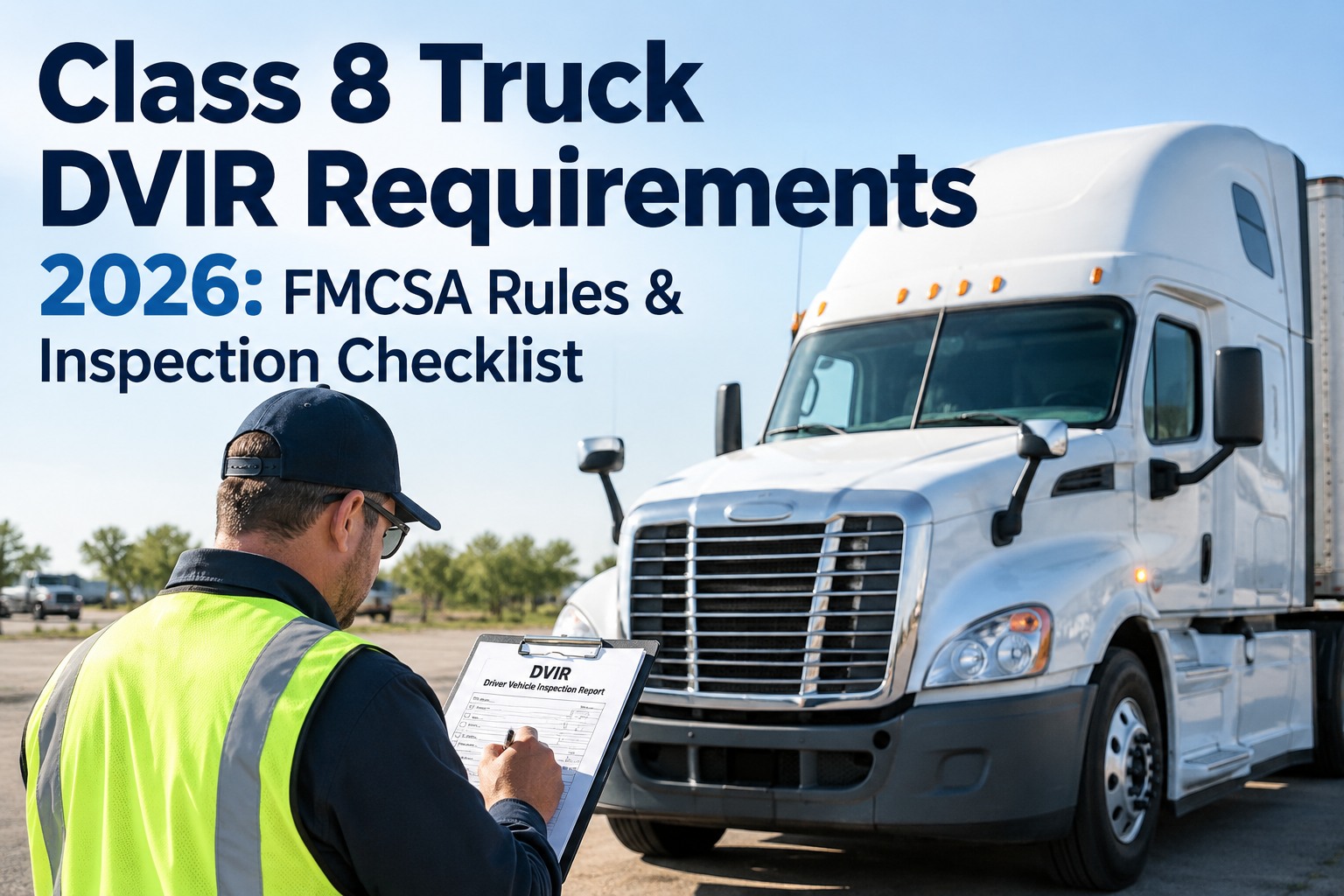
Every other truck class is one vehicle. Class 8 is usually two — a tractor and a trailer joined by a coupling the size of a dinner plate holding 80,000 lb together at highway speed. That's what makes Class 8 truck DVIR requirements different: you're inspecting a combination, and the rules treat the power unit and the trailer as separate machines that both have to pass. This guide covers the tractor, the trailer, the coupling between them, and how to keep it all documented. Book a demo to see it run.
One DVIR, Two Vehicles, One Critical Joint
A Class 8 combination is a tractor and a trailer inspected as separate units — and the coupling between them is the one component that turns a defect into a catastrophe.
If you run over-the-road semis, tractor-trailers, or heavy straight trucks at 33,001 lb and above, this is the top of the class ladder — and the top of the compliance pyramid. Class 8 fleets face the most inspection points, the strictest enforcement, and the highest stakes when something is missed. The good news: the failures are predictable. Almost everything that grounds a Class 8 truck at the scale house is something a disciplined pre-trip catches first.
What Is a Class 8 Truck?33,001 lb GVWR and up — the top of the ladder
Class 8 is the heaviest GVWR classification: any truck rated 33,001 lb or more. Gross Vehicle Weight Rating is the manufacturer's certified maximum loaded weight on the door-jamb sticker, not today's scale reading. A fully loaded tractor-trailer can gross up to 80,000 lb on the interstate without an overweight permit — which is why every safety-critical system on these trucks is built, and inspected, to a higher standard.
Class 8 is the only class in the ladder that is routinely a combination vehicle. That single fact reshapes the entire inspection picture: instead of one machine with one set of parts, you have a power unit, a towed unit, and the coupling system that joins them — each with its own failure modes and its own line on the DVIR.
Does a Class 8 Truck Require a CDL?yes — and it's the top of the license ladder
Yes, without the "usually" that qualified the lighter classes. A Class 8 tractor-trailer sits well above the 26,001 lb CDL threshold in 49 CFR 383.5, and because it tows a trailer typically rated over 10,000 lb, the combination requires a Class A CDL — the highest license classification. A heavy Class 8 straight truck with no trailer generally requires a Class B CDL, but the classic over-the-road semi is Class A territory, often with endorsements stacked on top.
Beyond the base license, Class 8 operations commonly layer on endorsements: hazmat (H or X) for placarded loads, tanker (N) for bulk liquids, and doubles/triples (T) for multi-trailer combinations. None of these change the inspection duty — they add to it. A tanker or hazmat load brings its own securement and equipment checks on top of the standard combination DVIR. Start free and tag each unit and driver with the right license and endorsement profile
Do Class 8 Trucks Require a DVIR?yes — and the combination changes how it works
Yes. A Class 8 truck is unquestionably a commercial motor vehicle under 49 CFR 390.5, and the Driver-Vehicle Inspection Report rules in 49 CFR 396.11 apply in full. But the combination introduces a wrinkle no other class has: how the report handles two vehicles at once. This is where Class 8 drivers and fleet managers most need the details right.
The core rule is the same as every commercial vehicle: inspect daily, file a signed DVIR when a defect affecting safe operation is found. Since 2014, property-carrying drivers can skip the paper on no-defect days — but the inspection still happens. And as of the March 23, 2026 eDVIR Final Rule, FMCSA wrote explicit electronic-DVIR language into 396.11 and 396.13, so digital creation, signature, and storage are now unambiguously compliant — it removed the last reason to stay on paper. Book a demo to see the driver-to-driver chain of custody enforced automatically
The Combination Inspection Checklist43 tractor points, 14 trailer points, walked as one
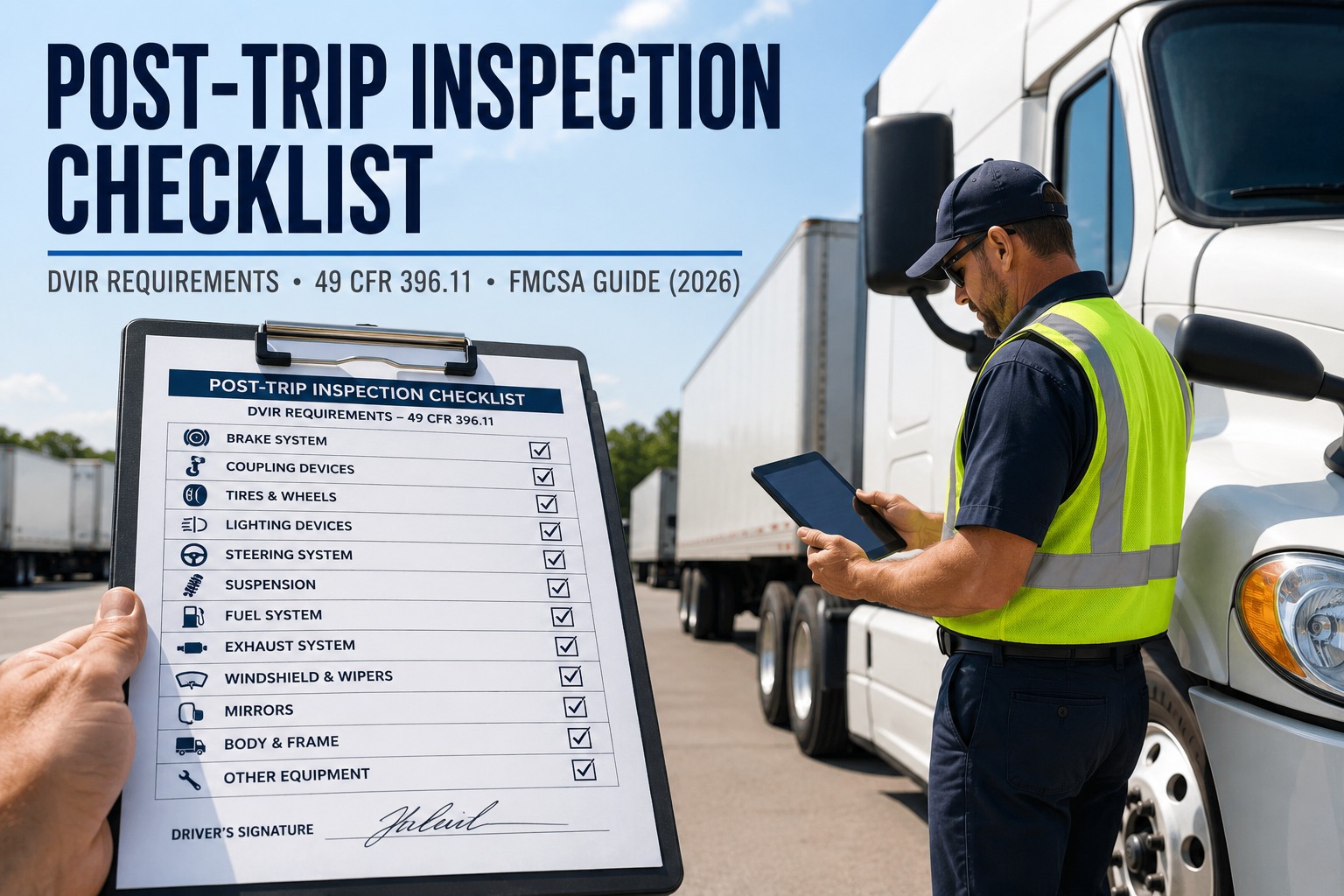
The 11 minimum categories in 396.11 apply to the whole combination, but they land differently on the power unit and the towed unit. Here's the Class 8 pre-trip split the way a driver actually walks it — tractor first, then across the coupling to the trailer. Post-trip mirrors it at day's end.
- Service & parking brakes, air system
- Steering & suspension
- Steer and drive tires, wheels & rims
- Lighting devices & reflectors
- Windshield, wipers & mirrors
- Horn & emergency equipment
- Engine, fluids, belts & leaks
- Fifth wheel (tractor side)
- Trailer brakes & adjustment
- Brake connections & glad hands
- Trailer tires, wheels & lug nuts
- Springs & suspension
- Lighting & reflective tape
- Landing gear operation
- King pin & upper coupler
- Cargo securement & doors
A driver operating an unfamiliar trailer from a drop-and-hook pool inherits its condition the moment it's coupled — which is exactly why the trailer half of this checklist is not optional even when the tractor is your own.
The Fifth Wheel: One Small Part, One Big Failurethe most safety-critical joint on the rig
Everything above is important. This one can kill people. The fifth-wheel coupling is the single joint holding an 80,000 lb combination together through braking, cornering, and impact — and when it fails, the trailer separates from the tractor. Under 49 CFR 393.70 it must prevent separation under maximum load and lock against inadvertent release. A visual glance doesn't cut it; the driver has to physically verify the jaw is fully latched.
Fifth-wheel violations account for a meaningful share of out-of-service placements every year despite the part being physically tiny — because inspectors know a coupling failure isn't a downtime event, it's a separation event. A 30-second latch check on the DVIR is the difference between catching wear in the yard and finding out on the interstate. Start free and make the fifth-wheel latch check a mandatory DVIR field
The Air-Brake Test Every Class 8 Driver Owesbrakes are the #1 reason trucks get parked
Brakes are the top out-of-service violation category at roadside, year after year — and on a Class 8 combination the threshold is brutal: just 20% of the brakes out of adjustment grounds the entire rig. The in-cab air-brake test is the check that catches it before an inspector does. It's a fixed sequence, and every CDL driver is scored on it.
- 1Governor cut-in / cut-outBuild pressure; governor should cut out around 120–135 PSI and cut back in around 100–115 PSI.
- 2Leak-down testEngine off, brakes released, wait one minute: pressure loss under 3 PSI on a combination. Repeat with brakes applied, same limit.
- 3Low-air warningFan the brakes down; the buzzer or light must activate before pressure drops below 55 PSI.
- 4Spring-brake pop-outKeep fanning down; the spring (parking) brakes must apply automatically at 20–45 PSI — the fail-safe.
- 5Applied & hold checksRebuild pressure, confirm the parking brake holds, and check slack-adjuster travel — excessive pushrod stroke is the single most common roadside brake failure.
None of this is exotic; it's the sequence every CDL holder learned for the skills test. Skipping it is how a $150 slack adjuster becomes a multi-thousand-dollar out-of-service order and a CSA hit. Book a demo to build the air-brake sequence into your guided pre-trip
The Roadside Realitywhat actually parks Class 8 trucks
Want to know where Class 8 inspection discipline pays off? Look at what enforcement finds. The Commercial Vehicle Safety Alliance runs a 72-hour International Roadcheck blitz each year, and the pattern is relentlessly consistent: the basics on the checklist above are exactly what grounds trucks.
Brakes lead, tires follow at around 21%, and lighting and coupling round out the repeat offenders — every one of them a DVIR item. An out-of-service order means a loaded semi parked on the shoulder, a missed delivery window, a CSA score hit that follows the carrier, and freight sitting still. The math on prevention isn't subtle: the daily walkaround is the cheapest insurance a Class 8 fleet buys.
Annual Inspection & Recordkeepingthe paper trail that survives an audit
Daily DVIRs are only one layer. Class 8 trucks carry a full stack of inspection records, each with its own cadence and retention window — and on a combination, both the tractor and each trailer need their own annual inspection.
Maintenance records under 49 CFR 396.3 are kept longer still. DVIR and coupling-device defects are among the most-cited violations in DOT audits, and inspection-and-maintenance penalties run well over $1,500 per day per violation — with the 2026 CSA changes weighting out-of-service violations even more heavily. Moving all of it to electronic records turns audit retrieval into a filtered search across the whole combination.
Paper vs Digital DVIRwhy the biggest fleets went digital first
Paper and digital DVIRs satisfy the same rule, but not the same risk — and Class 8 fleets, with the most units, the most inspection points, and the harshest roadside consequences, felt the gap first. The March 2026 clarification removed the last reason to stay on paper.
- Trailer defects lost in a glovebox stack
- No proof the prior DVIR was ever reviewed
- Fifth-wheel check reduced to a checkmark
- Audit prep means digging across units
- Uncertified defects roll out the gate
- Per-unit checklists, photo & time-stamped
- Prior-DVIR review enforced before dispatch
- Coupling defect locks the truck from service
- Audit prep is a filtered search
- Repair certification tracked to closure
This is where compliance becomes a cost story. A digital fleet inspection workflow turns each per-unit defect into a work order linked to that unit's history, enforces the prior-DVIR review, and holds a unit from dispatch until a critical defect is certified fixed — so the platform that keeps you compliant also prevents the coupling or brake failure a paper form would have buried.
From a safety director running an over-the-road fleet
The thing that kept me up wasn't the tractors — it was the trailers. We drop and hook constantly, so my drivers are coupling to equipment they've never seen, and the paper form basically trusted them to remember the fifth-wheel check on a cold morning at 4 a.m.
Going digital, the trailer inspection and the latch check are mandatory fields — the driver literally can't close the DVIR without them, and a defect locks the unit from dispatch. We caught a cracked fifth-wheel mount on a pool trailer in the first month. On paper that becomes a highway separation. That's not a compliance metric, that's people going home.
Class 8 truck DVIR requirements: the takeaway
Class 8 truck DVIR requirements come down to respecting that you're operating two machines joined at one critical point. The tractor, the trailer, and the coupling each have to pass; the brakes and the fifth wheel are where the real danger lives; and the records — daily, annual, and roadside — have to hold up across every unit. Handling that on paper across a fleet of tractors and trailers is a losing game. Done digitally, now fully sanctioned by FMCSA, compliance becomes a byproduct of the walkaround your drivers already do. Book a demo to see Class 8 combination DVIRs run end-to-end in HVI
Frequently asked questions
Does a Class 8 truck need a DVIR?
Yes. A Class 8 truck has a GVWR of 33,001 lb or more, far above the 10,001 lb threshold that defines a commercial motor vehicle under 49 CFR 390.5, so the Driver-Vehicle Inspection Report rules in 49 CFR 396.11 apply in full. The driver must inspect the vehicle and be satisfied it is safe before operating, and prepare a written, signed report at the end of the day whenever a defect that would affect safe operation or cause a breakdown is found. For a tractor-trailer combination, a single DVIR can cover both units, but any defect must be identified for each unit separately. Since the 2014 rule, property-carrying drivers are not required to file on no-defect days, though the inspection itself is still required, and drivers must review the previous DVIR before operating. As of the March 23, 2026 eDVIR final rule, these reports may be created, signed, and stored electronically.
Does a Class 8 truck require a CDL?
Yes. A Class 8 truck's GVWR of 33,001 lb or more is well above the 26,001 lb CDL threshold in 49 CFR 383.5, so a commercial driver's license is always required. A typical over-the-road tractor-trailer tows a trailer rated over 10,000 lb, which makes the combination a Class A CDL vehicle — the highest license classification. A heavy Class 8 straight truck operated without a trailer generally requires a Class B CDL. Class 8 operations also commonly require endorsements depending on the load: hazmat (H or X) for placarded materials, tanker (N) for bulk liquids, and doubles/triples (T) for multi-trailer combinations. These endorsements affect what the driver may haul but do not change the vehicle inspection and DVIR obligations, which apply to every Class 8 truck.
What is the GVWR of a Class 8 truck?
A Class 8 truck has a Gross Vehicle Weight Rating of 33,001 lb or more — the heaviest and top truck class. GVWR is the manufacturer's certified maximum loaded weight on the door-jamb sticker, not the truck's current scale weight. A fully loaded tractor-trailer can gross up to 80,000 lb on the interstate without an overweight permit. For context, Class 7 sits just below at 26,001 to 33,000 lb. Common Class 8 examples include over-the-road tractor-trailers, day-cab and sleeper semis, heavy dump trucks, cement mixers, and specialized haulers. Because Class 8 is routinely a combination vehicle — a tractor plus one or more trailers — the inspection picture covers a power unit, a towed unit, and the coupling system that joins them, each with its own DVIR considerations.
Can one DVIR cover both a tractor and its trailer?
Yes. FMCSA guidance allows a single Driver-Vehicle Inspection Report to cover a tractor-trailer combination, provided any defect is identified for each vehicle separately and the driver signs the report. This keeps the report practical for combination operations while preserving accountability for each unit's condition. However, if a driver operates more than one power unit during the day — for example, swapping tractors mid-shift — a separate report is required for each power unit. Trailers picked up through drop-and-hook from a pool or another carrier must still be inspected; once coupled, the trailer's safe condition is the operating driver's responsibility. Before operating, the driver must also review the previous DVIR for the equipment and confirm that any noted defect was repaired and certified. This driver-to-driver chain of custody is central to how the combination DVIR works.
What is inspected on a Class 8 fifth-wheel coupling?
The fifth-wheel coupling is the most safety-critical mechanical joint on a tractor-trailer, governed by 49 CFR 393.70. The driver must physically verify the jaw is fully latched on the king pin, the safety latch or lock bar is engaged, and any slider is locked with all pins seated — a visual glance is not enough. Under the CVSA North American Standard Out-of-Service Criteria, conditions that put the truck out of service include a gap over one-half inch between the king pin and the closed jaws (measured with a standard gauge), any loose or missing mounting bolt or nut, cracked or ineffective mounting including frame welds and brackets, and a lock that is not fully engaged. Because a coupling failure causes trailer separation rather than a simple breakdown, the fifth-wheel check is one of the highest-value items on the Class 8 pre-trip, and it should be a mandatory, documented step on every combination DVIR.
Run every Class 8 combination DVIR without touching a paper form
HVI inspects tractor and trailer as linked units, makes the fifth-wheel latch and air-brake checks mandatory fields, enforces the prior-DVIR review before dispatch, routes per-unit defects into tracked work orders, and keeps every record audit-ready — fully aligned with the March 2026 eDVIR rule. Compliance becomes a byproduct of the walkaround your drivers already do.
No credit card · No hardware · Combination DVIR ready on day one