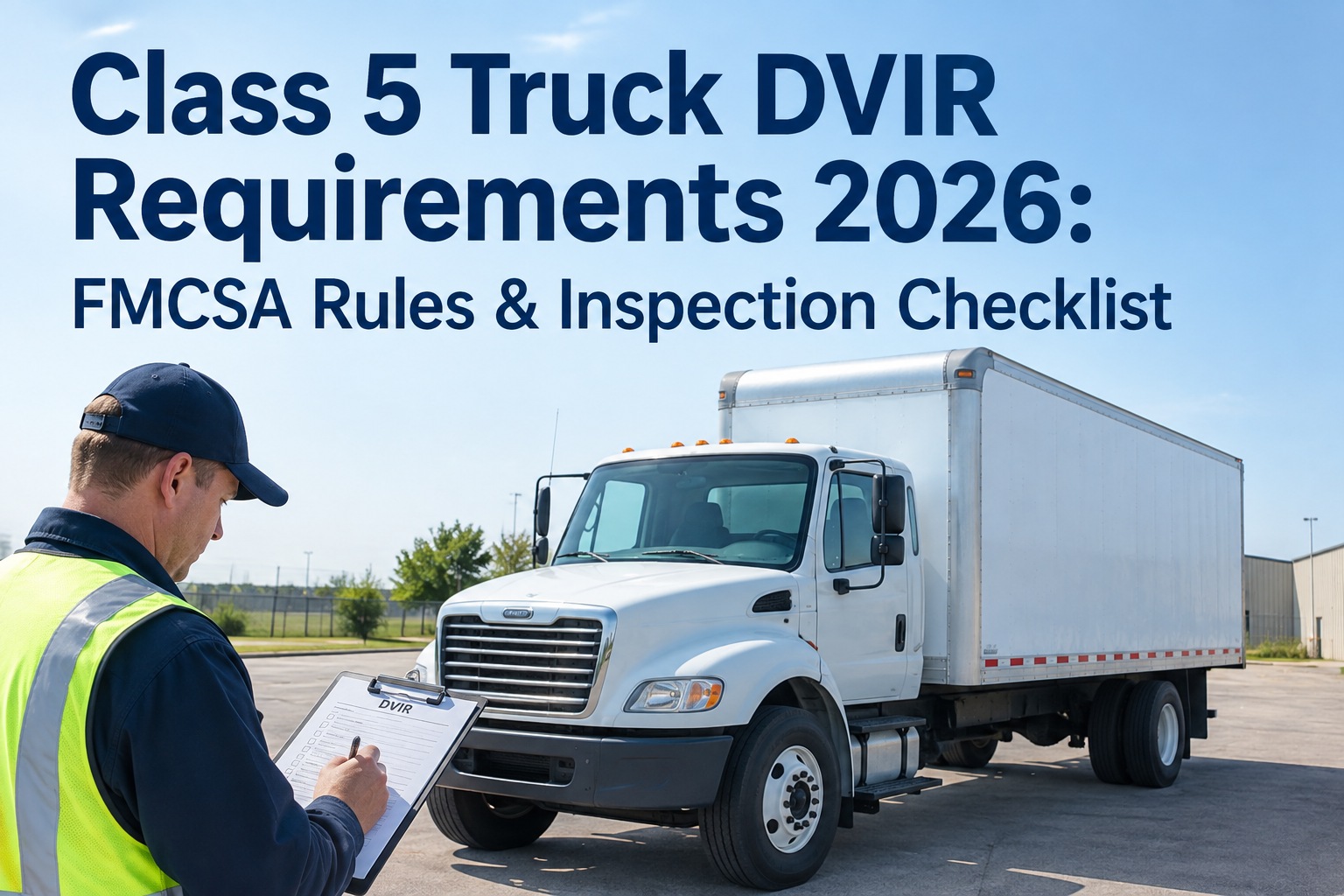
Here's the trap most Class 5 truck operators fall into: no CDL needed, so they assume no federal rules apply. That's exactly backwards. A Class 5 truck at 16,001 to 19,500 lb GVWR clears the FMCSA commercial vehicle line by a wide margin, which means Class 5 truck DVIR requirements are fully in play even when the driver holds an ordinary license. This guide untangles the three thresholds people constantly confuse, walks the exact inspection checklist, and shows what actually has to be documented. Book a demo once you see where your fleet stands.
The Three Weight Lines Every Class 5 Operator Confuses
Different weights trigger different obligations. Your truck can be "non-CDL" and still owe a full DVIR the same day. Here's where each line actually sits.
If you run box trucks, service trucks, utility bodies, or an upfitted F-550, this is your zone. The confusion is understandable — "commercial vehicle" and "CDL vehicle" sound like the same thing. They aren't, and the difference decides what you inspect, document, and keep on file every single day.
What Is a Class 5 Truck?the 16,001–19,500 lb GVWR workhorses
Class 5 is a GVWR classification, not a license class. Gross Vehicle Weight Rating is the maximum loaded weight the manufacturer certifies for the truck — the number on the door-jamb sticker, not what your scale reads today. Class 5 covers 16,001 to 19,500 lb GVWR, the medium-duty band where most vocational work trucks live.
The neighbors matter for context: Class 4 sits just below (14,001–16,000 lb), Class 6 just above (19,501–26,000 lb). All three are CMVs by weight, and all three fall under the same DVIR framework. The line that actually changes your license — CDL — doesn't arrive until 26,001 lb.
CDL vs CMVthe distinction that trips up every Class 5 fleet
This is the single most misunderstood point in medium-duty compliance, so it's worth being blunt about it. A commercial driver's license (CDL) and a commercial motor vehicle (CMV) are governed by two different regulations with two different weight lines. Under 49 CFR 383.5, the CDL requirement generally begins at 26,001 lb GVWR. Under 49 CFR 390.5, the CMV safety-rule definition begins at 10,001 lb GVWR. A Class 5 truck clears the second line and falls short of the first — so it's a CMV that does not require a CDL by weight.
- About who is allowed to drive
- Special license, testing, medical card
- Class 5 is below this line
- About how the truck is inspected & kept safe
- DVIR, maintenance records, periodic inspection
- Class 5 is well above this line
A quick caution: the CDL "by weight alone" answer flips if the truck is placarded for hazardous materials, is designed to carry enough passengers, or tows a trailer that pushes the combination over the line. And even a small trailer can matter — when the GVWR of the truck plus the trailer exceeds 10,001 lb, the combination is a CMV regardless of the truck alone. Start free and tag each unit with its correct compliance profile
Do Class 5 Trucks Need a DVIR?49 CFR 396.11, in plain English
Yes — a Class 5 truck operating as a CMV in interstate commerce falls under the Driver-Vehicle Inspection Report rules in 49 CFR 396.11. But the rule works differently than most people assume, and the 2014 update is where the confusion comes from. Here's the honest version, without the legalese.
Two practical notes. First, passenger-carrying CMVs still must file a DVIR every day regardless of defects — the no-defect waiver is for property carriers. Second, many carriers require a signed report every day anyway, defect or not, because a clean, dated trail is far easier to defend in an audit than a gap you have to explain. Book a demo to see the full defect-to-repair loop tracked automatically
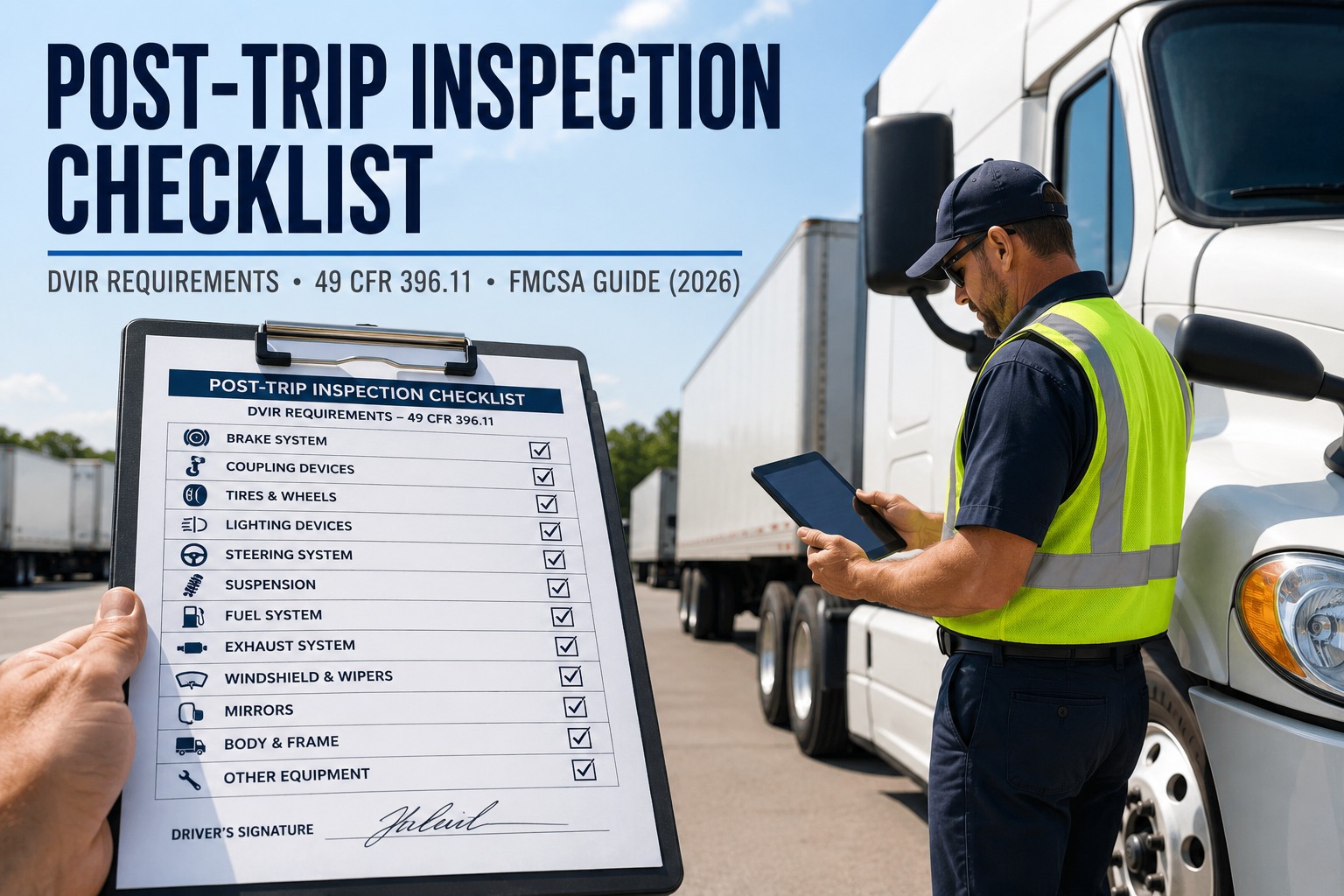
Class 5 Inspection Checklistthe 396.11 parts list, grouped for the walkaround
The regulation names a minimum list of parts and accessories a report must cover. That list is a floor, not a ceiling — carriers can and do add items. Here it is, grouped the way you'd actually walk the truck rather than the way the code prints it, so a Class 5 pre-trip inspection flows front-to-back in one pass.
- Service brakes & trailer brake connections
- Parking (hand) brake
- Steering mechanism
- Tires — tread, pressure, sidewall
- Wheels & rims
- Suspension components
- Lighting devices & reflectors
- Windshield wipers
- Rear-vision mirrors
- Horn
- Coupling devices (if towing)
- Frame & body condition
- Emergency equipment (triangles, extinguisher)
- Liftgate / crane / dump body function
- Any secondary hydraulic or PTO system
- Fluid levels & visible leaks
- Belts, hoses, exhaust
- Battery & connections
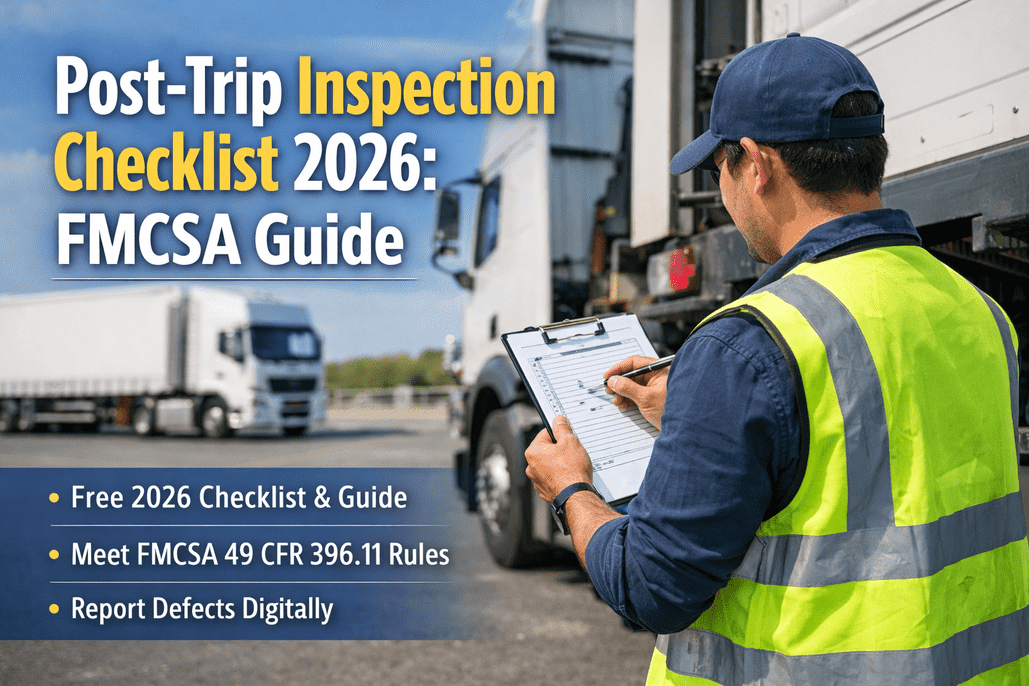
Post-trip mirrors pre-trip: the same points, walked at the end of the day, with anything that degraded during the shift written up so the next driver — or the morning tech — isn't blindsided. On upfitted Class 5 trucks the body-mounted equipment is where defects hide most, because a liftgate that cycles slow or a crane with a weeping cylinder passes a glance but fails under load. Book a demo to build custom checklist items for your specific upfits
Common Class 5 Defectswhere these trucks actually break
Class 5 trucks tend to fail in predictable places because of how they're used — lots of stop-and-go, heavy tail-end loads, and body equipment that gets cycled hundreds of times a day. Knowing the usual suspects makes the walkaround faster and the write-ups sharper.
None of these are exotic. They're the boring, repeat offenders that a disciplined daily inspection catches early and a rushed one lets grow into a roadside breakdown or a failed audit. The whole point of the DVIR is to surface item 4 before it strands a truck with a full load and a waiting customer.
Recordkeeping & Retentionwhat to keep, and for how long
Doing the inspection is only half the obligation. The paper trail is what an auditor actually reviews, and it's where paper-based fleets quietly fall apart — forms in glove boxes, coffee-stained carbons, gaps nobody can explain. Under 396.11 and 396.3, the documentation has a defined shape.
The regulation explicitly allows these reports to be created and kept in electronic format under 49 CFR 390.32 — which is exactly why forward-looking fleets stopped fighting paper years ago. The penalty math is sobering: FMCSA civil penalties for inspection and maintenance violations can run over $1,500 per day per violation, and repeated failures feed into a carrier's safety rating. Start free and keep every DVIR audit-ready from day one
Paper vs Digital DVIRwhy Class 5 fleets are switching
A paper DVIR and a digital one satisfy the same rule — but they don't carry the same risk. The difference shows up on the day you can least afford it: a roadside inspection, an audit request, or a defect that should have been caught but got buried in a stack of forms.
- Forms lost, smudged, or filled in the parking lot
- Defects sit until someone reads the sheet
- No proof the repair loop actually closed
- Audit prep = digging through boxes
- Easy to skip a day and never notice
- Checklist on the driver's phone, time-stamped
- Defect instantly becomes a work order
- Repair & certification tracked to closure
- Audit prep = a filtered search
- Missed inspections flag automatically
This is the part where the compliance story becomes a cost story. A digital fleet inspection workflow doesn't just file the report — it turns the defect into a work order, schedules the fix, and links the whole thing to the truck's maintenance history, so the same platform that keeps you compliant also cuts the downtime that quietly drains a medium-duty fleet's budget.
From a safety manager who runs a mixed non-CDL fleet
We got burned during an audit because half my guys thought "no CDL" meant "no DVIR." It doesn't. My Class 5 box trucks are CMVs, full stop, and the auditor didn't care that the drivers held regular licenses.
What actually fixed it wasn't a lecture — it was making the report impossible to skip. Now the checklist is on their phone, a bad liftgate becomes a work order before the truck leaves the yard, and I can pull ninety days of signed DVIRs in about thirty seconds. The lighting citations basically stopped.
Class 5 truck DVIR requirements: the takeaway
Class 5 truck DVIR requirements aren't a gray area once you separate the three weight lines. The trucks are commercial, the inspections are daily, and the records have to hold up. Handling that on paper is a slow, leaky process — handling it digitally turns compliance into a byproduct of work your drivers already do. Book a demo to see Class 5 DVIRs run end-to-end in HVI
Frequently asked questions
Does a Class 5 truck need a DVIR?
Yes. A Class 5 truck has a GVWR of 16,001 to 19,500 lb, which is well above the 10,001 lb threshold that defines a commercial motor vehicle under 49 CFR 390.5. That makes it subject to the Driver-Vehicle Inspection Report rules in 49 CFR 396.11 when operated as a CMV in interstate commerce. The driver must inspect the truck and be satisfied it is safe before operating it, and must prepare a written, signed report at the end of the day whenever a defect or deficiency is found that would affect safe operation or cause a breakdown. Since the 2014 DVIR rule, property-carrying CMV drivers are not required to file a report on days when no defect is found, but the daily inspection duty itself never went away, and passenger-carrying CMVs must still file every day. Many carriers require a signed report daily regardless, because a complete, dated trail is far easier to defend in an audit.
Does a Class 5 truck require a CDL?
By weight alone, no. The commercial driver's license requirement under 49 CFR 383.5 generally begins at 26,001 lb GVWR (or a combination over 26,001 lb where the towed unit exceeds 10,000 lb). A Class 5 truck tops out at 19,500 lb GVWR, so it sits below the CDL line and can typically be operated with an ordinary driver's license. Important exceptions can still trigger a CDL regardless of the truck's weight: transporting hazardous materials in quantities requiring placards, being designed to carry enough passengers, or towing a trailer that pushes the gross combination weight rating over the threshold. Remember that "no CDL required" does not mean "no rules apply" — the truck is still a commercial motor vehicle subject to FMCSA inspection, maintenance, and DVIR requirements.
What is the GVWR of a Class 5 truck?
A Class 5 truck has a Gross Vehicle Weight Rating between 16,001 and 19,500 lb. GVWR is the maximum loaded weight the manufacturer certifies for the vehicle — it is the rating on the door-jamb sticker, not the truck's current weight on a scale. For context, Class 4 sits just below at 14,001 to 16,000 lb, and Class 6 sits just above at 19,501 to 26,000 lb. Common Class 5 examples include heavier cab-and-chassis trucks in the F-550 range, larger box and straight trucks, service and utility trucks, and upfitted work trucks with liftgates, cranes, or dump bodies. Because the entire Class 5 band is above the 10,001 lb commercial-motor-vehicle threshold, every Class 5 truck operating in interstate commerce falls under FMCSA safety rules.
What are the FMCSA requirements for a Class 5 truck?
As a commercial motor vehicle, a Class 5 truck operating in interstate commerce is subject to the Federal Motor Carrier Safety Regulations covering inspection, repair, and maintenance in 49 CFR Part 396. The core obligations are: a daily pre-trip inspection so the driver is satisfied the vehicle is safe; a written Driver-Vehicle Inspection Report when a safety defect is found, signed by the driver; carrier repair and certification of any reported defect before the truck returns to service; systematic maintenance records under 396.3; and a documented periodic (annual) inspection under 396.17. The DVIR must cover a minimum list of parts and accessories including service brakes, parking brake, steering, lighting devices and reflectors, tires, wheels and rims, horn, windshield wipers, mirrors, coupling devices, and emergency equipment. Carriers may add items, such as liftgate or crane function on upfitted trucks. Records may be kept electronically under 49 CFR 390.32.
How long must Class 5 DVIR records be retained?
Driver-Vehicle Inspection Reports and the associated certification of repairs must generally be retained for three months from the date the report was prepared, kept where the vehicle is housed or maintained. Broader maintenance and repair records under 49 CFR 396.3 are kept for a longer period — while the vehicle is under the carrier's control and for a period after it leaves the fleet. The periodic (annual) inspection report under 396.17 should be retained on file as well. All of these records are explicitly permitted in electronic format under 49 CFR 390.32, which is why many fleets have moved off paper entirely: digital records eliminate lost forms, make retrieval during an audit a matter of seconds rather than hours, and automatically flag missed inspections before they become compliance gaps.
Run every Class 5 DVIR without touching a paper form
HVI puts the 396.11 checklist on every driver's phone, turns each reported defect into a tracked work order, certifies repairs before the truck rolls, and keeps every signed report audit-ready for the full retention window. Compliance becomes a byproduct of the walkaround your drivers already do — and your downtime and lighting citations drop along with the paperwork.
No credit card · No hardware · DVIR checklist ready on day one