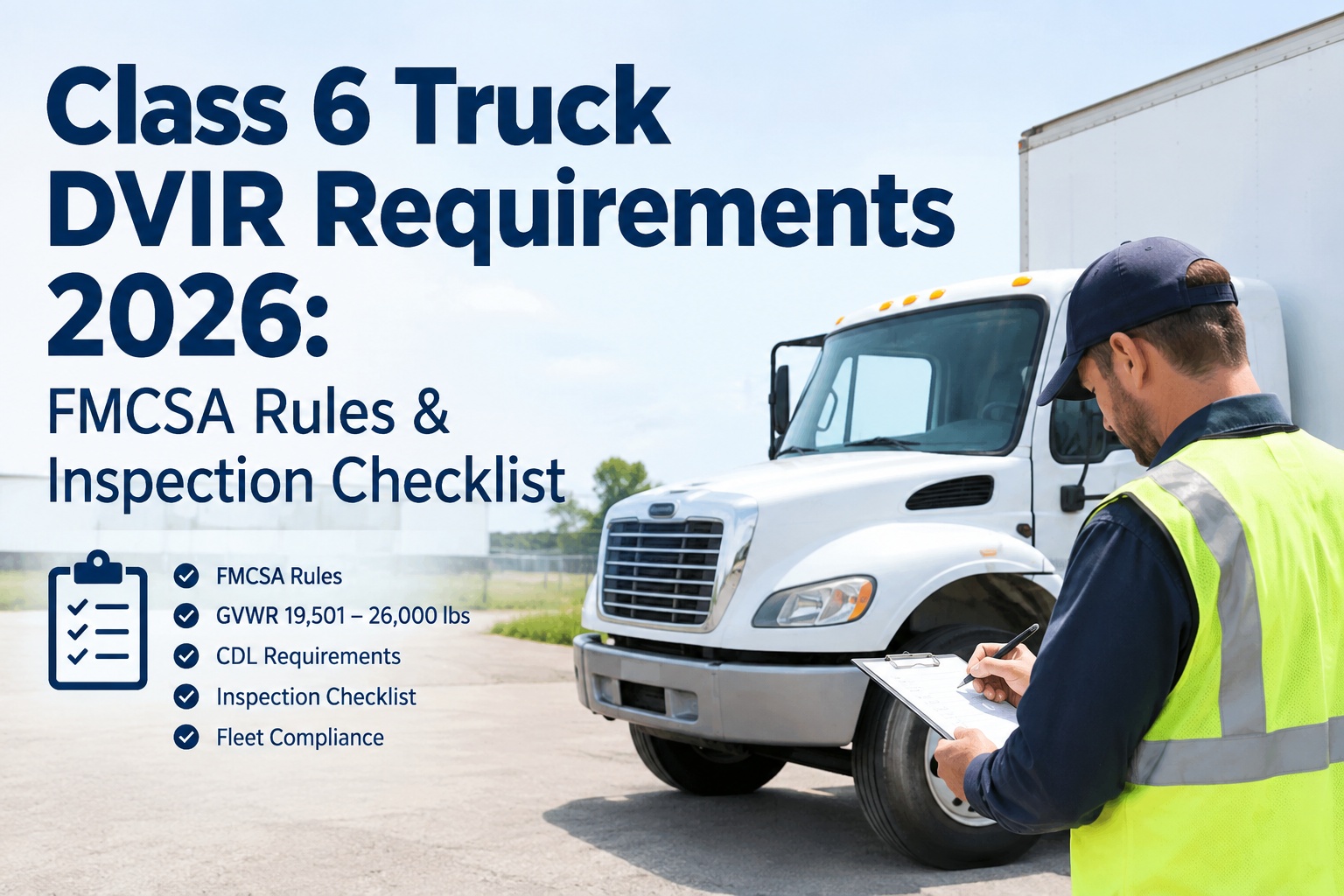
A Class 6 truck sits one pound under the CDL line — 26,000 lb GVWR, with the commercial license requirement starting at 26,001. That single pound is why Class 6 truck DVIR requirements confuse so many fleets: the truck feels "just under" the serious-regulation threshold, so drivers assume the daily inspection rules don't apply. They do. At 19,501 to 26,000 lb, a Class 6 delivery, dump, or refuse truck is squarely a commercial motor vehicle under FMCSA rules. This guide covers what to inspect, document, and keep — including the March 2026 eDVIR rule change. Book a demo to see it run.
Class 6 Lives on the Cliff Edge of the CDL Line
One pound of GVWR separates "no CDL needed" from "CDL required." But the inspection rules don't wait for that pound — they kicked in 9,500 lb earlier.
If you run box trucks, straight trucks, beverage routes, dump trucks, or refuse packers, this is your weight class — the busy middle of the medium-duty world. The trap is that Class 6 sits close enough to the CDL threshold that people treat "no CDL" as "no rules." The DVIR framework doesn't work that way, and the gap is exactly where roadside violations and failed audits come from.
What Is a Class 6 Truck?the 19,501–26,000 lb GVWR medium-duty core
Class 6 is a GVWR band, not a license category. Gross Vehicle Weight Rating is the maximum loaded weight the manufacturer certifies — the figure on the door-jamb sticker, not today's scale reading. Class 6 spans 19,501 to 26,000 lb, the heart of medium-duty. It's a broad, hard-working class, which is exactly why the inspection picture varies so much within it.
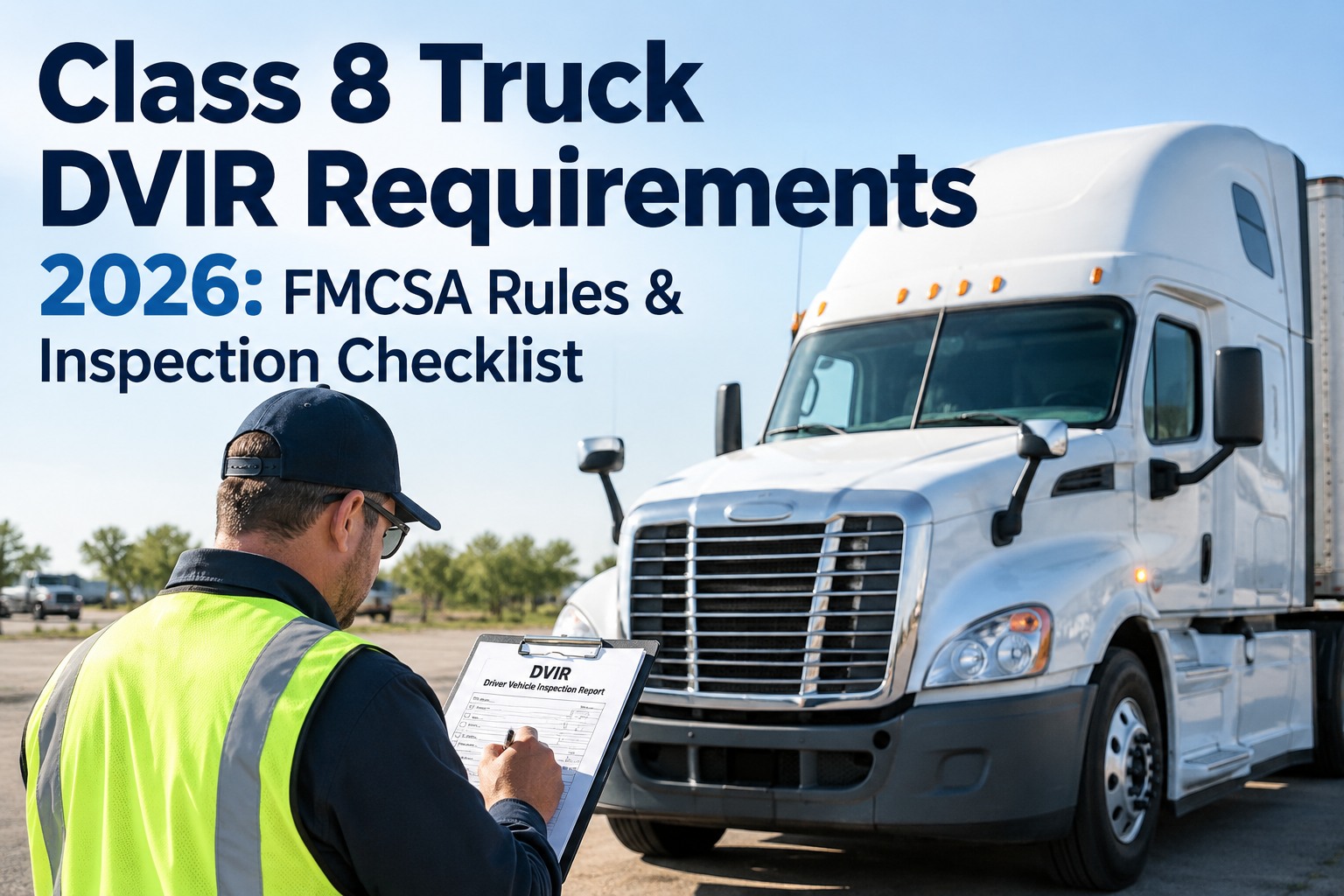
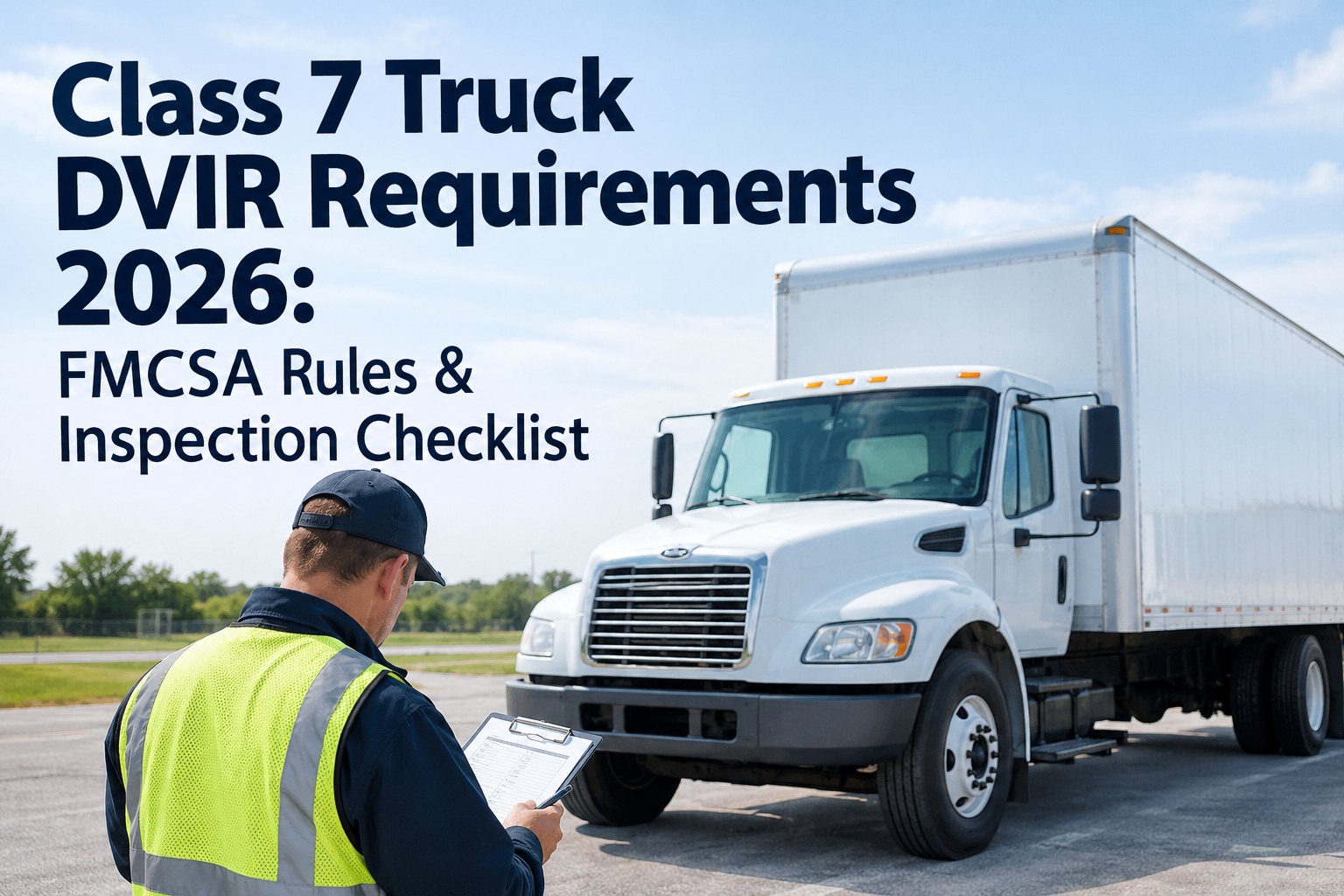
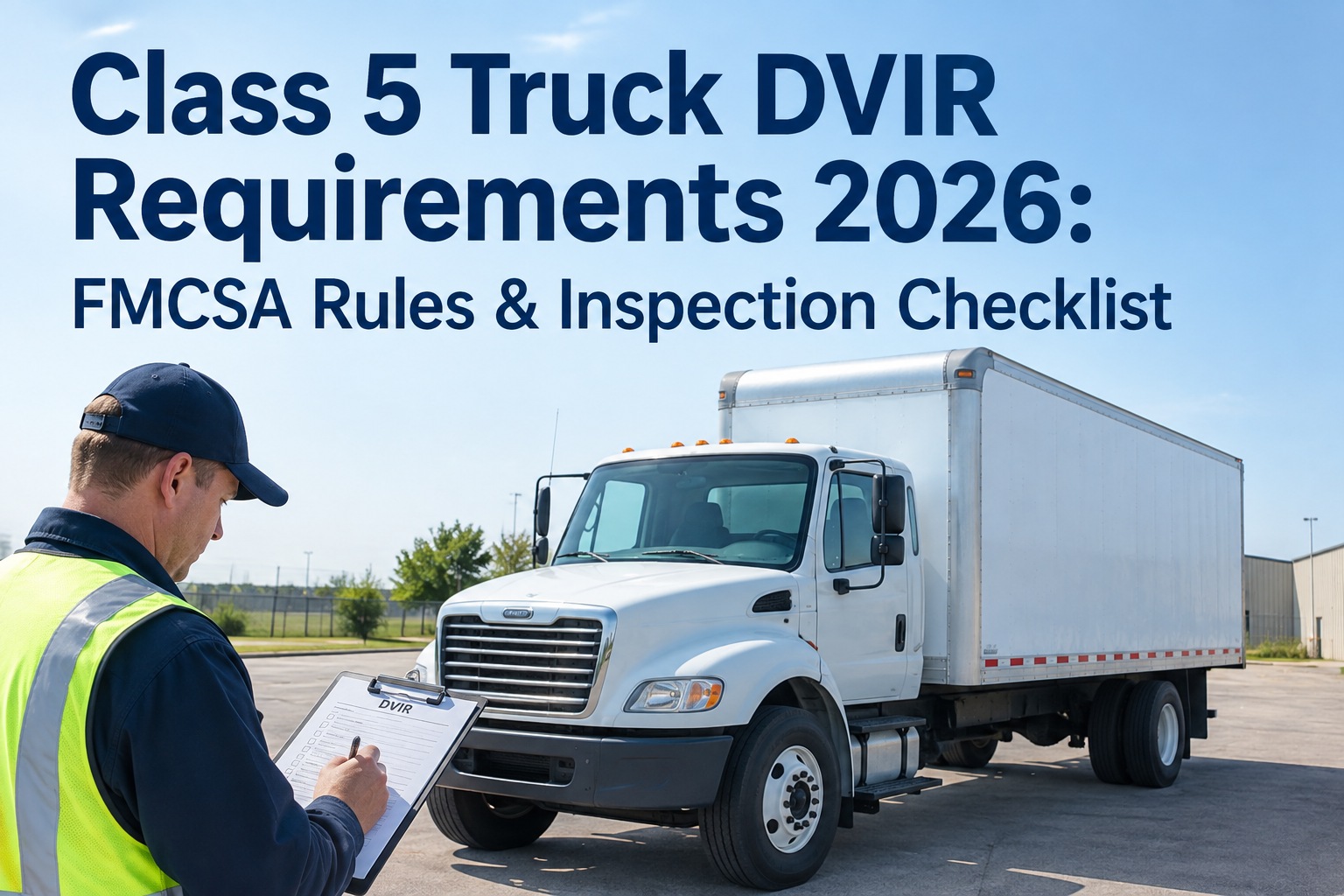
The neighbors set the boundaries: Class 5 sits just below at 16,001–19,500 lb, and Class 7 begins at 26,001 lb — which is also where the CDL requirement typically starts. Class 6 is the last stop before that line. Book a demo to profile each body type with its own inspection template
Does a Class 6 Truck Require a CDL?the cliff edge, the air-brake myth, and the towing trap
By weight alone, usually not — but Class 6 is where "usually" earns its caveats, because the truck sits right against the line. Under 49 CFR 383.5, the CDL requirement generally begins at 26,001 lb GVWR. A Class 6 truck tops out at 26,000 lb, one pound under, so a straight Class 6 truck can typically be driven on an ordinary license. Three things routinely flip that answer, and Class 6 operators hit all three more than any other class.
Here's the part that matters most, stated plainly: none of this changes the inspection obligation. Whether a Class 6 truck needs a CDL or not, it is a commercial motor vehicle under 49 CFR 390.5 the moment it clears 10,001 lb — which every Class 6 truck does by at least 9,500 lb. "No CDL required" and "no DVIR required" are two completely different questions with two completely different answers. Start free and tag each unit with its correct license and inspection profile
Do Class 6 Trucks Require a DVIR?49 CFR 396.11, and the March 2026 update
Yes. A Class 6 truck operating as a CMV in interstate commerce falls under the Driver-Vehicle Inspection Report rules in 49 CFR 396.11. The mechanics trip people up, though — especially after the 2014 rule change and the brand-new 2026 clarification. Here's the honest, current version.
That 2026 rule is worth understanding correctly, because there's a lot of noise about it. Electronic DVIRs were already permissible under 49 CFR 390.32 back to 2018 — the new rule simply removes the last grey area by writing eDVIR language directly into the inspection sections. Paper stays legal; FMCSA just made the digital path fully sanctioned and encouraged it as the cost-saving route. Book a demo to see a fully compliant electronic DVIR chain end to end
Class 6 Inspection Checklistthe 396.11 core, walked front to back
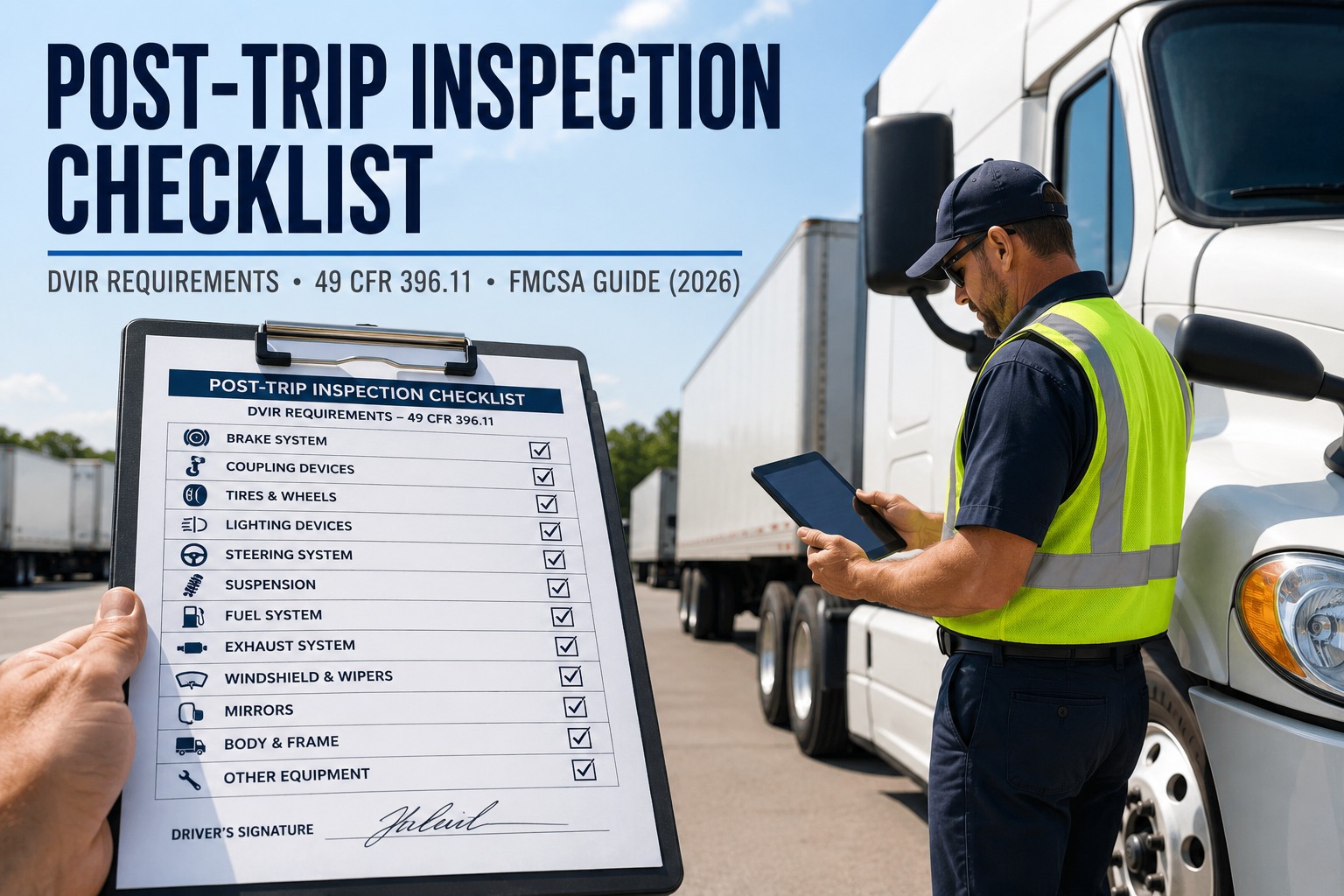
The regulation names a minimum list of parts a report must cover — a floor, not a ceiling. This is the Class 6 pre-trip base for every truck in the class, grouped the way you'd actually walk it. Post-trip mirrors it at day's end.
- Service brakes & connections
- Air-brake system (if equipped)
- Parking brake & steering
- Tires — tread, pressure, sidewall
- Wheels & rims
- Suspension components
- Lighting devices & reflectors
- Windshield wipers
- Rear-vision mirrors
- Horn
- Coupling devices (if towing)
- Frame & body condition
- Warning triangles / flares
- Fire extinguisher
- Spare fuses
- Fluid levels & visible leaks
- Belts, hoses, exhaust
- Battery & connections
Body-Specific Inspection Itemswhere delivery, dump, and refuse trucks diverge
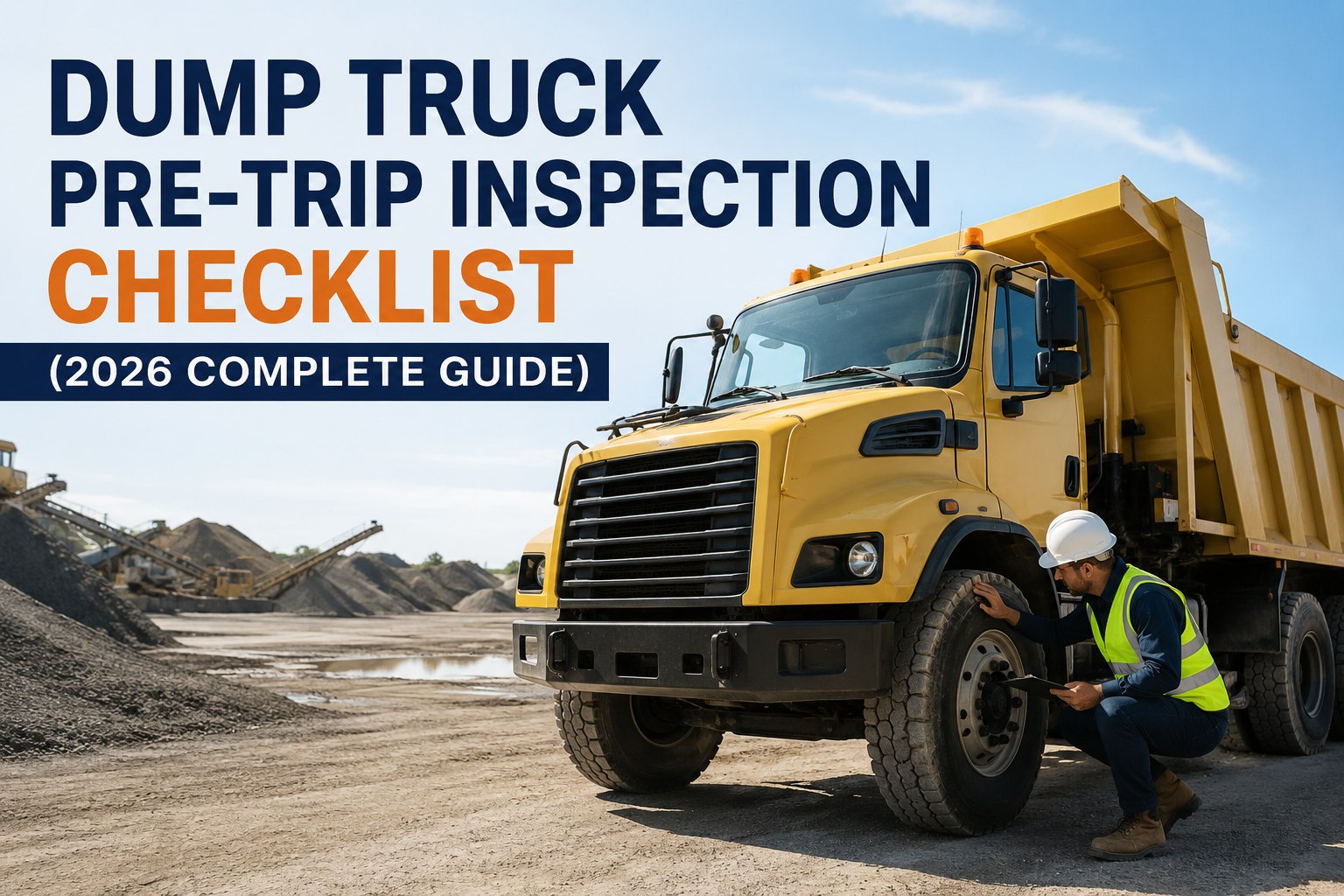
This is what makes Class 6 different from a one-size checklist: the same weight class contains wildly different machines. A generic DVIR covers the truck. It doesn't cover the body equipment that fails most — and on a dump or refuse truck, that equipment is what hurts people. These items get added on top of the core list.
- Liftgate cycle, cables & hydraulics
- Roll-up / swing door tracks & latches
- Cargo tie-downs & load bars
- Step & grab-handle integrity
- Hoist cylinders — leaks, rod scoring, mounts
- Hydraulic hoses & fittings for chafe/weep
- PTO engagement & indicator
- Tailgate latch & body up-limit / prop
- Packer / blade hydraulics & hoses
- Tipper or side-arm cylinders
- Back-up alarm & camera
- Body pins, latches & safety props
On a dump truck, the body up-limit cable and safety prop aren't paperwork items — they're what stops a raised bed from over-extending or dropping. A frayed cable or a hydraulic hose weeping at 3,000+ PSI is a critical defect that pulls the truck from service, and it's exactly what a rushed walkaround skips past. Custom checklist items per body type turn "we inspected the truck" into "we inspected the thing that actually fails."
Common Class 6 Defectswhere these trucks break under real duty cycles
Class 6 trucks fail in patterns shaped by how hard they work — heavy loads, constant stop-and-go, hydraulic bodies cycling all day. Knowing the repeat offenders makes the walkaround faster.
According to CVSA roadside data, a large share of vehicles pulled from service in an inspection blitz are flagged for defects a proper pre-trip would have caught — brakes and lighting lead the list year after year. None of these are exotic; they're the boring, repeat items a disciplined daily inspection catches before they strand a loaded truck.
Recordkeeping & Retentionwhat to keep, and for how long
Running the inspection is half the obligation; the record is the half an auditor actually reviews. Under Part 396, the documentation has a defined shape — and as of March 2026, keeping all of it electronically is explicitly sanctioned.
DVIR-related violations are among the most frequently cited in DOT audits, and penalties for inspection and maintenance failures can run well over $1,500 per day per violation, with repeat failures dragging down a carrier's safety rating. The point of moving these records off paper is that audit retrieval becomes a filtered search instead of a box-digging exercise. Start free and keep every Class 6 DVIR audit-ready from day one
Paper vs Digital DVIRwhy the 2026 rule tips the scale
Paper and digital DVIRs satisfy the same regulation — but they don't carry the same risk, and the March 2026 clarification removed the last excuse to stay on paper. The difference shows up on the day you can least afford it: a roadside stop, an audit request, or a body defect that got buried in a stack of forms.
- Forms lost, smudged, or filled in the lot
- Defects sit until someone reads the sheet
- No proof the repair loop actually closed
- Audit prep means digging through boxes
- A skipped day goes unnoticed
- Checklist on the phone, time-stamped
- Defect instantly becomes a work order
- Repair & certification tracked to closure
- Audit prep is a filtered search
- Missed inspections flag automatically
This is where compliance becomes a cost story. A digital fleet inspection workflow doesn't just file the report — it turns the defect into a work order, schedules the fix, and links it to the truck's maintenance history, so the same platform that keeps you compliant also cuts the downtime that quietly drains a medium-duty fleet's budget. With eDVIRs now explicitly authorized, the digital path isn't a grey area — it's the sanctioned one.
From a fleet manager running mixed Class 6 body types
My headache was that "Class 6" means five different trucks. My delivery boxes, my dumps, and my packer all need different eyes on them, but everybody was using the same generic paper form — so the dump-body cable checks just quietly didn't happen.
Going digital let me build a template per body type. Now the dump drivers physically can't close the inspection without answering the hoist and up-limit questions. We caught two frayed cables in the first month that the old form would never have surfaced. That's not a compliance win, that's a nobody-got-hurt win.
Class 6 truck DVIR requirements: the takeaway
Class 6 truck DVIR requirements come down to one clean idea: the license question and the inspection question are separate, and Class 6 clears the inspection bar with room to spare. The trucks are commercial, the inspections are daily, the body equipment needs its own eyes, and the records have to hold up. Doing that on paper is slow and leaky — doing it digitally, now fully sanctioned by FMCSA, turns compliance into a byproduct of the walkaround your drivers already do. Book a demo to see Class 6 DVIRs run end-to-end in HVI
Frequently asked questions
Does a Class 6 truck need a DVIR?
Yes. A Class 6 truck has a GVWR of 19,501 to 26,000 lb, far above the 10,001 lb threshold that defines a commercial motor vehicle under 49 CFR 390.5, making it subject to the Driver-Vehicle Inspection Report rules in 49 CFR 396.11 when operated as a CMV in interstate commerce. The driver must inspect the truck and be satisfied it is safe before operating it, and must prepare a written, signed report at the end of the day whenever a defect that would affect safe operation or cause a breakdown is found. Since the 2014 rule, property-carrying CMV drivers are not required to file a report on no-defect days, though passenger-carrying CMVs still must file every day, and many carriers require a signed report daily regardless because a complete dated trail is far easier to defend in an audit. As of March 23, 2026, FMCSA's eDVIR final rule explicitly permits these reports to be created, signed, and stored electronically.
Does a Class 6 truck require a CDL?
By weight alone, usually not. The CDL requirement under 49 CFR 383.5 generally begins at 26,001 lb GVWR, and a Class 6 truck tops out at exactly 26,000 lb — one pound under the line — so a straight Class 6 truck can typically be operated on an ordinary driver's license. Three situations commonly flip that: towing a trailer that pushes the gross combination weight rating over 26,001 lb (which can trigger a Class A CDL), hauling placardable hazardous materials, or a vehicle designed to carry enough passengers. One persistent myth to ignore: air brakes alone do not require a CDL on a vehicle under 26,001 lb, because there is no separate federal air-brake endorsement for non-CDL vehicles. Importantly, whether or not a CDL is required, a Class 6 truck is still a commercial motor vehicle subject to FMCSA inspection, maintenance, and DVIR requirements.
What is the GVWR of a Class 6 truck?
A Class 6 truck has a Gross Vehicle Weight Rating between 19,501 and 26,000 lb. GVWR is the maximum loaded weight the manufacturer certifies for the vehicle — the rating on the door-jamb sticker, not the truck's current weight on a scale. For context, Class 5 sits just below at 16,001 to 19,500 lb, and Class 7 begins just above at 26,001 lb, which is also where the CDL requirement typically starts. Common Class 6 examples include delivery and box trucks, beverage trucks, single-axle dump trucks, and refuse and specialty trucks. Because the entire Class 6 band is above the 10,001 lb commercial-motor-vehicle threshold, every Class 6 truck operating in interstate commerce falls under FMCSA safety rules including daily inspections and DVIRs.
What are the FMCSA requirements for Class 6 trucks?
As a commercial motor vehicle in interstate commerce, a Class 6 truck is subject to 49 CFR Part 396 covering inspection, repair, and maintenance. Core obligations: a daily pre-trip inspection so the driver is satisfied the vehicle is safe; a written, signed DVIR when a safety defect is found; carrier repair and certification of reported defects before the truck returns to service; systematic maintenance records under 396.3; and a documented periodic annual inspection under 396.17, performed by a qualified inspector under 396.19. The DVIR must cover a minimum list of parts including service brakes, parking brake, steering, lighting devices and reflectors, tires, wheels and rims, horn, windshield wipers, mirrors, coupling devices, and emergency equipment. Carriers should add body-specific items such as hydraulic hoist, PTO, tailgate latch, and back-up alarm on dump and refuse trucks. Records may be kept electronically, and the March 2026 eDVIR rule explicitly confirms digital DVIRs are compliant.
How long must Class 6 DVIR records be retained?
Driver-Vehicle Inspection Reports and the associated certification of repairs must generally be retained for three months from the date the report was prepared, kept where the vehicle is housed. Broader maintenance and repair records under 49 CFR 396.3 are kept for a longer period — while the vehicle is under the carrier's control and for a period after it leaves the fleet. The periodic annual inspection report under 396.17 should also be retained on file and kept in the vehicle. All of these records are permitted in electronic format under 49 CFR 390.32, and as of the March 23, 2026 eDVIR final rule, electronic creation, signature, and storage of DVIRs are explicitly authorized. Digital records eliminate lost forms, make audit retrieval a matter of seconds, and automatically flag missed inspections before they become compliance gaps.
Run every Class 6 DVIR without touching a paper form
HVI puts the 396.11 checklist on every driver's phone, adds body-specific items for delivery, dump, and refuse trucks, turns each reported defect into a tracked work order, certifies repairs before the truck rolls, and keeps every signed report audit-ready — fully aligned with the March 2026 eDVIR rule. Compliance becomes a byproduct of the walkaround your drivers already do.
No credit card · No hardware · eDVIR-ready on day one