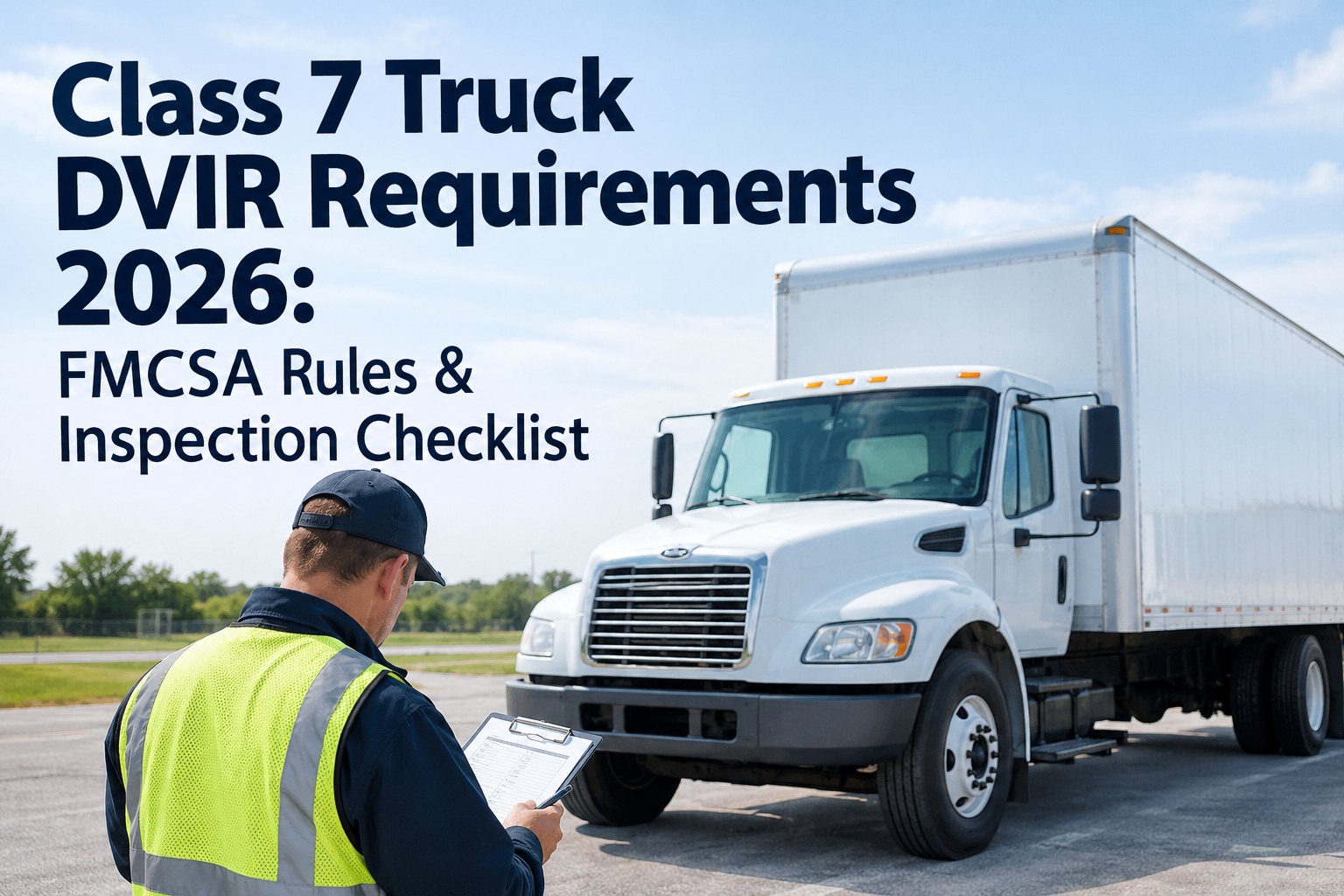
Class 7 is where the rules flip. From Class 6 down, "no CDL needed" was the usual answer. At Class 7 — 26,001 to 33,000 lb GVWR — you've crossed the federal CDL line, so a commercial license is typically required, and the inspection rules already in force get more teeth. Class 7 truck DVIR requirements land in a class where the license question and the inspection question finally point the same way: yes to both. Book a demo to see it run.
Class 7 Is Where the CDL Line Flips On
Lighter classes were commercial vehicles that usually didn't need a CDL. Class 7 is the first class where the license requirement typically switches on — and the inspection duty was already there.
If you run heavy straight trucks — tandem dumps, roll-offs, ready-mix mixers, big delivery and specialty rigs — this is your class. It carries the most demanding vocational bodies on the road, which is why the inspection stakes climb here: heavier loads, harder-working equipment, and a driver who now almost always holds a CDL that's on the line too.
What Is a Class 7 Truck?the 26,001–33,000 lb GVWR heavy-vocational tier
Class 7 is a GVWR band, not a license class — though at this weight the two finally overlap. GVWR is the manufacturer's certified maximum loaded weight (the door-jamb figure, not today's scale reading). Class 7 spans 26,001 to 33,000 lb — three-axle vocational trucks doing the heaviest work a straight chassis can handle.
Class 7 is the heavy-duty straight-truck sweet spot — the last tier before the tractor-trailers of Class 8, and the first where the CDL requirement has, in most cases, arrived.
Does a Class 7 Truck Require a CDL?yes, usually — and now the class of CDL matters
This is the reversal from the lighter classes. Under 49 CFR 383.5, the CDL requirement generally begins at 26,001 lb GVWR — precisely where Class 7 starts. So the default answer flips to yes: operating a Class 7 truck typically requires a commercial license. And that opens a question that never mattered before — which class of CDL.
A single heavy straight truck of 26,001 lb or more — a dump, roll-off, or mixer with no heavy trailer — generally calls for a Class B CDL.
Add a trailer over 10,000 lb GVWR to a combination rated 26,001 lb or more, and you're into Class A CDL territory for the whole rig.
Two things trip up Class 7 fleets. There is no separate federal "air-brake endorsement" — air brakes are a CDL restriction removed by testing in an air-brake truck, not an add-on. And crossing 26,000 lb GVWR flips on obligations unrelated to your license: a Class 7 truck is a "qualified motor vehicle" for IFTA fuel-tax reporting. Start free and tag each unit with its CDL class and endorsement profile
Do Class 7 Trucks Require a DVIR?49 CFR 396.11, and the March 2026 eDVIR rule
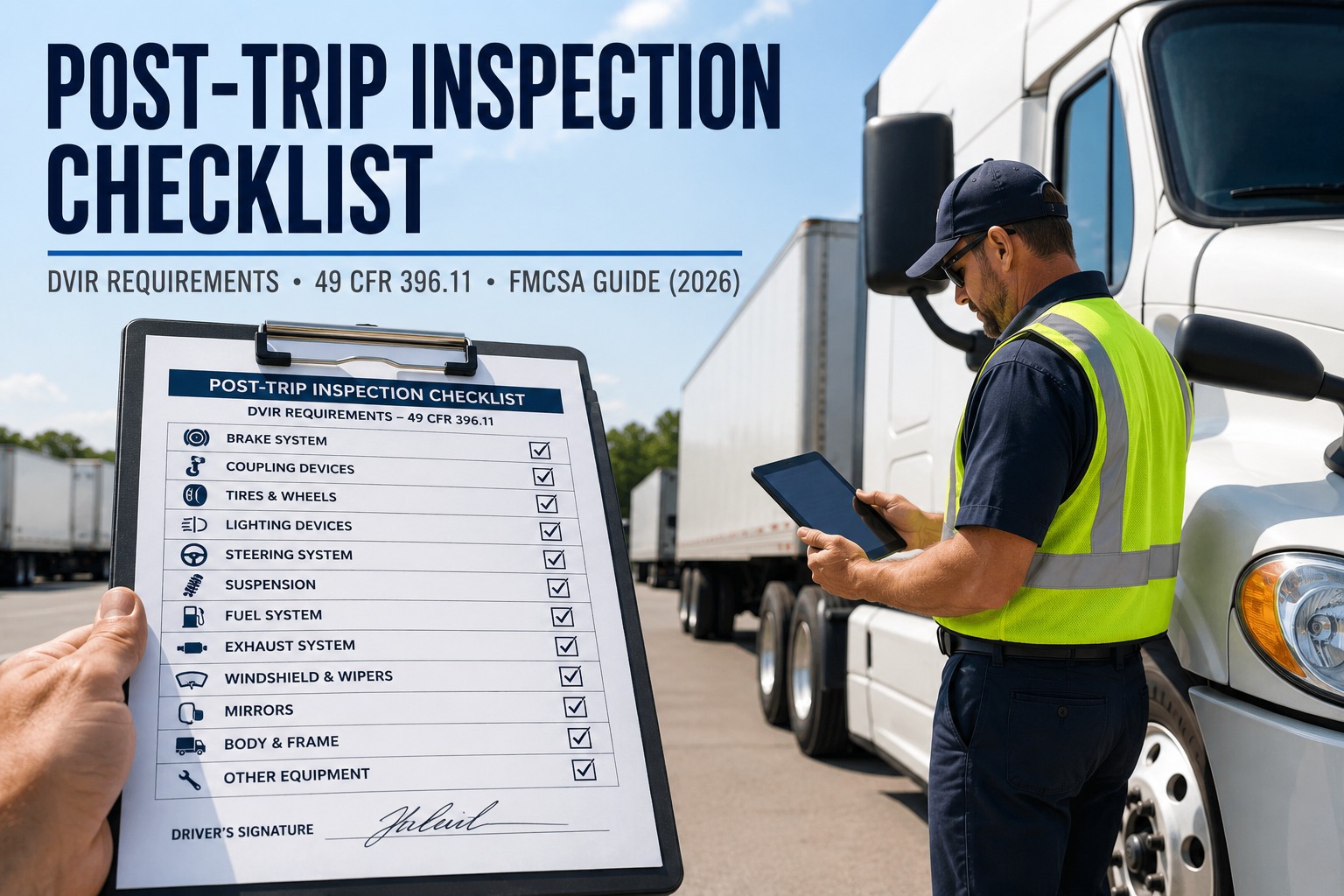
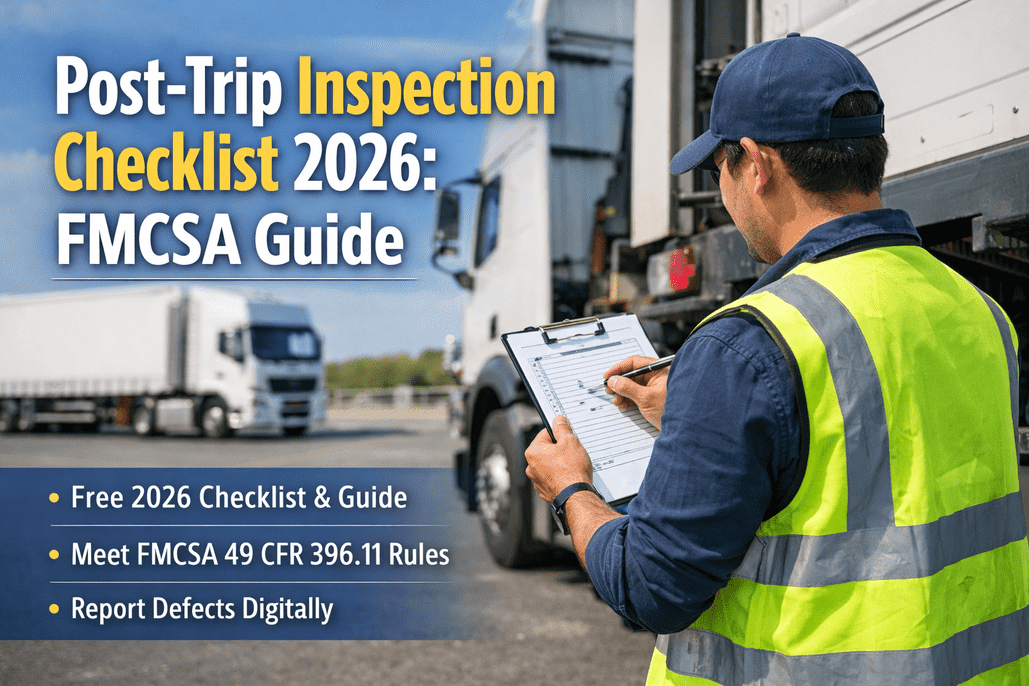
Yes. The DVIR obligation isn't the surprise it can be on lighter trucks — a Class 7 driver already holds a CDL and knows the vehicle is commercial. What trips people up is when a written report is required, shown below.
One clarification on that 2026 rule: eDVIRs were already permissible under 49 CFR 390.32 since 2018 — the new language just removes the last grey area. Paper stays legal, but on heavy vocational trucks where a single missed defect can be catastrophic, the sanctioned digital path is the safer one. Book a demo to see a compliant electronic DVIR chain end to end
Class 7 Inspection Checklistthe 396.11 core, plus what heavy weight demands
The regulation names a minimum list of parts a report must cover — a floor, not a ceiling. This is the Class 7 pre-trip base, grouped the way you'd actually walk it. On heavy vocational trucks the brake and tire items carry extra weight, literally: a loaded three-axle truck stresses them far harder than a light van.
- Air build-up & governor cut-out
- Low-air warning & brake adjustment
- Parking brake hold under load
- Tread depth & inflation to spec
- Lug torque & rust-streak check
- Sidewall damage on every axle
- Steering play & linkage
- Springs, hangers, U-bolts
- Air-ride bags (if equipped)
- Lighting devices & reflectors
- Windshield wipers
- Rear-vision mirrors
- Horn
- Coupling devices (if towing)
- Frame & cross-members
- Warning triangles / flares
- Fire extinguisher
- Spare fuses
The two highlighted categories carry real risk at Class 7 weights — and the roadside data in the next section shows exactly why.
Why the Basics Decide Everythingwhat roadside inspectors actually pull trucks for
Want to know where Class 7 inspections really matter? Look at what puts trucks out of service. The Commercial Vehicle Safety Alliance's annual 72-hour Roadcheck blitz shows the pattern never changes — the boring items on the checklist above are the ones that ground trucks.
Brakes and tires — the two highlighted checklist items — top the list year after year, and hit hardest on heavy trucks at rated load. Operating without the proper CDL was also among the most-cited violations, a direct risk for Class 7 fleets where the license requirement just switched on. An out-of-service order means a loaded dump parked on the shoulder and a CSA hit that follows the carrier. Book a demo to catch brake and tire defects before the roadside does
Body-Specific Inspection Itemsdump, roll-off, and ready-mix each add their own
This is what makes Class 7 unforgiving of a one-size checklist: the vocational bodies here are heavy, hydraulic, and dangerous when they fail. A generic DVIR covers the chassis. It doesn't cover the drum, the hoist cable, or the packer — and on these trucks that equipment causes the worst incidents. These items stack on top of the core list.
- Hoist cylinders — leaks, rod scoring
- Hydraulic hoses & fittings
- PTO engagement & indicator
- Tailgate latch, body up-limit & prop
- Hoist cable / wire rope & sheaves
- Cable tracking on drum
- Test through full range under load
- Container hooks, rails & pins
- Drum — cracks, dents, heat marks
- Rotation smooth, no grinding
- Chutes, fins & water system
- Drum hydraulics & PTO
The roll-off card is highlighted for a reason: the hoist cable is a life-safety component. OSHA requires an annual thorough wire-rope and hoist inspection by a qualified person, documented separately from the FMCSA annual — a frayed cable at full extension under a loaded container is the failure that makes headlines.
Recordkeeping & RetentionFMCSA plus the OSHA wire-rope layer
Maintenance records under 49 CFR 396.3 are kept longer still. DVIR violations are among the most-cited in DOT audits, with penalties running well over $1,500 per day per violation — and moving it all off paper turns audit retrieval into a filtered search. Start free and keep every Class 7 DVIR and annual record audit-ready
Paper vs Digital DVIRwhy heavy fleets went digital first
- Forms lost, smudged, or filled in the lot
- A frayed cable note sits until someone reads it
- No proof the repair loop actually closed
- Audit prep means digging through boxes
- A skipped inspection goes unnoticed
- Checklist on the phone, photo & time-stamped
- Critical defect instantly becomes a work order
- Repair & certification tracked to closure
- Audit prep is a filtered search
- Missed inspections flag automatically
Here compliance becomes a cost and safety story at once. A digital fleet inspection workflow turns each defect into a work order linked to the truck's history — so the platform that keeps you compliant also prevents the hoist or brake failure a paper form would have buried.
From a safety director running a heavy vocational fleet
My drivers all have CDLs, so the license side was never my worry — it was the bodies. A mixer drum and a roll-off cable don't fail like a headlight fails. When they go, someone can get hurt or a container comes off in traffic.
The paper form treated my dump, my mixer, and my roll-off like the same truck. Going digital let me build a real per-body checklist, with the wire-rope check as a can't-skip field on the roll-offs. We caught a cable starting to fray at the sheave that would've been the next incident. That one catch paid for the whole system.
Class 7 truck DVIR requirements: the takeaway
Class 7 truck DVIR requirements land in a class where nothing is ambiguous: the trucks are commercial, the driver holds a CDL, the inspections are daily, the vocational bodies need their own eyes, and the records — FMCSA and OSHA both — have to hold up. On paper across dumps, mixers, and roll-offs that's a losing game; done digitally, now fully sanctioned by FMCSA, compliance becomes a byproduct of the walkaround your drivers already do. Book a demo to see Class 7 DVIRs run end-to-end in HVI
Frequently asked questions
Does a Class 7 truck need a DVIR?
Yes. A Class 7 truck has a GVWR of 26,001 to 33,000 lb, far above the 10,001 lb threshold that defines a commercial motor vehicle under 49 CFR 390.5, so it is subject to the Driver-Vehicle Inspection Report rules in 49 CFR 396.11 when operated as a CMV in interstate commerce. The driver must inspect the truck and be satisfied it is safe before operating it, and must prepare a written, signed report at the end of the day whenever a defect that would affect safe operation or cause a breakdown is found. Since the 2014 rule, property-carrying CMV drivers are not required to file a report on no-defect days, though passenger-carrying CMVs still file daily and many carriers require a signed report daily regardless. As of March 23, 2026, FMCSA's eDVIR final rule explicitly permits these reports to be created, signed, and stored electronically. On heavy vocational trucks, carriers should add body-specific items for dump, roll-off, and ready-mix equipment.
Does a Class 7 truck require a CDL?
Usually yes. The CDL requirement under 49 CFR 383.5 generally begins at 26,001 lb GVWR, which is exactly where Class 7 starts, so operating a Class 7 truck typically requires a commercial driver's license — unlike lighter classes where a CDL often is not needed by weight. A single heavy straight truck such as a dump, roll-off, or mixer generally calls for a Class B CDL. If the truck tows a trailer over 10,000 lb GVWR in a combination rated 26,001 lb or more, it moves into Class A CDL territory. There is no separate federal air-brake endorsement; air brakes are handled as a CDL restriction removed by testing in an air-brake-equipped vehicle. Hazmat and passenger operations trigger their own endorsements regardless of weight.
What is the GVWR of a Class 7 truck?
A Class 7 truck has a Gross Vehicle Weight Rating between 26,001 and 33,000 lb. GVWR is the maximum loaded weight the manufacturer certifies for the vehicle — the rating on the door-jamb sticker, not the truck's current weight on a scale. For context, Class 6 sits just below at 19,501 to 26,000 lb (the last tier where a CDL usually is not required by weight), and Class 8 begins above at 33,001 lb, where tractor-trailers live. Common Class 7 examples include tandem dump trucks, roll-off and hooklift trucks, ready-mix concrete mixers, and heavy delivery and specialty straight trucks, typically on three axles. Because the entire Class 7 band is above both the 10,001 lb CMV threshold and the 26,001 lb CDL threshold, these trucks fall under FMCSA safety rules and generally require a commercial license.
What are the FMCSA requirements for Class 7 trucks?
As a commercial motor vehicle in interstate commerce, a Class 7 truck is subject to 49 CFR Part 396 covering inspection, repair, and maintenance. Core obligations: a daily pre-trip inspection; a written, signed DVIR when a safety defect is found; carrier repair and certification of reported defects before the truck returns to service; systematic maintenance records under 396.3; and a documented periodic annual inspection under 396.17, performed by a qualified inspector under 396.19. The DVIR must cover a minimum parts list including service brakes, parking brake, steering, lighting devices and reflectors, tires, wheels and rims, horn, windshield wipers, mirrors, coupling devices, and emergency equipment. Carriers should add body-specific items such as hydraulic hoist, PTO, drum rotation, and hoist cable. Roll-off and hoist trucks also carry an OSHA annual wire-rope inspection requirement. The March 2026 eDVIR rule confirms digital DVIRs are compliant.
How long must Class 7 DVIR records be retained?
Driver-Vehicle Inspection Reports and the associated certification of repairs must generally be retained for three months from the date the report was prepared, kept where the vehicle is housed. Broader maintenance and repair records under 49 CFR 396.3 are kept for a longer period — while the vehicle is under the carrier's control and for a period after it leaves the fleet. The periodic annual inspection report under 396.17 should also be retained and kept in the vehicle. On roll-off and other hoist-equipped trucks, OSHA requires the annual wire-rope inspection to be documented and retained with the date, inspector signature, and rope identifier. All FMCSA records are permitted in electronic format under 49 CFR 390.32, and as of the March 23, 2026 eDVIR final rule, electronic creation, signature, and storage of DVIRs are explicitly authorized. Digital records eliminate lost forms and make audit retrieval a matter of seconds.
Run every Class 7 DVIR without touching a paper form
HVI puts the 396.11 checklist on every driver's phone, adds body-specific items for dump, roll-off, and ready-mix trucks, makes the OSHA wire-rope check a can't-skip field, turns each reported defect into a tracked work order, and keeps every signed report audit-ready — fully aligned with the March 2026 eDVIR rule. Compliance becomes a byproduct of the walkaround your drivers already do.
No credit card · No hardware · eDVIR-ready on day one