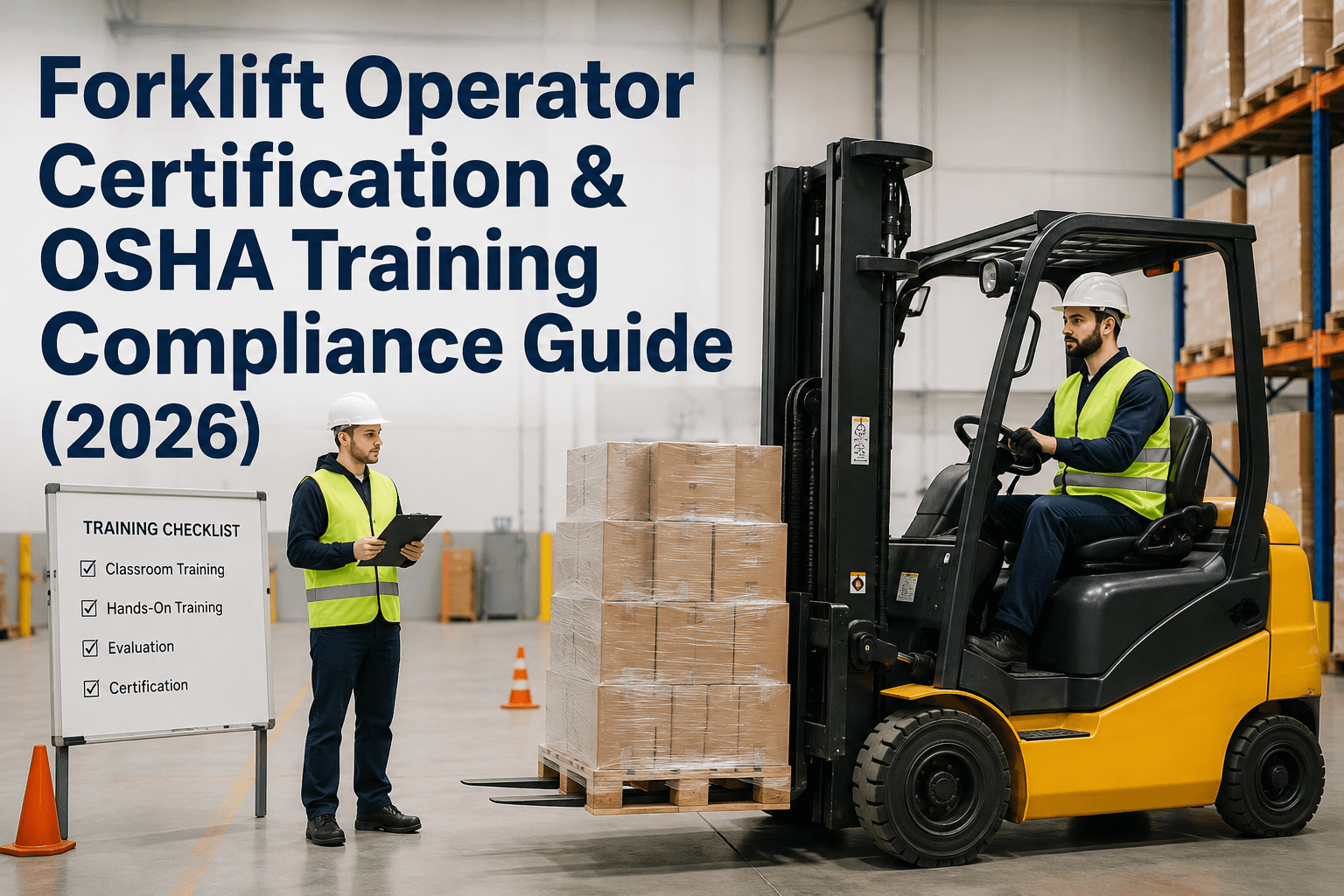
Powered industrial trucks rank sixth on OSHA's most-cited standards list, and the two violations employers get hit with most are simply operators not properly trained and refresher training skipped. The price of getting it wrong is steep: serious violations run up to $16,550 each, and willful or repeat violations reach $165,514 — one Texas distribution center drew $288,299 in proposed penalties after a fatal forklift incident exposed training failures. Forklifts cause roughly 100 deaths and 35,000 serious injuries a year in the US, yet timely recertification cuts accident rates by up to 30%. The frustrating part is that none of this requires a government license — OSHA puts the entire certification process on the employer, from training to evaluation to recordkeeping. Miss an expiration date, lose a signed evaluation form, or let a paper file go stale, and a compliant operator becomes a citation overnight. This guide breaks down exactly what OSHA 29 CFR 1910.178(l) requires, what every certification record must contain, when recertification is triggered, and how to keep it all audit-ready. book a 30-minute walkthrough to see it set up for your operators.
No government issues a forklift license. OSHA puts the whole certification on you.
HVI tracks every operator's training, evaluation, and three-year recertification date, stores signed records with all four OSHA-required fields, flags expirations before they lapse, and keeps the whole program audit-ready — so a missed renewal never becomes a $16,550 citation.
What non-compliance actually costs
Before the requirements, understand the stakes. Forklift training violations aren't an obscure technicality — they're among OSHA's most common citations, and the penalties scale fast.
The two single most-cited forklift violations are operators not properly trained and refresher training not provided. Both are entirely preventable with documentation — which is exactly why an unsigned form or a lapsed date is so expensive. OSHA citations are also public record, visible to customers and insurers alike.
The three parts OSHA requires
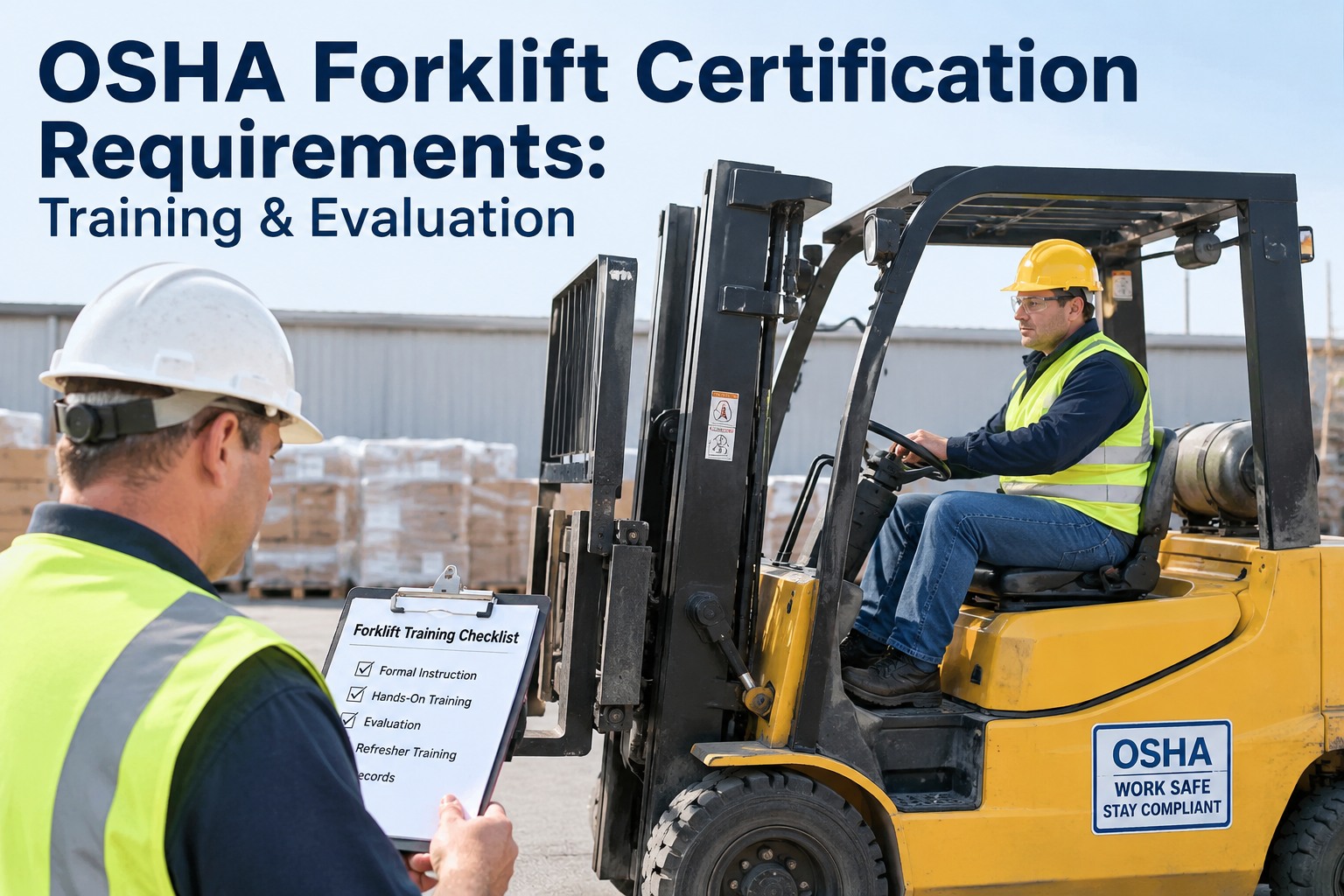
Under 29 CFR 1910.178(l), no operator runs a forklift unsupervised until all three of these are complete. Skip any one and the certification doesn't legally exist.
Formal instruction
Lecture, video, written material, or interactive learning covering truck-related and workplace-related topics. The classroom foundation before anyone touches a machine.
Practical training
Hands-on demonstrations by the trainer followed by supervised exercises by the trainee, on the actual equipment type the operator will run.
Workplace evaluation
A performance assessment in the real workplace by a qualified evaluator — confirming the operator is competent in your actual aisles, loads, and conditions.
Certification is type-specific: a credential on a sit-down counterbalance doesn't cover a reach truck or an order picker. Operators must be at least 18, and the employer — not the operator — owns the entire process. HVI tracks each operator's certified equipment types so no one runs a truck they aren't qualified on.
The certification record: four mandatory fields
OSHA 1910.178(l)(6) is explicit about what the written certification must contain. Miss any field and the record fails an audit — even if the training itself happened.
Operator name
The specific operator the certification applies to — no shared or crew records.
Training date
The date formal and practical training was completed.
Evaluation date
The date of the workplace performance evaluation — the clock that drives recertification.
Trainer / evaluator identity
The name of the qualified person who conducted the training or evaluation.
A binder full of forms missing one field is the audit finding nobody sees coming — and the most common reason a "trained" operator still triggers a citation. sign up free and capture all four fields on every digital certification record automatically, or book a demo to see audit-ready operator files.
When recertification is triggered
Three years is the maximum, not a schedule to coast on. OSHA requires re-evaluation or refresher training much sooner the moment any of these events occurs — regardless of when the operator was last certified.
Routine re-evaluation
A performance evaluation must be conducted at least once every three years for every operator — the hard outer limit under federal rules.
Accident or near-miss
Any incident or near-miss involving the operator triggers required refresher training and re-evaluation right away, not at the next cycle.
Unsafe operation observed
If a supervisor observes an operator running a truck unsafely, retraining is mandatory before they continue.
New truck type or changed conditions
Assignment to a different type of truck, or a change in workplace conditions, requires fresh training for that equipment or environment.
The most common compliance gap is waiting until a certification expires to start renewal — leaving operators legally uncertified in the meantime. HVI flags every three-year date in advance and logs incident-triggered retraining automatically, so the trigger never gets missed.
The violations OSHA cites most
Nearly every forklift citation clusters around the same handful of failures — and every one is a documentation or tracking problem before it's a safety problem.
Three of the top five are pure recordkeeping — training, refresher, and certification documentation — and the other two are daily inspection failures. Both live in the same system. sign up free and close every documentation gap with digital certifications and inspection logs in one place.
Paper binders vs. HVI
Both technically store certifications. Only one tells you a renewal is due before it lapses, proves every record is complete, and survives a surprise OSHA audit without a frantic file search.
Paper binders / spreadsheets
- Expiration dates discovered after they've already lapsed
- Records found missing a required field at audit time
- Incident-triggered retraining forgotten in the rush
- No view of who's certified on which truck type
- Daily inspections logged separately, if at all
- Audit prep means digging through filing cabinets
With HVI software
- Three-year dates flagged well before they expire
- All four OSHA fields captured on every record
- Accident and near-miss retraining logged automatically
- Operator-to-equipment-type qualifications tracked
- Daily pre-use inspections in the same platform
- Audit-ready operator files exported in seconds
avoided per willful violation — and far more once injury, downtime, liability, and insurance fallout are counted. The two most-cited forklift violations are both documentation failures that cost nothing to prevent and a fortune to settle. HVI keeps every operator certified, every record complete, and every renewal on time, automatically.
Frequently asked questions
How often does a forklift operator need to be recertified?
OSHA requires a performance evaluation at least once every three years for every operator under 29 CFR 1910.178(l)(4)(iii) — that's the maximum interval, not a recommendation. Refresher training and re-evaluation are required much sooner whenever a triggering event occurs: an accident or near-miss involving the operator, observed unsafe operation, assignment to a different type of truck, or a change in workplace conditions. The most common and costly mistake is waiting until a certification expires to begin renewal, which leaves the operator legally uncertified in the gap. HVI's inspection and maintenance software tracks every operator's three-year date and flags it well in advance, and lets you log incident-triggered retraining the moment it's needed, so a renewal never slips. sign up free and never miss a recertification date again.
What must a forklift certification record actually contain?
OSHA 1910.178(l)(6) requires the written certification to include four specific fields: the operator's name, the date of the training, the date of the evaluation, and the identity of the person who performed the training or evaluation. If any one of those is missing, the record fails an audit even if the training genuinely happened — which is why incomplete certification records are one of the most-cited forklift violations. A binder of paper forms is especially vulnerable because a single missing signature or date isn't visible until an inspector finds it. HVI's inspection and maintenance software captures all four fields on every digital certification record automatically, so each operator file is complete and audit-ready by default.
Who is responsible for forklift operator certification — the employer or the operator?
The employer, entirely. No government agency issues a forklift license, and certification is not something an operator carries between jobs as a personal credential. Under 29 CFR 1910.178(l), the employer owns the whole process: providing formal instruction, conducting practical hands-on training, performing a workplace-specific evaluation, designating qualified trainers, and maintaining the documentation. That means the legal and financial exposure for a missed renewal or an incomplete record sits with the company, not the worker. Because the responsibility is the employer's, having a system that proves the program is current and documented is what separates a compliant operation from a costly citation. book a demo to see how HVI keeps employer compliance airtight.
What are the penalties for forklift training violations?
OSHA penalties scale with severity and adjust upward each January for inflation. Serious violations run up to $16,550 each, while willful or repeat violations reach $165,514 each — and failing to correct a cited hazard by the deadline can add $16,550 per day. Powered industrial trucks consistently rank among OSHA's most-cited standards, with operator-training and refresher-training failures leading the list. Real cases show how fast it compounds: one tire distribution center faced $288,299 in proposed penalties after a fatal incident exposed multiple training failures. Beyond the fines, citations are public record and carry injury, downtime, liability, and insurance costs. Keeping documentation complete and current is the cheapest insurance available, and it's exactly what HVI's inspection and maintenance software is built to do.
How does HVI help manage forklift certification compliance?
HVI is an inspection and maintenance software platform that runs operator certification alongside equipment compliance in one place. It stores each operator's certification record with all four OSHA-required fields, tracks which equipment types each operator is qualified on, and flags every three-year recertification date well before it expires. When an accident, near-miss, or unsafe-operation event occurs, you log the triggered refresher training right against the operator's file so the requirement is never missed. It also runs the daily pre-use forklift inspections OSHA requires — the other common citation area — in the same platform, with photo capture on defects and automatic work orders. When an inspector arrives, complete, audit-ready operator and equipment files export in seconds instead of a filing-cabinet scramble. book a demo and we'll map the software onto your operators and equipment on the call.
Keep every operator certified, every record complete, every renewal on time.
HVI tracks training, evaluations, and three-year recertification dates, stores certification records with all four OSHA-required fields, logs incident-triggered retraining, manages operator-to-equipment qualifications, and runs daily pre-use inspections — all audit-ready in one platform. Stop letting a lapsed date or a missing signature turn a trained operator into a $16,550 citation.
No credit card required · Live in under two weeks · Certification tracking + recertification alerts + OSHA records + daily inspections in one platform