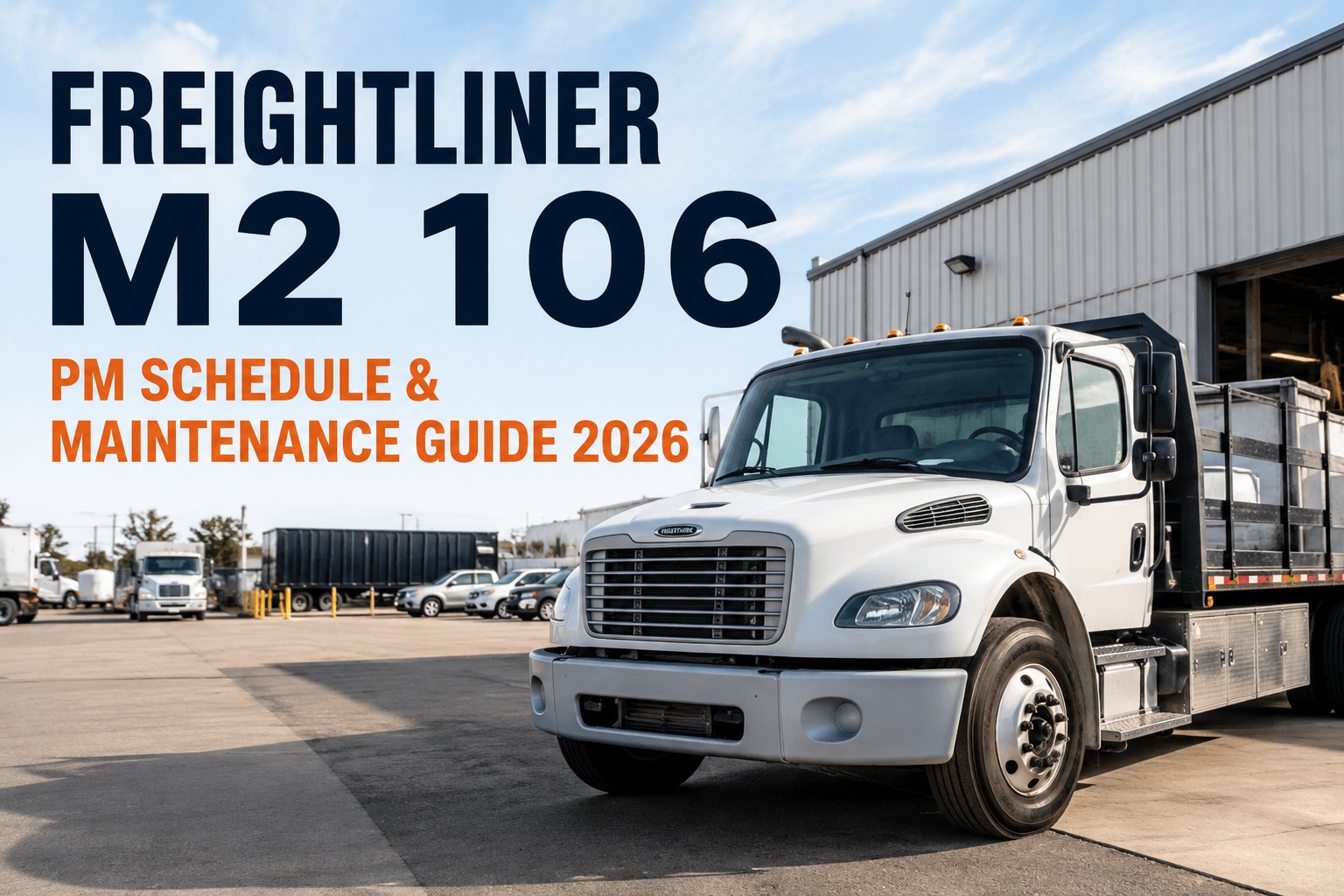
The Freightliner M2 106 is the medium-duty truck that does everything — utility bodies, dump beds, reefer boxes, tow rigs, school buses, municipal fleets. That versatility is also its PM challenge: a B6.7-powered delivery truck doing 200 stops a day and a L9-powered dump truck hauling aggregate live in completely different maintenance worlds, even though they share the same cab and frame. This guide maps the complete Freightliner M2 106 PM schedule by engine and duty cycle, and shows how to automate it across a mixed fleet. Book a demo to see M2 106 PM scheduling live.
Freightliner M2 106 PM Schedule: Every Engine, Every Vocation
Five applications. Three engines. One truck platform — and five different PM realities.
The M2 106 is the best-selling medium-duty truck platform in North America for a reason — it can be upfitted for virtually any vocational application. But that same flexibility means a one-size-fits-all PM schedule will either over-service your highway trucks or under-service your vocational units. Below is how to build the right schedule for each configuration.
Three Engines, Three PM ProfilesB6.7, L9, and DD5 maintenance differences
The M2 106 offers three engine options, each with its own maintenance architecture. The engine your truck is running determines every oil, filter, and aftertreatment interval.
Cummins B6.7 engines built to EPA 2021 specifications feature significantly extended maintenance intervals compared to older models: oil drain intervals up to 30,000 miles or 1,000 hours with the 19-quart pan, fuel filter replacement extended to 60,000 miles or 2,000 hours, and a completely maintenance-free crankcase ventilation filter. For pre-2021 B6.7 engines, oil intervals are typically 15,000 to 25,000 miles depending on duty cycle. The L9 follows its own duty-cycle matrix, with intervals ranging from 28,000 to 35,000 miles based on horsepower rating and fuel economy. Book a demo to see per-engine PM templates in HVI
The Complete M2 106 PM ScheduleCummins B6.7 and L9 intervals by duty cycle
Cummins defines four duty cycles based on average fuel economy: Severe (3 to 4.9 MPG), Short-Haul (5 to 5.9 MPG), Normal (6 to 6.9 MPG), and Light (7+ MPG). Most M2 106 trucks in vocational and urban delivery applications fall into the Severe or Short-Haul tier — the Normal and Light intervals apply primarily to regional or highway configurations.
| System / Component | Severe (3–4.9 MPG) | Short-Haul (5–5.9) | Normal (6–6.9) | Light (7+) |
|---|---|---|---|---|
| Engine oil + filter | 25,000 mi / 500 hrs | 30,000 mi / 750 hrs | 30,000 mi / 1,000 hrs | 30,000 mi / 1,000 hrs |
| Fuel filter | 25,000 mi / 500 hrs | 60,000 mi / 1,500 hrs | 60,000 mi / 2,000 hrs | 60,000 mi / 2,000 hrs |
| Air cleaner element | By restriction | By restriction | By restriction | By restriction |
| Coolant (ELC) | Test twice per year · Full drain/fill per Cummins CES14603 intervals | |||
| Valve lash adjustment | Inspect at first oil change; adjust as needed per OEM specs | |||
| DPF ash cleaning | By check engine light / backpressure — return to Cummins authorized location | |||
| CCV filter (EPA 2021+) | Maintenance-free | |||
| Chassis lubrication | 10,000 mi | 15,000 mi | 25,000 mi | 25,000 mi |
| Brake inspection | 10,000 mi | 15,000 mi | 25,000 mi | 25,000 mi |
Scroll right on mobile · Source: Cummins B6.7 Quick Reference Guide
The Cummins L9 follows a similar structure with slightly different numbers: oil drain intervals up to 35,000 miles or 1,000 hours for the 260 to 350 HP rating, and up to 28,000 miles or 1,000 hours for the 370 to 380 HP rating. The higher-output L9 runs hotter and harder, which is why the interval compresses at higher power ratings. For M2 106 trucks with the Detroit DD5, follow Detroit's duty-cycle intervals: 25,000 miles for severe, up to 35,000 miles for long-haul. Start free — configure per-engine PM templates in HVI
Vocation Changes Everythinghow application type reshapes the PM schedule
The same M2 106 chassis does wildly different work depending on what's bolted to the frame. Here's how each major vocation shifts the PM reality beyond what the engine interval table shows.
High stop count (50 to 200+ per day), constant brake use, liftgate cycling. Brake inspections should be at every oil service. Liftgate hydraulics need separate PM tracking — fluid, cylinders, platform hinge pins. The engine rarely reaches sustained operating temperature, which delays DPF regeneration and increases soot loading.
Near-GVWR loading, off-road operation, dust exposure, PTO-driven hydraulic dump body. Air filter needs checking at every oil service — restriction gauge is the only reliable indicator. PTO and dump body hydraulics run on a separate service cycle: fluid, pump, cylinders, valve body, and hose routing at 500-hour intervals. Book a demo — track PTO and dump body PM separately in HVI
Extended idle at job sites (40%+ is common), PTO-driven crane or aerial device, outrigger deployment. Engine hours accumulate far faster than miles. A utility M2 106 idling 5 hours a day hits the 500-hour oil trigger at roughly 12,000 miles — half of a 25,000-mile schedule. Engine-hours must be the primary PM trigger.
Year-round mixed duty: plow/salt in winter, mowing/grading in summer, general hauling between seasons. Salt exposure accelerates chassis and brake corrosion. Winter operation demands more frequent coolant testing and battery inspection. PMs need to shift seasonally — shorter brake intervals in winter, more frequent chassis lube after salt season.
Aftertreatment + DEFDPF and SCR maintenance on B6.7 and L9 engines
Both the B6.7 and L9 use Cummins' single-module aftertreatment system that combines the DPF and SCR into one flow-through unit. The EPA 2021 B6.7 version is up to 70% smaller and 30% lighter than the system it replaced — easier to install and maintain, but still the most expensive single-component service on the truck.
Trigger: Check engine light or backpressure
Process: Return DPF to Cummins authorized location for exchange with New/Recon unit
Cost: $500–$1,500 cleaning; replacement higher
Key: Cummins recommends against unauthorized cleaning methods
Consumption: ~2–3% of diesel fuel burned
Quality: Use DEF certified by API to ISO 22241
Inspection: Check lines, injector, and tank heater at every PM
Risk: Contaminated DEF causes SCR faults and derates Book a demo
On delivery trucks with frequent short trips, the DPF rarely reaches passive regeneration temperature. Active regens increase in frequency, and the engine may request parked regens that operators defer. Each deferred regen adds soot load. Over time, the DPF becomes unrecoverable through regen alone and needs a full ash cleaning. Tracking regen frequency and duration in your maintenance platform is the best early-warning system for DPF health.
5 M2 106 PM Mistakesthe patterns that cost medium-duty fleets the most
The B6.7 at 30,000 miles and the L9 at 28,000 or 35,000 miles have different intervals by horsepower rating. A fleet running both engines on a single 25K schedule is over-servicing some trucks and potentially under-servicing others.
A utility M2 106 idling 5 hours a day hits 500 engine hours in roughly 100 working days — around 12,000 to 15,000 odometer miles. Without an hours trigger, that truck runs to 25,000 miles before an oil change — nearly double the actual engine-wear interval. Book a demo — HVI triggers PM by hours or miles, whichever comes first
Liftgates, dump bodies, crane systems, and PTO-driven equipment all have their own PM requirements. A liftgate that cycles 80 times a day needs hydraulic service on a completely different schedule from the engine. Track body equipment PM as separate assets tied to the truck.
Delivery drivers under time pressure defer parked regens because they take 20 to 40 minutes. Each deferral adds soot load. After enough deferrals, the DPF reaches a point where regen alone can't recover it, and the engine derates. Track regen requests and completions per truck.
A delivery M2 on 25K oil, a dump truck on 28K with PTO service at 500 hours, and a utility body on hours-based triggers need three different PM templates. A single fleet-wide interval means two out of three vocations are on the wrong schedule.
From a public works fleet manager running 34 M2 106 units
We have M2 106s in three configurations: 8 dump trucks with L9 engines, 14 utility bodies with B6.7s, and 12 general service trucks. When we ran them all on the same 25,000-mile oil schedule, the utility trucks were consistently over-hours by the time they hit mileage. Two of them threw aftertreatment codes within the first year because the oil was breaking down from idle heat cycling well before the odometer trigger.
Once we set up per-vocation PM profiles — hours-based for utility, mileage for the service trucks, and a hybrid for the dumps — our unplanned downtime dropped by about a third in the first six months. The biggest win was catching the dump body hydraulic issues early instead of waiting for the engine service interval.
Frequently asked questions
What is the oil change interval for the Freightliner M2 106?
The oil change interval on a Freightliner M2 106 depends on the engine and duty cycle. For the Cummins B6.7 (EPA 2021+), the standard interval is up to 30,000 miles or 1,000 engine hours for normal and light duty, dropping to 25,000 miles or 500 hours for severe duty (under 5 MPG). For the Cummins L9, intervals range from 28,000 miles (370 to 380 HP rating) to 35,000 miles (260 to 350 HP rating), both at up to 1,000 engine hours. The Detroit DD5 follows Detroit's duty-cycle tiers at 25,000 to 35,000 miles. Most M2 106 trucks in delivery, utility, and vocational applications fall into the severe or short-haul duty cycle, making the lower end of these ranges the appropriate interval.
How does vocation affect the M2 106 maintenance schedule?
Vocation significantly changes the M2 106 maintenance schedule beyond just engine oil intervals. Delivery trucks with high stop counts need more frequent brake inspections and liftgate hydraulic service. Dump trucks operating off-road in dusty conditions need air filter checks at every oil service and separate PTO/dump body hydraulic PM at 500-hour intervals. Utility trucks with extended idle need hours-based PM triggers because engine hours accumulate much faster than miles. Municipal trucks exposed to road salt need more frequent chassis lubrication and corrosion inspection. Each vocation effectively requires its own PM profile, even when the trucks share the same engine and chassis.
When should the DPF be serviced on an M2 106 with a Cummins engine?
DPF ash cleaning on Cummins B6.7 and L9 engines is triggered by the check engine light or elevated backpressure readings, not by a fixed mileage interval. Cummins recommends that DPFs requiring ash cleaning be returned to a Cummins authorized repair location for exchange with a new or remanufactured unit, and explicitly advises against unauthorized cleaning methods. In delivery and vocational applications where the engine rarely reaches sustained operating temperature, passive regeneration happens less frequently and active regen requests increase. Tracking regen frequency and completion rates through your maintenance platform provides the best early warning of when the DPF will need service.
Should I track engine hours or mileage for M2 106 PM?
Track both and trigger on whichever comes first. This is especially critical for M2 106 trucks in high-idle vocations like utility, crane, and PTO-driven applications. A utility M2 106 idling 5 hours per day accumulates 500 engine hours in roughly 100 working days, which corresponds to about 12,000 to 15,000 odometer miles. If you're only tracking mileage, that truck will reach 25,000 miles before its first oil change, running on degraded oil for thousands of additional hours. Cummins specifies both miles and hours for every interval, and the engine hours trigger is the one that catches the trucks mileage alone would miss.
Can I automate M2 106 PM across a mixed-vocation fleet?
Yes. A CMMS like HVI (Heavy Vehicle Inspection) lets you configure per-truck PM profiles based on engine type and vocation. Set B6.7 delivery trucks on 25,000-mile or 500-hour oil intervals, L9 dump trucks on 28,000-mile intervals with separate PTO service at 500 hours, and utility bodies on hours-based triggers. HVI tracks engine PM and body equipment PM (liftgate, dump body, crane) as separate maintenance schedules tied to the same truck. Work orders generate automatically when any threshold is reached, with the correct Cummins or Freightliner-specific checklist attached. Digital inspection reports, parts tracking, and fleet-wide PM status dashboards are included.
Every M2 106, on the right schedule — delivery, dump, utility, municipal, tow
Configure PM by engine and vocation. Track miles, hours, and body equipment cycles. Auto-generate work orders. Attach OEM checklists. Log parts. Keep warranty-ready records. Works with any telematics. Live in under two weeks.
No credit card · No hardware required · Works with Cummins Connected Diagnostics