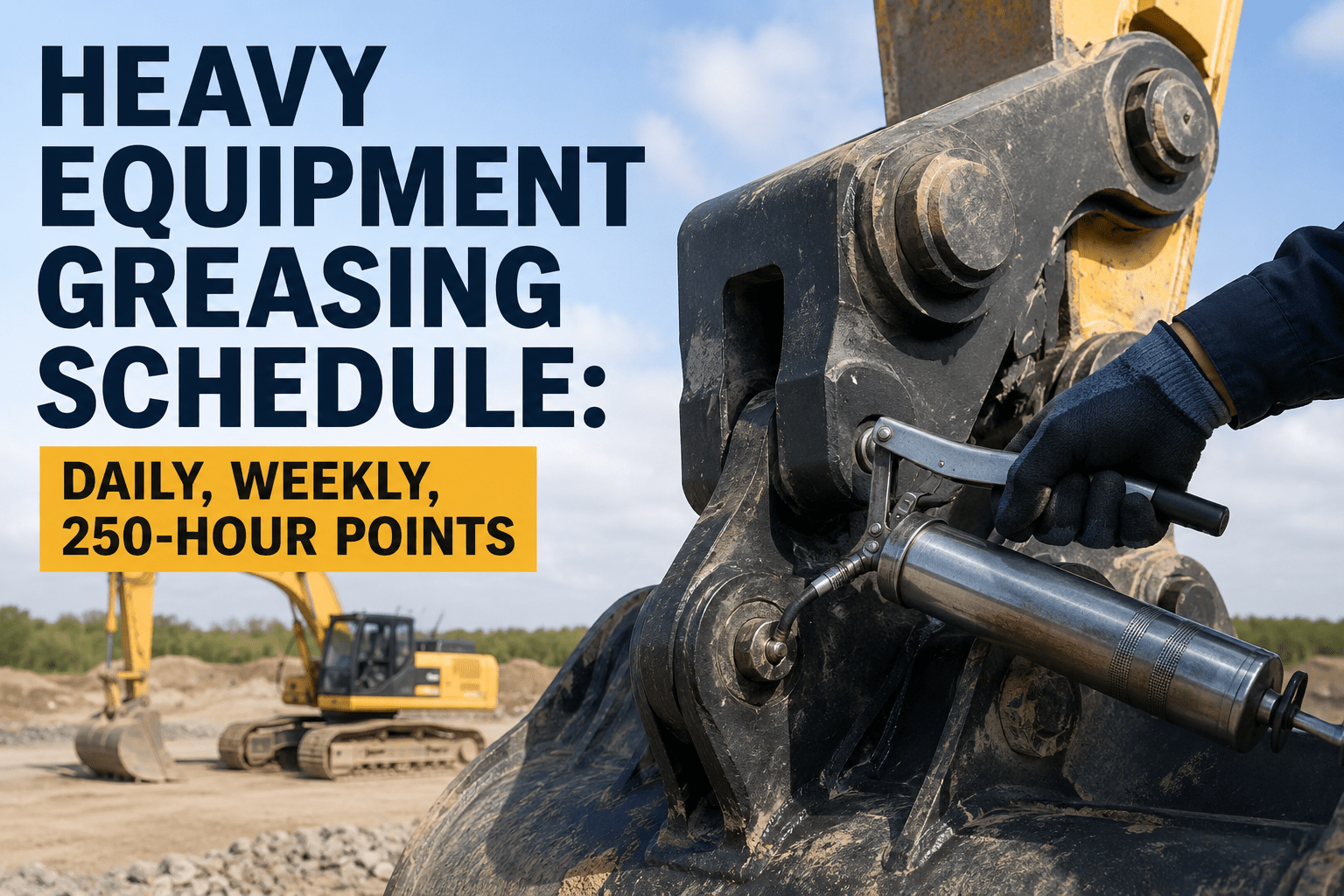
Greasing is the cheapest maintenance you can do and the most expensive to skip. A typical excavator has 30 to 50-plus grease zerks, and missing even one leads to premature wear on a pin or bushing that costs hundreds to replace — or, on a swing bearing, tens of thousands. The difference between a machine that runs 10,000 hours and one that becomes a parts donor at 3,000 often comes down to whether someone hit every fitting on schedule. But "on schedule" isn't one number: high-stress points like excavator boom and bucket pins need daily greasing every 8–10 operating hours, lower-load joints like steering linkages need weekly attention around every 40–50 hours, and swing bearings and extended points fall on the 250-hour interval. Get the grease type wrong, or over-grease, and you create new problems — blown seals and contamination from too much, premature wear from too little. This guide lays out the greasing schedule by interval, how to match grease type to the application, the points to hit on each equipment class, and the real pros and cons of auto-lube systems. HVI's equipment maintenance software turns the greasing routine into a tracked schedule — daily, weekly, and 250-hour lube tasks fired automatically, with each zerk logged so none gets missed. schedule a 30-minute walkthrough with our team to see it set up for your fleet.
30 to 50 zerks per machine. Miss one and you're replacing a pin — or a swing bearing.
HVI turns your greasing routine into a tracked schedule — daily, weekly, and 250-hour lube points fired by engine hours, every zerk logged, so the cheapest maintenance you do never gets skipped.
The greasing schedule by interval
Greasing frequency depends on the load and motion at each point — not a single fleet-wide number. Three tiers cover most heavy equipment, and HVI fires each one as a recurring task.
High-stress points under load
Boom, stick, and bucket pins — the working end takes the most abuse. Under heavy conditions, bucket pivots may need it twice daily. These are the points where a missed day shows up fastest as wear.
Lower-load & low-motion joints
Steering joints, linkage pivots, and cylinder-attach points that move less or carry lighter load. Important, but they tolerate a longer interval without accelerating wear.
Bearings & extended points
Swing bearing, slew ring, and points specified on the longer interval — including some auto-lube-fed components. A swing-bearing failure is one of the most expensive on the machine, so this tier matters.
The golden rule of application: pump until purge. Apply grease until a slight bead of fresh grease appears at the seal, then stop — that confirms old, contaminated grease has been pushed out and the cavity is full. Over-greasing past that point blows seals; under-greasing leaves the joint starved.
Match the grease to the job
Grease isn't generic. The thickener and additives determine where it works — and mixing incompatible types can destroy lubrication entirely. NLGI #2 is the standard consistency; always confirm against your manual.
| Grease type | Best for | Notes |
|---|---|---|
| Lithium complex (NLGI 2) | General-purpose — 70–80% of points | ~−20°F to 350°F; good water resistance; ~$8–12/tube |
| Calcium sulfonate | Wet conditions, extreme pressure | Superior water & corrosion protection; ~$12–18/tube |
| Moly (MoS2) | Pins & bushings under heavy load | Solid lubricant for shock load; resists galling |
| Polyurea | Sealed-for-life & high-temp bearings | Long service life, >260°C drop point, clean-burning |
| NLGI 1 / 0 | Cold weather & auto-lube systems | Softer, flows easier through centralized lines |
Never mix grease types — different thickener bases can be chemically incompatible, and mixing them can break down the grease and leave a joint effectively unlubricated. Pick a primary grease for most points, use moly where pins take shock load, and keep containers clean to avoid contamination.
Grease points by equipment class
Every pivot that moves under load needs lubrication — but the count and the critical points vary by machine. Here's what to expect across the fleet.
Excavators
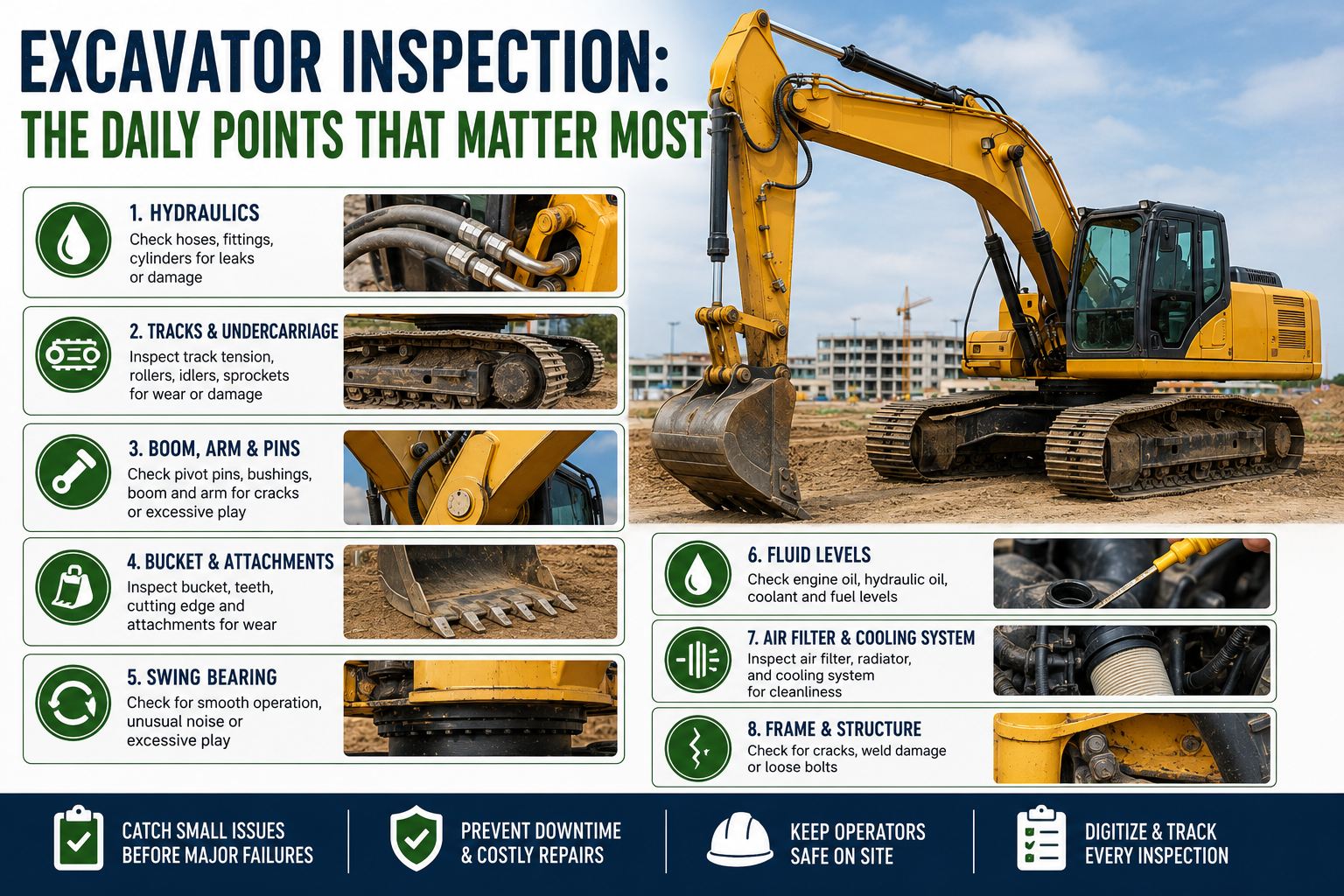
30–50+ zerks. Boom foot, stick, and bucket pins (daily, under load), swing bearing (250 hr), plus cylinder pivots and quick-attach. A 20–30 ton machine consumes 12–18 kg of grease a month.
Loaders & backhoes
Loader-arm and bucket pins, tilt and lift cylinder ends, articulation joint, and stabilizer pins on backhoes. High pivot count — a Cat backhoe alone has 21 grease fittings.
Dozers & track machines
Blade and ripper pins, equalizer bar, and track components — idlers, rollers, and tensioner where equipped. Undercarriage points plus the working-tool linkages.
Skid steers
Numerous pivot points and bearings operating under heavy load in dirty conditions — loader linkage, bucket and quick-attach pins. Demand a robust EP lithium complex grease.
With 30–50 zerks on a single excavator and different intervals per point, a paper lube chart is exactly where fittings get skipped. sign up for a free HVI account and turn your lube chart into a checked-off digital routine per machine, or schedule a live demo to see daily, weekly, and 250-hour grease tasks scheduled automatically.
Auto-grease systems: pros and cons
Automatic lubrication systems dispense grease at preset intervals while the machine runs — increasingly common on newer excavators. They solve real problems but aren't a set-and-forget fix. Weigh both sides.
Pros
- Lubricates while running — little grease film never breaks down
- Hits every point consistently, even hard-to-reach zerks
- No daily manual greasing labor across 30–50 points
- Reduces both over- and under-greasing with metered flow
- Frees the operator to focus on the walkaround
Cons
- Still requires monitoring and refilling — not maintenance-free
- A blocked line or empty reservoir starves points silently
- Upfront cost and installation on existing machines
- Needs softer NLGI 1 / 0 grease that flows through lines
- Purge valves and lines become their own inspection items
Auto-lube doesn't remove greasing from your maintenance program — it changes the task from "pump every zerk" to "verify the system is full, flowing, and not blocked." In HVI, that verification becomes a scheduled check, and remote grease banks or manual points still get their own logged tasks. sign up free and track auto-lube refills and manual points together.
Paper lube chart vs. HVI greasing program
Both start from the same OEM lube points. Only one fires the right interval automatically, logs every zerk, and proves it happened.
Paper lube chart
- One of 30–50 zerks quietly skipped each day
- Daily, weekly, and 250-hr points tracked from memory
- Over-greasing blows seals; under-greasing starves joints
- Wrong or mixed grease type used by accident
- Auto-lube reservoir runs empty unnoticed
- No record a point was greased when wear shows up
With HVI software
- Daily, weekly, and 250-hr lube tasks fire by engine hours
- Each zerk and point logged, with photos where needed
- Correct grease type and NLGI grade stored per machine
- Auto-lube refills and purge checks scheduled as tasks
- Greasing history per machine proves the routine ran
- Grease consumption and cost tracked across the fleet
hours of machine life — that's the gap between a machine greased on schedule and one run dry, with a single swing bearing costing tens of thousands to replace. Daily pins, weekly joints, 250-hour bearings, the right grease, pumped until purge. HVI tracks every interval and every zerk so the cheapest maintenance you do is the one you never skip.
Frequently asked questions
How often should heavy equipment be greased?
It depends on the point's load and motion, not a single schedule. High-stress points like excavator boom, stick, and bucket pins need daily greasing every 8–10 operating hours — and under heavy conditions, bucket pivots may need it twice daily. Lower-load, low-motion joints like steering linkages and some cylinder pivots can go weekly, around every 40–50 hours. Bearings and extended points, such as the swing bearing on an excavator, fall on the 250-hour interval. Always confirm the exact points and intervals in your machine's manual, since they vary by make and model and tighten in severe conditions like heavy dust or continuous high load. HVI lets you set each point to its correct interval and fires daily, weekly, and 250-hour lube tasks automatically by engine hours.
What type of grease should I use on heavy equipment?
NLGI Grade 2 lithium complex grease is the industry standard and handles 70–80% of points — it's versatile, takes heat and water reasonably well, and runs about $8–12 a tube. For specific conditions, choose accordingly: calcium sulfonate for wet environments and extreme pressure (superior corrosion protection, ~$12–18/tube); moly (molybdenum disulfide) for pins and bushings under heavy shock load, where its solid lubricant resists galling; polyurea for sealed-for-life and high-temperature bearings; and softer NLGI 1 or 0 for cold weather or centralized auto-lube systems that need grease to flow through lines. Always check your OEM specification — many manufacturers require a specific grade for warranty compliance. Critically, never mix grease types, since incompatible thickeners can break the grease down. HVI stores the correct grease type and grade per machine.
Can you over-grease heavy equipment?
Yes, and it's a common and costly mistake. Over-greasing forces too much grease into a cavity and blows out seals, which then lets contaminants in and grease out — the opposite of what you want. It also wastes expensive grease. Under-greasing is equally damaging, starving the joint and causing premature wear. The correct technique is "pump until purge": apply grease until a slight bead of fresh grease appears at the seal, then stop. That tells you the old, contaminated grease has been pushed out and the cavity is properly filled, without over-pressurizing the seal. Consistent, correct-volume application at the right interval is what protects the component — not simply pumping as much grease as possible. HVI's logged routine helps standardize technique across operators.
Are automatic greasing systems worth it?
For many fleets, yes — but they're not maintenance-free. The advantages are real: an auto-lube system lubricates points while the machine runs so the grease film never fully breaks down, hits every point consistently (including hard-to-reach zerks), eliminates the daily labor of manually greasing 30–50 points, and reduces both over- and under-greasing through metered delivery. The trade-offs: the system still requires monitoring and refilling, a blocked line or empty reservoir can silently starve points, there's upfront cost and installation, it needs softer NLGI 1 or 0 grease to flow through the lines, and the lines and purge valves become their own inspection items. The right approach is to treat auto-lube verification as a scheduled task rather than assuming it's handled. HVI tracks auto-lube refills and any remaining manual points together.
How does HVI help with equipment greasing?
HVI turns greasing from a memory-dependent chore into a tracked program. You set each grease point to its correct interval — daily for high-stress pins, weekly for lower-load joints, 250 hours for bearings — and the system fires those lube tasks automatically by engine hours, so none gets skipped across the 30–50 zerks on a typical machine. The correct grease type and NLGI grade are stored per machine, auto-lube refills and purge-valve checks are scheduled as their own tasks, and each point can be logged (with photos where useful) so there's a record the routine actually ran. Greasing history and grease consumption are tracked per machine, helping you budget and spot abnormal usage. Because it's brand-agnostic, your excavators, loaders, dozers, and skid steers all live in one program. schedule a demo and we will set it up around your specific machines and lube points on the call.
Never skip a zerk again — put your whole greasing routine on schedule.
HVI fires daily, weekly, and 250-hour lube tasks by engine hours, stores the right grease type per machine, schedules auto-lube checks, and logs every point so the cheapest maintenance you do is also the most reliable. Protect your pins, bushings, and bearings — and the 10,000-hour machine life that depends on them. Sign up free today.
No credit card required · Live in under two weeks · Interval-based lube scheduling + grease-type tracking + zerk logging in one platform