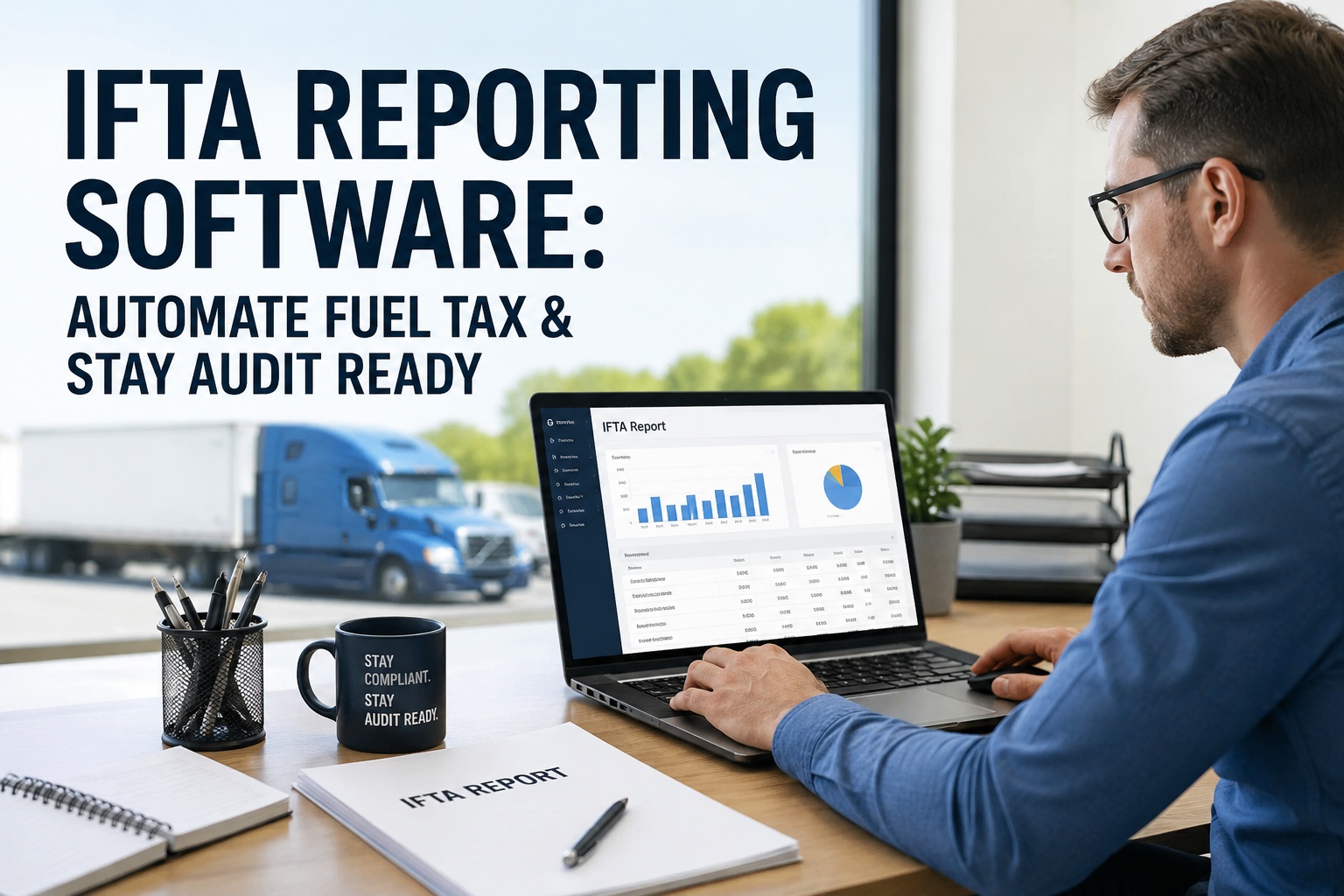
IFTA (International Fuel Tax Agreement) reporting is one of the most consistent quarterly compliance obligations a commercial fleet faces — and one of the most common sources of unexpected tax bills, penalties, and audits when it's done wrong. The agreement between 48 US states and 10 Canadian provinces means any qualified motor vehicle operating across state lines files one quarterly report to its base jurisdiction covering miles driven and fuel purchased in every jurisdiction it operated. This 2026 IFTA fuel tax reporting guide walks the four quarterly deadlines that structure the compliance calendar, the records every carrier must keep, exactly how the tax is calculated across jurisdictions, and the five common mistakes that trigger IFTA audits. Book a demo after you see how ELD-integrated IFTA workflow closes every gap.
The 2026 IFTA Filing Cycle
Four quarters. Four deadlines. Miss any one and the penalty is $50 or 10% of net tax due — whichever is greater — plus interest that keeps accruing until paid.
The four deadlines above are the fixed points every IFTA-licensed fleet plans around. Below is the complete guide: who has to file, what records to keep, exactly how the tax is calculated, and the five mistakes that turn a routine filing into an audit.
What IFTA is — and who has to file quarterly reports
IFTA replaced a chaotic patchwork of state-by-state fuel tax filings with one consolidated quarterly report to the carrier's base jurisdiction (typically the home state where the fleet is licensed). The base jurisdiction collects taxes for every state or province the fleet operated in and redistributes them accordingly.
Who has to file IFTA
Required to operate under IFTA
If your fleet moves interstate, IFTA applies. Even one mile driven outside the base jurisdiction in a quarter creates the filing obligation for that quarter. Book a demo to see automated IFTA filing prep
What happens when you miss an IFTA filing deadline
IFTA penalties are structured to escalate quickly. The base penalty is small; the compounding consequences aren't.
Late filings also trigger closer account review by the base jurisdiction, which increases the audit probability going forward. Filing on time — even zero-activity quarters — is the single most effective IFTA compliance habit. Start free and let IFTA deadlines auto-remind your team
Records you must keep for IFTA filing and audit
Every IFTA return relies on two categories of records: mileage per jurisdiction and fuel purchases per jurisdiction. Both must be retained for four years and both must survive audit scrutiny.
Mileage records
Fuel receipts
Missing records default to the auditor's assumption — typically the worst-case tax owed with no offsetting credit for fuel purchased. Every fleet running IFTA operations should treat records as insurance, not paperwork. Book a demo to see automatic mileage-by-jurisdiction tracking
How IFTA fuel tax is actually calculated
The IFTA calculation is a five-step process that runs identically for every jurisdiction the fleet operated in during the quarter. The math is straightforward — the discipline is in maintaining accurate mileage and fuel records to feed it.
Total miles
Sum all miles driven across every IFTA jurisdiction for the quarter, per vehicle and fleet-wide.
Total gallons
Sum all gallons of fuel purchased across every jurisdiction (only tax-paid gallons with valid receipts).
Fleet MPG
Divide total miles by total gallons. This average is applied across every jurisdiction for the quarter.
Gallons consumed per jurisdiction
For each jurisdiction, divide miles driven there by fleet MPG. This equals the gallons your fleet consumed operating in that jurisdiction.
Net tax owed or refund
For each jurisdiction: (gallons consumed − gallons purchased) × jurisdiction tax rate = net owed or refund. Rates come from the official IFTA Tax Rate Matrix, updated quarterly.
The calculation runs across every jurisdiction the fleet operated in during the quarter. Positive net = tax owed to that jurisdiction. Negative net = refund credit from that jurisdiction. Everything nets out at the base jurisdiction for a single payment or refund on the quarterly return. Book a demo to see the calculation automated
5 mistakes that trigger IFTA audits
Roughly 3% of IFTA licensees are audited each year, and audits are frequently triggered by the same five recurring mistakes. All five are preventable.
Estimating miles instead of tracking them
Fleet estimates mileage from Google Maps or dispatch notes rather than ELD/GPS breadcrumbs. Auditor asks how mileage was derived, and the answer is a red flag. Estimated miles never survive an IFTA audit.
Fuel receipts with missing details
Credit card statement or fuel card summary without the individual receipt showing date, jurisdiction, gallons, vehicle. Auditor rejects the tax-paid claim and inflates the tax owed.
Filing "zero" when the truck actually operated
Owner-operator files a zero-activity quarter to avoid the paperwork. ELD data later shows the truck was interstate. Amended returns, penalties, and audit escalation follow.
Using stale tax rates from last quarter
IFTA tax rates change every quarter. Fleet reuses last quarter's rates because "they're close enough." Under-payment triggers audit; over-payment leaves refund credits on the table.
Commingling tractor fuel with reefer or off-highway diesel
Reefer diesel and off-highway diesel are separately taxed and reported. Commingling them into the IFTA tractor calculation inflates gallons purchased and understates tax owed — a classic audit trigger.
Every mistake above is preventable with disciplined digital record-keeping. The fleets doing IFTA right treat quarterly filing as an automated data process, not a spreadsheet scramble. Book a demo to see automated IFTA prep — or start free and be Q2 2026 ready this week .
From a fleet operations manager on the shift to automated IFTA
We used to spend three full days every quarter reconstructing mileage and matching fuel receipts. Two people, six days total, four times a year. That's 48 days of admin work every year just for IFTA. And we still got hit with a $4,200 audit finding last year because the mileage estimates didn't tie to the ELD data cleanly.
We switched to ELD-integrated IFTA workflow in Q1 2026. Quarterly filing now takes about 40 minutes. No math errors. Every mile GPS-verified. The finding won't happen again.
Frequently asked questions
What is IFTA fuel tax reporting?
IFTA (International Fuel Tax Agreement) is a tax collection agreement between 48 US states and 10 Canadian provinces that simplifies fuel tax reporting for commercial motor carriers operating across state lines. Instead of filing separate fuel tax returns in every jurisdiction they operated in, carriers file one consolidated quarterly return with their base jurisdiction (the home state where the fleet is licensed). The base jurisdiction collects the total tax owed and distributes it to each state or province where the fleet actually operated, based on miles driven there and fuel purchased. Carriers pay net tax owed or receive a credit if they purchased more fuel in a jurisdiction than they consumed there. IFTA covers all diesel and gasoline used in qualified motor vehicles — typically Class 7 and Class 8 trucks operating interstate.
Who needs to file IFTA reports?
Any carrier operating a qualified motor vehicle interstate must file IFTA. A qualified motor vehicle meets any one of three criteria: (1) 2 axles with gross vehicle weight or registered GVW exceeding 26,000 pounds; (2) 3 or more axles regardless of weight; or (3) used in combination when combined gross weight exceeds 26,000 pounds. The vehicle must be used for business purposes and must operate in at least 2 IFTA member jurisdictions (48 US states plus 10 Canadian provinces). Recreational vehicles used exclusively for personal pleasure are exempt. Carriers operating only within a single state don't need IFTA. Once qualified, the fleet needs an IFTA license from the base jurisdiction and two IFTA decals per vehicle mounted on the cab doors. Filing is quarterly, every quarter, even in zero-activity quarters where the truck didn't operate at all.
When are the 2026 IFTA filing deadlines?
IFTA returns are due on the last day of the month following each quarter. For 2026: Q1 (January 1 – March 31) is due April 30, 2026 (weekday, no extension). Q2 (April 1 – June 30) is due July 31, 2026 (weekday, no extension). Q3 (July 1 – September 30) is technically due October 31, 2026 — but October 31 falls on a Saturday, so the deadline shifts to Monday, November 2, 2026. Q4 (October 1 – December 31) is technically due January 31, 2027 — but that's a Sunday, so the deadline shifts to Monday, February 1, 2027. Missing any deadline triggers a penalty of $50 or 10% of net tax due, whichever is greater, plus interest that continues accruing until paid. Late filings also increase the audit probability going forward.
What records do I need to keep for IFTA?
Two categories of records are required, both retained for a minimum of 4 years. First, mileage records: total miles driven per qualified vehicle in every IFTA jurisdiction (both taxable and non-taxable), odometer readings at state borders or ELD-derived equivalents, trip origin and destination, GPS or ELD data with state-by-state breakdowns, and clear separation of tractor fuel from reefer or off-highway diesel. Second, fuel receipts: date of purchase, jurisdiction where fuel was purchased, number of gallons, fuel type, vehicle unit number and driver, and vendor name and location. Credit card statements alone don't qualify as valid IFTA fuel receipts — the full itemized receipt is required. Missing records default to worst-case audit assumptions, typically inflated tax owed with no credit for tax-paid fuel.
Can ELD data be used for IFTA reporting?
Yes, and ELD data is now considered the strongest form of IFTA mileage documentation for both filing and audit defense. ELDs automatically capture GPS coordinates, timestamps, and state border crossings continuously, which lets fleet management software derive precise mileage per jurisdiction without manual trip sheets. During an IFTA audit, ELD-derived mileage records are treated as more reliable than handwritten trip logs or estimated miles because they're timestamped, tamper-resistant, and independently verifiable against the FMCSA registered ELD list. Best practice for 2026: use ELD data for mileage-per-jurisdiction, capture fuel receipts digitally with all seven required data points, integrate both into IFTA reporting software that automatically applies current-quarter tax rates from the official IFTA matrix, and generate the quarterly report in minutes rather than days. This is the workflow HVI enables for fleets of every size.
Turn quarterly IFTA filing from three days of admin into 40 minutes
HVI integrates ELD-tracked mileage per jurisdiction, digital fuel receipt capture with every required detail, quarterly MPG calculation, and one-click IFTA report generation with current-quarter tax rates. Live in under two weeks. Your Q2 2026 filing can be automated before the July 31 deadline.
No credit card · No hardware · IFTA workflow ready day one