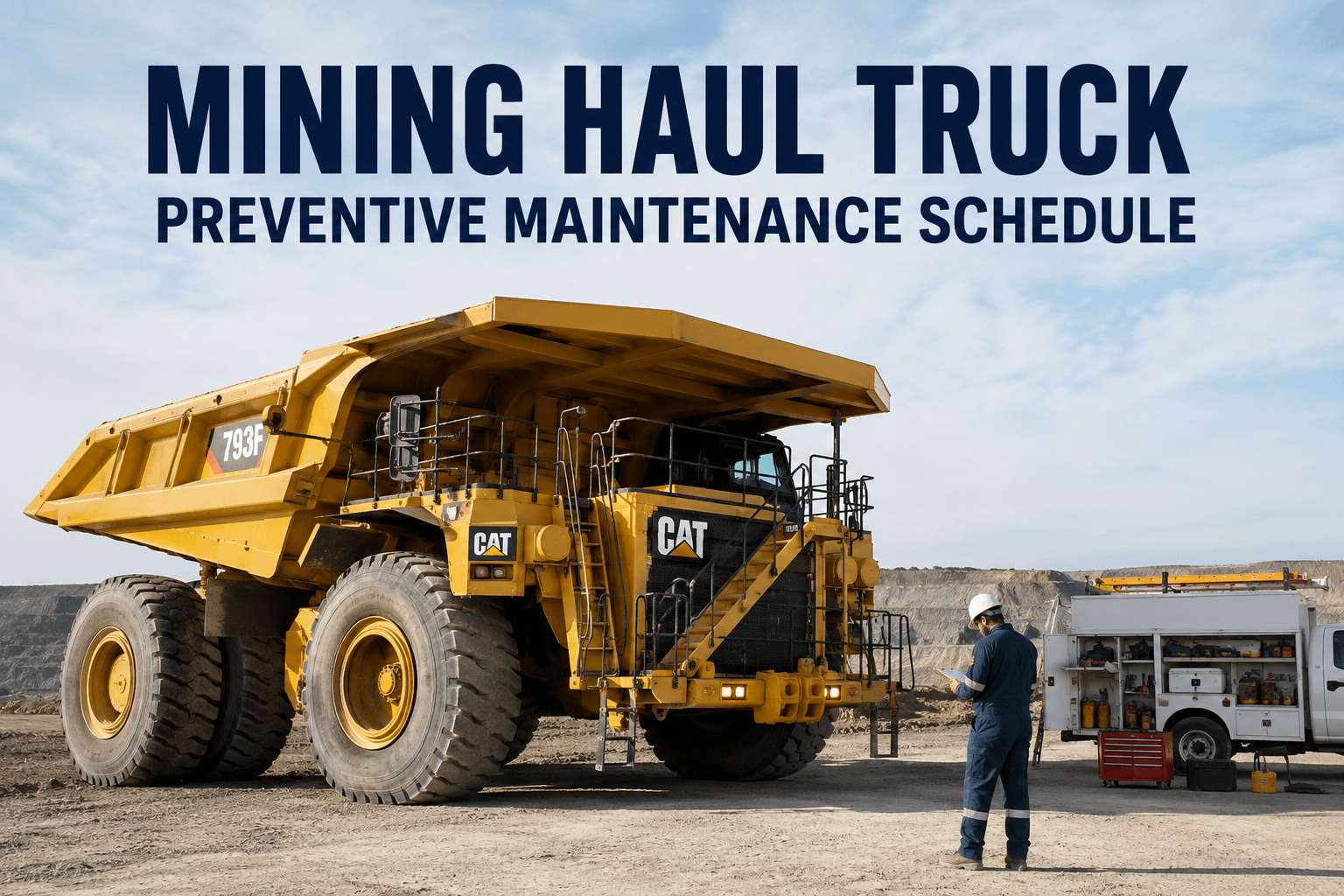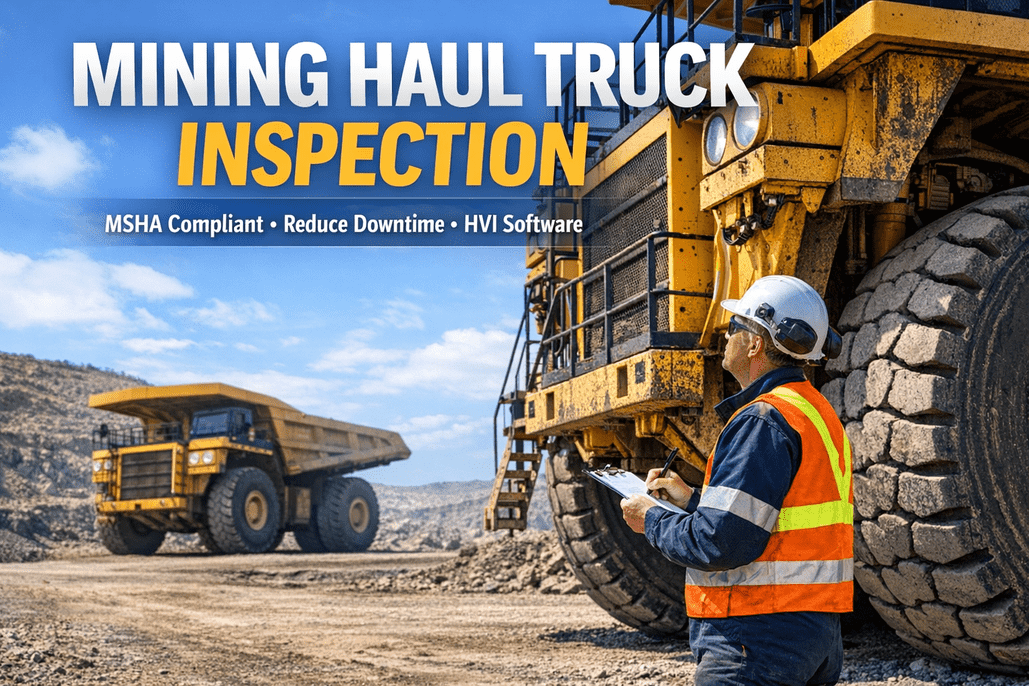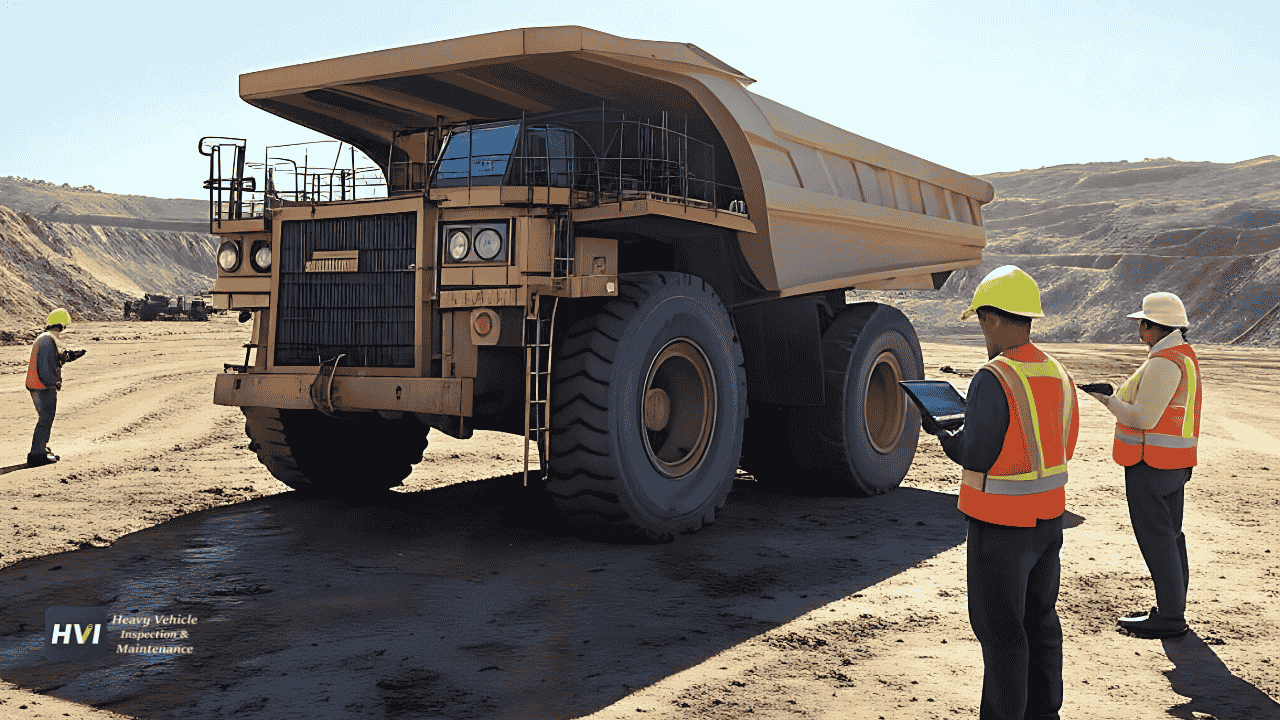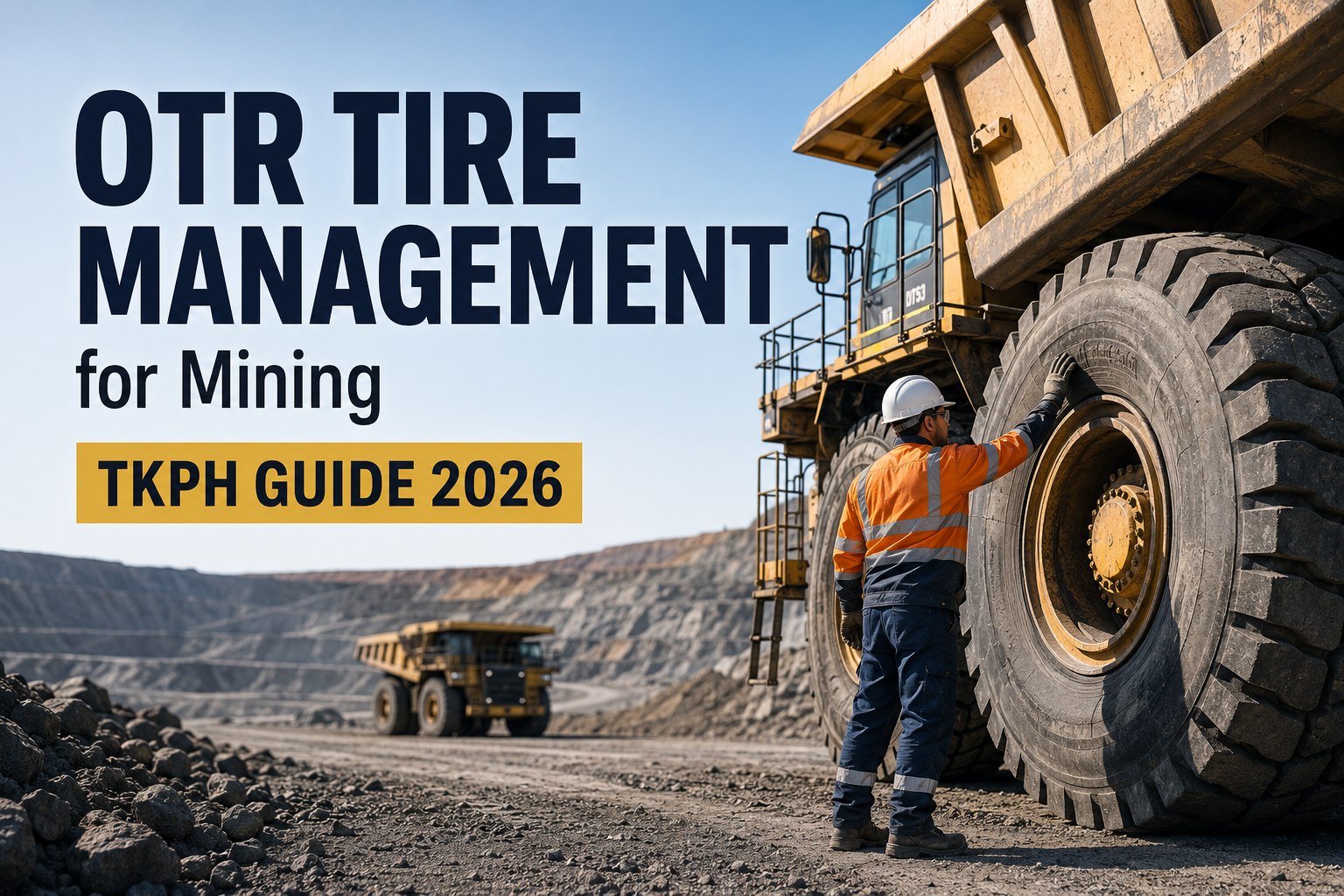
A single Caterpillar 793 haul truck runs on six tires that cost between $60,000 and $100,000 each — call it half a million dollars of rubber wrapping every one of the trucks moving ore out of the pit. Multiply that across a fleet of 40 to 200 haul trucks and OTR tire management mining operations run becomes one of the largest controllable operating expenses on the site. Tire life at that scale is measured in weeks to twelve months depending on how the pit is run — and the difference between the two extremes is discipline, not luck. It's the discipline of matching TKPH (Ton-Kilometer Per Hour) capacity to real site operating conditions, catching cut damage before it propagates into a full carcass failure, maintaining exact inflation pressure across shifting ambient temperatures, and running inspection cadences that don't get skipped when production is running hot. This guide is the operational playbook mining teams use to extend haul truck tire life by 15-25%, cut catastrophic failures to near zero, and turn tire spend from a black box into a measurable KPI. Book a mining demo to see the platform running on your pit.
TKPH: the number that keeps a $600,000 set of tires alive.
If the tire's operating Ton-Kilometer Per Hour exceeds its rated TKPH, layer separation is not a risk — it's a certainty. Here's how the math works.
Why OTR mining tires are managed differently from every other fleet tire
A commercial truck tire fails and the truck goes to the shoulder for an hour. An Ultra Class OTR tire fails and a $6M haul truck goes out of service for 8-16 hours at minimum, the tire itself is a total loss at $60,000-$100,000, and the pit operation loses production while dispatch reroutes. The economic differential drives everything about how mining tires are managed. Six factors make the discipline uniquely demanding.
A commercial semi tire costs $500-$800. An Ultra Class OTR tire (40.00R57 up to 63/80R63) costs $60,000-$100,000+ each. A single Caterpillar 793 or Komatsu 830E rolls on $360,000-$600,000 of rubber. Getting tire management wrong at this cost basis is not a rounding error.
OTR mining tire life ranges from several weeks to twelve months depending on site conditions. Same tire, same truck, different mine sites can show 3x variance in tire hours before change-out. The discipline that controls the variance is what separates well-run pits from expensive ones.
Consumer tires wear evenly to the wear bar. OTR mining tires fail catastrophically — cuts propagate to full separation in a single haul cycle, overheating triggers layer separation in minutes, impact damage compromises structural integrity instantly. There's no "checking the wear" between events.
Every OTR tire has a manufacturer-published TKPH rating. Every mine site produces a real operating TKPH from load, speed, and cycle math. If site TKPH exceeds rated TKPH, layer separation is the mathematical outcome — not a probability. Managing this delta is the daily work of the tire manager.
Ultra Class OTR tires have 6-12 month lead times from manufacturers (Bridgestone, Michelin, Goodyear). Tire shortages have driven mines to run under-spec tires on cycles that exceed their TKPH capacity — a compromise that shows up as increased failure rates 3-6 months later.
Ultra Class tire failure at speed can cause haul truck instability, roll-over risk, and material spillage in populated pit areas. Tire safety is not just cost management — it's a Zero Harm KPI on every major mining operation and reports to the CEO monthly.
Every factor above compounds. Get any one wrong and the tire economics collapse; get all six right and tire life extends to the top of the range while unplanned change-outs approach zero. Book a mining demo to see integrated tire management running on real pit data
The 6 site conditions that modify real TKPH
Manufacturer-rated TKPH is a nominal value under standardized conditions. Real site TKPH gets modified by the actual conditions the tire operates in — and the delta between nominal and real can be 20-40% in either direction. Six site conditions dominate the modifier calculation.
Temperatures above 30°C significantly reduce effective TKPH capacity — the tire cannot dissipate heat as fast. Below 15°C, effective TKPH can actually increase. Chilean and Australian summer conditions can drop usable TKPH by 15-20% versus winter operations.
Impact: ±15-20% on effective TKPHSustained grades above 8% dramatically increase power demand, engine loading, and drive-tire torque. Steep-pit operations show 20-30% higher effective TKPH on drive-position tires versus steer-position tires on the same cycle. Route grade modeling matters.
Impact: 20-30% higher on drive positionsUnderinflation by 10% below spec increases sidewall flex, heat generation, and effective TKPH by 15-20% — a tire rated for 1,450 t·km/h effectively becomes a 1,200 t·km/h tire when 10% underinflated. Overinflation reduces contact patch but increases impact damage risk.
Impact: 15-20% for every 10% underinflationPoor road maintenance (potholes, spilled material, rock fragments, standing water) accelerates cut damage exponentially. Every 10-minute delay in road maintenance across a shift compounds to measurable increases in unplanned change-outs. Road quality is a tire-life KPI.
Impact: 2-4x cut damage rate on poor roadsLonger haul cycles (10+ km) generate more heat over the cycle before tire cooling can catch up. A 15-km haul on the same truck can push effective TKPH 25-30% above a 5-km haul with identical payload and speed. Route length changes must trigger TKPH re-calculation.
Impact: 25-30% for cycles above 10 kmTruck payload variance impacts TKPH more than average payload does. A truck with nominal 250-tonne rating that averages 265 tonnes on some cycles pushes those cycles above rated TKPH. Payload distribution monitoring is a tire-life protection tool.
Impact: Overload cycles 3-5x failure rateEvery one of the six modifiers gets tracked in a serious tire program — not once when the tire is spec'd, but continuously as conditions change through the operating year. Book a mining demo to see real-time TKPH modifier tracking on your fleet
The 4 catastrophic OTR failure modes — and how each is prevented
Every OTR tire failure resolves to one of four modes. Each has distinct root causes, warning signs, and prevention strategies. Understanding which mode is which is the difference between managing tires and reacting to them.
What happens: Sharp rock, spilled material, or road debris punctures the tire tread and progresses through the casing plies. Small cuts can propagate to full carcass failure across a single haul cycle.
Root causes: Poor haul road maintenance, material spillage from over-filled trucks, blast debris not cleared from roads, transitioning surfaces without cleaning.
Prevention: Aggressive road-maintenance schedule (grader passes per shift), spillage-cleanup KPIs, cut-resistant tire compounds on cut-prone routes, walkaround inspection every 12 hours to catch progressing cuts before failure.
What happens: Operating TKPH exceeds the tire's rated capacity, internal temperature rises beyond the compound's design threshold, and layer separation occurs between the tread and casing plies. Failure is catastrophic and often unrecoverable.
Root causes: Route length increased without TKPH re-check, payload consistently above nominal, tire under-inflated, ambient temperature above assumption, wrong tire compound specified.
Prevention: Real-time site TKPH monitoring, TPMS with temperature alerts, payload weighing at load-out, quarterly TKPH review against actual operating conditions, correct rubber compound for the duty cycle.
What happens: Repeated stress at switchbacks, tight corners, and grade transitions causes the tread-to-casing bond to fatigue. Separation initiates as a small delamination and propagates until the tread section detaches.
Root causes: Poor haul-road geometry with tight switchbacks, aggressive cornering speeds, transitioning between hard and soft surfaces at speed, improper tire matching between duals.
Prevention: Haul-road geometry review, speed governance in corners, dual tire circumference matching, thermal imaging inspection quarterly to catch early delamination.
What happens: Sudden impact with a large rock, ore chunk, or road hazard compromises casing structural integrity. Sometimes visible immediately, sometimes latent damage that fails days or weeks after the impact event.
Root causes: Rocks in haul road left uncleared, blast debris migration onto active roads, over-driving hazards at speed, load-zone geometry allowing spillage.
Prevention: Impact detection via TPMS shock sensors, immediate inspection after any known impact event, road-condition inspection every 4 hours, structured post-blast road cleanup before resuming production.
Roughly 40% of catastrophic OTR failures are cuts, 30% overheating, 20% mechanical separation, and 10% impact damage — distribution varies by site and duty cycle. All four are preventable with proper tire management discipline. Start a free trial to configure failure-mode tracking on your fleet.
Tire inspection cadence — from operator walkaround to detailed audit
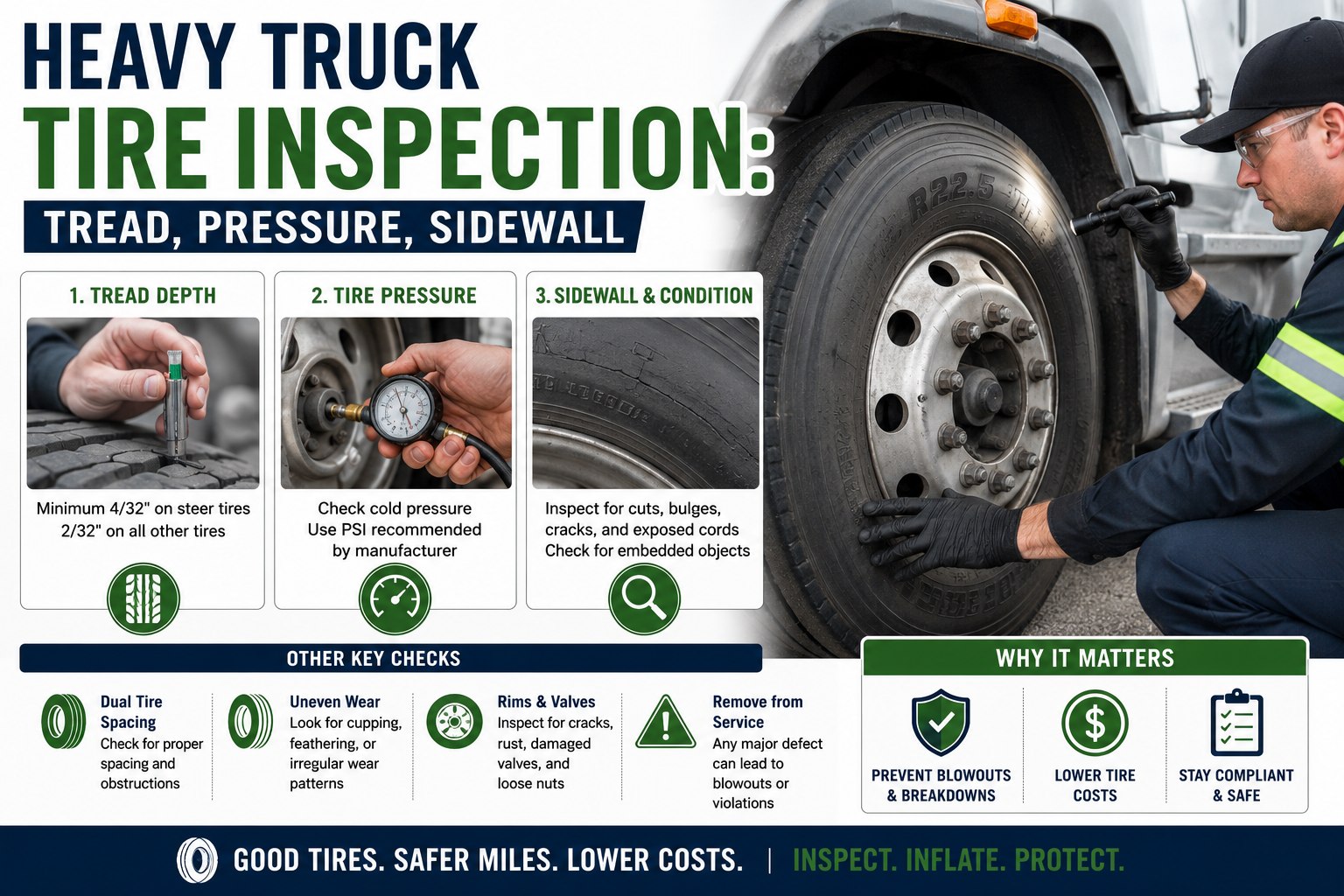
OTR tire inspection is not a single event but a nested cadence — brief operator checks at shift change, structured mechanic inspections weekly, comprehensive tire-team audits monthly, and full-teardown analysis at change-out. Skipping any tier compromises the ones above.
Operator walkaround — 5 minutes
- Visual check of all 6 tires from ground level
- Obvious cut, tear, or bulge identification
- Wheel-nut visual check for movement or missing
- Sidewall damage flag for any visible marking
- Digital DVIR entry with photos of any concerns
Detailed inspection — 30 minutes
- Close-range visual of tread, sidewall, bead area
- Tread-depth measurement (minimum 4 positions/tire)
- Cold pressure measurement all 6 positions
- Wheel-nut torque check (minimum 3 lugs/wheel)
- TPMS sensor data review since last inspection
- Photo documentation of any wear or damage patterns
Comprehensive audit — 2 hours
- Thermal imaging scan for latent separation
- Ultrasonic thickness measurement at multiple points
- Rotation and rim inspection for damage
- Cost-per-hour analysis vs fleet average
- TKPH trend analysis for the month
- Change-out projection based on wear rate
Full analysis — 4 hours
- Root-cause analysis of removal reason
- Total hours and total tonne-km at removal
- Historical failure-mode pattern update
- Compound-vs-cycle performance data capture
- Feedback loop to tire selection for next set
- Warranty claim submission if applicable
The cadence stack is what turns tire management from reactive to predictive — each tier catches what the tier above it missed, and the change-out post-mortem feeds intelligence back into the selection and monitoring cycles. Start a free trial to configure the four-tier cadence with your tire team.
TPMS integration — the always-on monitoring layer
Modern OTR tire management pairs walkaround inspection cadence with continuous Tire Pressure and Temperature Monitoring (TPMS). In-tire sensors report pressure and temperature every few seconds via 900 MHz or LoRa radio to fixed pit-side receivers or truck-mounted gateways — delivering the missing data layer between inspection cycles.
Modern OTR TPMS sensors deliver sub-PSI accuracy at ambient temperatures from -40°C to +85°C. Continuous monitoring catches gradual under-inflation before it exceeds the 10% threshold that begins TKPH degradation.
Internal tire temperature measurement is the leading indicator of TKPH stress. Sensors report temperature at 5-30 second intervals and alert when readings cross thresholds set by the tire manufacturer.
Mining operations running integrated TPMS + inspection programs consistently report 15-25% tire life extension in the first 12 months, driven by earlier defect catching and better pressure discipline.
Michelin's published data on MEMS TPMS deployments cites up to 20% annual tire cost reduction — combining life extension, fewer catastrophic failures, and reduced fuel consumption from correct inflation.
The tire management platform is where TPMS data becomes decisions. Inspection findings, TPMS pressure/temperature streams, TKPH calculations, cost analytics, and work orders live in one system — delivering the visibility that turns tire spend from a black box into a controllable KPI. Book a mining demo to see the integration on your existing TPMS.
From a Tire Manager who dropped tire cost per operating hour by 22%
We run 68 Cat 793F haul trucks at a copper operation in Chile. Tire spend was $14 million annually and rising, catastrophic failures ran about one per week averaged across the year, and our tire life sat right in the middle of the industry range with no discipline for driving it higher. Our TPMS gave us pressure data but nobody was building operational decisions off it.
We rolled out integrated tire management in Q2 last year — real-site TKPH monitoring per truck, TPMS data flowing into the inspection platform, four-tier inspection cadence enforced by the shift boss, and change-out post-mortem on every set removed. First year: tire life extended 24%, catastrophic failures dropped from ~52 per year to 7, and our cost per operating hour on tires came down 22%. The tire program didn't need more spending — it needed the discipline and data infrastructure to run properly.
Frequently asked questions
What is TKPH and how do you calculate it for haul truck tires?
TKPH stands for Ton-Kilometer Per Hour (or TMPH — Ton-Mile Per Hour — in imperial units) and expresses the thermal load a tire can safely sustain from the combination of payload, speed, and cycle length. The real-site TKPH formula is: TKPH = ((Loaded Weight per Tire in tonnes × Loaded Distance in km) + (Empty Weight per Tire in tonnes × Empty Distance in km)) / Total Cycle Time in hours. A simplified version used for approximations is TKPH = Average Tire Load (tonnes) × Average Speed (km/h). Every OTR tire has a manufacturer-published TKPH rating printed on the sidewall — typical values for Ultra Class mining tires range from 800 to 1,800 t·km/h depending on compound and construction. If the site operating TKPH exceeds the tire's rated TKPH, internal temperature rises beyond the compound's design threshold, and layer separation between the tread and casing plies becomes mathematically certain rather than a probability. Managing this delta — keeping site TKPH comfortably below rated TKPH with margin for site-condition modifiers like ambient temperature, route grade, and inflation pressure — is the fundamental daily discipline of any competent mining tire management program.
How long do mining haul truck tires typically last?
Ultra Class OTR mining tire life varies dramatically by site conditions and operational discipline — the published range is anywhere from several weeks in the worst cases to more than twelve months in the best-managed operations. Typical mid-range performance runs 4,000-8,000 operating hours per tire before change-out, translating to roughly 6-9 months of production time on an actively producing haul truck. The variance is driven by six factors: haul cycle length (longer cycles reduce life), ambient temperature (hot climates reduce life), road condition (poor roads accelerate cuts), payload discipline (overloading accelerates wear), TKPH margin (operating too close to rated capacity reduces life), and inspection cadence (missed defect catches lead to earlier failures). Well-run operations with integrated TPMS, TKPH monitoring, four-tier inspection cadences, and disciplined road maintenance consistently extend tire life 15-25% beyond baseline — which translates directly to significant tire spend reduction given the $60,000-$100,000+ per-tire cost basis. Best-in-class operations achieve tire cost per operating hour that's 20-25% below industry median through consistent execution of these disciplines rather than any single magic bullet.
What are the most common OTR mining tire failure modes?
Four failure modes account for essentially all catastrophic OTR mining tire failures. Cuts (roughly 40% of failures) result from sharp material impact — rocks, spilled ore, blast debris on haul roads — with damage progressing from surface cut to full casing failure often within a single haul cycle. Prevention: aggressive road maintenance, spillage cleanup, cut-resistant compounds on cut-prone routes. Overheating and layer separation (roughly 30% of failures) occur when operating TKPH exceeds rated TKPH, causing internal temperature to rise beyond the compound threshold and delaminating the tread from the casing plies. Prevention: real-time site TKPH monitoring, TPMS temperature alerts, correct compound selection for duty cycle. Mechanical separation (roughly 20% of failures) results from repeated stress at haul-road switchbacks, tight corners, and grade transitions causing tread-to-casing fatigue. Prevention: haul-road geometry review, speed governance, dual tire matching, thermal imaging. Impact damage (roughly 10% of failures) results from sudden shock loading when hitting rocks or road hazards — sometimes visible immediately, sometimes latent damage that fails days or weeks later. Prevention: impact-detection TPMS, immediate post-impact inspection, aggressive road-condition management. All four modes are preventable with proper discipline — well-run mining operations reduce catastrophic failures from industry-typical rates of 40-60 per year on a mid-size fleet to under 10 per year within 12 months of implementing integrated tire management.
Do we need TPMS for OTR mining tires?
Yes, and TPMS has become effectively standard on serious mining operations for both economic and safety reasons. Modern OTR TPMS delivers ±0.1 PSI pressure accuracy and ±1°C temperature resolution across ambient ranges from -40°C to +85°C, reporting continuously every 5-30 seconds via in-tire sensors to pit-side or truck-mounted receivers. The economic case is straightforward: Michelin's published data on their MEMS TPMS product cites up to 20% annual tire cost reduction, and mining operations running integrated TPMS + inspection programs consistently report 15-25% tire life extension in the first 12 months. The mechanism: continuous pressure monitoring catches gradual under-inflation before it exceeds the 10% threshold that begins to degrade effective TKPH capacity by 15-20%, and temperature monitoring provides the leading indicator of TKPH stress before layer separation occurs. Safety cases are equally strong — Ultra Class tire failures at speed can cause haul truck instability, roll-over risk, and material spillage in populated pit areas. Major mining operators (BHP, Rio Tinto, Anglo American, Codelco, Antofagasta) now specify TPMS as baseline capability on new haul truck orders. The remaining strategic decision is which TPMS platform, how to integrate the data with the inspection and maintenance platform, and how to build operational decisions from the continuous data stream — which is where integrated tire management platforms deliver the outcome differentiation over standalone TPMS deployments.
What's the ROI of a proper OTR tire management program?
For a mid-size mining operation running 40-80 haul trucks with annual tire spend in the $8-20 million range, integrated OTR tire management typically delivers 6-9 month payback and 300-500% annual ROI in the first year. The measurable outcomes across mid-large mining operations include: 15-25% tire life extension driving proportional tire spend reduction, catastrophic failure rate reduction from 40-60 per year on baseline programs to under 10 per year, downtime hour reduction of 400-1,200 per year from fewer emergency change-outs, tire cost per operating hour reduction of 18-25% as a bottom-line KPI, and productivity gains from higher fleet availability. On a $14 million annual tire spend baseline, a 22% tire cost per operating hour improvement translates to roughly $3 million per year of direct savings — not counting the downtime, productivity, and safety benefits from fewer catastrophic events. The payback math is even stronger for operations running very high-cost Ultra Class tires (63-inch rim and above) where per-tire costs run $80,000-$120,000+ and a single prevented catastrophic failure often covers the annual platform cost. The discipline required is real — it takes six months to a year to institute the four-tier inspection cadence, TKPH monitoring, and TPMS-driven workflows properly — but the operational and financial upside compounds every quarter after go-live.
$600,000 of rubber per truck. One platform to protect every dollar of it.
HVI's mining tire management module combines real-site TKPH monitoring, TPMS integration with any provider, four-tier inspection cadence enforcement, cost-per-hour analytics, and change-out post-mortem workflows into one system built specifically for surface mining operations. Live for your pit in 6-8 weeks — typical mining operations see 15-25% tire life extension and 18-25% tire cost per operating hour reduction in year one.
Works with Bridgestone, Michelin, Goodyear, MAXAM · Compatible with Rimex TyreSense, Michelin MEMS, TMS-Remote · Copper, iron, coal, gold, oil sands