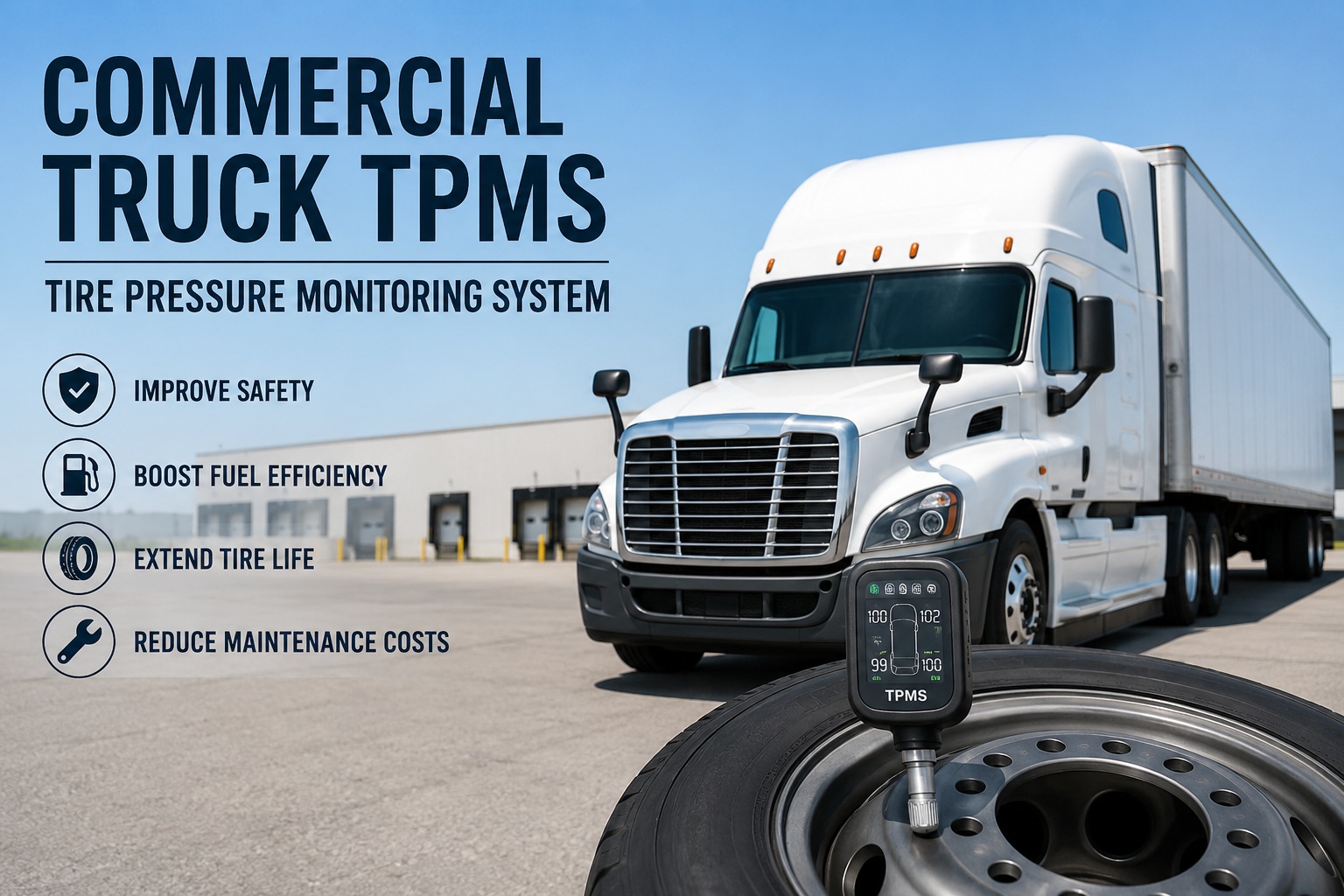
Commercial truck TPMS (tire pressure monitoring system) is one of the highest-ROI investments a fleet can make in 2026 — typically paying back purchase and installation inside 12 months through fuel savings, extended tire life, and prevented blowouts. Unlike passenger vehicles covered under FMVSS 138, Class 8 commercial trucks have no federal TPMS mandate, so the adoption decision comes down to economics rather than compliance. This commercial truck TPMS guide walks the two main system types (direct sensors reporting actual pressure vs indirect systems inferring pressure from wheel-speed data), the three direct sensor styles and when each fits, real cost breakdown by fleet size, integration with fleet inspection and telematics systems, and the five common mistakes fleets make with TPMS deployment. Book a demo after you see how TPMS integrates with the full fleet compliance workflow.
Direct TPMS vs Indirect TPMS vs No TPMS
Three tire monitoring approaches for commercial fleets. Different cost, different accuracy, different fleet fit. Below is what each actually delivers in real service.
Direct TPMS
Indirect TPMS
No TPMS (manual)
The comparison above frames the technology decision. Below is the deeper buyer's view: the three direct sensor types and when each fits, the real cost breakdown by fleet size, how TPMS integrates with fleet inspection and telematics, and the five common mistakes fleets make during deployment.
The 3 direct TPMS sensor types — which one fits your fleet
Direct TPMS is the accurate choice for most commercial fleets, but not all direct sensors are the same. Three mounting styles dominate the commercial market, each with distinct install, service, and reliability characteristics.
Internal (valve-stem mounted)
Sensor screws onto the valve stem inside the tire. Most common OEM factory installation. Highest reliability and signal integrity because sensor is inside the tire's protected environment.
External (valve-cap mounted)
Sensor screws onto the outside of the valve stem, replacing the cap. Most common retrofit style because installation takes minutes without dismounting the tire. Vulnerable to theft and damage from road debris.
Fabric-banded (wheel-mounted)
Sensor mounts on a fabric or Velcro strap inside the wheel drop-center. Higher signal reliability than external sensors, no valve stem interference, better durability than valve-mounted units under rough duty cycles.
The right sensor type depends on how the fleet operates. OEM factory installs favor internal sensors; existing fleets doing large-scale retrofits typically go external for speed; specialized cargo or off-road applications benefit from fabric-banded reliability. Book a demo to see per-vehicle sensor tracking and pressure history in HVI
Commercial truck TPMS cost breakdown by fleet size
TPMS cost per truck varies significantly by fleet size, sensor choice, and installation approach. Below is the realistic budget range for three typical fleet profiles — and the payback timeline for each.
Savings estimates above draw from U.S. Department of Energy fuel-per-PSI data (0.3% fuel loss per 1% pressure drop) and industry-reported tire life extension of 15–25%. Actual fleet results vary by duty cycle, driver behavior, and tire quality. Start free and model your fleet's TPMS ROI
TPMS + inspection + telematics — the integrated fleet workflow
Standalone TPMS delivers real-time pressure data. Integrated TPMS turns that data into work orders, predictive maintenance triggers, and CSA-friendly inspection records. The integration is where fleets capture the full ROI.
Sensor detects deviation
PSI or temperature crosses threshold. Signal transmitted to receiver on the truck within seconds of the deviation.
Alert routed by severity
Info-level alert logged to dashboard. Warning alerts driver in-cab. Critical alerts driver + fleet manager immediately.
Work order auto-generated
Critical alerts create a service work order routed to the nearest terminal. Info-level items batch into the next PM.
Repair verified + logged
Mechanic sign-off closes the loop. Tire pressure history preserved for CSA record and warranty defense.
The #1 reason TPMS deployments underperform isn't the technology — it's alert overload. When drivers get too many non-critical notifications, they start ignoring all of them, including the ones that matter. Structured alert tiers and clear response protocols make the difference between a system that prevents failures and one that gets muted. Book a demo to see three-tier alert routing in production
5 common mistakes fleets make with commercial truck TPMS deployment
Every fleet that gets subpar TPMS ROI can trace the underperformance to one of five recurring mistakes. All five are preventable with the right deployment plan.
Choosing indirect TPMS to save upfront cost
Fleet picks indirect TPMS because it's cheaper. First year, blowout rate is unchanged because indirect misses the gradual 5–15% underinflation that drives most fuel and tire waste. Money "saved" on sensors gets spent multiple times over on tires and fuel.
External sensors without theft-loss planning
Fleet retrofits with external valve-cap sensors because installation is fastest. First year, 8–12% of sensors go missing to theft, damage, or off-road impact. Replacement costs erode the ROI.
No alert-tier structure — drivers ignore everything
TPMS system alerts on every 3 PSI deviation, most of them normal temperature-related. Drivers get 20+ alerts per shift, tune them out entirely, then miss the real critical alert three months later.
Skipping trailer TPMS to save budget
Fleet installs TPMS on tractors only, skips trailers because "trailers rotate too often." Trailer tires actually blow more often than tractor tires because they're harder to inspect and drivers spend less time near them.
TPMS as standalone data instead of workflow integration
Fleet buys TPMS and looks at pressure data on the dashboard. Nobody creates work orders from alerts. Nobody feeds the pressure history into PM scheduling. Data exists but no workflow acts on it. All the potential value stays theoretical.
Every mistake above compounds silently across the fleet until the first roadside blowout or the first quarterly ROI review that comes in below projection. Get the deployment right the first time. Book a demo to see integrated TPMS workflow — or start free and integrate your existing TPMS this week .
From a fleet maintenance director on year-one TPMS results
We retrofitted external valve-cap sensors on 60 tractors and 40 trailers in Q1. First quarter felt underwhelming — sensors just told us what we already suspected: half our trucks were rolling on tires 8–12% underinflated on any given day. But the real value showed up months 4 through 12.
Blowout rate dropped 70%. Fuel efficiency improved 1.6% fleet-wide. Tire replacement cost per truck dropped $340 in year one. Payback landed at 9 months. The lesson: TPMS is a slow-burn investment, not an overnight fix. Set alert tiers correctly, integrate with work orders, and the ROI compounds every quarter.
Frequently asked questions
What is a commercial truck TPMS?
A commercial truck TPMS (Tire Pressure Monitoring System) is a fleet safety and efficiency technology that continuously monitors tire pressure across every wheel position on a truck or trailer and alerts drivers or fleet managers when pressure deviates from spec. Two main approaches exist: direct TPMS uses physical sensors mounted inside each tire (or on the valve stem) that report real-time PSI and temperature data via radio to a receiver in the cab; indirect TPMS uses the ABS wheel-speed sensors already on the truck to detect low tires by comparing rotation speeds across wheels. Direct TPMS delivers actual pressure measurements accurate to about ±1 PSI; indirect TPMS provides alerts only, no measurement. For a typical Class 8 tractor-trailer with 18 tire positions, direct TPMS retrofit runs $500–800 per vehicle and pays back through fuel savings, extended tire life, and prevented blowouts — typically within 12 months.
Direct vs indirect TPMS — which is better for a commercial fleet?
Direct TPMS is the better choice for the vast majority of commercial fleets. The economics are clear: direct TPMS delivers real PSI measurements accurate to ±1 PSI on every tire, catches the gradual 5–15% underinflation that drives most fuel and tire waste, and typically returns 3–5x its cost in year-one fuel and tire savings. Indirect TPMS, which uses ABS wheel-speed data, only alerts on significant underinflation (typically 20%+ pressure loss) and provides no actual measurement — it misses the exact gradual pressure loss most costly to the fleet. Indirect TPMS makes sense only in narrow cases: as a bundled OEM option on a new truck, as a backup layer on low-mileage or off-highway vehicles, or when budget genuinely doesn't permit direct TPMS. For long-haul OTR, regional, and any fleet where fuel and tire life matter, direct TPMS pays back its higher upfront cost inside 12 months.
Are TPMS required by law for commercial trucks?
No federal U.S. mandate requires TPMS on Class 8 commercial trucks. The federal TPMS mandate under Federal Motor Vehicle Safety Standard 138 (FMVSS 138) applies only to passenger vehicles and light trucks under 10,000 lbs GVWR. Class 7 and Class 8 commercial trucks are exempt from the mandate, so TPMS adoption on commercial fleets is entirely voluntary and driven by economics rather than compliance. That said, growing insurance pressure, shipper safety requirements, and CSA scoring implications are pushing adoption. Some large shippers now require carriers to have TPMS on trucks hauling high-value or hazmat cargo. Insurance premiums increasingly reflect TPMS presence in the underwriting model. And under the 2026 CSA overhaul, any tire-related roadside violation carries doubled severity weight in the Vehicle Maintenance BASIC. Voluntary adoption is now the default expectation on any professionally run commercial fleet.
How much does a commercial truck TPMS system cost?
Commercial truck TPMS cost varies by sensor type, fleet size, and installation approach. For a typical Class 8 tractor-trailer with 18 tire positions, retrofit direct TPMS runs $500–800 per vehicle for external valve-cap sensors, $700–1,000 for internal or fabric-banded sensors, and $200–500 per vehicle when specified as an OEM factory option on a new truck order. Fleet-wide costs scale linearly: a 25-truck fleet retrofit runs $12,500–25,000; a 100-truck retrofit runs $50,000–100,000. Fleet dashboard software adds $25–50 per truck per month for integrated monitoring. Annual savings from direct TPMS typically run $900–1,800 per truck through improved fuel economy (1–3%), extended tire life (15–25%), and prevented blowouts and roadside failures. Payback period is typically 6–12 months for retrofit installations, and 3–8 months for OEM-specified installs on new equipment.
What's the ROI of TPMS for a commercial fleet?
Commercial truck TPMS ROI is driven by four measurable outcomes: fuel savings, tire life extension, prevented blowouts, and reduced roadside service events. On fuel: the U.S. Department of Energy notes that every 1% drop in tire pressure causes a 0.3% rise in fuel consumption, and an FMCSA study found TPMS/ATIS systems improve fuel economy by approximately 1.4% on average. On tire life: proper inflation extends tire life 15–25% by eliminating the uneven wear patterns underinflation creates. On blowouts: TPMS catches gradual pressure loss before it becomes a catastrophic failure, cutting roadside blowout rates 60–80% in most deployments. On roadside service: fewer blowouts means fewer emergency callouts, tow charges, and cargo delays. Total annual savings typically run $900–1,800 per truck depending on duty cycle, translating to a 6–12 month payback on retrofit and 3–8 months on OEM-specified installs.
Turn your commercial truck TPMS into a fleet-wide workflow
HVI ingests TPMS data from all major sensor vendors, routes pressure alerts by severity tier, creates work orders on critical alerts automatically, tracks per-tire pressure and temperature history for predictive maintenance, and integrates the whole loop with your pre-trip inspection workflow. Live in under two weeks.
No credit card · No hardware · TPMS integration ready day one