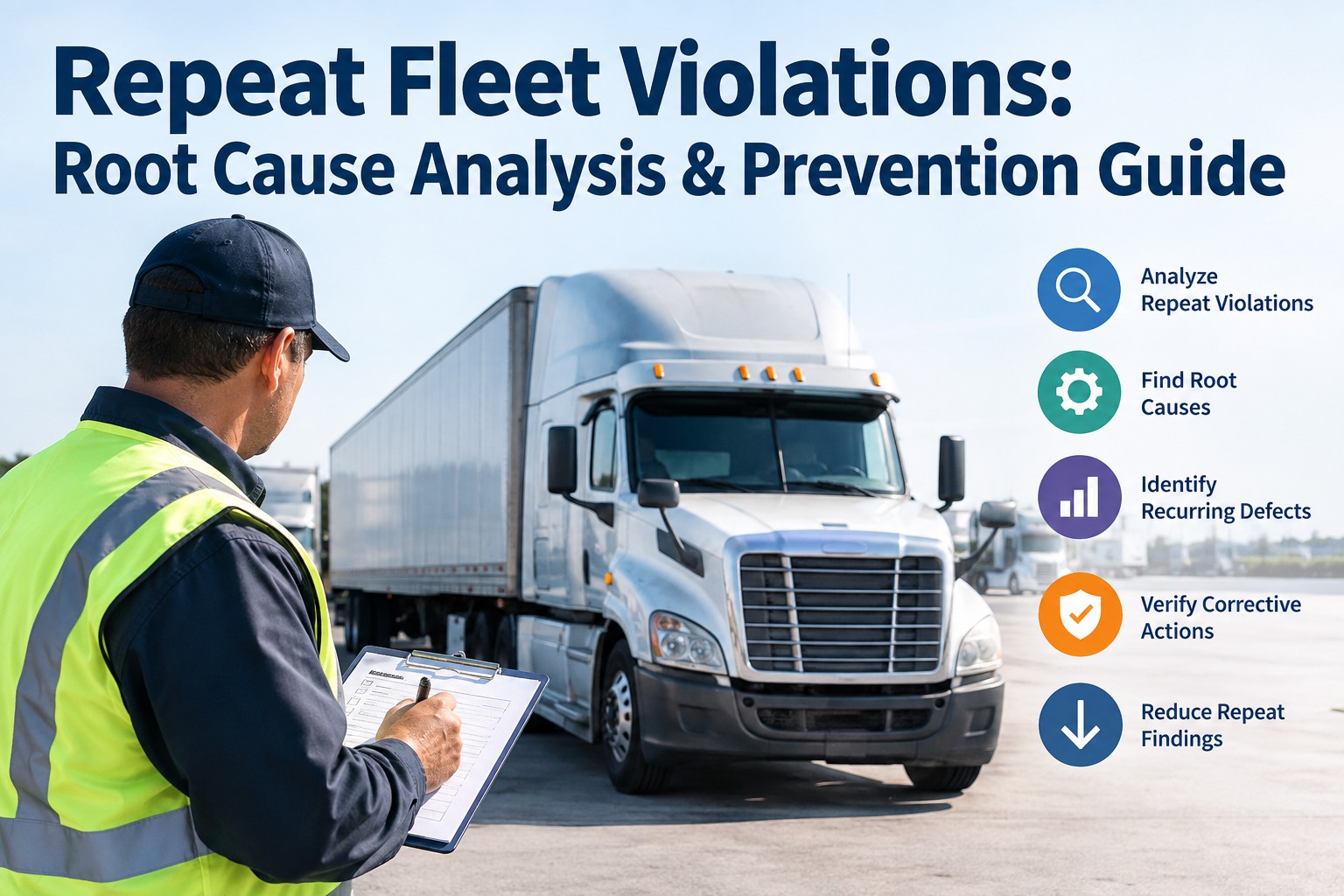
A first violation is bad luck. The same violation again is a message — and most fleets read it wrong. They fix the truck, close the ticket, and move on, only for the identical defect to surface a month later on the same unit, driver, or terminal. That recurrence is the single most damaging pattern a fleet can carry, because enforcement and plaintiff attorneys read repeat violations as proof of a systemic failure. But it's also a diagnostic gift: it tells you exactly where a system is broken. See recurring violations surfaced at asset level
A repeat violation is a clue — slice it to find the system
Pick what the recurrences have in common. The axis they concentrate on tells you which system is actually broken — and each one has a different fix.
The recurrence is the diagnosis. Whichever axis it concentrates on names the broken system — and points straight at the fix that actually stops it.
Every fleet has a compliance report. Very few actually analyse it — they watch the percentile, react when a threshold looms, and correct violations one at a time. The fleets that get ahead do something different: they treat the violation record as a dataset, hunt for patterns instead of incidents, and chase every repeat finding to a root cause and a verified fix. This guide walks that discipline: why repeats hurt more than they look, how to find the pattern, how to fix the cause rather than the symptom, and how to prove it stayed fixed.
Why a repeat violation hurts more than a first one
It's tempting to see two of the same violation as double the points. It's worse than that, in three compounding ways — and the deepest damage is what a pattern signals to the people reading your record.
CSA caps severity points from any single inspection, so the same defect spread across several inspections does more cumulative damage to your percentile than one loaded inspection. Recurrence beats concentration — not in your favour.
A documented pattern of the same finding is what an auditor treats as a "non-systematic" maintenance program — one of the primary triggers for a downgraded safety rating.
After a crash, plaintiff attorneys review CSA history and highlight repeats as evidence of systemic failure. A single lighting defect is a fix; the same one five times is a story someone tells about your fleet.
Book a demo to see repeat findings flagged before they become a pattern
Symptom fix vs. root-cause fix: why the loop stays open
The reason the same violation keeps coming back is almost always that the last "fix" addressed the immediate cause and never touched the root cause. Replacing a chafed hose stops today's leak; it doesn't stop the bracket that's chafing the next one. A corrective action that only addresses the immediate cause produces a temporary fix — the failure mode is still live, so it recurs.
- Replace the failed part, close the ticket
- Addresses what broke, not why it broke
- No verification the cause is gone
- Same defect returns — on the same unit or another
- Ask why the failure was possible at all
- Fix the process, spec, routing, or training gap
- Verify the defect doesn't recur within a set window
- Failure mode eliminated — pattern ends
The discipline behind this is a closed loop borrowed from reliability engineering: a finding is reported, an investigation identifies both the immediate cause and the underlying system, process, or training gap that allowed it, a corrective action with a named owner and a due date addresses the root, and — the step most fleets skip — the asset is monitored to confirm the failure hasn't recurred before the loop is closed. Root causes usually fall into three buckets: physical (a part, a spec, wear beyond tolerance), human (a rushed pre-trip, a training gap), or process (a PM interval, a missing inspection step). Naming which one is what turns a recurring violation into a solved one. Book a demo to see corrective actions tracked to verified non-recurrence
The pencil-whipped inspection: where repeats are born
One root cause hides behind all the others: the inspection that didn't really happen. When a pre-trip is rushed, skipped, or signed without being done, a defect that should have been caught in the yard rolls out to the road — where it becomes a roadside violation instead of a work order.
A fleet whose internal inspections keep passing units that then fail at the roadside has an inspection-quality gap, not just a maintenance gap. The most-cited defects — brakes, tires, lighting, coupling — are exactly the ones a real walkaround catches.
Compare what internal inspections flag against what roadside finds, score the correlation, and coach the drivers and locations whose "clean" checks keep producing surprises. Photo evidence on key items makes the walkaround real — hard to pencil-whip a check that demands a timestamped photo.
Closing this gap is often the single highest-leverage move against repeat findings, because it attacks the source, not the symptom. Book a demo to see internal inspection quality scored against roadside outcomes
Closing the loop: from pattern to verified prevention
Put it together and repeat-violation prevention is a repeatable four-step loop. It's not complicated — the discipline is in doing every step, especially the last one, which is the one that separates fleets that actually reduce repeats from fleets that just keep re-opening the same finding.
That last step is where documentation becomes your defence: showing that you identified the problem, corrected the condition, and established a control that prevented recurrence is exactly what an auditor wants to see — and exactly what turns a "non-systematic" narrative into a demonstrably systematic one. Prevention controls close the front door too: a dispatch lock that won't release a unit with an open critical defect stops a known problem from becoming a repeat roadside violation in the first place. The fleets that drive repeat findings down don't work harder at fixing violations — they work at not needing to fix the same one twice. Start free and build the closed loop into your inspection and dispatch workflow
The repeat-violation root-cause checklist
When the same finding shows up twice, run this before you close the ticket — it's the difference between a symptom fix and a fix that holds. Use this root-cause checklist online free, so every recurrence is sliced, traced, and verified against your live records.
From a compliance officer who stopped chasing percentiles
We were playing whack-a-mole with our Vehicle Maintenance BASIC for two years. Same lighting and brake findings kept coming back and we kept fixing them one at a time, watching the percentile like it was a stock ticker. It wasn't until a near-miss made me actually pull the data that I saw it: eighty percent of our repeats traced to two terminals and a handful of drivers whose pre-trips were basically fiction.
Once we could see the pattern by driver and location, the fixes got obvious — coaching for the drivers, a process audit at the two shops, and photo evidence required on the items that kept slipping through. The percentile followed, but that was the lagging indicator. The real change was that we stopped fixing the same violation twice. A repeat finding now gets treated as a question — what system let this happen again — not just another repair ticket.
Repeat fleet violation FAQs
Why are repeat violations worse than isolated ones for a fleet?
Beyond just adding points, recurrence compounds the damage. CSA math weights recent and repeated violations more heavily, so a pattern climbs your percentile faster than scattered one-offs. Worse, enforcement and plaintiff attorneys read a repeat finding as proof of a systemic failure, not bad luck — which raises audit and liability exposure well past the citation itself.
How do you do root cause analysis on recurring fleet violations?
Treat the violation record as a dataset, not a pile of isolated tickets. Slice recurring findings by type, vehicle, driver, and terminal — the axis they concentrate on names the broken system. A defect that repeats on one unit is a maintenance issue; across one terminal, a process issue; across one driver, a training issue. The concentration points straight at the fix.
What is corrective action verification and why does it matter?
Corrective action verification is confirming, after a fix, that the defect hasn't recurred over a defined monitoring window — before you call the finding closed. It matters because most fleets close the ticket when the repair is done, not when the fix is proven. Without a verification step, a symptom fix looks resolved while the root cause quietly reopens the loop.
How do pencil-whipped inspections cause repeat violations?
A pencil-whipped inspection — signed off without actually being performed — is a hidden root cause behind many repeats, because it launders a real defect onto the road as 'inspected.' The same fault keeps surfacing because it was never truly caught. Scoring inspection quality and requiring photo evidence on key items turns the walkaround back into a genuine filter.
Can you prevent repeat violations with dispatch controls?
Yes — they're one of the most direct prevention tools. A dispatch lock ties a truck's release to its defect status, so a unit with an open critical defect can't leave the yard until it's corrected and recorded. That physically stops a known problem from becoming another roadside violation, breaking the recurrence at the point it would otherwise repeat.
Turn repeat violations from a recurring cost into a solved problem
HVI surfaces recurring violations at vehicle, driver, and terminal level, links every finding to the asset's inspection history, scores inspection quality to expose the pre-trips that let defects through, documents corrective actions with photo evidence to verified non-recurrence, and can lock dispatch on an open critical defect. Find the pattern, fix the root cause, prove it held — and stop the same finding from coming back. See it on your own fleet.
No credit card · Repeat-violation analysis from day one · Corrective actions tracked to verification