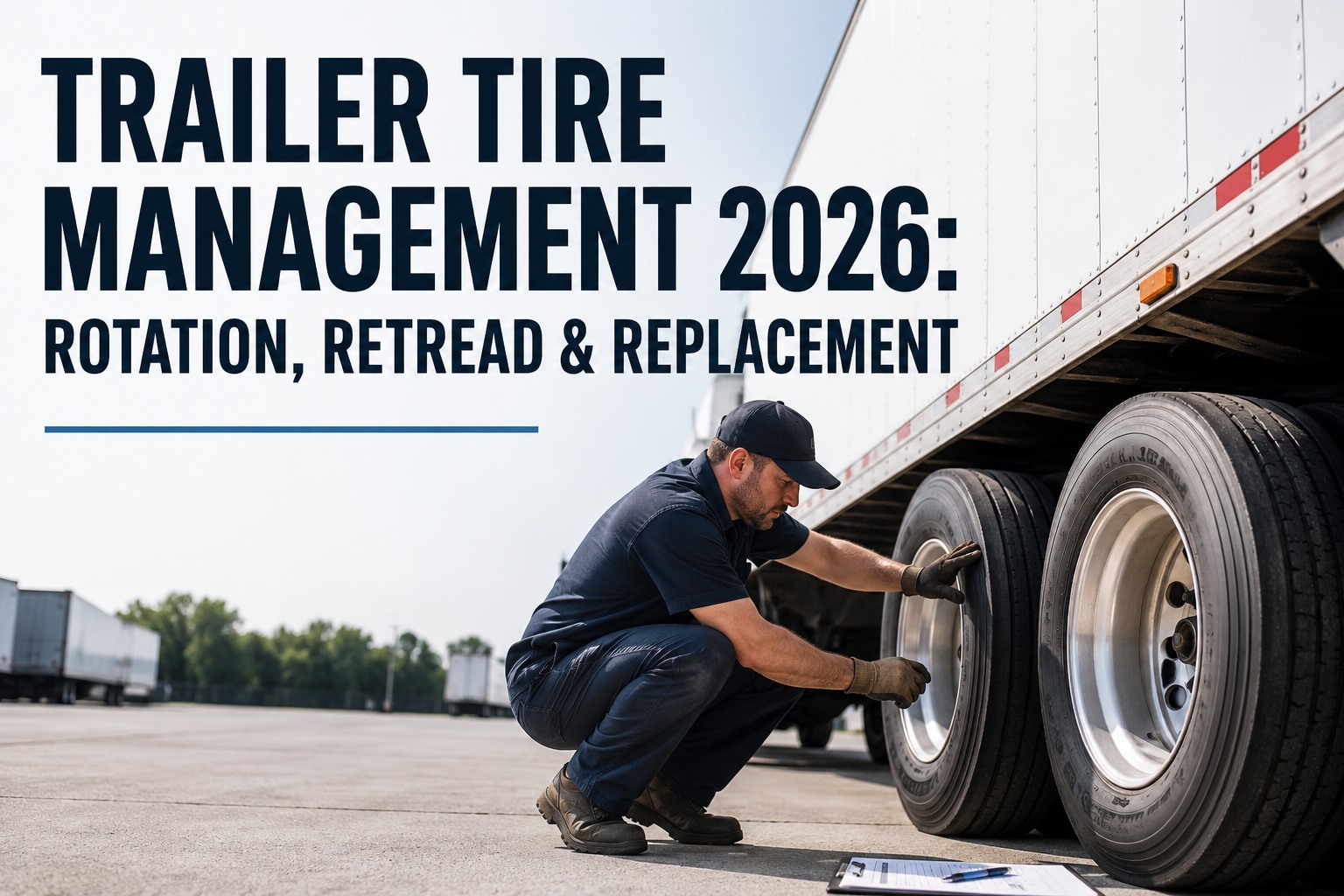
Trailer tires are the forgotten fleet asset. They sit in yards for days between loads, get checked less than any other position, and produce the highest silent cost per casing on the fleet — because nobody's watching. FMCSA data puts 1 in 5 trailers running at least one tire 20+ PSI low, and CVSA lists tire violations in the top out-of-service categories every year. This trailer tire management guide covers the wear patterns, rotation cadence, and retread economics that cut trailer tire spend in half. Book a demo
Eight positions. Eight casings. Eight cost centers you probably aren't tracking.
Every trailer wheel position wears differently. Every casing has its own retread eligibility, its own replacement window, and its own economics. Managed as one number, they cost 30-50% more than they should.
A drop trailer sitting in a yard for 96 hours with a slow leak reveals nothing on a walkaround that never happens. When it hooks up Monday morning and rolls 300 miles at 60 PSI instead of 100, the casing takes damage that won't show for another 20,000 miles — then the retread rejection at year three costs the fleet $400 the operator never traced back to the leak. That's the trailer tire economy in one sentence.
The trailer wheel map — where wear happens and why
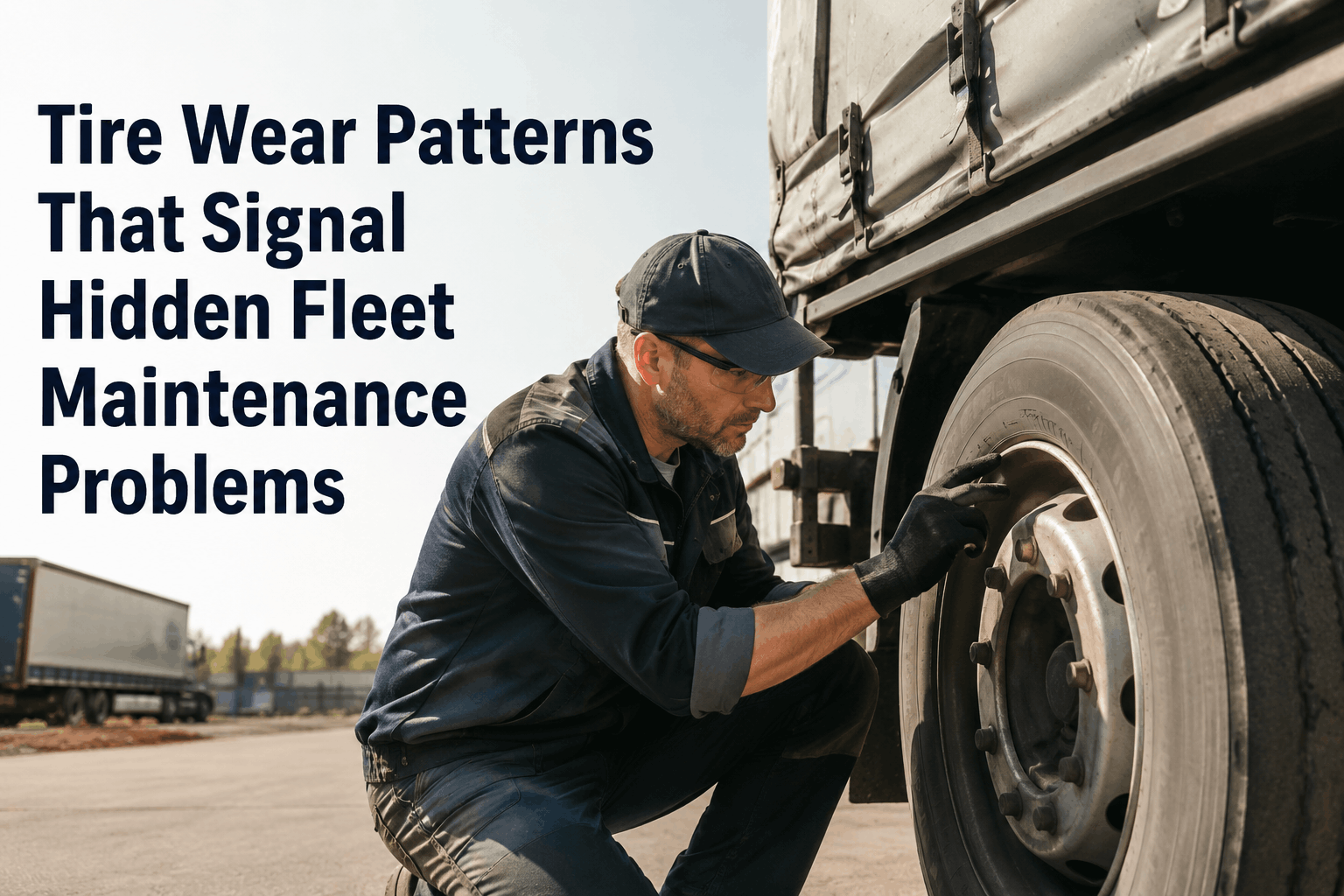
A standard 53-foot tandem-axle dry van has 8 trailer tires. A spread-axle configuration has 8 but with different geometry. Each position wears in a distinct pattern. Reading those patterns is how a trailer tire manager catches problems 20,000 miles before they become blowouts.
The insight: no single tire wears the same as its partner across the axle. Yet most fleets replace all four tires on an axle together when one shows a wear-out pattern, throwing away 30-40% of usable tread on the healthier three. Position-level tracking is what unlocks the retread and rotation savings. Book a demo to see per-position tread tracking across the trailer fleet
6 wear patterns and what each one is really telling you
Every wear pattern on a trailer tire points to a specific mechanical or operational root cause. Fixing the pattern is treating the symptom. Fixing what caused it is what saves the next tire.
Every one of these patterns compounds over 10,000-20,000 miles before it becomes a blowout event. Photographing and logging the pattern at the PM catch turns a $500 tire loss into a $50 alignment fix. Book a demo to see automated wear-pattern flagging on per-tire inspections
Rotation cadence — when moving casings across positions actually pays
Trailer positions don't wear evenly. Forward-axle tires typically wear the shoulders more from lateral scrubbing during turns. Rear-axle tires wear the center from higher static load. Rotating between positions equalizes wear and extends total fleet tread mileage 20-30% on properly executed programs. But rotation costs labor — and only pays back on trailers that actually see the miles.
The trap: rotating every trailer on the fleet every 6 months regardless of miles produces a labor line item that offsets the savings. Rotation is a discipline to execute deliberately per unit, not a policy to blanket across the fleet. Start free and get per-position tread differentials tracked automatically per trailer
The casing lifecycle passport — a single tire's economic journey
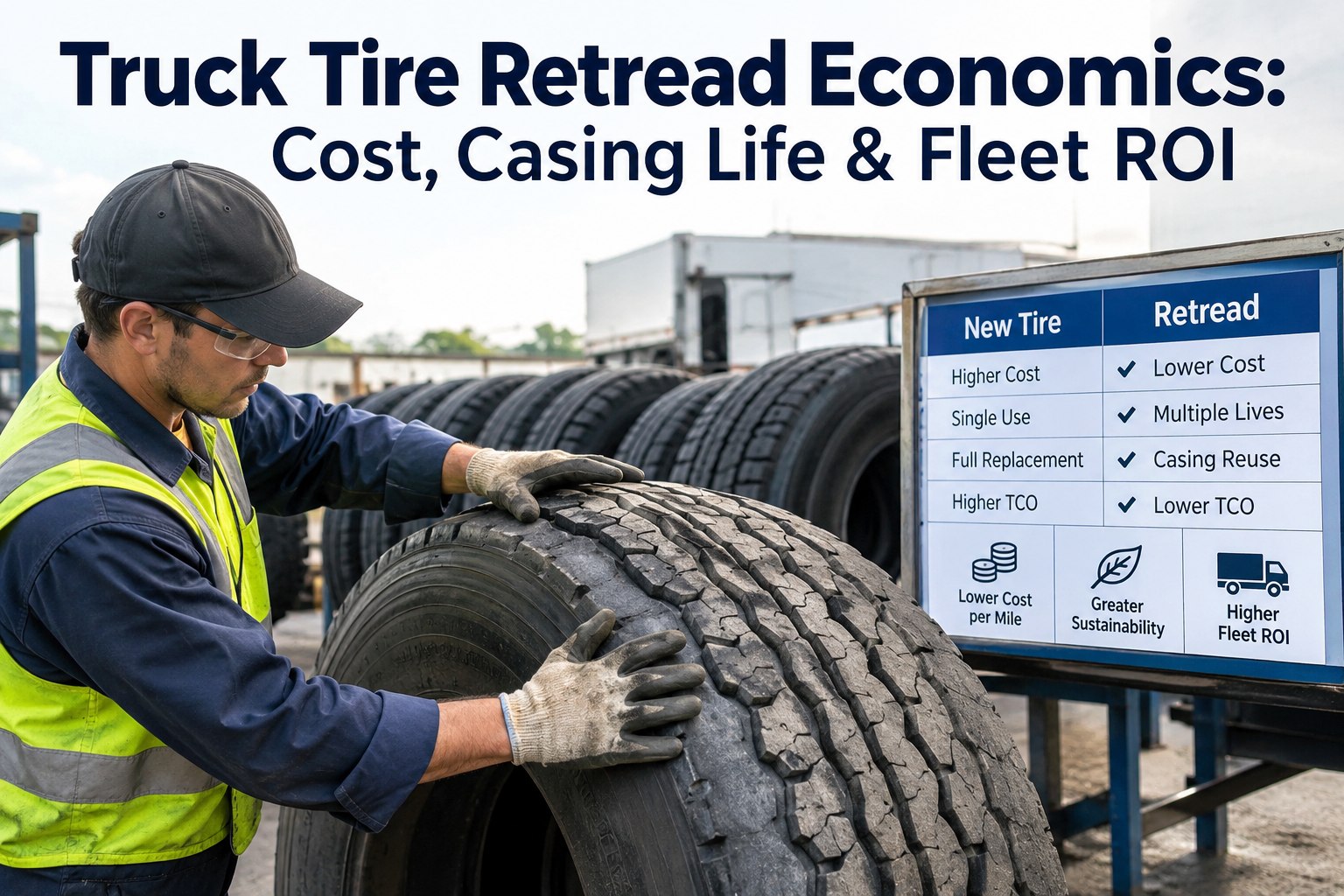
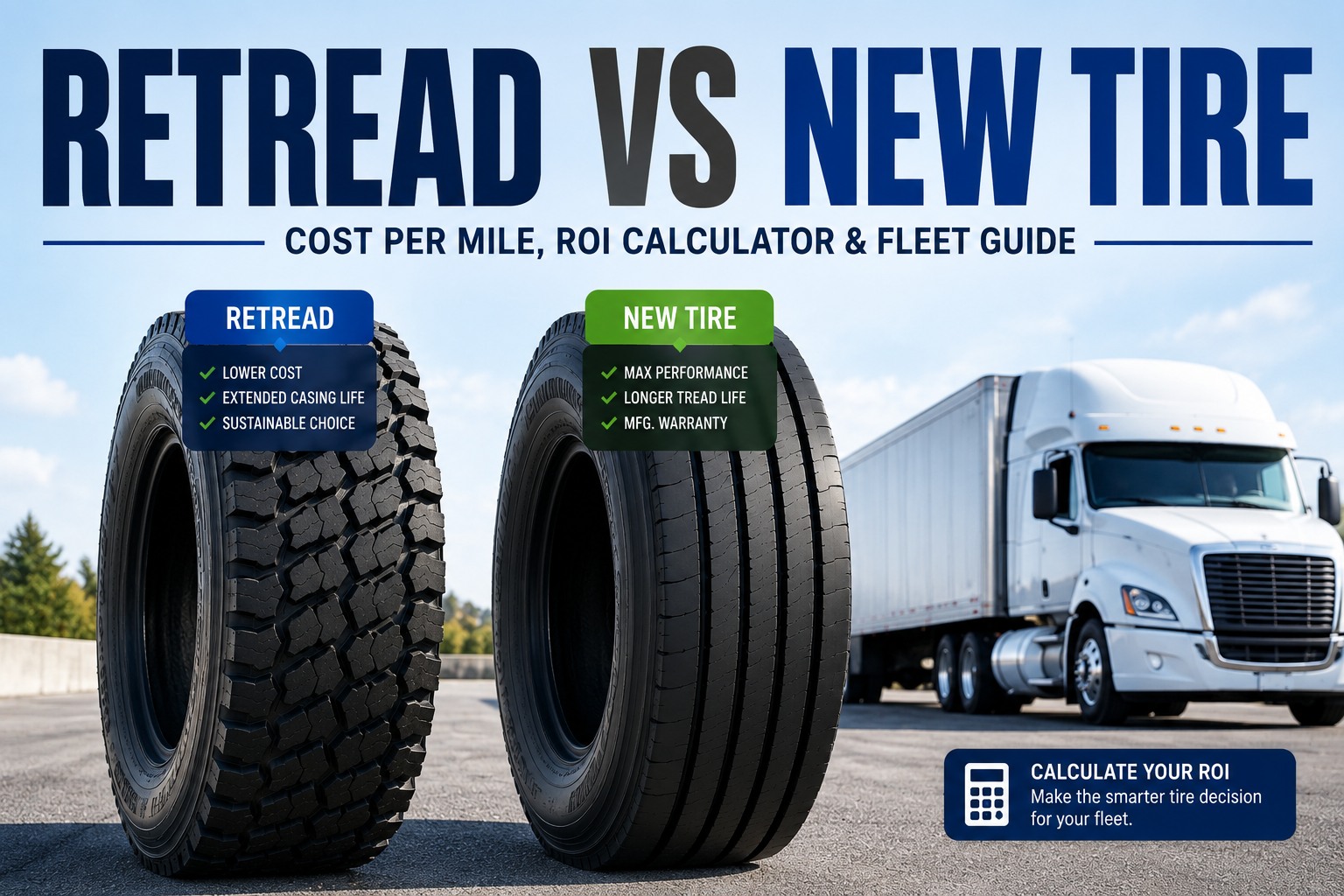
The economics of trailer tire management aren't about the purchase price. They're about how many revenue miles you get out of one casing. Most of a tire's manufacturing cost is in the casing itself — the belts, plies, and bead structure. Retreading reuses that casing at 30-50% of new-tire cost. A fleet that tracks casings by serial number and pulls them for retread at the right moment cuts trailer tire spend in half. A fleet that doesn't buys new every time.
The failure mode: casings pulled at 1/32" or run to failure are unrecoverable. The retread window is narrow and only visible in the data. Fleets tracking casings by serial capture the retread economics; fleets that "just replace them when they wear out" don't. Book a demo to see casing serial tracking, retread eligibility flags, and generation counts
Replacement thresholds — when to pull, when to run, when it's a violation
DOT regulation is the floor, not the strategy. Running to the minimum leaves retread value on the table. Below is the practical replacement framework for trailer positions.
The window between 4/32" and 2/32" is worth roughly $250 per casing in retread value. Fleets running trailers to failure forfeit this on every wheel position on every trailer — on a 100-trailer fleet that's a five- to six-figure annual line item hiding in the tire budget.
From a tire manager who runs 340 trailers across 3 terminals
Trailer tires were the tire budget line I never trusted. Drivers barely inspect them, they sit in yards for days, and by the time anyone looks close the casing's already gone. Two years ago we started logging tread depth per wheel position on every PM, not just "tires OK" on a checkbox. The first quarter, we caught 40 casings that would've been junked because they were down to 1/32" — we would've been replacing them new instead of retreading.
Second quarter, the alignment issues showed up. A trailer at our east terminal was eating outer shoulders on RR positions every 30K miles. We'd been replacing those tires for two years without ever tracing it back to a bent axle from a curb strike in 2022. One alignment fix, $600. Cost of the tires we'd been burning through: about $3,200/year. Position tracking pays for itself faster than any other maintenance discipline we've ever put in.
Frequently asked questions
How often should trailer tires be inspected?
FMCSA regulation requires a visual tire check on every pre-trip inspection under DVIR (49 CFR 396.11). For trailers specifically, that means every driver walkaround before hooking up. However, the walkaround is a visual condition check — it does not substitute for a proper tread depth measurement or pressure reading with a calibrated gauge. Best practice for trailer fleets: pressure measurement weekly with a gauge, tread depth measurement at every PM interval (typically every 25,000-30,000 miles or quarterly, whichever comes first), and full alignment check annually or immediately after any curb strike or impact event. Drop trailers that sit unattended for days benefit from a formal pre-hookup inspection separate from the driver's walkaround, because the driver has no baseline of what the trailer looked like when it was parked. Trailer tires are the position most often neglected on commercial fleets simply because nobody owns them the way a driver owns their tractor.
Can retread tires be used on trailer positions?
Yes. DOT regulation permits retreads on all drive and trailer positions with no restriction. Federal Motor Vehicle Safety Standard rules do restrict retreads on steer axles of commercial motor vehicles, but trailer axles are fully approved. Trailer positions are actually the ideal retread application for most fleets — the position handles pure load with no steering forces, wear rates are relatively predictable, and casing quality is easier to preserve because trailer tires don't experience the torque loads that drive tires absorb. Industry data shows FedEx, UPS, Schneider National, and most other large fleets retread trailer positions as standard practice. Roughly half of all replacement tires in the North American commercial market are retreads. The cost math is compelling: a retread costs $120-$250 per casing versus $300-$500 for a new trailer tire. On an 8-tire trailer replaced at once, retreads save $1,000-$2,000 per trailer per replacement cycle. Multiplied across a fleet of hundreds of trailers, the savings run six figures annually.
What causes uneven wear on trailer tires and how do you fix it?
Six primary wear patterns show up on trailer tires, each pointing to a specific root cause. Shoulder wear on both edges: chronic underinflation — the tire flexes at the sidewall and the shoulders take extra load; fix by finding and repairing the leak or valve issue. Center wear: chronic overinflation — the crown of the tire carries the load while the edges lift; fix by using a calibrated gauge against the tire's load-and-inflation table. One-sided wear: axle alignment issue (camber or toe out of spec) or overload; fix requires trailer alignment and load balance verification. Feathering (sawtooth): toe misalignment detected by touch rather than eye; fix is alignment plus inspection of suspension bushings and axle U-bolts. Cupping or scalloping (random bald patches): unbalanced tire, worn wheel bearings, or bad shocks; fix requires rebalancing plus suspension inspection before mounting a new casing. Flat spot: locked-wheel skid from brake grab or hard emergency braking; if the casing is otherwise sound, the tire may still be retreadable despite the cosmetic damage. The general rule: fix the root cause before mounting a new tire, otherwise the next tire wears the same way and the money is spent twice.
What is casing tracking and why does it matter for trailer tire management?
Casing tracking means logging every trailer tire by its unique DOT serial number and tracking that casing through its entire service life — mount date, wheel positions occupied, mileage accumulated, tread depth readings at each PM, wear patterns observed, pull date, retread generation count, and final disposal. The economic case: a single trailer casing can carry 380,000+ miles over its lifetime if managed through 2-3 retread cycles, at a total cost of roughly $700 (one new tire plus two retreads). The same 380,000 miles bought as new tires costs $1,000-$1,200. Fleets without casing tracking cannot identify which casings are retread-eligible when they come off, so they default to new tires on nearly every replacement — forfeiting the retread savings on every wheel position on every trailer, year after year. On a 100-trailer fleet, the difference between disciplined casing tracking and default-to-new is typically $80,000-$150,000 in annual tire spend, with the savings scaling linearly with fleet size. Casing tracking is what separates fleets with a $28-per-tire-per-month cost from fleets running $47+.
How does HVI help fleets manage trailer tires?
HVI's tire management module captures three-point tread depth (inner, center, outer) per wheel position on every PM inspection, pressure readings on every driver walkaround (DVIR), casing serial numbers logged at mount, and retread generation count tracked per casing through disposal. Wear patterns are flagged automatically — shoulder wear, center wear, one-sided, feathering, cupping, and flat spots each generate a specific alert with the likely root cause identified. When any tire crosses fleet-defined thresholds (pressure below spec, tread approaching retread pull point, or wear pattern developing), a work order fires automatically to schedule the intervention before the casing becomes unrecoverable. Every trailer's tire history is available per unit or aggregated fleet-wide, so tire managers see cost-per-mile per casing, retread rates per position, and outlier trailers that consume tires faster than fleet average. For fleets running 100+ trailers, the discipline typically pays back in the first quarter through retread capture on casings that would otherwise have been junked. Start free and track every trailer casing.
Every trailer casing has a passport. Most fleets are throwing them in the trash at year one.
HVI tracks every trailer tire by serial, wheel position, mileage, tread reading, and retread generation. The result: 2-3 retread cycles per casing, wear patterns caught before they compound, and trailer tire spend cut 30-50% versus default-to-new replacement.