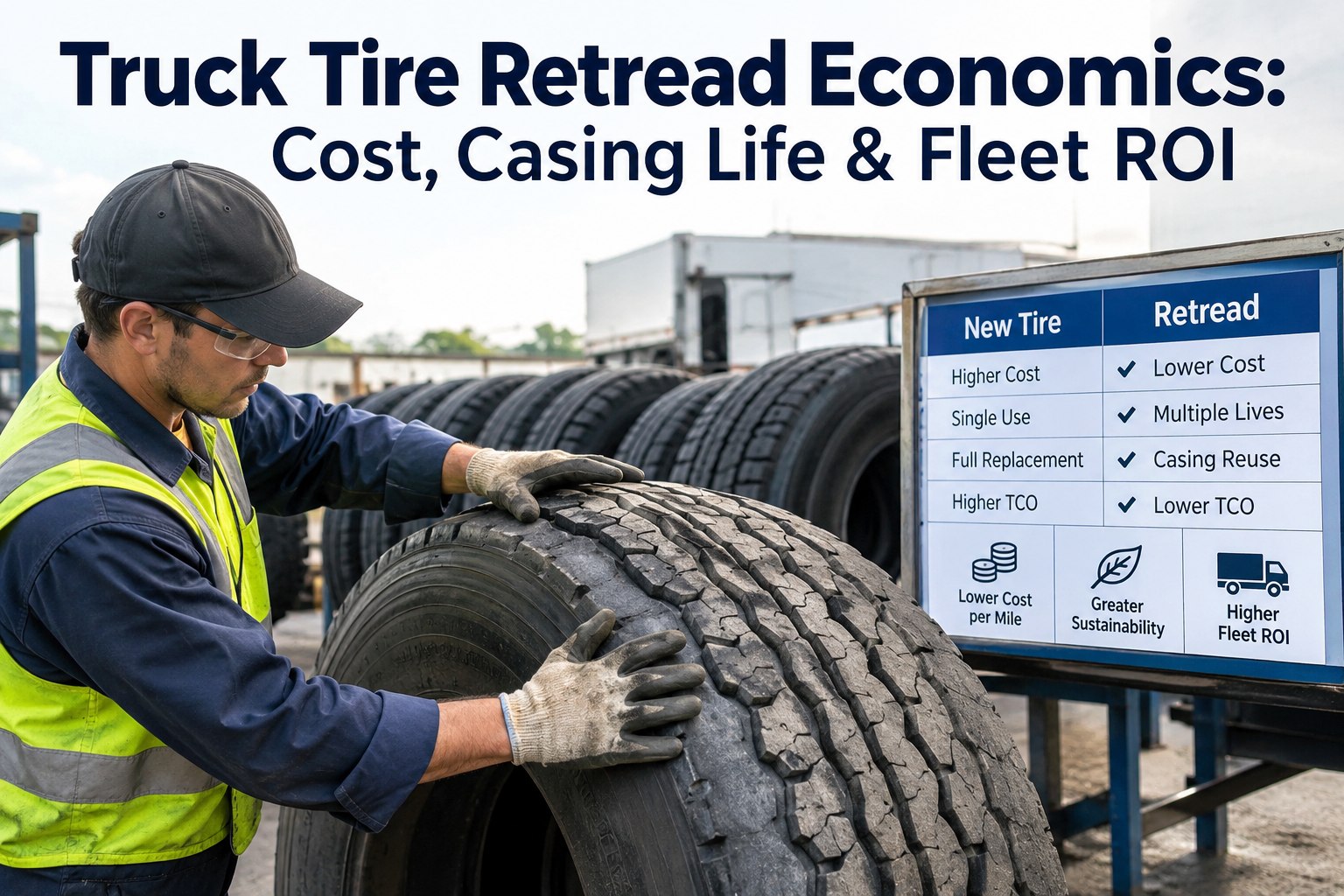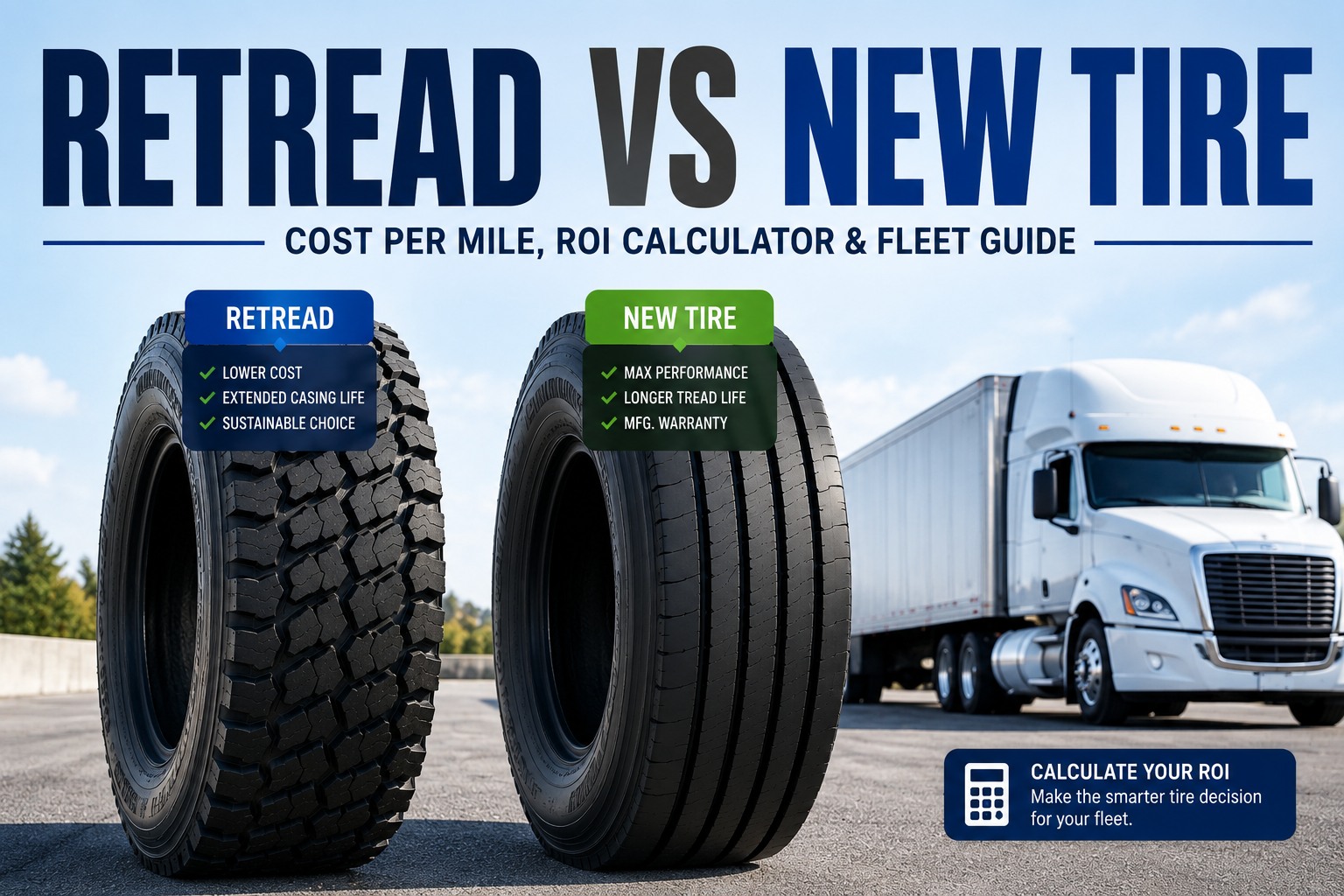
Retreads cost 30-50% less than new commercial tires — but the retread vs new tire decision isn't a sticker-price comparison. It's a cost-per-mile calculation weighted by tire position, casing quality, and lifecycle discipline. Get it right and a 100-truck fleet recovers $150,000+ annually; get it wrong and a single steer-position failure funds someone else's attorney. Book an HVI demo to see casing lifecycle tracking on your fleet.
One tractor-trailer. 18 tires. 3 different retread decisions.
The right answer isn't "all new" or "all retread" — it's the position-based strategy that hits the lowest total cost per mile
Directional control · brake response · blowout consequences most severe. Fleet policy prohibits retreads on steer regardless of DOT allowance under 4,920 lb load.
Deep tread for traction, drive torque. Casings support 2-3 retread generations. This is where the CPM math turns most favorable for well-managed fleets.
Free-rolling, no drive torque, lowest failure severity. Retread the standard from day one. Highest CPM savings across all three position categories.
The cost-per-mile formula — the only number that matters
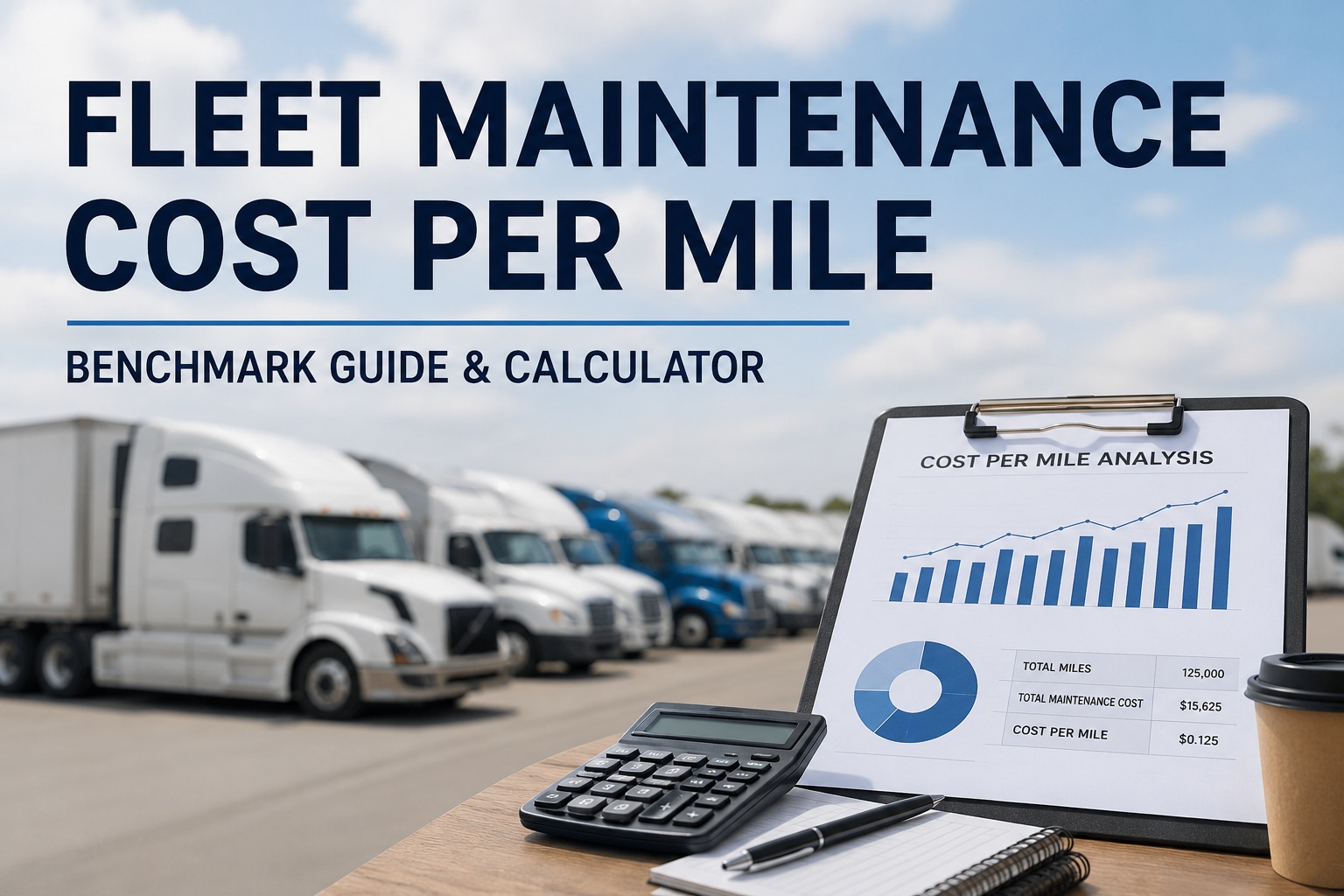
Sticker price on a tire is a distraction. The number that determines whether a fleet is winning or losing on tire spend is cost per mile (CPM) — the total cost of the tire (purchase, mounting, disposal) divided by the miles it actually delivers before removal. Get comfortable with the formula and every retread decision becomes obvious.
A quality retread doesn't have to match a new tire's mileage to win on CPM — it just has to deliver mileage proportional to the cost delta. In the example above, the retread delivers 83% of the new-tire mileage at 45% of the cost. That's the math driving the 4.5:1 retread-to-new ratio at every major North American fleet. Book an HVI demo to see CPM tracked per tire on your fleet
The 5 factors that determine if a casing is retreadable
Not every tire that comes off the truck can be retreaded. A quality retread shop rejects 15-25% of casings submitted for retreading — too low a rejection rate signals a shop that isn't inspecting rigorously enough. Five factors drive the accept-or-scrap decision.
Premium casings (Michelin, Bridgestone, Goodyear, Continental) support 2-3 retread cycles. Tier 3 and Tier 4 imports typically cannot be retreaded — the false economy of the cheap new tire disappears the first time you try to reuse it.
Most retreaders reject casings older than 7 years from the DOT date code, regardless of visible condition. Rubber compounds age from the inside out and casing integrity can be compromised well before external damage is visible.
Ultrasound-like inspection reveals internal separations, belt cracking, and ply damage invisible to the naked eye. A quality retreader shearographs every casing — if your shop doesn't, they're rejecting nothing and passing damage through.
A casing that has been run underinflated, at low pressure, or against curbs shows internal heat damage even if externally intact. Fleet inspection history (pressure logs, DOT roadside citations, driver reports) tells the retreader whether the casing has been abused.
Casings with multiple prior repairs, sidewall injuries, or bead damage face automatic rejection. Industry standard limits are typically 3 tread-area repairs maximum, no sidewall repairs, and no bead-area damage acceptable.
The five factors together are what a certified retreader evaluates during casing intake. Fleets that track inspection history, pressure discipline, and repair records against each casing barcode routinely see their acceptance rates climb from industry-average 75-80% to 90%+ — because the casings being submitted are the ones already likely to pass. Book an HVI demo to see casing history tracked per tire from purchase forward
The casing lifecycle — from purchase to scrap
A commercial tire casing is a tracked asset worth $50-$100+ throughout its life. Well-run fleets follow every casing through its complete lifecycle: purchase, wear cycles, retread generations, position rotations, and final scrap. This is what makes the CPM math actionable rather than theoretical.
Every tire gets a unique barcode or RFID tag at purchase. Purchase date, brand, model, DOT date code, and initial position recorded. First lifecycle position is typically steer or drive; casing quality is highest in this phase.
Tire pulled when tread depth reaches 4/32" (drive) or 2/32" (trailer). Casing sent to retreader for inspection. Shearography, visual inspection, and repair-eligibility check performed. Accept-or-scrap decision made and logged against the barcode.
Accepted casing retreaded and returned to fleet for drive or trailer position. Retread generation counter incremented in the tracking system. Warranty terms specific to that casing/retreader combination recorded.
Premium casings that pass inspection after the first retread wear cycle move to second retread — typically trailer position only at this stage. Casings that don't pass inspection are scrapped and lifecycle CPM calculated for final analytics.
Casing removed from service and scrapped. Total lifecycle miles, total lifecycle cost, and final CPM calculated against the barcode. This data feeds purchasing decisions for the next tire generation and identifies which brands deliver the best long-run economics.
The disciplined fleets running this workflow consistently outperform peer fleets on cost per mile by 25-40% — not because they buy differently, but because they track differently. Try HVI free to see casing lifecycle tracking on your first 10 tires this week.
The environmental case — when the math also happens to be right
The economic case for retreading stands on its own, but the environmental math is a bonus. Per retreaded tire, the numbers are straightforward and add up quickly across a fleet.
New tire manufacturing requires ~22 gallons of oil per tire. Retreading requires ~7 gallons. Delta of 15 gallons per retread cycle.
Each retreaded commercial casing keeps 100 lbs of rubber and steel out of landfills. Compounded across a 100-truck fleet: 4-8 tons of waste diverted annually.
Retreading generates roughly $3 billion in annual cost savings across the North American commercial trucking industry — making it the single largest recycling-driven cost win in transportation.
The largest North American fleets run a 4.5:1 ratio of retread to new tire purchases — the operational endorsement that closes the case. If retreads didn't work at scale, the biggest fleets wouldn't use them.
The environmental math is what most manufacturers lead with in their sustainability marketing, but for the fleet operator it's the economic delta that funds the decision — the environmental benefit is the tailwind that makes it easy to explain to a board that also cares about ESG metrics. Book an HVI demo to see ESG-friendly casing lifecycle metrics reported alongside cost tracking
Choosing the right retreader — 4 signals of a serious operation
The single biggest variable in retread economics is which retreader the fleet uses. A quality retreader delivers casings that hit or exceed new-tire mileage; a budget operation delivers casings that fail early and drag average CPM back to new-tire levels. Four indicators separate serious retreaders from the rest.
Ask if 100% of intake casings are shearographed. Anything less means visual inspection alone is passing damaged casings through. Serious retreaders can produce equipment logs showing shearography scan volume matches intake volume.
The healthy range. Below 10% rejection means the shop is passing damaged casings through to keep throughput up. Above 30% means the fleet's casing management upstream is failing. Track this metric per retreader annually.
Tire Industry Association Retread Tire Specialist certification is the industry credential for retread technicians. A serious retreader employs certified technicians on every shift and maintains certification renewals as a matter of policy.
Quality retreaders back their product with 100% workmanship warranties covering separation, tread throwing, and manufacturing defects. Ask about claim response time and casing replacement policy before signing a supply agreement.
A fleet running well-managed casings through a certified retreader consistently delivers CPM 60-70% below the "all-new-tires" baseline. A fleet running poorly-managed casings through a budget retreader can end up with total tire spend that exceeds the all-new-tire program — the worst possible outcome. The retreader decision is the second most important tire decision after position strategy. Try HVI free to configure retreader scorecards on your fleet.
From a Maintenance Director running 240 tractors and 720 trailers
We were an "all-new tire" shop for a decade. Fleet Manager before me thought retreads were cheap, dangerous, and beneath us. We ran industry-average CPM and paid $1.4M annually on tire spend for 240 tractors and 720 trailers. When I inherited the program in 2024, I ran the CPM math against actual mileage per position — steer was fine at 0.37¢ but drive was running 0.32¢ and trailer 0.28¢. Both catastrophically above what quality retreads deliver.
We moved drive positions to a new-then-retread cycle and trailer to retread-first. Held steer as new-only. First 12 months: tire spend dropped to $920K — roughly 34% reduction on a $1.4M base. Zero increase in tire-related road calls. The math was there the whole time. What we needed was the tracking discipline to see it.
Frequently asked questions
Are retread tires safe for commercial trucks?
Yes, when produced by a certified retreader and installed on drive or trailer positions. NHTSA-sponsored research (University of Michigan tire debris study) collected approximately 86,000 lbs of tire debris across five states and found that new and retread tires experience roadway failure at statistically similar rates — meaning the "gator" debris drivers commonly attribute to retread failures is not disproportionately from retreads. The safety case rests on three practices: certified retreaders using shearography inspection (ultrasound-like testing that catches internal separations invisible to visual inspection); position discipline (drive and trailer positions only, never steer on a Class 8 tractor even though DOT technically permits retreads on steer for load ratings under 4,920 lbs); and proper casing management (rejecting casings above 7 years old, with sidewall damage, or with more than 3 tread-area repairs). Every major North American fleet runs retreads at a 4.5:1 ratio to new tires — an operational endorsement that would not survive if the safety math didn't work. The remaining safety risk sits with cheap import casings from Tier 3-4 manufacturers that were never designed for retreading in the first place.
How much does tire retreading cost vs buying new?
A quality retread from a certified retreader typically costs $150-$250, versus $400-$600+ for a comparable new commercial truck tire — a 30-50% price reduction. But sticker price is the wrong number to focus on. What matters is cost per mile (CPM), calculated as total tire cost divided by miles delivered before removal. A new drive tire at $500 delivering 150,000 miles produces a CPM of 0.33 cents. A quality retread at $225 delivering 125,000 miles produces a CPM of 0.18 cents — a 45% reduction on the metric that actually flows through to the P&L. Across a standard tractor-trailer with 16 retreadable positions (8 drive + 8 trailer, excluding 2 steer), a full retread cycle saves approximately $3,500 per truck. Multi-generation savings over 2-3 retread cycles per casing typically reach $7,000-$10,500 per truck lifetime. For a 100-truck fleet spending $450,000 annually on tires, a structured position-based retread program typically delivers $112,500-$180,000 in annual savings — the equivalent of hiring 2-3 additional drivers or funding a small maintenance bay renovation without adding to the operating budget.
How many times can a commercial truck tire be retreaded?
Premium commercial truck casings from major manufacturers (Michelin, Bridgestone, Goodyear, Continental) typically support 2-3 retread generations before final scrap — assuming the casing has been well-maintained throughout its life. The retreadability limit is not a fixed count but a casing-by-casing decision made at each pull based on five factors: casing brand and construction quality, casing age from DOT date code (typically 7 years maximum), shearography inspection results for internal damage, run-flat and impact history from fleet inspection records, and cumulative repair count with tread-area, sidewall, and bead-area damage limits. A quality retreader rejects 15-25% of casings submitted — too low a rejection rate signals inadequate inspection, too high suggests the fleet's casing management is poor. Tier 3 and Tier 4 cheap-import casings typically cannot be retreaded at all, which turns the apparent "savings" on the initial purchase into a false economy the moment the first retread cycle is attempted. Well-managed fleets running premium casings through the full 2-3 retread lifecycle achieve total tire cost per mile 60-70% below fleets running single-use imports.
Can retread tires be used on the steer axle?
Technically yes under limited DOT circumstances, but virtually all commercial fleet policies prohibit the practice on Class 8 tractors. FMCSA §393.75 allows retreads on steer positions only when the tire load rating does not exceed 4,920 lbs — a threshold most Class 8 tractor front axles routinely exceed under load. Beyond the regulatory carve-out, three operational factors keep steer retreads off responsible fleets: directional control (steer tire failure causes immediate loss of steering, unlike drive or trailer failures which allow controlled deceleration); brake response (steer axles carry the majority of braking load during emergency stops); and litigation exposure (in a fatality or serious-injury lawsuit involving a steer failure, the presence of a retread on the steer position becomes an aggravating factor plaintiff attorneys build cases around). The economic argument for steer retreads is also weak: steer tires typically deliver 150,000+ miles at highway speeds because they aren't subject to drive torque or trailer scrubbing, meaning the CPM difference between new steer and retread steer is minimal even when it's technically permitted. The industry standard is unambiguous: new tires on steer, position-optimized retread strategy on drive and trailer.
What is tire cost per mile (CPM) and why does it matter more than tire price?
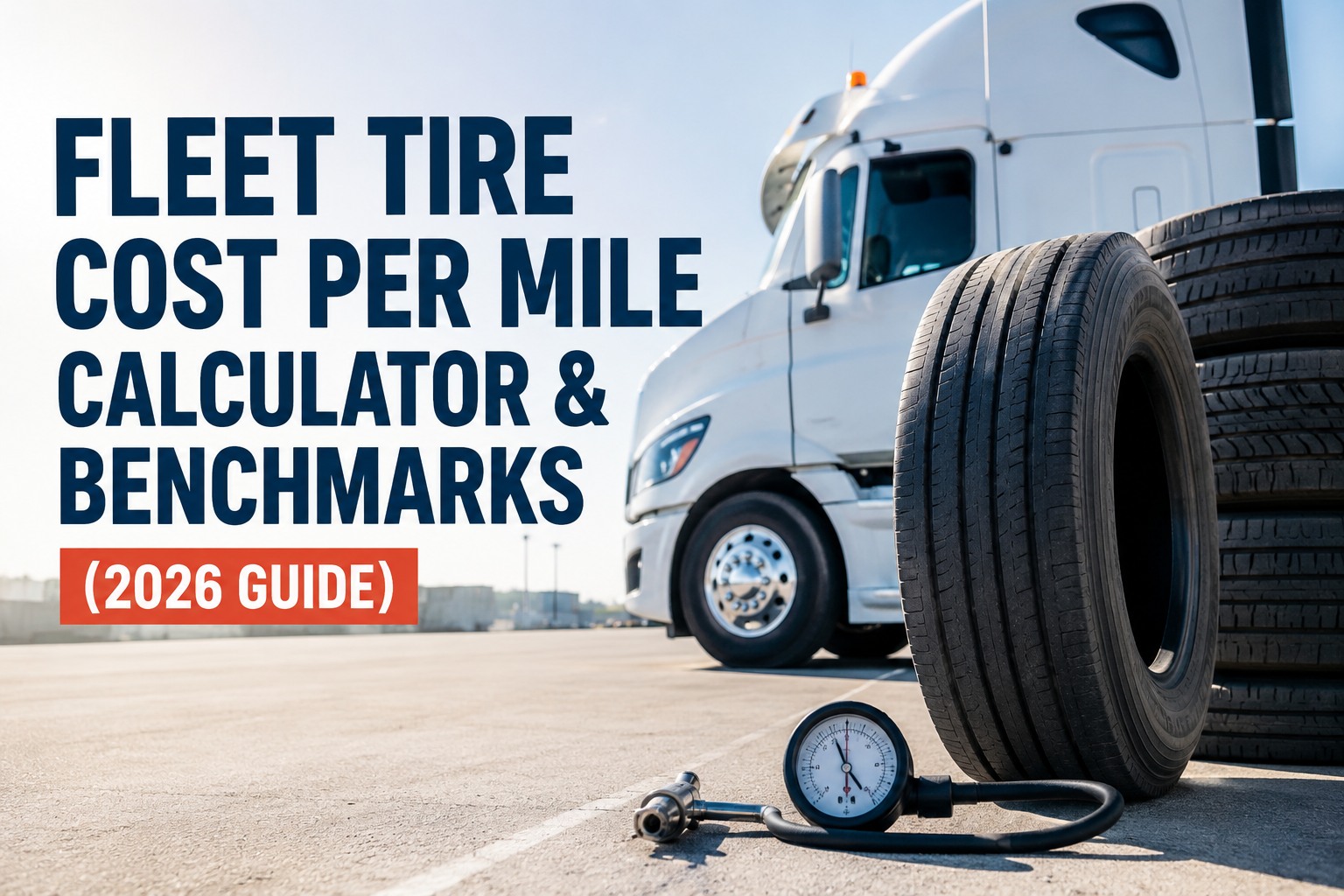
Tire cost per mile (CPM) is total tire cost — including purchase price, mounting, disposal, and any associated service fees — divided by the miles the tire actually delivers before removal. It is the only number that meaningfully compares tire economics across brands, models, positions, and new-versus-retread decisions. A $400 tire that delivers 100,000 miles has a CPM of 0.40 cents. A $600 tire delivering 200,000 miles has a CPM of 0.30 cents despite the higher sticker price — because it delivers twice the mileage. The American Transportation Research Institute (ATRI) tracks tire CPM as a distinct line in its annual cost-of-trucking analysis; industry average is approximately 4.3 cents per mile for the total tire program across a fleet (roughly 2.7% of total operating cost per mile of $1.59). Well-run programs using position-based retreading cut this to 1.5 cents per mile — a 65% reduction that flows directly to the bottom line. CPM matters more than sticker price because tires are consumable capital assets, not one-time purchases. A fleet manager who only looks at unit price systematically overpays and can't explain why the tire budget keeps climbing. A fleet manager who tracks CPM per tire per position identifies which tire investments actually deliver value and which don't.
Turn every casing into a tracked asset — and every tire decision into a CPM decision.
HVI's tire management module barcodes or RFID-tags every tire at purchase, tracks position history through every rotation and retread generation, calculates CPM per casing and per position automatically, and scores retreader quality by casing rejection rate and warranty outcomes. Live for your fleet in under two weeks. Typical results: 25-40% tire cost reduction in year one, near-zero surprise removals, and a purchasing decision framework your CFO will actually trust.
Works with Michelin, Bridgestone, Goodyear, Continental · Bandag, Marangoni retreaders · TPMS integrated