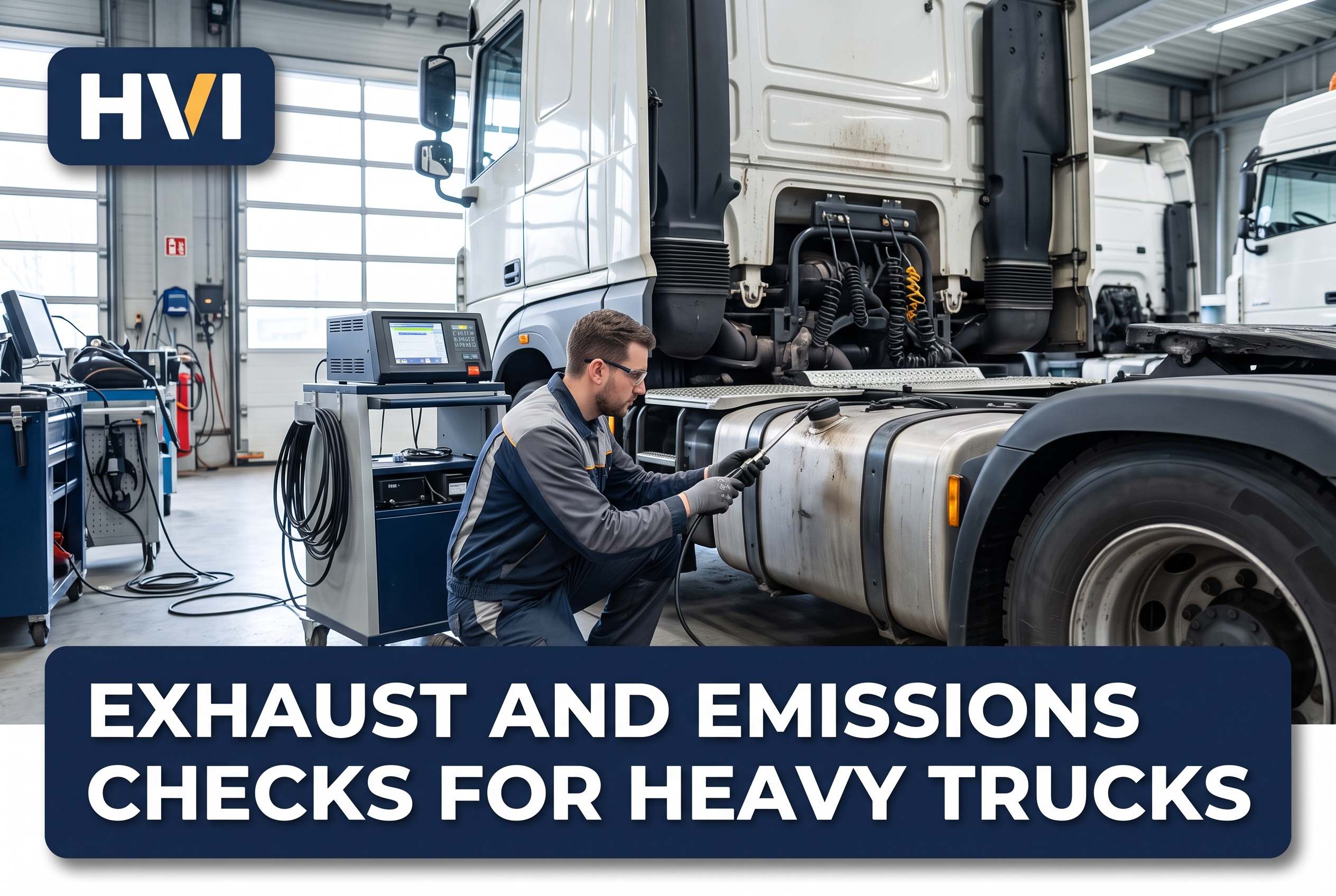
A truck doesn't have to break a driveshaft or snap an axle to be forced off the road. Sometimes it's just a clogged diesel particulate filter or a bad batch of diesel exhaust fluid that puts it out of commission. When an aftertreatment system derates a heavy truck on a hill climb, it's not just an inconvenience—it's a compliance failure, a delayed load, and a massive maintenance bill. Modern truck exhaust inspection has moved far beyond looking for leaking manifolds. Today's emissions inspection covers DPF, SCR, and EGR systems that are heavily monitored by the EPA and CARB. Run your emissions checks digitally with HVI to catch aftertreatment failures before they trigger a 5-mph derate.
Exhaust and Emissions Checks for Heavy Trucks
The complete guide to modern aftertreatment inspections, CARB Clean Truck Check compliance, and preventing NOx-related derates that ground your fleet.
- DPF Soot Load42%
- DEF Quality32.5%
- Last Regeneration2 Days Ago
- NOx SensorActive
- 14,000 lb
GVWR threshold requiring CARB Clean Truck Check emissions testing
CARB 2024 Regulation - $45,268
maximum civil penalty per noncompliant engine under EPA regulations
EPA Civil Penalty Update - 5 mph
forced speed derate triggered by active SCR or DPF fault codes
OEM Engine Protection Logic - 2027
EPA Phase 3 implementation requiring stricter NOx limits and dual-dosing SCR
EPA Phase 3 Rule
Why modern emissions checks go beyond the tailpipe
A decade ago, checking a truck's exhaust meant looking for soot around the manifold, listening for exhaust leaks, and making sure the stack wasn't blowing black smoke. Today, heavy-duty diesel trucks are rolling chemistry labs. The introduction of DPF, SCR, and EGR systems means that an emissions inspection is a highly technical evaluation of sensors, fluid quality, and filter loading. If any of these components fall out of spec, the engine control module (ECM) takes over. It starts by cutting power, then forces a 5-mph derate, and ultimately shuts the truck down to protect the aftertreatment hardware. You can't just "drive it through" anymore. When a fleet maintenance software flags an active aftertreatment code, that truck needs to be routed to the shop immediately before it becomes a roadside service call.
Under CARB's Clean Truck Check program, vehicles over 14,000 lbs operating in California must undergo periodic emissions testing to verify their onboard diagnostics (OBD) systems are functioning correctly. The EPA's upcoming 2027 Phase 3 standards will make this even stricter, requiring dual-dosing SCR systems that demand near-perfect DEF quality and NOx sensor accuracy. Failing to catch these issues during a routine truck exhaust inspection leads to forced regenerations, cooked DPF units, and compliance violations that carry civil penalties up to $45,268 per noncompliant engine.
The 5-stage exhaust and aftertreatment inspection workflow
An effective emissions check isn't just reading fault codes with a laptop. It requires a physical and digital inspection of the entire aftertreatment chain. Here is the 5-stage workflow our master technicians use to keep heavy trucks compliant and on the road.
Exhaust Leak & Hardware Check
Inspect the exhaust manifold, turbocharger flange, EGR cooler, and flex pipes for physical leaks. Exhaust leaks upstream of the DPF alter the oxygen levels and temperature the ECM expects to see, causing erroneous regen cycles and EGR flow faults. Look for carbon tracking, listen for hissing under load, and verify all DPF and DOC clamps are torqued to spec.
DPF Soot & Ash Load Evaluation
Pull the live data stream from the ECM to check the current soot load percentage. If soot load exceeds 80%, the truck is overdue for a parked regeneration. Check the ash load as well—unlike soot, ash cannot be burned off and eventually requires a manual DPF clean or replacement. High ash load increases exhaust backpressure and ruins fuel economy.
DEF Quality & SCR System Test
Draw a small sample of diesel exhaust fluid and test it with a refractometer. DEF must be exactly 32.5% urea. If it's diluted, frozen, or contaminated, the SCR system will fail to convert NOx, triggering derate codes. Verify the DEF doser valve isn't clogged with crystallization and that the DEF tank heater is operational.
Sensor & Dosing Verification
Verify the operation of the inlet and outlet NOx sensors, exhaust gas temperature sensors (EGTs), and differential pressure sensors. A failed differential pressure sensor will falsely report a clogged DPF, forcing unnecessary parked regens. Compare sensor readings against expected values during a parked regen to ensure the dosing is happening at the right temperature.
OBD & Compliance Code Clear
Connect to the diagnostic port and verify there are no active or pending aftertreatment fault codes. Ensure the ECM is not storing any historical derate triggers. For CARB Clean Truck Check compliance, verify the OBD system readiness monitors are set. Document the inspection results and schedule the next DPF cleaning interval based on ash accumulation.
DPF vs SCR failure modes: What derates your truck?
Understanding the difference between a DPF failure and an SCR failure is critical for fleet managers. Both will trigger a check engine light and eventual derate, but the root causes and maintenance responses are entirely different. Use this comparison table to train your drivers and shop techs on what they are actually looking at when a fault code appears. Book a demo with HVI to see how these fault categories are tracked in a unified maintenance dashboard.
| Inspection Factor | DPF (Diesel Particulate Filter) | SCR (Selective Catalytic Reduction) |
|---|---|---|
| Primary Function | Captures and burns off solid soot particulates. | Converts NOx gases into nitrogen and water using DEF. |
| Common Failure Cause | Excessive idling, low exhaust temps, bad turbo seals causing ash buildup. | Contaminated or diluted DEF, failed NOx sensors, crystallized doser valve. |
| First Warning Sign | High exhaust backpressure, frequent automatic regen cycles, loss of power. | Check engine light, poor DEF consumption, elevated NOx readings. |
| Derate Trigger | Soot load exceeds 100% or failed regen attempts force a 5-mph shutdown. | ECM detects NOx conversion efficiency below EPA thresholds. |
| Maintenance Action | Forced parked regen, manual DPF baking/cleaning, or filter replacement. | Drain and flush DEF tank, replace doser valve, replace NOx sensors. |
Daily driver inspection vs shop-level emissions testing
Drivers cannot be expected to perform a full OBD scan during their pre-trip, but they are your first line of defense against emissions system failures. A comprehensive digital DVIR process bridges the gap between the driver's physical walk-around and the shop's diagnostic tools. Drivers should be checking for visible exhaust leaks, listening for changes in turbo whine or hissing EGR valves, and monitoring the dashboard for DPF and SCR warning lamps. If the truck requests a parked regen, the driver needs clear instructions on when and where to perform it, and the shop needs that data logged for future analysis.
Shop-level emissions testing goes deeper. When a driver reports a recurring DPF lamp, the shop tech connects to the ECM to pull the exact soot load percentage, verifies the differential pressure sensor, and checks the EGR valve position. If the truck is subject to CARB Clean Truck Check, the shop must verify the OBD readiness and ensure no active fault codes will cause a failure at the weigh station or roadside inspection.
Expert view from the shop floor
"The biggest killer of our DPFs isn't highway miles—it's the reefer units idling in the yard for three days straight. The exhaust never gets hot enough to burn off the soot. We used to pull our hair out replacing sensors until we started tracking soot load percentages in HVI. Now, if a unit hits 65% soot load without a regen, we flag it for a highway run before it becomes a $4,000 forced cleaning bill.
-- Marcus S., Maintenance Director, refrigerated carrier
Frequently asked questions
How often should a truck DPF be inspected?
The DPF should be checked during every preventative maintenance service (typically every 10,000 to 25,000 miles) by reading the ECM soot and ash load percentages. Drivers should monitor the DPF dashboard lamp daily during pre-trip inspections. If a truck frequently requires parked regenerations, the DPF and EGR system need a full diagnostic inspection immediately.
What causes an SCR system derate?
An SCR derate is almost always caused by the ECM detecting that NOx conversion efficiency has dropped below legal thresholds. This is usually due to poor DEF quality (diluted or contaminated fluid), a clogged DEF doser valve, failed inlet/outlet NOx sensors, or a malfunctioning DEF tank heater. The derate begins as a 25% power cut and escalates to a 5-mph limit if not corrected.
Can you drive with a minor exhaust leak?
No. Beyond the obvious safety hazards of hot exhaust gases under the cab, an exhaust leak upstream of the aftertreatment sensors introduces excess oxygen and drops exhaust temperatures. This prevents the DPF from regenerating properly and causes false EGR flow codes, eventually leading to a derate. Exhaust leaks must be repaired before the truck is dispatched.
What is the CARB Clean Truck Check requirement?
The CARB Clean Truck Check requires all trucks over 14,000 lbs GVWR operating in California to undergo periodic OBD emissions testing. The test verifies that the truck's onboard diagnostics are functioning and that there are no active aftertreatment fault codes. Failing to submit test results results in registration blocks and civil penalties.
Does low-quality DEF actually damage the SCR system?
Yes. DEF must be exactly 32.5% urea and 67.5% deionized water. If operators top off the DEF tank with tap water or low-grade fluid, it disrupts the SCR chemical reaction. The ECM detects the failure to convert NOx, triggers derate codes, and the impurities in bad DEF will permanently clog the doser valve and ruin the SCR catalyst, requiring thousands of dollars in replacement parts.
Track DPF health, DEF quality, and emissions compliance in one platform
HVI digitizes your exhaust and emissions inspections, logs ECM soot load data directly to work orders, and alerts you before a derate takes your truck off the road. Stay ahead of CARB Clean Truck Check and EPA Phase 3 regulations effortlessly.
No credit card · No hardware · Live on your fleet in under two weeks