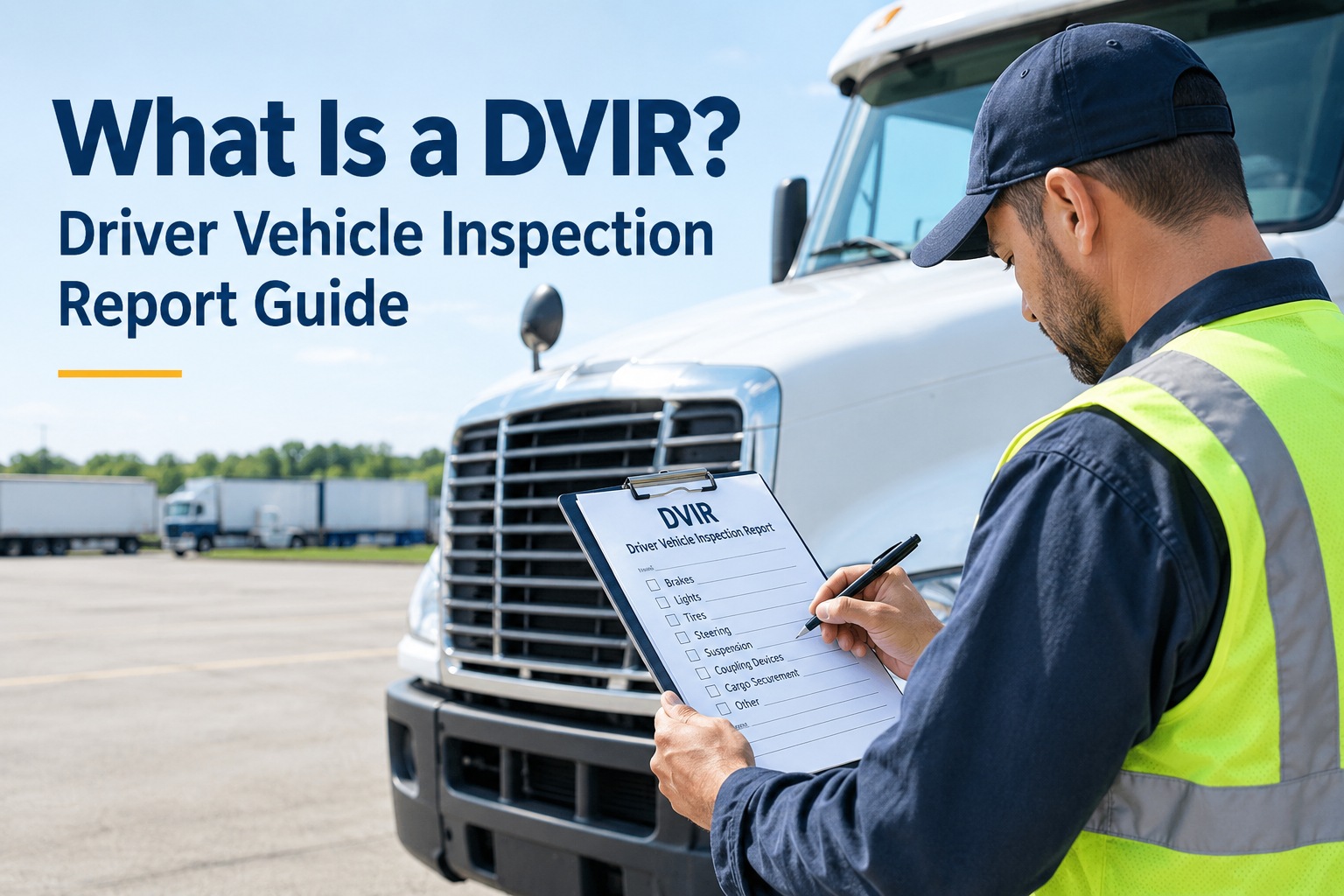
A driver scrawls "brakes bad" on a form, parks the truck, and goes home. The next morning a different driver reads it, has no idea which brakes or how bad, shrugs, and rolls out. That failure is what a DVIR is supposed to prevent. So what is a DVIR? A Driver Vehicle Inspection Report is the written record a commercial driver creates to document a vehicle's condition and any defects found — the handoff note between the person who spotted a problem and the people who have to fix it. Done right, it keeps unsafe trucks parked. Done lazily, it's just paper. Book a demo to see one done right.
Anatomy of a DVIR
Strip away the jargon and a DVIR is just five things on one page. Miss any one of them and the report can't do its job — protect the next driver and prove you inspected.
A driver vehicle inspection report exists so a defect can't fall through the cracks between shifts. The driver who finds a problem often isn't the one who drives the truck next, and neither of them is the mechanic. The DVIR is the thread that ties all three together — and in the US and Canada, it's also a legal record regulators can demand. Below is what goes on it, when you need one, and why the words a driver writes matter more than the checkboxes.
When you need onepre-trip, post-trip, and the confusion between them
Here's where most people get DVIRs wrong. The inspection and the report are two different things. A driver physically checks the vehicle — that's the inspection. The DVIR is the written document that comes out of it. In the US, the pre-trip inspection is its own requirement that doesn't demand a written form, while the DVIR is the end-of-day document. In practice, most fleets run a report at both ends of the shift anyway, and it helps to picture the driver's actual day.
Driver reads yesterday's DVIR, confirms listed defects were repaired, then inspects the vehicle before driving.
Driver watches for issues that develop during the trip. A safety-critical defect means stop and notify — don't keep driving.
Driver inspects again and writes the DVIR. Defects found go on the report; the carrier must repair before the next dispatch.
The one-line rule to remember: the pre-trip asks "is this truck safe to drive right now?" and the post-trip DVIR answers "what condition did I leave it in?" Both matter, and a good system captures both without a driver filling the same boxes twice. Skipping the morning review of yesterday's report is one of the most common ways a repaired-but-uncertified defect, or an unrepaired one, ends up back on the road — the review step is what closes the loop between one driver's shift and the next. Book a demo to see pre-trip and post-trip in one workflow
The defect that workswhy the words on a DVIR matter more than the checkboxes
This is the part guides skip, and it's the whole point of the document. A DVIR only helps if the defect description tells the mechanic what to look at and the next driver whether it's safe. "Brake problem" starts a guessing game. A useful entry ends it. The regulation asks for enough detail to act on — here's what that looks like in practice.
"Brakes bad"
- Which axle? Which side?
- Bad how — soft, grabbing, noise?
- Safe to move or not?
- Mechanic starts from zero
"Right rear brake grabs hard on light pressure, pulls truck right"
- Exact location
- Clear symptom and trigger
- Tells next driver: don't run it
- Mechanic knows where to start
The same logic applies to a photo. A modern DVIR lets a driver snap the cracked lens or the worn tread and attach it — a picture removes all the ambiguity a rushed sentence leaves behind. That's the single biggest quality jump between a paper form and a digital one: the defect becomes something a mechanic can act on without a phone call. It also protects the driver — a documented, photographed defect is proof they flagged it, which matters if that component later fails. Book a demo to see photo-backed defect reporting Or start free and let drivers attach photos to every defect
USA vs Canadatwo systems that trip up cross-border fleets
If you run into Canada — or hire drivers trained there — know that the DVIR rules aren't the same across the border. The US runs on FMCSA regulations; Canada runs on the National Safety Code Standard 13 daily trip inspection. They share a goal but differ on the details that get you cited. Here's the side-by-side.
The one that catches people hardest: in Canada a driver must produce a report even when the truck is clean, and a major defect means the vehicle can't move until it's fixed — no judgment call. A driver who learned the US "no defect, no report" habit can get a clean truck detained at a Canadian scale for missing paperwork. A digital DVIR that knows both rule sets removes that risk entirely. Book a demo to see cross-border DVIR handling
Paper vs digitalwhy fleets are dropping the clipboard
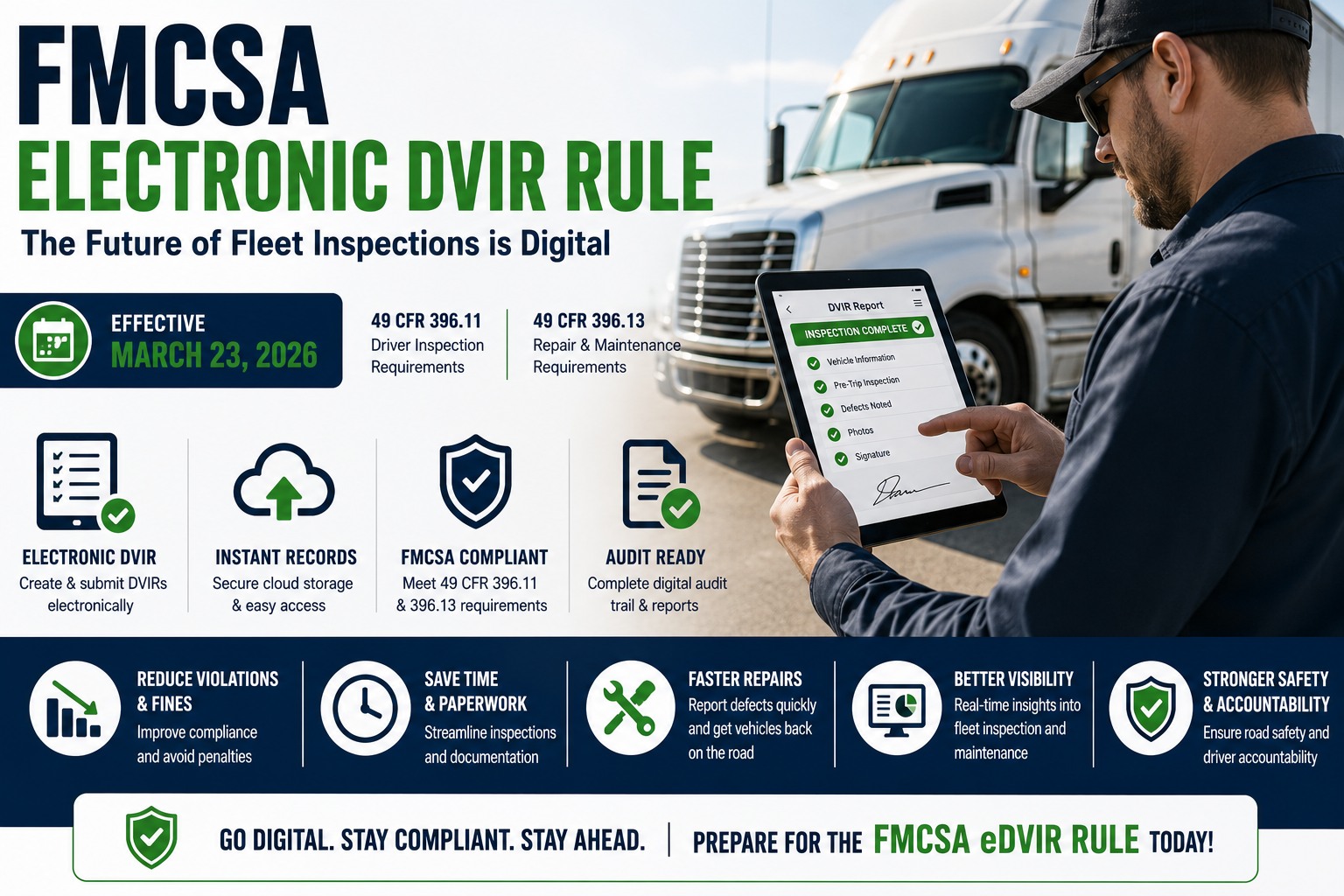
Electronic DVIRs have been permitted for years, and a recent FMCSA rule made their status in the regulation explicit — effective March 2026, electronic creation and maintenance of DVIRs is unambiguously compliant. Paper still works legally, but the gap in day-to-day usefulness is wide. It's not about going paperless for its own sake; it's about closing the gaps where compliance actually breaks.
Paper: the form sits in a truck until someone collects it. Digital: submitting the DVIR fires a work order to the mechanic in real time.
Paper: a cramped comment line. Digital: attach a photo of the exact defect so nobody has to interpret handwriting.
Paper: retention depends on a folder no one loses. Digital: every report and repair certification is stored and searchable for the full window.
Paper: dig through gloveboxes and binders. Digital: export three (or six) months of DVIRs on demand, already organized.
None of this changes what the law requires — a digital DVIR still has to identify the vehicle, describe defects, carry the driver's signature, show the repair certification, and be retained. It just makes hitting every one of those far harder to fumble. Start free and move your DVIRs off paper this week
From a safety manager who reads every report
The thing nobody tells new managers is that a DVIR is only as good as the sentence the driver writes. I used to get "check engine light" with no other detail, twenty times a week. Useless. I couldn't triage any of it.
Once drivers could tap a defect and snap a photo, everything changed. Now I see the actual cracked marker light, the actual tread. My mechanics stopped calling drivers to ask what they meant, and my "clean" reports finally mean something because I can prove the inspection happened. The report went from a formality to an actual tool.
Frequently asked questions
What is a DVIR?
A DVIR, or Driver Vehicle Inspection Report, is the written record a commercial driver creates to document a vehicle's condition and any defects found during a daily inspection. It's the formal proof that an inspection happened and the communication link between the driver who spots a problem, the mechanic who fixes it, and the next driver who needs to know the vehicle is safe. A complete DVIR identifies the vehicle (by unit number, plate, or VIN), lists any defect that would affect safe operation or cause a mechanical breakdown, carries the driver's signature, includes the carrier's certification that reported defects were repaired or are unnecessary to repair, and is retained on file. It can be completed on paper or electronically. Beyond compliance, its real purpose is to keep unsafe vehicles off the road by making sure a reported defect can't be forgotten between shifts.
What is the difference between a pre-trip inspection and a DVIR?
They're related but not the same thing, and conflating them is the most common DVIR mistake. A pre-trip inspection is the physical act of checking the vehicle before driving to confirm it's safe to operate; in the US, federal law requires the inspection but doesn't require a written form for it. A DVIR is the written report documenting the vehicle's condition, generally at the end of the workday. Think of it this way: the pre-trip answers "is this truck safe to drive right now?" and the DVIR answers "what condition did I leave it in and what needs attention?" Both typically cover the same core components, and most fleets document both ends of the shift as company policy even where a written pre-trip isn't federally mandated. In Canada under NSC Standard 13, the daily trip inspection produces a report that serves this documentation role and must be carried and produced on request.
What are the DVIR requirements in the US?
Under FMCSA rules (49 CFR §396.11), the DVIR must identify the vehicle and cover at least eleven components: service brakes including trailer brake connections, parking brake, steering mechanism, lighting devices and reflectors, tires, horn, windshield wipers, rear vision mirrors, coupling devices, wheels and rims, and emergency equipment. Any defect affecting safe operation or likely to cause a breakdown must be listed and described clearly enough for a mechanic to act on. The driver who prepared the report signs it. The carrier must repair any safety-affecting defect and certify the repair before the vehicle is used again, and the report plus certifications must be kept for three months. A driver is not required to file a written report if no defect is found, though many fleets file daily "no defect" reports anyway to prove inspections were performed. FMCSA does not require a specific form — any format works if it contains the required information and signatures.
How do DVIR rules differ in Canada?
Canada uses the National Safety Code (NSC) Standard 13 for daily trip inspections, adopted by every province, rather than the US FMCSA regulation. The differences matter for cross-border fleets. Under NSC Standard 13, a driver inspects the vehicle against the applicable schedule (Schedule 1 covers trucks, tractors, and trailers) at least every 24 hours, and a report must be produced even when no defect is found — the opposite of the US rule. Defects are formally split into minor and major categories, and a vehicle with a major defect cannot be operated until it is repaired. Drivers must carry the schedule and the report and produce them to an officer on request, and carriers must retain the reports for six months rather than the three required in the US. A driver trained only on US rules can get a clean truck detained at a Canadian scale for not having a report on board, so any fleet running both sides of the border should use a system that handles both rule sets.
Are digital DVIRs legal, and are they better than paper?
Yes, digital DVIRs are legal. Electronic records have been permissible under US federal rules for years, and an FMCSA final rule effective March 23, 2026 wrote electronic reporting explicitly into the regulation, removing any remaining doubt. Paper DVIRs are still allowed. A digital DVIR must meet the same substantive requirements as paper — identify the vehicle, describe defects, carry the driver's signature, show the repair certification, and be retained for the required period. The practical advantages are significant: drivers complete inspections on a phone with guided checklists, attach photos of defects so nothing is left to interpretation, and the moment a report is submitted the defect can trigger an automatic work order to the shop. Records store themselves and can be exported instantly during an audit instead of being dug out of gloveboxes and binders. The law is neutral on format; the difference shows up in how reliably you actually meet each requirement day after day.
Turn the DVIR from paperwork into protection
HVI gives drivers guided pre-trip and post-trip checklists with all the required components, photo capture on every defect, and electronic signatures — then routes each defect straight to the shop as a work order and files every report and repair certification for the full retention window, US or Canada. When an officer or auditor asks, you produce clean records in seconds. Live in under two weeks.
No credit card · Compliant eDVIRs on mobile · US & Canada rule sets built in