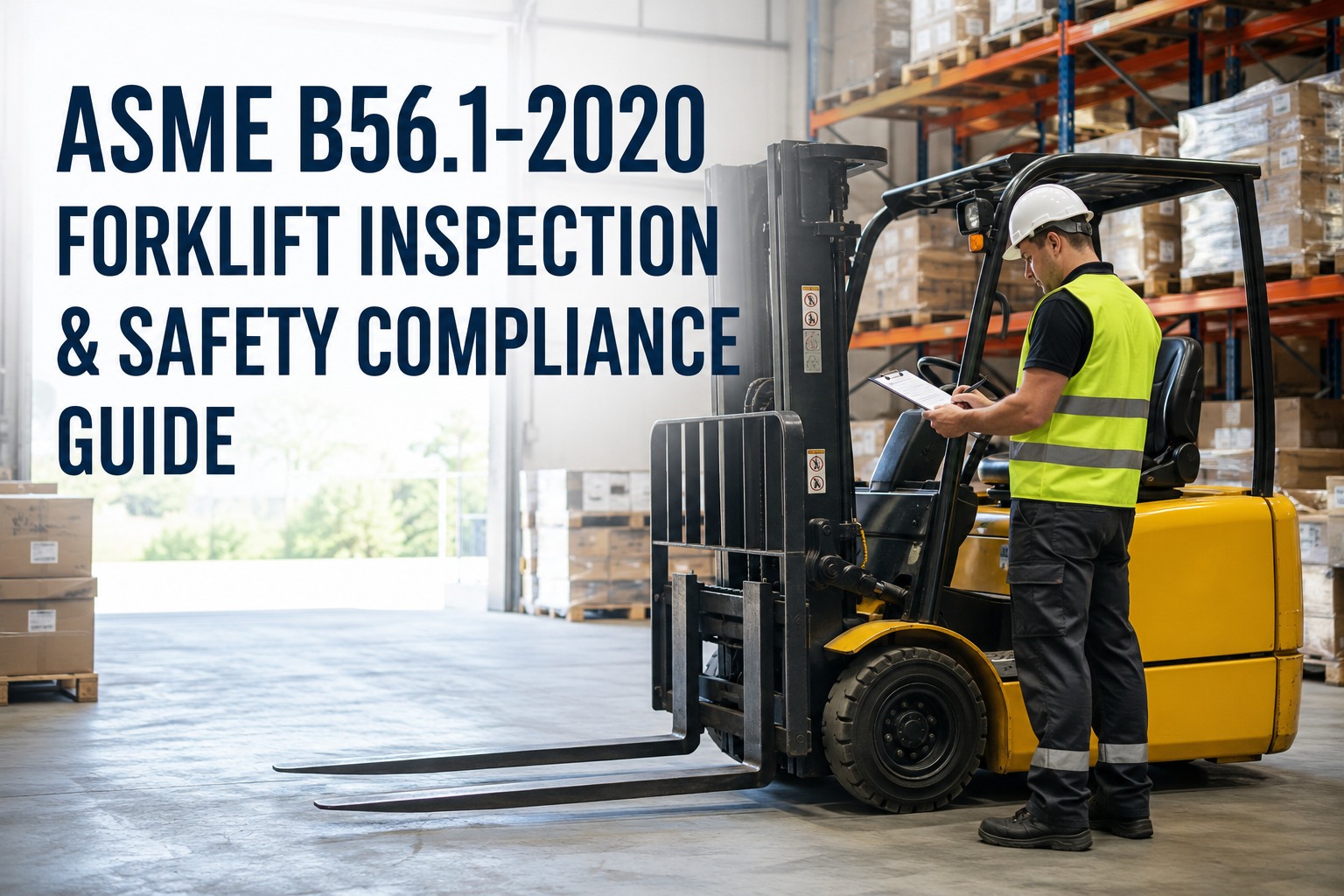
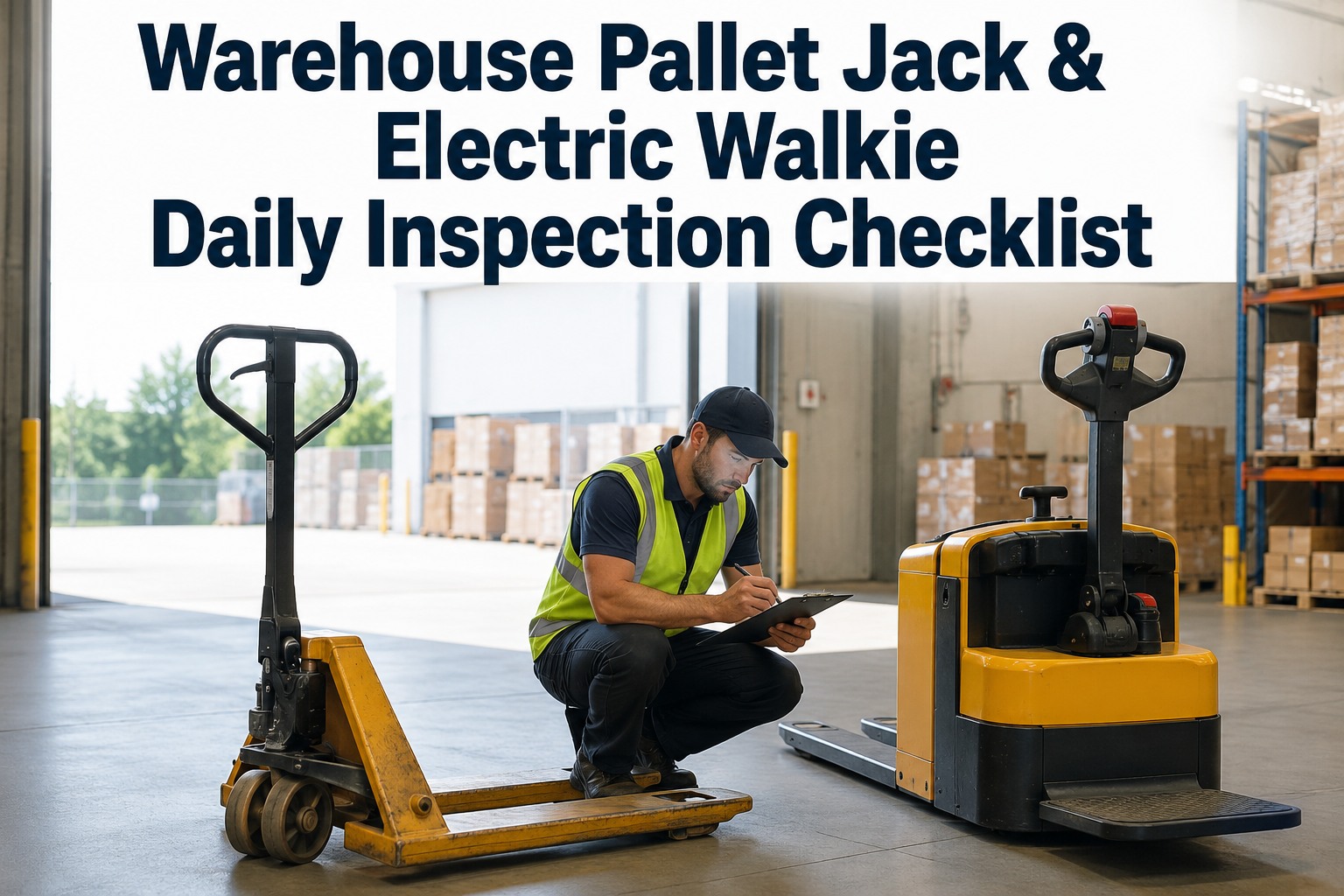
Forklifts are involved in approximately 85 deaths and 34,900 serious injuries every year in the United States — making powered industrial trucks one of OSHA's most-cited safety categories. The regulatory framework governing forklift inspection is split across two standards: OSHA 29 CFR 1910.178 sets the operational and training requirements, while ASME B56.1-2020 (ANSI/ITSDF B56.1-2020) defines the design, maintenance, and inspection standards that determine what "safe" actually looks like for low-lift and high-lift trucks. Together, they require pre-shift operator inspections, planned maintenance programs following manufacturer recommendations, annual fork inspections with specific rejection criteria (blade thickness below 90% of original, heel angle deviation exceeding 3 degrees), and documentation that proves compliance during OSHA audits. Most warehouse operations check a box on a clipboard and call it done. This guide breaks down what ASME B56.1-2020 and OSHA 1910.178 actually require — item by item — and shows how HVI's warehouse inspection platform automates compliance for every powered industrial vehicle in your facility.
Automate Forklift Inspection Compliance
HVI provides ASME B56.1-compliant digital checklists, photo-verified inspections, automated defect routing, and audit-ready records — for every powered industrial vehicle in your warehouse.
OSHA 1910.178 vs. ASME B56.1-2020: What Each Standard Covers
Understanding which standard governs which requirement prevents the most common compliance gap: doing the OSHA inspection but missing the ASME maintenance and fork-specific requirements.
OSHA 29 CFR 1910.178
Operational Requirements
Pre-shift inspection before each shift (1910.178(q)(7))
Operator training and certification every 3 years
Remove unsafe trucks from service immediately
Supervisor responsible for inspection completion
Documentation retained for audit evidence
Penalty: Up to $16,131 per serious violation; $161,323 for wilful/repeated
ASME B56.1-2020
Technical Standards
Planned maintenance per manufacturer specs (6.2)
Only trained, authorised personnel perform maintenance (6.2(b))
Fork inspection at least every 12 months (6.2.8)
Fork rejection criteria: 90% blade thickness, 3-degree angle (6.2.8.1)
Hydraulic system, mast, chain, and attachment inspection requirements
Enforcement: Referenced by OSHA — ASME violations become OSHA violations during audits
The Pre-Shift Inspection Checklist: What OSHA Requires
OSHA 1910.178(q)(7) requires operators to inspect the truck at the beginning of each shift. Here is every item the standard covers — and what HVI's digital checklist verifies with photo evidence.
Operational Controls
Service brake — full stop test at walking speed
Parking brake — holds on grade without drift
Steering — smooth, no excessive play or binding
Accelerator / drive control — smooth engagement, returns to neutral
Horn — audible from operational distance
Lights — headlights, tail lights, warning lights functional
Backup alarm — functional (if equipped)
Hydraulic System
Hydraulic fluid level — check at sight glass with forks lowered
Hydraulic hoses — no cracks, abrasion, or bulging
Lift function — full stroke test, check for mast drift (max 1" in 60 sec under rated load)
Tilt function — smooth operation, no hesitation or drift
Cylinders — no visible leaks at seals or connections
Mast, Chains & Forks
Lift chains — no elongation over 3%, no pitting or deformed links
Mast channels — no cracks, smooth roller operation, proper lubrication
Forks — no visible cracks, bends, or excessive wear (see ASME annual criteria below)
Fork positioning lock — engages and holds securely
Backrest extension — secured, no cracks or damage
Tyres, Wheels & Body
Tyres — adequate tread (pneumatic), no chunking (solid), no flat spots (polyurethane)
Lug nuts — tight, none missing (pneumatic-tyred units)
Overhead guard — secured, no structural damage or cracks
Data plate — present, legible (capacity, attachments, weight)
Seatbelt — present and functional (if equipped)
Power Source (Type-Specific)
Electric: Battery secured, connections clean and tight, electrolyte level, charger condition
LP Gas: Tank secured, fittings tight, no leaks (soapy water test), tank within certification date
Diesel/Gas: Fluid levels (oil, coolant, fuel), exhaust condition, air filter, belts
HVI provides digital checklists for all 5 inspection groups — with photo-required checkpoints, pass/fail gates, and automatic defect routing to maintenance.
Start free or
schedule a demo to see forklift-specific templates.
ASME B56.1 Fork Inspection: The Annual Requirement
ASME B56.1-2020 Section 6.2.8 requires fork inspection at intervals of not more than 12 months for single-shift operations — more frequently for multi-shift. These are the specific rejection criteria that determine whether forks stay in service.
Blade Thickness
Below 90% of original manufacturing thickness
Remove from service — no repair permitted
Heel Angle Deviation
Exceeds 3 degrees from original angle between blade and shank
Remove from service or professionally reset
Tip Height Difference
Height difference between fork tips exceeds 3% of blade length
Remove from service — indicates permanent deformation
Surface Cracks
Any visible crack at heel, blade, or hook — regardless of length
Immediate removal — crack propagation risk under load
Straightness
Blade or shank bent or twisted beyond manufacturer tolerance
Remove from service — indicates overload damage
Positioning Lock Wear
Lock mechanism worn, broken, or not engaging reliably
Repair or replace before returning to service
Maintenance Program Requirements Under ASME B56.1
Section 6.2 mandates a planned maintenance, lubrication, and inspection system. This is not a suggestion — it is a requirement that OSHA references during audits. Sign up free for HVI and automate your forklift PM program.
Planned Maintenance Schedule
Follow manufacturer-recommended intervals for lubrication, filter changes, fluid replacement, and component inspection. HVI's multi-trigger PM scheduling handles engine hours, calendar, and whichever-comes-first — matching how warehouse equipment actually accumulates usage.
Authorised Personnel Only
Only trained and authorised personnel may maintain, repair, adjust, or inspect industrial trucks — and must follow manufacturer specifications. Operator daily checks are separate from technician maintenance. HVI tracks technician qualifications alongside inspection records.
Defect Removal from Service
Any truck found unsafe must be removed from service until restored to safe operating condition. Under OSHA 1910.178(q)(7), defective trucks shall be reported to supervisors immediately. HVI enforces this: defects flagged during pre-shift inspection auto-generate work orders and restrict the unit from assignment.
Documentation & Records
Maintenance records, inspection reports, and defect histories must be retained and available for OSHA audits. OSHA does not specify a retention period — but industry best practice is 3+ years. HVI stores all records in tamper-evident cloud storage with one-click audit export.
HVI's warehouse inspection platform covers daily operator checks, periodic maintenance tracking, annual fork inspections, and operator certification management — all on one platform with audit-ready documentation.
Schedule a demo to see forklift compliance in action.
How HVI Automates Forklift Inspection Compliance
HVI is not just a CMV inspection tool — it supports warehouse and industrial equipment inspection with the same guided workflow, photo verification, and compliance documentation. Start free today.
ASME B56.1 / OSHA-Compliant Templates
Pre-built forklift checklists covering all 5 inspection groups with power-source-specific variants (electric, LP gas, diesel). Photo-required checkpoints at forks, mast, hydraulics, and tyres. Pass/fail gates that block completion if critical items are skipped.
Annual Fork Inspection Tracking
Automated 60/30/7-day alerts for annual fork inspections per ASME 6.2.8. Blade thickness and heel angle measurements logged digitally. Historical comparison shows wear progression across inspection cycles.
Instant Defect-to-Work-Order
When an operator flags a defect during pre-shift inspection, HVI auto-generates a work order with photo evidence, severity classification, and parts requirements — removing the unit from assignment until repair is certified.
Operator Certification Tracking
OSHA requires operator training evaluation every 3 years — or after any unsafe act, near-miss, or equipment change. HVI tracks certification dates per operator with automated renewal alerts and dispatch restriction at expiration.
Multi-Unit Fleet Dashboard
Inspection completion rates, open defects, PM compliance, fork inspection status, and operator certification across every forklift in your fleet — one screen, real time. Drill down to any individual unit or operator record.
Audit-Ready Documentation
Every pre-shift inspection, maintenance record, fork inspection report, and operator certification stored with timestamp, operator ID, and unit ID. Complete OSHA audit packages exportable in under 5 minutes for any date range.
Compliance Is Not Optional — and It Should Not Be Manual
OSHA 1910.178 and ASME B56.1-2020 together require daily pre-shift inspections, planned maintenance programs, annual fork inspections with specific rejection criteria, operator certification management, and documentation that proves every requirement is met during audits. Managing this across 10, 50, or 100 forklifts with paper checklists and spreadsheets is the same problem that CMV fleets faced before digital inspections — and the failure modes are identical: missed inspections, lost forms, unreported defects, expired certifications, and audit scrambles. HVI brings the same digital inspection infrastructure that 25,000+ CMV users rely on to warehouse operations: guided checklists, photo verification, automated defect routing, PM scheduling, certification tracking, and audit-ready records — all on one platform. Start free today — or schedule a demo to see forklift inspection templates configured for your warehouse.
Automate Forklift Safety Compliance
ASME B56.1 + OSHA 1910.178 compliant. Pre-shift checklists. Fork inspection tracking. PM automation. Operator certification. Audit-ready. Trusted by 25,000+ users.
Frequently Asked Questions
Q: What is ASME B56.1-2020?
ASME B56.1-2020 (also ANSI/ITSDF B56.1-2020) is the safety standard for low-lift and high-lift powered industrial trucks (forklifts). It defines design, operation, and maintenance requirements — including planned maintenance programs, fork inspection criteria, and safety specifications. OSHA references this standard in 29 CFR 1910.178, making ASME B56.1 requirements enforceable during OSHA inspections.
Q: How often must forklifts be inspected?
Two inspection frequencies apply: (1) pre-shift operator inspection before each shift per OSHA 1910.178(q)(7), covering controls, hydraulics, tyres, forks, and power source, and (2) annual fork inspection per ASME B56.1 Section 6.2.8 at intervals of not more than 12 months for single-shift operations — more frequently for multi-shift or harsh environment operations.
Start free with HVI and automate both.
Q: When must forklift forks be replaced?
ASME B56.1-2020 Section 6.2.8.1 specifies: blade thickness reduced below 90% of original, heel angle deviation exceeding 3 degrees, tip height difference exceeding 3% of blade length, any visible crack at heel/blade/hook, or permanent blade/shank deformation. Forks below the 90% thickness threshold cannot be repaired — they must be replaced.
Schedule a demo to see fork inspection tracking.
Q: Can digital forklift inspections replace paper checklists?
Yes. OSHA accepts digital inspection records with operator identification, timestamp, unit identification, and inspection results. Digital platforms with photo verification and electronic signatures provide stronger audit evidence than paper checklists — which are often illegible, incomplete, or lost. HVI's digital forklift checklists include all required data elements with tamper-evident cloud storage.
Q: What are the OSHA penalties for forklift inspection violations?
OSHA penalties for 1910.178 violations: up to $16,131 per serious violation (2026 adjusted) and $161,323 per wilful or repeated violation. Powered industrial trucks are consistently among OSHA's top 10 most-cited standards. Beyond penalties, forklift incidents cause approximately 85 deaths and 34,900 serious injuries annually — making compliance both a financial and moral imperative.
Start free.