Every APU sales sheet quotes the same dreamy number: "pays for itself in under a year." Sometimes true. Sometimes not even close. The truck APU ROI that actually lands on your books depends on how many hours you idle, what diesel costs this month, your climate, and which unit you bought — and one industry study is blunt that the savings can vanish entirely below about 1,000 idle hours a year. This guide skips the hype and shows you how to run the numbers yourself, comparing diesel, battery-electric, and solar-assisted APUs on payback, not marketing. Book a demo to calculate real payback per truck in HVI.
Truck APU ROI in 2026: The Math Behind the "Pays for Itself" Pitch
Same APU, wildly different payback. It all rides on your idle hours, fuel price, and climate.
An APU keeps the cab warm or cool and powers a driver's devices without running the main engine all night — cutting idle fuel, engine wear, and emissions. That part is real. What isn't automatic is the payback. The same unit that's a slam-dunk for a long-haul sleeper can be a money-loser for a regional truck home every night. So before you spec one, understand what an APU does, then learn to run the ROI on your own assumptions.
What an APU actually doesand why idle hours are the whole game
An auxiliary power unit is a small, separate system that provides cab heating, cooling, and 120V electrical power for "hotel loads" — the driver's HVAC, microwave, CPAP, devices — while the main engine is off. It also keeps the tractor battery charged and can pre-warm the engine in the cold.
The financial logic is simple: a heavy-duty engine idling to keep a cab comfortable burns roughly 0.8 to 1.2 gallons per hour producing zero miles. An APU delivers the same comfort on a fraction of that. Thermo King, for example, states its diesel APUs consume around 75% less fuel per hour than an idling tractor engine. Multiply the saved gallons by your idle hours and fuel price, and you have the top line of your APU ROI — which is exactly why idle hours drive everything. Book a demo to see idle hours captured automatically per truck
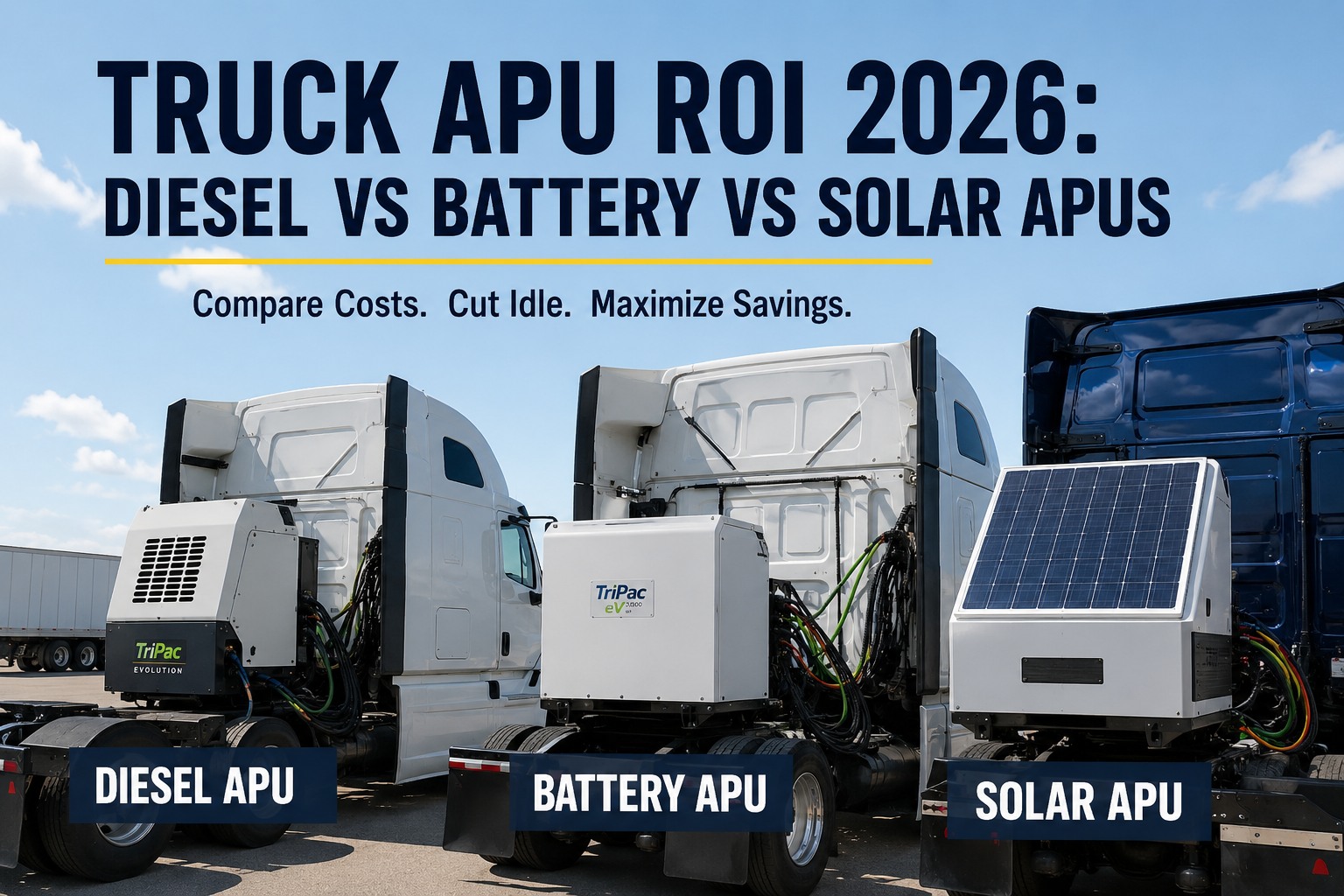
Three APU types, three cost profilesdiesel vs battery-electric vs solar-assisted
These aren't interchangeable. Each has a different upfront cost, operating cost, runtime limit, and maintenance tail — and those differences decide which one actually pays off for your duty cycle.
Unlimited runtime, more maintenance
A small diesel engine burning roughly 0.15–0.25 gal/hr. Runs as long as you have fuel, delivers full HVAC in any climate or season — the reason long-haul drivers in hot southern nights still choose it. But it's another engine: oil, filters, and valve service every 500–2,000 hours, plus HVAC upkeep.
Silent, clean, finite hours
A battery bank (increasingly lithium/LiFePO₄) powering HVAC with near-zero operating cost, no emissions, and minimal maintenance. The catch is runtime — a fixed number of hours before the truck must run to recharge, and in extreme heat it can run out mid-rest. Battery replacement every 3–5 years is a real future cost.
Range-extender, not a system
Solar panels (e.g. rooftop kits) that feed the battery bank — conditioning batteries and extending electric runtime rather than replacing the APU. Manufacturers cite meaningful run-time or engine-run reductions from solar assist. Best understood as a bolt-on that improves an electric or diesel unit's economics, not a standalone APU.
The honest summary: diesel wins on unlimited runtime and lifetime cost for heavy over-the-road use; battery-electric wins on quiet, emissions, and low upkeep where rest periods fit its runtime; solar assist sweetens either by trimming fuel or extending battery hours. Start free on HVI and track each unit's real fuel, runtime, and service so the "best" type reveals itself in your data.
The comparison, side by sideplanning ranges, not promises
Here's the head-to-head. Every figure is a directional 2026 planning range from manufacturer specs and independent studies — costs vary by brand, truck, and install, so use these to build your model, then confirm real quotes.
| Factor | Diesel APU | Battery-Electric | Solar-Assisted |
|---|---|---|---|
| Installed cost | ~$8,500–13,000 | ~$3,000–10,000+ | Add-on to either |
| Fuel / energy use | ~0.15–0.25 gal/hr | Battery only, recharge cost | Reduces fuel/battery draw |
| Runtime | Unlimited (fuel-limited) | Finite (hours per charge) | Extends runtime |
| HVAC in extreme heat/cold | Full, any season | May fall short on long hot nights | Helps at margins |
| Maintenance | Engine service every 500–2,000 hrs | Minimal; battery monitoring | Very low |
| Major replacement | Rebuild over life | Battery every 3–5 yrs (~$2–4k) | Panel life is long |
| Weight | Heavier (~400–600 lb) | Lighter (lithium ~250–350 lb) | Minimal added |
| Best fit | Heavy OTR, all climates | Rest fits runtime, no-idle zones | Boosting either system |
Note the federal weight exemption (commonly cited at up to 550 lb) that keeps an APU from eating into payload — it applies to qualifying idle-reduction units, so a heavier diesel APU usually won't cost you cargo. Book a demo to compare these options against your own idle and fuel data
How to actually calculate APU ROIthe formula and the inputs that move it
Forget the headline. Here's the real calculation. Annual idle-fuel cost avoided, minus the APU's own operating and maintenance cost, gives your yearly saving. Divide the installed cost by that saving, and you have payback in years.
The inputs that swing the answer most: your idle hours (the single biggest lever), fuel price (volatile), climate (hotter nights mean longer runtime), and the unit's maintenance and eventual battery or engine replacement. Change any one and the payback moves — which is why no single savings number is honest for every fleet. Start free and let real idle and fuel data feed the formula instead of estimates.
Worked exampleswatch the payback move with the assumptions
Same diesel APU, same $10,000 installed cost. Only the idle hours and fuel price change. Watch what happens to payback — this is why "under a year" is a claim, not a guarantee.
Long-haul sleeper, 10-hr breaks. The classic APU win.
Regional with regular layovers. Still worth it, slower return.
Home most nights. Payback may exceed useful life.
Illustrative figures, rounded for clarity — but the pattern is the point. A study by ATRI found real-world APU paybacks ranging from about 16 to 45 months, with some units not paying back within the ownership period at all. The light-idler case is exactly the fleet a generic "1-year payback" pitch would burn. Book a demo to run these numbers on your actual trucks
Anti-idling rules & the compliance anglea real cost the fuel math misses
ROI isn't only fuel. Anti-idling regulations across many US states and municipalities limit how long you can idle — Thermo King notes rules in more than 30 states plus many cities — and violations carry fines. California's well-known 5-minute limit is one example, with other states and cities running their own limits and exemptions.
APUs are generally treated as a compliant alternative to main-engine idling, and CARB-compliant units matter for trucks entering California. But specifics — limits, temperature exemptions, sleeper-berth carve-outs, and penalties — vary by jurisdiction and change over time, so verify current state and local rules for your lanes before relying on them. For fleets running no-idle corridors, avoided fines and staying loadable on those lanes can shorten payback well beyond the fuel savings alone. Tracking which trucks run regulated lanes lets that compliance value factor into the APU decision, not just the fuel math.
From a fleet spec manager who stopped guessing
We almost bought APUs for the whole fleet because the brochure promised a one-year payback. Then we actually pulled idle data. Our long-haul sleepers idled 1,800-plus hours a year — easy win. But a third of our trucks were regional, home most nights, idling maybe 500 hours. On those, the APU would've outlived its payback.
So we split the order: diesel units on the heavy idlers, nothing on the light ones. Saved a pile by not equipping trucks that didn't need it. The lesson wasn't diesel-versus-electric — it was measure your idle hours per truck before you spend a dollar.
Your APU decision frameworkmatch the system to the truck
Run every APU decision through these lenses. They turn "should we buy APUs" into "which trucks get which type, and which get none."
The make-or-break input. Below ~1,000/yr, payback gets shaky.
Long-haul sleeper vs regional-home-nightly changes everything.
Hot southern nights favor diesel's unlimited HVAC runtime.
Higher diesel shortens payback; model a realistic range.
Can you service another small engine, or is low-upkeep electric better?
No-idle corridors add compliance value beyond fuel.
Model battery swap (electric) or rebuild (diesel) over the hold.
Longer keep = more time to earn back; APUs can lift residual.
Work through these and most fleets land where Carlos did: APUs on the heavy idlers, a lighter or electric spec where rest periods fit, and none on trucks that simply don't idle enough. That's a defensible plan — but only if idle hours are measured, not assumed.
The bottom line on truck APU ROImeasure first, spec second
Truck APU ROI is real but never universal. For a heavy long-haul idler, an APU can pay back inside a year or two and save thousands annually thereafter. For a light idler home most nights, the same unit may never earn back its cost. Diesel wins on unlimited runtime and lifetime cost in demanding, all-climate use; battery-electric wins on quiet, clean, low-upkeep operation where rest fits its runtime; solar assist improves either by extending runtime or trimming fuel. The right answer is per-truck, driven by your idle hours, fuel price, climate, and duty cycle.
That's why the smartest APU decision starts with data, not a sales sheet. Capturing idle hours, fuel consumption, maintenance cost, and utilization by vehicle is what turns a generic "pays for itself" claim into a real payback number you can stand behind — and it's exactly what HVI is built to do. Model the ROI on your own trucks, then spec the units that actually pay. Book a demo to put real numbers behind every APU decision.
Frequently asked questions
How do I calculate the ROI on a truck APU?
Start with the idle fuel you'll avoid: multiply your annual idle hours by the main engine's idle fuel burn (roughly 0.8 to 1.2 gallons per hour) by your diesel price. That's your gross annual saving. Then subtract the APU's own operating cost — a diesel APU burns about 0.15 to 0.25 gallons per hour, an electric one adds a small recharge cost — plus its annual maintenance. The result is your net yearly saving. Divide the installed cost (roughly $8,500 to $13,000 for diesel, less for many electric units) by that net saving to get payback in years. The inputs that swing the answer most are idle hours (by far the biggest lever), fuel price, and climate. Because those vary so much between trucks, there's no single universal payback figure — a heavy long-haul idler might pay back in a year while a light regional truck may never recoup the cost. Always run the numbers on your actual idle data rather than a brochure estimate.
Is a diesel or battery-electric APU better for a fleet?
Neither is universally better — it depends on your duty cycle and climate. Diesel APUs run as long as you have fuel and deliver full HVAC in any weather, which is why long-haul drivers in hot southern climates often prefer them; the trade-off is that they're another small engine needing oil, filter, and valve service every 500 to 2,000 hours. Battery-electric APUs are silent, emission-free, and need minimal maintenance, but they deliver a finite number of runtime hours per charge and can fall short on a long, hot night; they also require battery replacement every 3 to 5 years, often costing $2,000 to $4,000. Purchase prices have converged, so the real deciders are runtime needs, climate, maintenance capability, and how you value quiet, zero-emission operation. Many fleets run a mix — diesel on heavy over-the-road trucks, electric where rest periods fit the runtime and no-idle compliance matters. Track real runtime and service cost per unit to confirm which fits each truck.
How much fuel does an APU actually save?
It depends entirely on how much the truck would otherwise idle. A main engine idling for cab comfort burns roughly 0.8 to 1.2 gallons per hour, while a diesel APU providing the same comfort uses about 0.15 to 0.25 gallons per hour — Thermo King cites roughly 75% less fuel per hour than idling the tractor engine. So a driver idling 10 hours a night can save on the order of 2,000-plus gallons a year, which at recent diesel prices can approach or exceed several thousand dollars annually. But those figures assume heavy idling; a truck that idles only a few hundred hours a year saves proportionally less. The savings also depend on climate (hotter or colder nights mean longer runtime), the specific unit's efficiency, and current fuel price. The honest way to estimate your savings is to track your actual idle hours per truck and apply your real fuel price, rather than using a headline gallons-saved number that assumes a heavy-idle profile you may not have.
Do anti-idling laws require an APU?
Anti-idling regulations don't specifically require an APU, but they restrict how long you can idle the main engine, which makes APUs a practical compliant alternative. Rules exist across many US states — commonly cited as more than 30 — plus numerous municipalities, each with its own idle-time limit, exemptions, and penalties. California's 5-minute limit is a well-known example, and CARB compliance matters for units operating there. APUs are generally treated as an accepted way to keep a cab comfortable without violating idle limits, since they don't run the main engine. However, the specific limits, temperature-based exemptions, sleeper-berth carve-outs, and fines vary significantly by jurisdiction and change over time, so you should verify the current state and local rules for the specific lanes you run rather than relying on a single national summary. For fleets operating regulated corridors, avoiding fines and staying eligible to run those lanes can add real value on top of fuel savings.
How can fleet software help decide on APUs?
The single biggest input to APU ROI — idle hours per truck — is exactly what most fleets estimate rather than measure, and that's where fleet software changes the decision. A platform like HVI captures actual idle hours, fuel consumption, vehicle utilization, and maintenance cost by vehicle and route, so you can calculate real payback for each truck instead of applying a generic brochure figure across the whole fleet. That lets you identify which trucks idle enough to justify an APU, which type (diesel, electric, or solar-assisted) fits each duty cycle and climate, and which trucks don't idle enough to bother — avoiding money spent equipping vehicles that won't recoup the cost. Once APUs are installed, HVI can track their service history, fuel or energy use, and downtime so you can verify the units are actually delivering the projected savings and factor APU maintenance into total cost of ownership. In short, it turns the APU decision from a sales-sheet gamble into a per-vehicle calculation grounded in your own operating data.
Calculate APU ROI on your actual trucks, not a brochure's best case
HVI captures idle hours, fuel consumption, utilization, maintenance cost, and APU service history by vehicle and route — so you can calculate true payback per truck, spec the units that pay off, and skip the ones that won't. Turn the APU decision into a data-driven calculation. One platform, mobile-first, live in under two weeks.
No credit card · Works across diesel, electric & solar APUs · Idle & cost analytics on day one