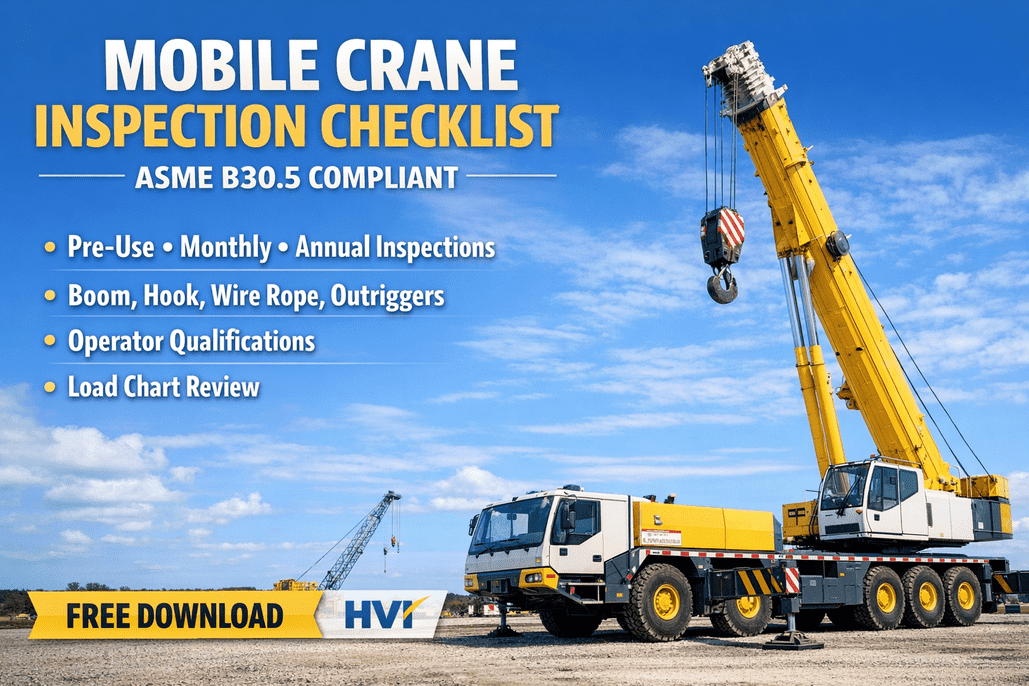
Mobile crane inspection is a systematic, frequency-based examination hierarchy designed to catch both obvious daily operational issues and hidden long-term deterioration before they cause catastrophic failures. Under ASME B30.5 (Mobile and Locomotive Cranes) and OSHA standards (29 CFR 1926.1412 for construction, 29 CFR 1910.180 for general industry), mobile cranes require inspections at three distinct intervals: pre-use/shift inspections by the operator before each use, periodic inspections at monthly-to-quarterly intervals by a designated person, and annual comprehensive inspections by a qualified inspector. The stakes are real: crane-related fatalities average 42-44 per year in the United States, and penalties for non-compliance can reach $165,514 per willful violation. This checklist covers all mobile crane types — all-terrain, rough-terrain, crawler, truck-mounted, and boom trucks — organized by system with 70 items across 7 systems, each mapped to the appropriate frequency tier per ASME B30.5.
Inspection Frequency: Three Tiers by ASME B30.5
ASME B30.5 establishes three inspection tiers with increasing depth and decreasing frequency.
Pre-Use / Shift
Before each use or start of shift
Crane operator
Written record recommended, required by many jurisdictions
Periodic
Monthly (heavy/severe) to quarterly (normal)
Designated person with knowledge to identify deficiencies
Detailed signed report — required
Annual
At least once per 12 months
Qualified inspector
Comprehensive report — retained 12+ months
Service Severity (Determines Periodic Frequency)
Normal
~50% capacity, moderate use. Quarterly.
Heavy
Near rated capacity, high use. Monthly.
Severe
At/near capacity, very high use. Monthly+.
Standby
Infrequent, light loads. Quarterly-semi.
Complete Checklist by System (70 Items)
Items color-coded by tier: PRE = every shift, PER = monthly/quarterly, ANN = annual. All lower-tier items included in higher tiers.
PRE
Boom sections — visual for cracks, dents, bends, corrosion
PRE
Boom extend/retract — smooth operation, no hesitation
PRE
Boom hoist — raise/lower function, no unusual noise
PRE
Boom angle indicator — readable, accurate
PER
Boom pins — wear measurement, retention, lubrication
PER
Extension cylinder(s) — leaks, rod condition, mounting
PER
Boom wear pads — thickness, contact pattern
PER
Nesting alignment — sections track properly
PER
Extension locks — positive engagement under load
PER
Boom hoist cylinder — leaks, rod, mounting pins
ANN
Structural welds — NDT of critical joints
ANN
Internal condition — corrosion, fatigue (disassembly may be required)
ANN
Lattice members (if equipped) — chord/lacing integrity
ANN
Boom tip sheaves — bearing, groove wear, guards
Hook & Load Block
10 items
PRE
Hook latch — present, functional, closes fully
PRE
Hook throat — visual for cracks, deformation, wear
PRE
Hook swivel — rotates freely, no binding
PRE
Load block — sheaves turn freely, guards in place
PER
Hook throat opening — measurement (15% increase = removal per B30.10)
PER
Hook shank twist — measurement (10 degrees = removal)
PER
Hook wear — saddle and bearing surface measurement
PER
Load block sheave grooves — rope groove wear
ANN
Hook NDT — magnetic particle or dye penetrant for cracks
ANN
Load block complete — bearing assessment, sheave pin wear
PRE
Visual — kinking, bird-caging, crushing, obvious broken wires
PRE
Reeving — correct pattern per load chart, no crossed ropes
PRE
Drum wraps — minimum 2 wraps remaining at all times
PER
Broken wire count — per B30.2 (6 random in 1 lay or 3 in 1 strand = remove)
PER
Diameter — measure at multiple points; 5% loss = evaluate
PER
End attachments — spelter, swage, or wedge socket condition
PER
Corrosion — external and valley breaks indicating internal
PER
Heat damage — discoloration from excessive heat exposure
ANN
Complete rope inspection with measurement record and life assessment
Outriggers & Stabilizers
8 items
PRE
Extension — full extension, positive locking, level indicators
PRE
Pads/floats — proper placement, adequate bearing area
PRE
Cylinders — full extension, no drift, hold under load
PRE
Ground conditions — bearing capacity, level, cribbing
PER
Beam — structural integrity, pin wear, extension mechanism
PER
Cylinder condition — rod scoring, seals, mounting pins
PER
Float pad condition — cracks, deformation, proper size
ANN
Structural welds — NDT, box beam internal inspection
Safety Devices & Controls
10 items
PRE
Anti-two-block (A2B) — functional test, warning and auto-stop
PRE
Load Moment Indicator (LMI) — powered, calibrated, accurate
PRE
Boom angle/length/radius display — accurate readings
PRE
Emergency stop — tested, stops all motion immediately
PRE
All controls — smooth, responsive, no sticking or delay
PRE
Swing brake — holds position, no drift under load
PER
A2B calibration — weight, cable routing, switch verification
PER
LMI calibration — sensors verified for current configuration
PER
Hoist limit switches — upper and lower function test
ANN
Complete safety device calibration against known values
Carrier, Engine & Hydraulics
12 items
PRE
Engine — starts normally, oil pressure, temp, no unusual noise/smoke
PRE
Hydraulic fluid — at level, no visible leaks
PRE
Service and parking brakes — hold test, proper feel
PRE
Tires/tracks — inflation, condition, tread; track tension/pads
PRE
Lights, horn, mirrors, wipers — all functional
PRE
Counterweight — secure, correct config for planned lift
PER
Hydraulic hoses/fittings — abrasion, cracking, swelling, age
PER
Hydraulic pressure test — verified against specs
PER
Swing bearing/ring gear — wear, lubrication, bolt torque
PER
Turntable bearing — play measurement, rotation noise
ANN
Hydraulic cylinder internal — seals, rod, bore wear
ANN
Complete electrical — insulation testing, control wiring
Documentation & Compliance
7 items
PRE
Load chart — present, legible, matches configuration
PRE
Operator manual — present and accessible in cab
PRE
Annual inspection cert — current (within 12 months)
PRE
Operator certification — valid for crane type and capacity
PRE
Lift plan — completed for critical lifts
PER
Maintenance records — PM history, outstanding defects
ANN
Complete doc review — manuals, charts, mods, training records
70
Total items across 7 systems
26
Periodic added (monthly/quarterly)
9
Annual added (comprehensive)
HVI provides customizable crane inspection templates covering all 70 items with frequency-tier indicators, photo capture, severity classification, and auto-generated work orders.
Book a demo. Or
start free.
Wire Rope Removal Criteria (ASME B30.2)
Wire rope removal criteria are specific and measurable — not subjective. Any single criterion met requires removal from service.
Broken wires (running)
6 randomly distributed in one lay, OR 3 in one strand in one lay
Broken wires (standing)
2 broken wires in one rope lay
Diameter reduction
More than 5% decrease from nominal
Kinking
Any kink distorting rope structure — immediate removal
Bird-caging
Any core protrusion or strand separation — immediate removal
Corrosion
Significant external or valley breaks indicating internal
Heat damage
Discoloration from excessive heat — evaluate immediately
End attachment
Cracked spelter, slipped swage, or deformed wedge socket
Operator Qualifications & Load Chart Requirements
Inspection and operation are inseparable safety functions. The operator must be qualified and the load chart must match the crane's actual configuration.
Operator Qualification (OSHA 1926.1427)
Certified by accredited testing organization for crane type and capacity
Employer evaluation documenting ability to operate the specific crane
Valid medical fitness — see, hear, and physically operate all controls
Knowledge of load charts, manufacturer limits, and site-specific hazards
Recertification every 5 years plus ongoing employer evaluation
Load Chart Verification (Every Lift)
Chart present, legible, matches crane model and serial number
Correct section for configuration: outriggers extended, on rubber, or crawler
Boom length, radius, load weight verified against chart capacity
Deductions applied: rigging, hook block, load line, wind, dynamic factors
Ground bearing pressure verified for actual conditions
42-44 Annual Crane Fatalities: Inspection Prevents the Predictable
Leading causes — power line contact, struck-by-load, structural/mechanical failure — are directly preventable through systematic inspection, lift planning, and hazard awareness. Every checklist item traces to a fatal failure mode.
Digital Crane Inspection: Photo Evidence and Trend Data
Paper checkmarks produce no defect evidence or trend data. Digital platforms with photo capture, measurement tracking, and severity classification create documentation that withstands OSHA investigation and identifies deterioration before failure.
Book a demo.
OSHA Penalties: Up to $165,514 Per Willful Violation
Serious: up to $16,550. Willful/repeated: up to $165,514 each. Failure-to-abate: $16,550/day. Multiple deficiencies on a single crane can generate multiple separate violations. Documented inspection programs are the primary defense.
Telematics Expanding Between-Inspection Monitoring
Modern cranes transmit load history, cycle counts, error codes, and hours continuously. This data supplements periodic inspections by identifying usage patterns indicating accelerated wear. Cranes near capacity consistently warrant more frequent periodic inspections.
Every Lift Depends on the Last Inspection
A mobile crane lifting loads overhead is only as safe as its last inspection. The 70 items across 7 systems are the specific failure points that cause booms to fail, loads to drop, and workers to die. Pre-use catches the obvious. Periodic measures the developing. Annual reveals the hidden. All three tiers working together create the inspection program that ASME B30.5 requires and workers' lives depend on.
Digital Crane Inspection Templates for Your Fleet
HVI provides ASME B30.5-aligned inspection templates — pre-use, periodic, and annual checklists with photo documentation, wire rope measurement tracking, defect classification, and audit-ready records.
Frequently Asked Questions
Q: How often must mobile cranes be inspected?
Three tiers per ASME B30.5: pre-use by operator before each shift, periodic at monthly (heavy service) to quarterly (normal) intervals by a designated person, and annual comprehensive by a qualified inspector. All lower-tier items included in higher tiers.
Q: What are the wire rope removal criteria?
Per B30.2: 6 randomly distributed broken wires in one lay or 3 in one strand in one lay (running ropes); 2 broken wires in one lay (standing); diameter loss exceeding 5%; any kinking or bird-caging; significant corrosion; heat damage; damaged end attachments. Any single criterion = remove from service.
Start free with HVI.
Q: Who is qualified to inspect cranes?
Pre-use: crane operator. Periodic: designated person with knowledge to identify deficiencies. Annual: qualified inspector competent to perform inspection and evaluate findings. OSHA and ASME allow only qualified persons with completed training to inspect cranes.
Q: What must be verified on the load chart before each lift?
Chart present and matching crane model/serial. Correct section for configuration. Boom length, radius, and total load verified against capacity. Deductions for rigging, hook block, wind, and dynamic factors. Ground bearing pressure for actual conditions. Lifts exceeding 75% of chart capacity are typically critical lifts requiring written plans.
Q: What documentation is required?
Pre-use: written record recommended, required by many jurisdictions. Periodic: detailed signed report — required. Annual: comprehensive report with all items, results, inspector identity, and date — retained 12+ months. Deficiency and corrective action records required for all defects at any tier.
Q: What are OSHA penalties for crane violations?
Serious: up to $16,550 per violation. Willful or repeated: up to $165,514 each. Failure-to-abate: $16,550 per day. Multiple deficiencies can generate multiple separate violations on a single crane. Documented systematic inspection programs are the primary defense against penalties and negligence liability.






.png)