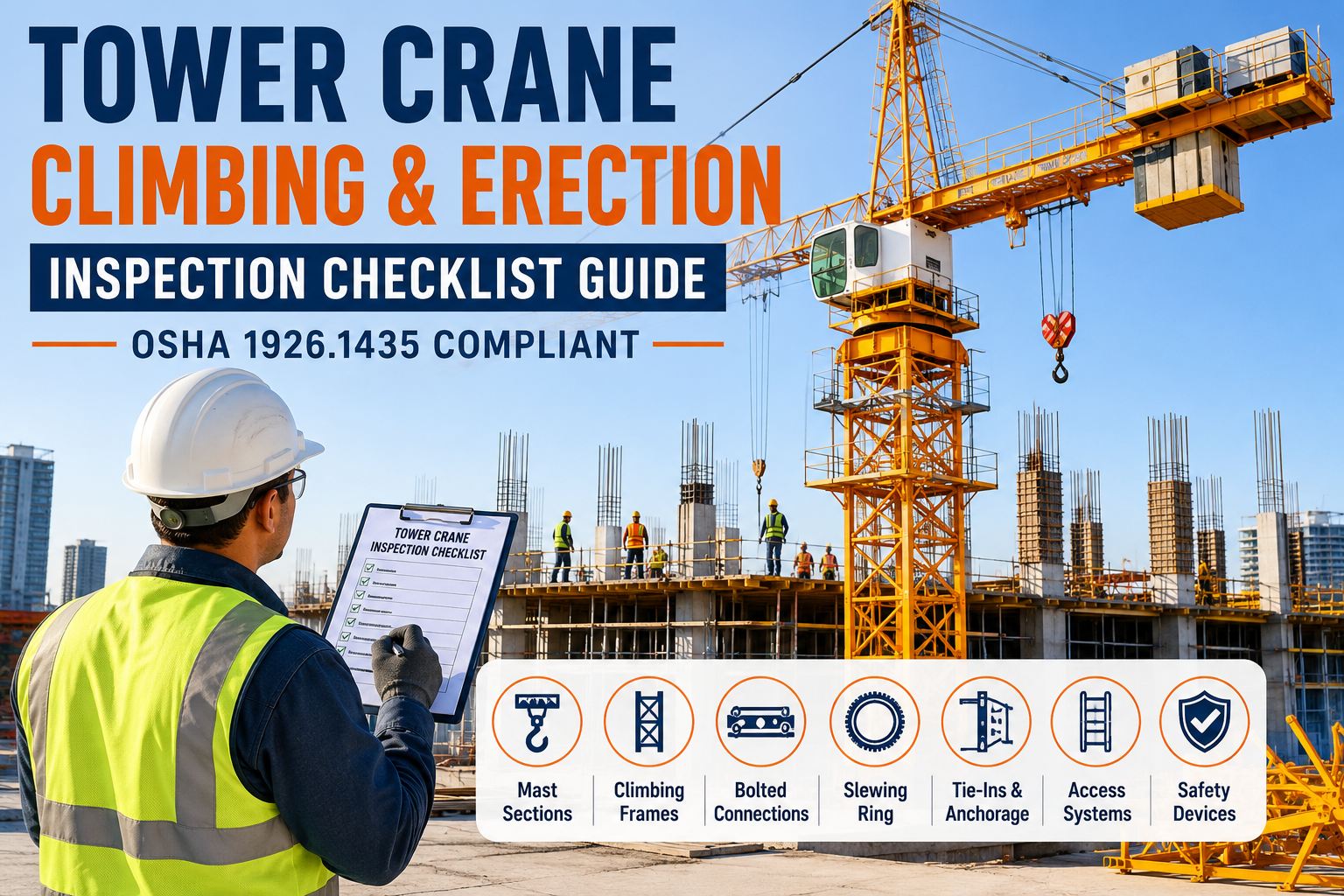
Tower cranes are the most visible, most consequential pieces of equipment on a high-rise site — and the moments they're erected, climbed, and dismantled are where the highest-stakes failures happen. The mast section that goes up incorrectly torqued, the slewing ring with the missed crack, the climbing frame pin not seated, the host structure tie-in installed without a registered professional engineer's verification — each one has caused a collapse. Crane-related fatalities average 42–44 per year in the United States, and tower crane erection and climbing incidents account for an outsized share. OSHA 29 CFR 1926.1435 layers a specific, stricter set of inspection rules on top of the general crane standard (1926.1412) precisely because of this risk: a pre-erection inspection of every component by a qualified person, a post-erection load test with certified weights, plumb verification to a 1:500 tolerance, and monthly inspection of every tower bolt and tie-in above the uppermost brace. Run on paper, this becomes binders and folders that fail the moment an OSHA inspector or insurer asks for proof. A digital tower crane inspection & maintenance platform built for 1926.1435 turns the entire erection-climb-dismantle cycle into a guided, photo-verified, signed-off workflow on HVI — mast sections, bolted connections, slewing ring, climbing frames, tie-ins, safety devices, and load test results all stored on the asset record, all audit-ready. This page is the comprehensive checklist.
OSHA 1926.1435 + ASME B30.3 + HVI
The Tower Crane Climbing & Erection Inspection Checklist
Every mast section, slewing ring, bolted connection, tie-in, climbing frame, and safety device — verified in sequence, signed by the right qualified person, and stored on the asset record in HVI.
1926.1435
OSHA standard tower cranes must meet
42–44
crane fatalities per year in the US
1:500
required plumb tolerance after erection
$165K
max OSHA willful penalty per violation
What 1926.1435 Demands That Other Cranes Don't
The standard tower crane rule layers four additional requirements on top of 1926.1412. Miss any one and the erection isn't legal — which is why HVI's tower crane templates are built around these four pillars.
Pre-Erection by Qualified Person
Every component — mast, jib, slewing ring, climbing frame, counterweight — inspected for damage/wear before it leaves the ground. Documented per asset.
Plumb to 1:500
After erection, the tower must be plumb to manufacturer tolerance — or 1:500 (≈1 inch in 40 feet) — verified by a qualified person. Out of tolerance = stop.
Post-Erection Load Test
A load test using certified weights (or a certified scale) per manufacturer's instructions — or per an RPE's written procedure when none exist. Required after each erection.
Monthly Bolt & Tie-In Audit
Every tower bolt from the base up — or above the uppermost brace — plus tie-ins, braces, floor supports, and wedges checked monthly for loose/dislodged condition.
The Three-Stage Inspection Timeline
1926.1435 splits the work into three stages with different inspectors and different sign-offs. HVI runs them as a single connected workflow on the asset record — no stage closes until the previous one is signed.
STAGE 1
Pre-Erection & Component
Foundation engineered & signed by manufacturer or RPE. Each component inspected on the ground by a qualified person before being lifted into the assembly.
Inspector: Qualified Person
STAGE 2
Erection & Climbing
A/D director directs erection. Climbing only under manufacturer prohibitions, RPE-verified host structure, and within wind limits. No personnel under jib/rotating section.
Inspector: A/D Director + Competent Person
STAGE 3
Post-Erection Verify
Plumb verification to 1:500, load test with certified weights, functional test of all controls and safety devices, documentation signed and retained.
Inspector: Qualified Person
The Complete Checklist — Seven Sections
Every item below is what an HVI tower crane template prompts in sequence. Each section closes only when every required item is answered, photo-evidenced where needed, and signed off by the right inspector tier.
01
Foundation & Site Prep
QUALIFIED PERSON / RPE
Foundation engineered & signed by manufacturer or registered PE
Ground conditions firm, drained, and within bearing capacity
Anchor bolts torqued to manufacturer specification
Site plan checked — no contact path between adjacent cranes
Power line clearance verified per 1926.1408 Table A
Erection zone barricaded — no entry under jib during operation
02
Component Pre-Erection Inspection
QUALIFIED PERSON
Mast sections — no cracks, dents, or paint loss exposing primer
Slewing ring — no excessive play, gear teeth intact
Climbing frame / cage — no deformation, pins/lugs sound
Jib & counter-jib — chords, diagonals, welds inspected
Counterweights — correct number, secured, labels readable
Cab & operator station — controls, glass, seat, e-stop
Hoist winch & drum — no flat spots, brake function
Trolley & sheaves — bearings smooth, no scoring
Wire rope — per 1926.1413 rejection criteria, no broken wires
Hooks & safety latches — throat opening, free rotation
03
Bolted Connections & Pins
COMPETENT PERSON
Tower (mast) bolts torqued to spec — torque log captured per joint
Slewing ring bolts — verified pattern, correct torque sequence
Climbing frame pins fully seated & retained
Jib connection pins / bolts secured with manufacturer hardware
Counter-jib tie bars — pins, washers, retainers in place
No reused / non-OEM fasteners anywhere in the structure
04
Climbing Operation
A/D DIRECTOR
Manufacturer climbing procedure on site & followed exactly
RPE has verified host structure strength & brace anchorages
Wind speed within manufacturer climbing limit (typically <20 mph)
Crane secured / locked in position before any crew enters area
No personnel under jib or rotating section during climb
Tie-in installed at every required floor — bolts torqued
Braces, floor supports, and floor wedges fully seated
Hydraulic climbing system pressure logged at each step
05
Safety Devices & Operational Aids
COMPETENT PERSON
Load Moment Indicator (LMI) — functional & calibrated
Anti-two-block device — tested under controlled lift
Upper / lower hoist limit switches — function verified
Trolley travel limit switches — both directions
Slewing limit / zone-protection system — tested
Wind speed indicator (anemometer) — live reading at cab
Emergency stop (cab + ground) — both functional
Brake system — service, parking, holding brakes verified
06
Post-Erection Verify & Load Test
QUALIFIED PERSON
Plumb verified to manufacturer spec or 1:500 (≈1 in / 40 ft)
Load test with certified weights or scaled to certified scale
Load test conducted per manufacturer / RPE written procedure
All controls trial-operated — no abnormal noise, drift, or lag
Wire rope reeving verified per manufacturer drawing
Inspection signed & dated by qualified person — record retained
07
Access, Egress & Fall Protection
COMPETENT PERSON
Ladders / climbing rails secure, no missing rungs, fall arrest rail
Rest platforms at manufacturer intervals — guardrails intact
Cab access platform — gate operational, kickplates in place
Fall protection anchor points identified & rated load tagged
PPE for climbers — full body harness, twin-leg lanyard, helmet
Lighting on ladders / platforms functional for dawn / dusk work
Wind, Weather & Stop-Work Limits
Tower cranes have hard environmental limits during erection and climbing. The HVI checklist enforces them as required fields — no climb step closes if conditions exceed manufacturer or site-specific thresholds.
Wind Speed Limit
Typically <20 mph during climb; manufacturer's documented limit always governs. Wind speed logged at cab anemometer before each climb step.
Lightning & Storms
Stop work and evacuate the crane if lightning is observed within site-specific distance. Climbing not resumed until all-clear from competent person.
Visibility & Ice
No climb in heavy rain, fog reducing visibility below site standard, or ice on climbing frame. Conditions logged on the asset record before sign-off.
Who Signs What — The Inspector Tier Matrix
Using a competent person where a qualified person is required is itself a citable violation. HVI binds each checklist section to the correct user role so the wrong sign-off can't happen.
Activity
Required Inspector
OSHA Citation
Pre-erection component check
Qualified Person
1926.1435(f)(1)
Foundation & structural design
Manufacturer / RPE
1926.1435(c)
Climbing — host structure check
Registered PE
1926.1435(e)(2)
Each-shift visual inspection
Competent Person
1926.1412(d)
Monthly bolts & tie-in audit
Competent Person
1926.1435(f)(3)
Post-erection load test & plumb
Qualified Person
1926.1435(f)(2)
Annual comprehensive inspection
Qualified Person
1926.1412(f)
Paper Binder vs. HVI Tower Crane Workflow
The difference between a checklist that passes an audit and one that doesn't is whether every signature, photo, torque value, and load test result is searchable on demand — or buried in a folder somewhere.
PAPER BINDER
Torque logs hand-written, hard to verify per joint
Load test photos kept on a phone, never filed
No role enforcement — wrong person signs off
Monthly bolt audit gets skipped above brace line
Audit prep means days of folder digging
HVI DIGITAL WORKFLOW
Torque value logged per joint with photo & timestamp
Load test & plumb evidence attached to asset record
Role-locked sign-offs — qualified vs competent enforced
Monthly bolt & tie-in audit scheduled & auto-reminded
Audit package exported in under 5 minutes
Run the Full 1926.1435 Checklist on HVI
HVI gives tower crane operations a digital, OSHA-aligned inspection workflow covering pre-erection components, bolted connections, climbing operations, safety devices, and post-erection load test — with role-locked sign-offs for qualified persons, competent persons, A/D directors, and RPEs. Photo-verified, timestamped, audit-ready. Trusted by 25,000+ users worldwide.
Frequently Asked Questions
What is OSHA 1926.1435 and how does it differ from 1926.1412?
1926.1412 is the general crane inspection standard under Subpart CC — it sets the shift, monthly, and annual inspection structure for all construction cranes. 1926.1435 layers tower-crane-specific requirements on top: a pre-erection inspection of every component by a qualified person before it's lifted into the assembly, a post-erection load test using certified weights, a plumb verification to manufacturer tolerance or 1:500 (about 1 inch in 40 feet) by a qualified person, monthly inspection of every tower bolt and structural connection (including tie-ins, braces, floor supports, and floor wedges above the uppermost brace), and engineered foundations signed by the manufacturer or a registered PE. Climbing operations have additional rules — manufacturer prohibitions, RPE-verified host structure, no personnel under the jib during the climb. HVI's tower crane templates encode all of this in one workflow.
Start a free HVI trial to run the 1926.1435 checklist.
Who is qualified to inspect a tower crane during erection?
OSHA distinguishes three tiers. A registered professional engineer (RPE) is required for engineering design — the foundation, structural supports, and host-structure verification before climbing. A "qualified person" — someone with a recognized degree, certificate, or professional standing demonstrating expertise — performs the pre-erection component inspection (1926.1435(f)(1)), the post-erection plumb verification and load test (1926.1435(f)(2)), and the annual comprehensive inspection (1926.1412(f)). A "competent person" — capable of identifying hazards and authorized to correct them, typically the operator or trained supervisor — performs each-shift visual checks and the monthly bolt and tie-in audit. Using a competent person where a qualified person is required is itself a citable violation, which is why HVI binds each section to the right user role.
Book a demo to see role-locked sign-offs.
What is the post-erection load test requirement?
After every tower crane erection, 1926.1435(f)(2) requires a load test using certified weights — or scaled weights using a certified scale with a current calibration certificate. The test must follow the manufacturer's written instructions when available, and when no manufacturer procedure exists, it must follow a written load test procedure developed by a registered professional engineer familiar with the equipment. The load test is in addition to the standard post-assembly inspection under 1926.1412(c), not a replacement for it. The qualified person who oversees the test signs off the result, and the documentation goes into the asset record. In HVI, the load test step won't close until the certified weight value, the test load chart, the inspector signature, and photo evidence are all attached.
Sign up for a free HVI trial to log load tests digitally.
What does the monthly tower crane inspection have to cover?
In addition to the standard monthly items under 1926.1412(e), 1926.1435 adds tower-crane-specific checks. Inspectors must verify all tower (mast) bolts and other structural bolts for loose or dislodged condition — from the base of the tower up if the crane stands free, or above the uppermost brace if the crane is tied to or braced by the host structure. They must also inspect the uppermost tie-in, braces, floor supports, and floor wedges where the crane is supported by the structure. The inspection is performed by a competent person, the items checked and results are documented, and the record (with inspector name, signature, and date) must be retained for at least three months. HVI schedules the monthly inspection automatically, prompts for every required item, and stores the signed record indefinitely.
Schedule a demo to see HVI's monthly bolt audit.
What are the climbing operation safety requirements?
1926.1435(e) governs climbing — both inside-climbing and top-climbing. The employer must comply with every manufacturer prohibition, have a registered professional engineer verify that the host structure is strong enough to sustain the forces imposed through the braces, brace anchorages, and supporting floors, and confirm that no personnel are in or under the tower, jib, or rotating portion of the crane during climbing unless the manufacturer's instructions direct otherwise and the crane is in a secured/locked position. Wind speed must stay within the manufacturer's documented climbing limit (commonly under 20 mph), the climbing-procedure document must be on site and followed exactly, and tie-ins, braces, floor supports, and floor wedges must be installed at every required floor and torqued to spec. HVI's climbing-stage checklist enforces these as required fields — no step closes if wind, RPE sign-off, or personnel-clearance items are missing.
Sign up for a free HVI trial to enforce climbing safety.
How does HVI's digital checklist work for tower cranes?
HVI gives every tower crane a single asset record with three connected checklists — pre-erection components, climbing operations, and post-erection verification — plus the recurring shift and monthly inspections under 1926.1412 and 1926.1435. Each section is role-locked, so a competent person can't sign off a qualified-person task. Defects require a photo and a severity assignment, which auto-generates a work order routed to maintenance. Torque values, plumb readings, wind speeds, and load-test results are captured as structured data, not free-text, so the asset's full history is searchable. When an OSHA inspector or insurance auditor asks for proof, the full erection package — components, bolts, tie-ins, load test, signatures, photos — exports in under five minutes. Audit pass rates on HVI run 96% versus 73% on paper.
Book a demo to see HVI's tower crane workflow.
.png)
.png)