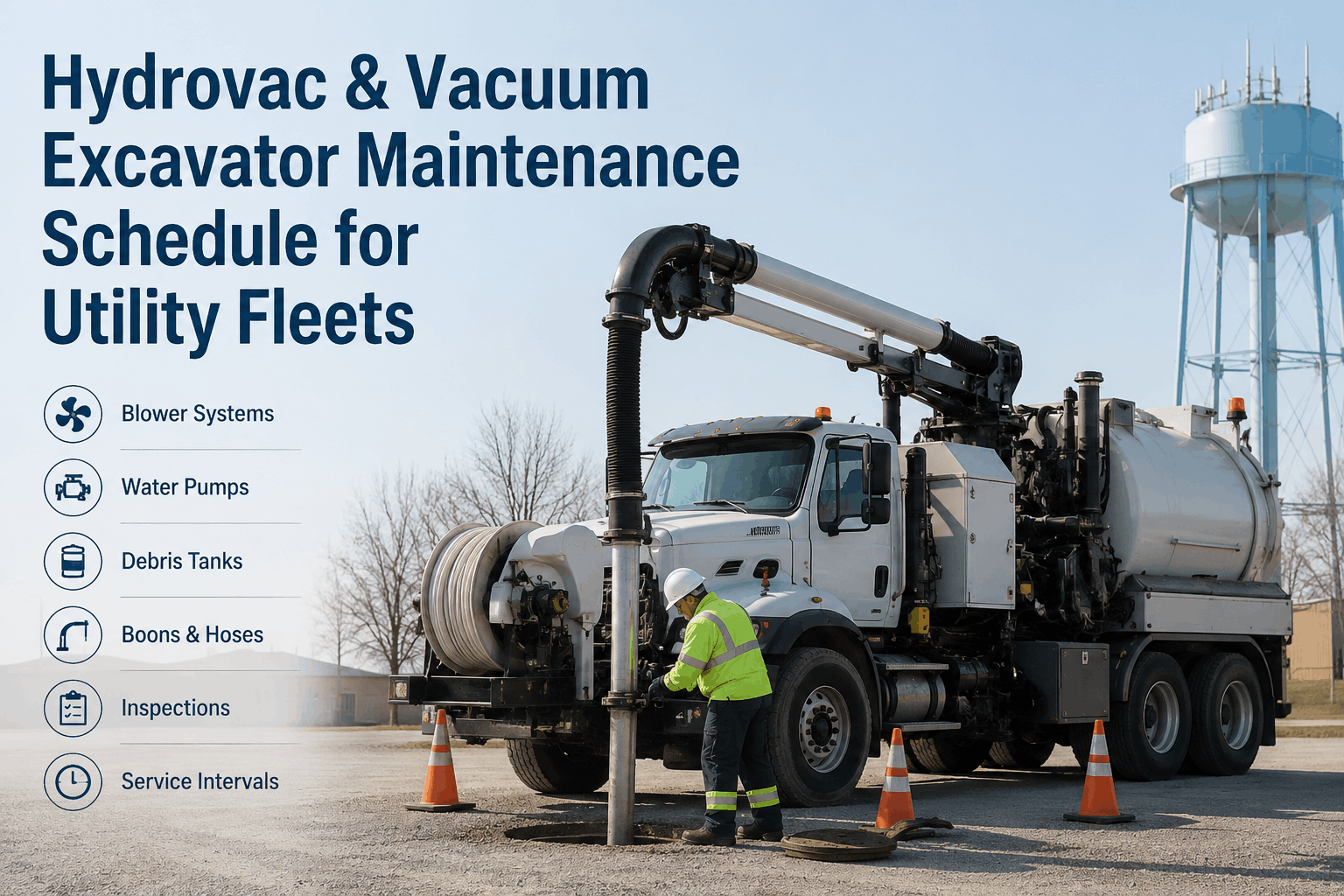
A hydrovac is really four demanding machines bolted to one chassis. A positive-displacement blower pulling 3,000–6,000 CFM, a water pump driving 3,000–4,000+ PSI through a cutting lance, a debris tank swallowing tons of wet slurry, and an articulating boom feeding it all — each running at the edge of its limits on every dig, in mud, frost, and grit. That complexity is exactly why hydrovac downtime is so punishing for a utility fleet: when one system fails, the whole truck stops, and a $30 filter ignored today is the $8,000 blower rebuild waiting next month. The blower is the heart of the machine and the most expensive thing to wreck, yet it lives or dies on a filtration system that takes minutes to check. The water pump's cutting power fades the instant its oil or filters are neglected. The debris tank's float balls silently stop protecting the blower when they seize in their cages. And the high-pressure hoses and boom take more abuse than anything else, wearing thin until one bursts. None of it is mysterious — it's all on a schedule, if someone keeps the schedule. A structured hydrovac maintenance program turns that schedule into tracked, documented service that keeps the truck digging. This page breaks down the four systems, their service intervals, and the daily checks that prevent the big failures.
The Four Systems That Keep a Hydrovac Digging
Each subsystem has its own failure mode and its own maintenance rhythm. Understand what each one needs — and what it costs to ignore it — and the whole maintenance program falls into place.
Blower System
The heart. The positive-displacement blower generates the vacuum. Filtration is its lifeline — any carryover past the filters scores the blower internals and kills performance.
Keep it alive: clean filters daily, replace per manufacturer hours, check the cyclone/separator. Maintain oil and filter intervals to keep the blower running for years.
Water Pump
The cutter. Drives 3,000–4,000+ PSI through the lance to break up ground. Cutting power fades fast when pump oil and filters are neglected.
Keep it alive: change pump oil and clean/replace filters on schedule, inspect nozzles for wear or clogging, service the boiler/burner for frozen-ground heat.
Debris Tank
The holder. A 6–15 yd³ tank carrying wet slurry, with float balls and a level indicator that shut off vacuum before debris reaches and ruins the blower.
Keep it alive: verify float balls move freely in their cages, check the level indicator sweeps, clean the tank and seals, inspect the door and dump cylinder.
Boom & Hoses
The reach. Articulating boom and 6–8 in. suction hose plus high-pressure lines — the hardest-working, most-abused parts on the machine.
Keep it alive: inspect hoses for thinning, cracks, and bulges daily; grease boom pivot points; check hydraulic lines and pendant controls; replace hoses before they burst, not after.
The Maintenance Schedule by Interval
Hydrovac service stacks across daily, weekly, and hour-based intervals. The daily checks prevent the catastrophic failures; the deeper services keep the four systems running for years. Here's the structure.
The High-Pressure Safety Layer
A hydrovac isn't just maintenance-intensive — it's hazardous when neglected. The same systems that need servicing carry serious risk, so the daily check is a safety check too.
Jetting System
2,000–4,000+ PSI water can cut skin. Verify lance trigger lock, HP hose integrity (no cuts or bulges), whip checks on couplings, and tip nozzle condition every shift.
Pressure Vessel
The debris tank is a pressure vessel. Confirm E-stop, interlocks, relief valves, and gauges function — and never open a pressurized tank.
Heat & Noise
Engines run at high RPM to power blower and pump — extreme heat and noise. Verify guards over hot exhaust and rotating belts, and noise panels are intact.
Ground & Outriggers
Ground must support the loaded truck with outriggers deployed, especially near excavation edges. Check pads, deployment, and stability before digging.
From Daily Check to Documented Uptime
The payoff of a structured program is the loop: inspect, schedule, fix, and record — so the blower filter gets cleaned, the pump oil gets changed on time, and every service is proven.
Inspect Daily
Crew runs the guided four-system check on a phone — blower filters, pump, float balls, hoses — with photos on any defect.
Schedule by Hours
Pump oil, filters, and blower service track by engine hours; the system fires the work order before each interval is due.
Fix & Document
A flagged defect becomes a routed work order; every inspection and service logs to the truck's record, audit-ready.
Keep Every Hydrovac Digging, Not Sitting
Guided daily inspections for blower, water pump, debris tank, and boom; hour-based PM scheduling; high-pressure safety checks; defect-to-work-order routing; and timestamped service records — built for utility vacuum excavation fleets. Protect the blower before a filter becomes a rebuild. Trusted by 25,000+ users worldwide.



.png)
.png)