During a DOT audit, a missing record is treated exactly like a missing repair — it doesn't matter how well you maintained the truck if you can't prove it. That's the hard lesson of 49 CFR Part 396, the federal rulebook for inspecting, repairing, and maintaining commercial motor vehicles. It's not one rule but a connected set: systematic maintenance, driver inspection reports, annual inspections, and three different record-retention clocks that trip up fleets constantly. This guide walks every major section in plain operator language, so you know what each requires, what records to keep, and what an auditor will ask for. Book a demo to see it managed in one place.
49 CFR Part 396: Inspection, Repair & Maintenance
The federal framework that governs how you keep — and prove — a safe fleet. Section by section, in plain language.
Part 396 applies to every motor carrier and covers the full lifecycle of keeping a commercial motor vehicle roadworthy: inspect it, find defects, fix them, prove you did, and repeat on schedule. The sections below each handle one piece of that cycle. Read them together and a clear operational picture emerges — one that's far easier to run on a connected system than on scattered paper.
396.3Systematic inspection, repair & maintenance
This is the backbone of the whole part. It requires every carrier to systematically inspect, repair, and maintain all vehicles under its control — and the word "systematic" is doing a lot of work.
"Systematic" means a documented, regular, repeatable process — not fixing things when they break. In practice, an auditor expects to see scheduled maintenance intervals, a way to track defects through to repair, and due dates that don't slip. Carriers must maintain records for each vehicle that show the identification (make, model, VIN or company number), plus a history of inspections, repairs, and maintenance.
The core failure here isn't dirty trucks — it's the absence of a documented process. A fleet that maintains well but can't show a systematic method, with records to back it, is still exposed.
- Vehicle identification info
- Maintenance & inspection schedule
- History of repairs performed
- Defect tracking to resolution
Closely tied to this is 396.7 — unsafe operations forbidden: a vehicle must not be operated in a condition likely to cause an accident or breakdown. Systematic maintenance under 396.3 is how you stay on the right side of 396.7 in the first place — a documented, scheduled process is both the safety mechanism and the audit evidence.
396.9Roadside inspections in operation
When an officer inspects one of your vehicles on the road, the responsibility doesn't end at the roadside. 396.9 puts specific follow-up duties on the carrier — and skipping them is a documented failure.
The carrier must review the roadside inspection report for any violations or defects noted.
Any defects listed must be repaired and the vehicle brought back into compliance.
Sign the certification that violations were corrected and return the form as required, keeping a copy.
The trap fleets fall into is treating the roadside report as "handled" once the truck rolls again. The regulation wants proof the noted defects were actually fixed and certified. A digital defect-to-repair trail makes that certification a two-minute task instead of a paper hunt. Start free on HVI to capture roadside findings and their repairs in one record.
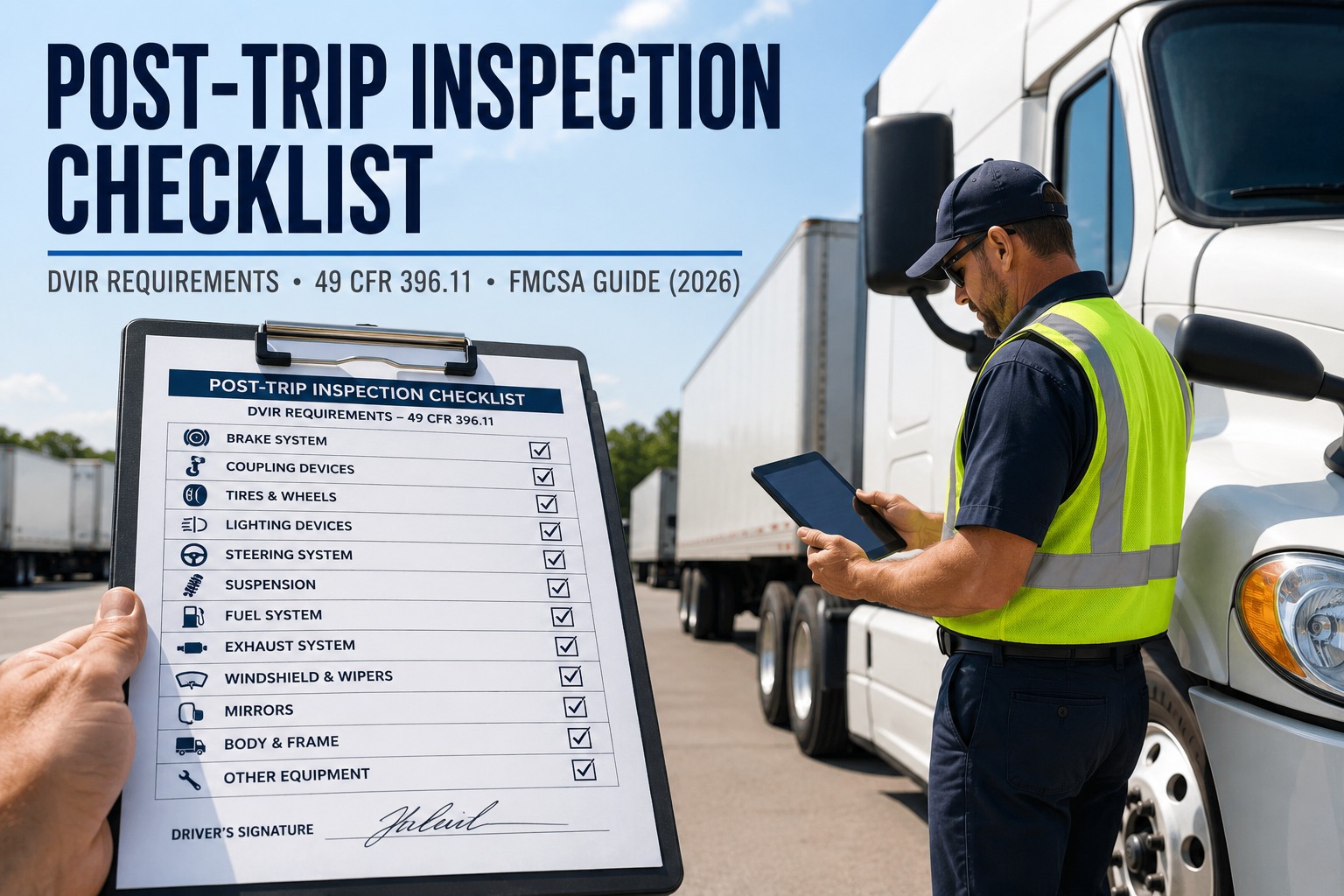
396.11Driver Vehicle Inspection Reports (DVIR)
The DVIR is the daily heartbeat of Part 396 — the mechanism that surfaces defects from the people who drive the trucks. Here's the full lifecycle, because every handoff in it is a place compliance can break.
At day's end the driver documents any defect found or reported on the vehicle (and trailers).
The carrier fixes any defect that would affect safe operation before the vehicle is dispatched.
The carrier certifies repairs were made — or that none were needed — and the driver reviews and signs.
Notice this is a chain of custody: report → repair → certify → review. Break any link — a defect reported but not certified as fixed, or a report that never gets filed — and you have a Part 396 finding waiting to be written. Book a demo to see the full DVIR chain captured digitally
396.13Driver inspection before operating
Before a driver drives, 396.13 gives them three concrete duties. It's short, but it's the front line — the moment a known defect either gets caught or rolls onto the highway.
Be satisfied the vehicle is in safe operating condition before driving it.
Review the last DVIR for the vehicle, if one was prepared.
Sign the report — if defects were noted — to acknowledge review and that required repairs were certified.
This closes the loop opened by 396.11: the previous driver's report has to actually reach the next driver, who confirms the fixes before rolling. On paper, that handoff is fragile; a defect certified in the office does the driver no good if the paperwork never makes it to the cab — which is why putting the last DVIR in the driver's hand at login matters.
396.17Periodic (annual) inspection
On top of daily driver checks, every commercial motor vehicle needs a formal periodic inspection at least once every 12 months against a defined minimum standard. This is the "annual inspection" fleets know — and often let lapse.
The inspection must cover, at minimum, the components in the regulation's appendix of Minimum Periodic Inspection Standards. In a combination vehicle, each unit — tractor, semitrailer, full trailer, converter dolly — must be inspected. Proof of the passing inspection must be kept on the vehicle, either as the inspection report or as a sticker/decal showing the inspection date, the entity holding the report, vehicle identification, and a certification of compliance.
You don't have to use FMCSA's inspectors: a qualifying state program, an authorized commercial facility, or a carrier's own self-inspection program can satisfy 396.17, as long as it meets the federal minimum standard.
- 396.19 — inspector qualifications: the person inspecting must meet defined training/experience criteria
- 396.21 — the report must identify the inspector, carrier, date, vehicle, and components, and certify the results
The most common failure is simply an overdue annual — a truck still running past its 12-month mark because no one tracked the due date. That's a recurring-reminder problem, and it's exactly the kind of date a system should surface weeks ahead, not discover at the roadside. Start free and let annual-inspection due dates track themselves.
The three retention clocks that trip fleets up
This is the single most common Part 396 mistake: treating every record as if it has the same retention period. It doesn't. Three record types, three different clocks — purge on one fixed schedule and you'll discard something you're still legally required to hold.
Kept where the vehicle is housed or maintained for 1 year under your control, plus 6 months after it leaves your control (sale, trade, lease end).
The driver report, the certification of repairs, and the driver's review certification — retained 3 months from the date the report was prepared.
The periodic inspection report retained 14 months from the inspection date — the longest routine clock of the three.
Verify these against the current regulation before setting a retention policy, since specifics and guidance can change. But the principle is durable: different documents, different clocks. A system that timestamps each record and holds it for the right period removes the guesswork — and the risk of shredding a file you still needed. Book a demo to keep every record for exactly the right retention window
Where fleets lose Part 396 compliance
Auditors and roadside inspectors see the same failures over and over. Every one is a documentation or tracking gap — not usually a maintenance skill gap — which is precisely why the right system prevents them.
The work was done but can't be produced — treated as if it never happened.
A vehicle running past its 12-month periodic inspection with no current proof.
A reported defect with no documented repair or certification closing it out.
Reports missing required fields — inspector, date, components, certification.
Records exist somewhere but can't be retrieved on demand at the vehicle's location.
Records purged too early because every document was held to one schedule.
The through-line: Part 396 is as much about proof as performance. A fleet can maintain its trucks beautifully and still fail an audit on records alone. Closing these gaps is a workflow problem with a workflow solution. Book a demo to close every one of these gaps in one platform
From a compliance manager who survived an audit
Our maintenance was solid. What nearly sank our audit was retrieval — the auditor asked for a specific annual inspection and a DVIR chain from four months back, and we spent two days digging through binders and a shared drive. We had the records; we just couldn't produce them fast.
The retention rules were the other landmine. We'd been purging everything at ninety days, which meant we'd tossed maintenance files we were supposed to hold for over a year. Going digital fixed both — every record timestamped, held for the right window, and searchable in seconds. An audit went from dread to a filter and a click.
Part 396 is a system — manage it like one
49 CFR Part 396 ties together everything that keeps a commercial fleet legal and safe: systematic maintenance under 396.3, the daily DVIR cycle under 396.11 and 396.13, roadside follow-up under 396.9, the annual periodic inspection under 396.17, and the recordkeeping and retention rules that prove all of it happened. The recurring theme across every section is that documentation is the requirement — you must not only maintain the vehicle, but be able to produce the evidence on demand, held for the correct retention period.
That's why fragmented compliance is so risky, and why a connected workflow is the real fix. HVI is built to be that operational layer: standardized digital inspections, defect capture that flows straight to repair documentation, recurring reminders for annual inspections and maintenance due dates, correct retention on every record type, and audit-ready retrieval in seconds. Manage Part 396 as one system and the audit stops being a threat. Always confirm current requirements against the regulation and FMCSA guidance, since rules can change. Book a demo to see your whole Part 396 workflow in one place.
Frequently asked questions
What does 49 CFR Part 396 require?
Part 396 is the FMCSA framework governing inspection, repair, and maintenance of commercial motor vehicles. At its core, section 396.3 requires every motor carrier to systematically inspect, repair, and maintain all vehicles under its control and to keep records showing it. The part also covers roadside inspection follow-up (396.9), Driver Vehicle Inspection Reports (396.11), the driver's pre-operation inspection duties (396.13), the annual periodic inspection at least every 12 months (396.17), inspector qualifications (396.19), and periodic inspection documentation (396.21). Section 396.7 prohibits operating a vehicle in a condition likely to cause an accident or breakdown. Running through all of it is a documentation obligation: carriers must not only maintain vehicles but be able to produce records proving inspections, defects, and repairs — each held for its specific retention period. Always confirm current specifics against the regulation, as requirements can change.
How long must I keep DVIRs and maintenance records?
Different Part 396 records carry different retention clocks, and mixing them up is one of the most common compliance mistakes. Driver Vehicle Inspection Reports under 396.11 — including the original DVIR, the certification of repairs, and the driver's review certification — must be kept for three months from the date the report was prepared. General maintenance records under 396.3 must be kept where the vehicle is housed or maintained for one year while the vehicle is under the carrier's control, plus an additional six months after it leaves the carrier's control through sale, trade, or lease end. Annual periodic inspection reports under 396.21 must be kept for 14 months from the inspection date. Because these three periods differ, purging all records on a single fixed schedule risks discarding documents you are still legally required to retain. Verify current periods against the regulation before setting policy.
How often does a commercial vehicle need a periodic (annual) inspection?
Under 396.17, every commercial motor vehicle must pass a periodic inspection at least once every 12 months. The inspection must cover, at minimum, the components listed in the regulation's appendix of Minimum Periodic Inspection Standards, and in a combination vehicle each unit — tractor, semitrailer, full trailer, and converter dolly — must be inspected individually. Proof of the passing inspection must be kept on the vehicle, either as the inspection report itself or as a sticker or decal showing the inspection date, the name and address of the entity holding the report, vehicle identification, and a certification of compliance. Carriers don't have to use FMCSA inspectors: a qualifying state inspection program, an authorized commercial facility, or a carrier's own self-inspection program can satisfy the requirement as long as it meets the federal minimum standard. A vehicle passing a qualifying state inspection is generally credited for 12 months.
What's the difference between a DVIR and a periodic inspection?
They operate on completely different cycles and serve different purposes. A DVIR (396.11) is tied to daily operation — the driver documents defects found or reported on the vehicle, the carrier repairs anything affecting safe operation and certifies it, and the next driver reviews it before operating under 396.13. Its retention period is three months. The periodic inspection (396.17) is a formal, comprehensive inspection performed at least once every 12 months against the appendix minimum standards by a qualified inspector, with the report retained 14 months and proof carried on the vehicle. In short, the DVIR is the daily safety net catching day-to-day defects, while the periodic inspection is the annual deep check verifying the whole vehicle against a defined standard. A compliant fleet needs both working together, not one substituting for the other.
How can software help with Part 396 compliance?
Part 396 compliance fails most often at the seams between systems — inspections in one place, defects in another, repair proof somewhere else, annual certificates in a drawer — and at retrieval, when a fleet has records but can't produce them fast during an audit. A digital inspection and maintenance platform like HVI addresses this by creating one connected workflow: standardized digital inspections and DVIRs, defect capture that flows directly into repair documentation and certification, recurring reminders that surface annual periodic inspections and maintenance due dates before they lapse, and retention handling that holds each record type for its correct period. Because everything is timestamped and searchable, producing a specific DVIR chain or annual inspection report during an audit becomes a filter-and-click instead of a two-day binder hunt. It also gives fleet-level visibility so managers can see overdue inspections and open defects across the whole fleet at a glance, turning fragmented, paper-based compliance into a single reliable system.
Run your entire Part 396 workflow in one connected system
HVI standardizes digital inspections and DVIRs, flows defects straight into documented repairs, sends recurring reminders for annual inspections and maintenance due dates, holds every record for its correct retention window, and makes audit-ready retrieval a filter-and-click. Turn fragmented Part 396 compliance into one reliable workflow. Mobile-first for drivers, live in under two weeks.
No credit card · Digital DVIRs & inspection records · Audit-ready retrieval on day one