If you only fix one thing about how your crew maintains its dozers, make it the undercarriage. It accounts for roughly 20% of a bulldozer's purchase price but up to 50% of its total lifetime repair cost — and the single biggest driver of that cost is something an operator can check in 30 seconds: track tension. Caterpillar names tight track the number-one cause of crawler-tractor downtime, and proper tension alone prevents an estimated 85% of undercarriage wear problems. The stakes compound from there. Poorly maintained dozers run 45% higher operating costs and 35% more unplanned downtime than systematically serviced machines, the average breakdown costs around $150,000 once you add emergency repairs and project delays, and a neglected undercarriage rebuild runs $65,000-plus. The fix is a disciplined daily walkaround plus measured wear tracking — and the discipline is exactly what paper checklists fail to enforce. HVI's dozer inspection and maintenance software puts the walkaround on every operator's phone, trends undercarriage measurements over time, and turns defects into tracked work orders. This guide covers the systems that matter, the wear numbers to measure, and the PM rhythm that turns a worn-out dozer into a long-lived one. schedule a 30-minute walkthrough with our team to see it set up for your Cat and Komatsu machines.
The undercarriage is half your dozer's lifetime cost. Track tension protects most of it.
HVI puts the daily dozer walkaround on every operator's phone — undercarriage, hydraulics, and powertrain — trends track-wear measurements over time, and routes defects straight to a work order before they become a $150,000 breakdown.
Why dozer maintenance is mostly undercarriage maintenance
The cost and risk on a track-type tractor concentrate in one place. These numbers explain why the undercarriage earns the bulk of your inspection attention — and where the savings are.
Caterpillar names tight track the No. 1 cause of crawler-tractor downtime. Poorly maintained dozers run 45% higher operating costs and 35% more unplanned downtime — while a single neglected undercarriage rebuild costs $65,000-plus. The lever is daily attention, not deep expertise.
The 3 systems that decide dozer uptime
A dozer lives or dies on three systems. Each needs its own inspection focus — and in HVI, its own checklist section and service schedule.
Undercarriage & tracks
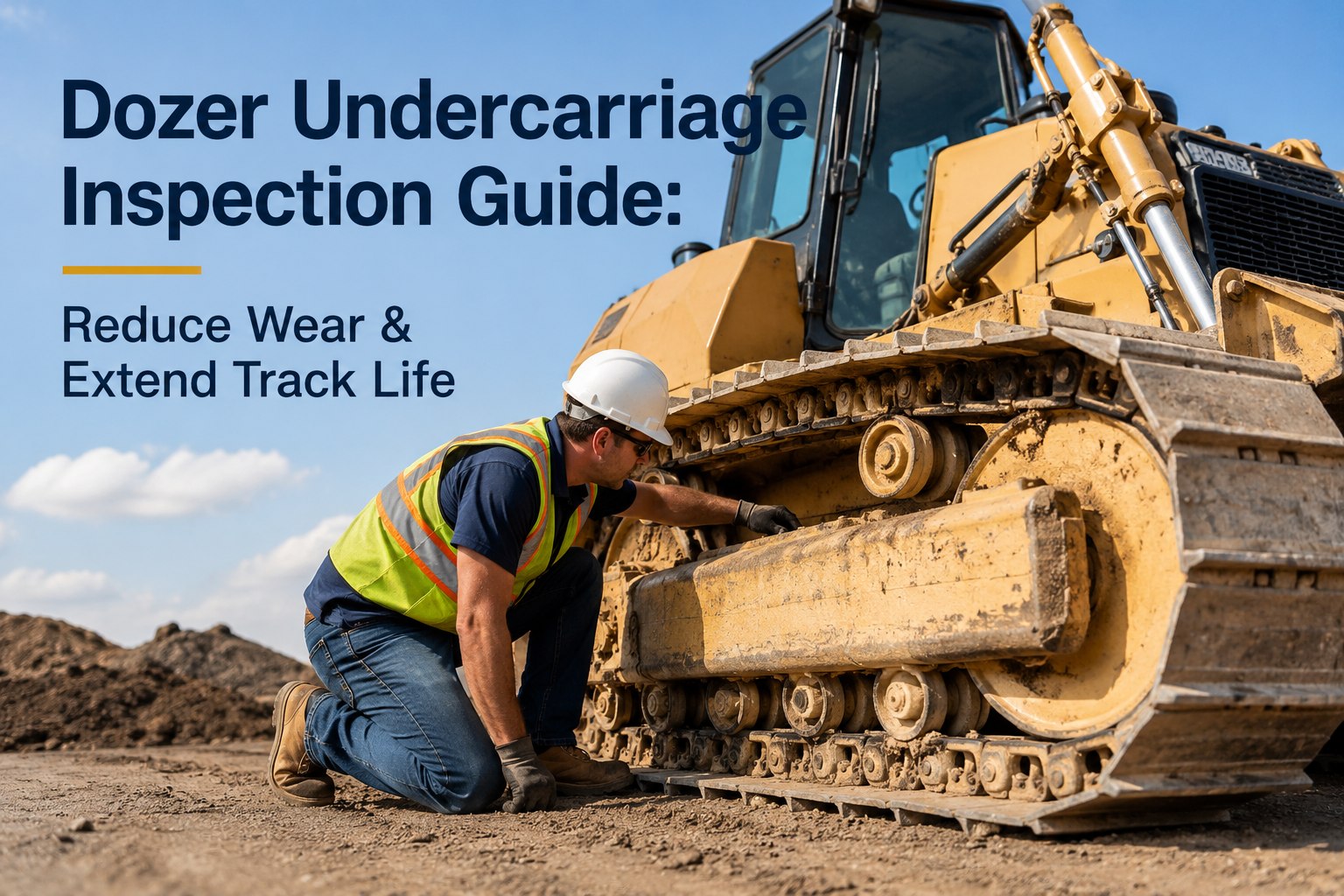
The highest-cost system, bar none. Clean out packed debris daily so components move freely, then check track tension — you want to see two dips between sprocket and idler. Keep a little slack: taut tracks accelerate bushing and sprocket wear. Inspect rollers, idlers, and sprocket-tooth profile for wear.
Daily: clean + tensionHydraulics & blade
Powers the blade and ripper. Up to 75% of hydraulic failures come from contaminated fluid, so check oil level and clarity, inspect cylinders and hoses for leaks, and service filters on schedule. Watch for blade drift at rest, slow cycle times, and a worn cutting edge — torque the cutting-edge bolts.
Daily: leaks + driftEngine & powertrain
Engine, transmission, and final drives. Check engine oil and coolant, scan for leaks, and watch the air-filter restriction indicator. Check final-drive oil with the level mark horizontal. Cross-reference overnight fault codes, and use fluid analysis (Cat S·O·S, Komatsu KOWA) to catch internal wear before symptoms show.
Daily: fluids + codesThe undercarriage alone is half your dozer's repair budget — and the two-dip tension check that protects it takes seconds. sign up for a free HVI account and build a dozer walkaround that screens all three systems, or schedule a live demo to see a track-tension flag routed straight to a work order.
Measure the wear — don't just eyeball it
The most valuable data on your highest-cost system comes from measuring four undercarriage dimensions every 500 hours and trending them over time. Trend analysis predicts replacement before failure.
| Measurement | What it tells you | When |
|---|---|---|
| Grouser (shoe) height | Track-shoe wear and remaining traction life | Every 500 hrs |
| Link pitch | Chain stretch — drives sprocket-match and replacement timing | Every 500 hrs |
| Roller diameter | Roller and idler wear from contact and load | Every 500 hrs |
| Sprocket tooth profile | Sprocket wear — replace with the chain, never alone | Every 500 hrs |
Compare each measurement against the manufacturer's wear limits (Cat's Undercarriage Management System provides a standardized method). HVI stores the measurements with trend analysis, projecting replacement timing and cost for your highest-cost system — the single most valuable maintenance data you can collect.
The daily walkaround, by zone
Work the dozer in zones so nothing is missed. In HVI, each zone is a checklist section the operator completes on a phone in under 12 minutes, with a photo required on any flagged item.
Ground & undercarriage
- Undercarriage cleaned; debris cleared from frame and links
- Track tension — two dips between sprocket and idler
- Rollers, idlers, sprocket, and shoes for wear or damage
- Equalizer bar end pins and roller-frame seals
Blade & hydraulics
- Cutting edge and end bits for wear; bolts torqued
- Cylinders, hoses, and fittings for leaks
- Hydraulic oil level and clarity; no blade drift at rest
- Ripper (if equipped) tips, shanks, and pins
Engine & cab
- Engine oil, coolant, fuel; air-filter indicator
- Overnight fault codes reviewed; clean start
- ROPS, seat belt, horn, backup alarm, lights
- Mirrors, glass, and wipers clean and intact
Critical defects — hydraulic leaks, structural cracks, ROPS damage, brake failure, inoperative backup alarm — take the dozer out of service until repaired. In HVI, flagging one as critical tags the machine out automatically and opens a work order. sign up free and build your dozer critical-defect list in minutes.
The PM tier schedule
Dozers follow a tiered PM rhythm in engine hours, serviced on whichever comes first — hours or calendar. Tighten intervals in severe conditions. HVI fires each tier automatically and reserves parts two weeks ahead.
Walkaround & clean
Run the three-zone walkaround, clean the undercarriage, check track tension and all fluids, and review fault codes. The single highest-value daily habit on the machine.
PM1 — basic service
Engine oil and filter, fuel filter, hydraulic return filter, fan-belt tension, battery check, final-drive oil level, detailed undercarriage visual, and cutting-edge bolt torque.
PM2 — measured service
All PM1 tasks plus undercarriage wear measurement vs. limits, hydraulic oil sample, final-drive oil check, ROPS bolt torque, turbocharger and detailed hose inspection.
Major service
Hydraulic oil change, coolant flush, transmission and final-drive service, complete undercarriage vs. wear limits, and structural inspection at high-stress welds. Per OEM spec.
From clipboard to one tracked system with HVI
A dozer checklist only protects your budget if it's actually done, logged, and trended — every machine, every shift. That's the gap paper leaves open and HVI closes.
Paper checklists
- Track tension checked by feel — or skipped
- Undercarriage measurements never recorded or trended
- Operator notices a hydraulic leak, mentions it, it's forgotten
- 250 and 500-hour services tracked on a whiteboard
- No proof of inspection when an auditor asks
- Worn undercarriage discovered as a $65K rebuild, not a trend
With HVI software
- Daily walkaround logged with photos and hour reading
- Grouser, link, roller, sprocket wear trended over time
- A flagged leak becomes a photo-backed work order instantly
- Every PM tier fires by engine hours, parts reserved 2 weeks ahead
- Full inspection and service history exports in seconds
- Replacement timing predicted from wear trends, not guesswork
less unplanned downtime with systematic dozer maintenance — alongside 20–40% longer equipment life and avoidance of $150,000 breakdowns and $65,000 undercarriage rebuilds. HVI makes sure the walkaround happens, the wear gets measured, and every PM tier fires — on every dozer, every shift.
Frequently asked questions
Why is the undercarriage the most important part of dozer maintenance?
Because it dominates the cost. The undercarriage is roughly 20% of a bulldozer's purchase price but up to 50% of its total lifetime repair cost — making track and roller inspection the single highest-value daily check an operator can perform. The biggest driver of that cost is track tension: Caterpillar names tight track the number-one cause of crawler-tractor downtime, and proper tension prevents an estimated 85% of undercarriage wear problems. Daily cleaning matters too — packed debris keeps components from moving freely and accelerates wear. HVI makes the cleaning and two-dip tension check a required daily step and trends undercarriage wear over time.
How do I check bulldozer track tension correctly?
Caterpillar's rule of thumb is that you want to see two dips between the sprocket and the idler. Let the machine coast to a stop on level ground before checking — engage the park brake, lower the blade, and lock out the hydraulics. The key principle is to keep a bit of slack: taut tracks accelerate wear on bushings and sprockets and cause dry joints, which is why over-tight track is such a common and expensive mistake. Always confirm the correct tension for your specific model in the Operation and Maintenance Manual, since the exact figure varies. Checking tension daily is the cheapest way to protect your most expensive system.
What undercarriage measurements should I track, and how often?
Measure four key dimensions every 500 hours and compare them against the manufacturer's wear limits: grouser (shoe) height for traction life, link pitch for chain stretch, roller diameter for roller and idler wear, and sprocket tooth profile for sprocket wear. Caterpillar's Undercarriage Management System provides a standardized measurement method. The real value isn't a single reading — it's the trend. Logging these measurements over time lets you project when each component will hit its wear limit, so you can plan and budget replacement instead of being surprised by a $65,000-plus rebuild. HVI stores the measurements and runs the trend analysis automatically for your highest-cost system.
How often should a bulldozer be serviced?
Dozers follow a tiered PM schedule by engine hours, serviced on whichever comes first — hours or calendar time. A daily walkaround and undercarriage cleaning comes first. PM1 at 250 hours covers engine oil and filter, fuel and hydraulic filters, belt tension, battery, final-drive oil level, and undercarriage visual. PM2 at 500 hours adds undercarriage wear measurement, hydraulic oil sampling, ROPS bolt torque, and turbocharger inspection. Major service at 1,000–2,000 hours includes hydraulic oil change, coolant flush, transmission and final-drive service, and structural weld inspection. Severe conditions — heavy dust, mud, continuous heavy load — warrant tightening these intervals. HVI fires each tier automatically and reserves parts two weeks ahead.
How does HVI help with bulldozer inspection and maintenance?
HVI brings the whole program into one place. Operators run the three-zone walkaround — ground/undercarriage, blade/hydraulics, engine/cab — from a phone in under 12 minutes, with photos required on flagged items and hour-meter logging built in. Critical defects like hydraulic leaks, structural cracks, or ROPS damage automatically tag the machine out of service and create a work order. Undercarriage measurements (grouser height, link pitch, roller diameter, sprocket profile) are stored and trended to predict replacement timing for your highest-cost system. All PM tiers fire automatically by engine hours, with parts reserved two weeks ahead, and the full history exports in seconds for audits or warranty. It's system-based, so it works across Cat D-Series, Komatsu, John Deere, Case, and more. schedule a demo and we will set it up around your specific dozers and intervals on the call.
Protect your dozer's most expensive system before it costs you a rebuild.
HVI runs your daily walkaround, undercarriage wear trending, tiered PM scheduling, and defect work orders in one platform built for heavy equipment. Catch the tight track and the leaking cylinder in the yard — not as a $150,000 breakdown mid-project. Sign up free and turn track tension and wear data into protected uptime.
No credit card required · Live in under two weeks · Walkaround + undercarriage trending + tiered PM + work orders in one platform