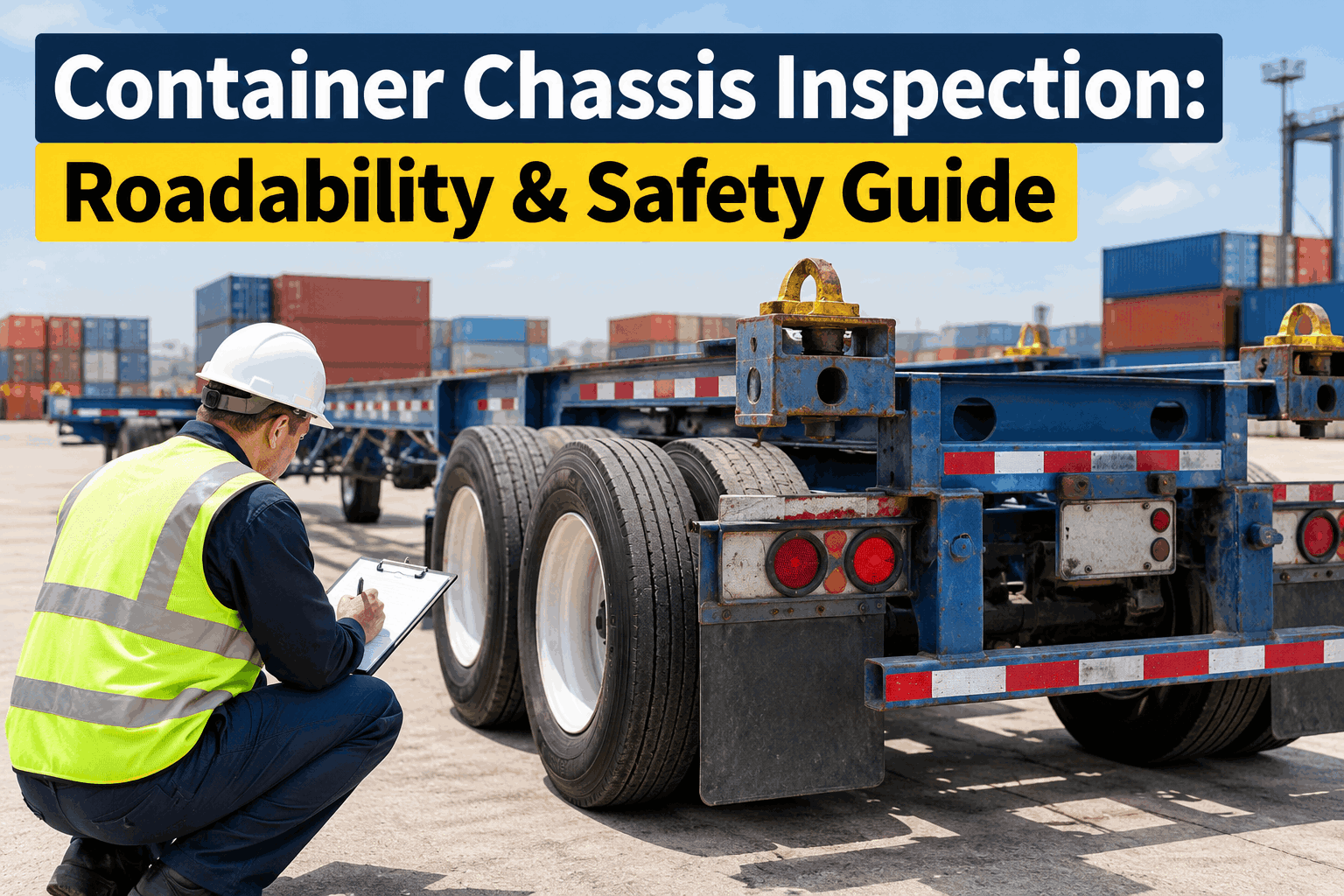
A container chassis inspection at pickup proves the unit was roadable the moment you took it — but roadability is a condition it has to hold every mile after, not a box ticked at the gate. On a chassis that's shared across a pool, pounded at ports, and handed between carriers, staying roadable is an ongoing program: recurring checks, a maintenance history per unit, and a template built for the twist locks and brakes a generic trailer form skips. Book a demo to see roadability tracked over a chassis's life.
Roadable at Pickup Isn't Roadable for Good
A pickup check is a snapshot. Roadability is a status a shared chassis has to keep across every port, pool and carrier — which makes it a program, not a one-time form.
Proves condition at one moment, at one handoff.
Keeps the chassis serviceable across its whole life.
Here's the full picture — what roadability legally means, the safety-critical systems it covers, why twist locks get their own attention, how an ongoing program differs from a pickup check, keeping history on a shared pool chassis, the port and yard conditions that wear them fast, and how to run it all on one record.
What "roadable" actually meansa legal condition, not a vague judgment
Roadability isn't a feeling — it's the requirement that an intermodal chassis is in safe, working order before it carries a container on public roads. Under the intermodal equipment rules, the equipment provider must maintain it and the motor carrier must not operate it with a known defect. "Roadable" is the line both sides are measured against.
Roadable = safe to place in service. Every safety-critical system — brakes, tires, wheels, lights, electrical, suspension, landing gear and frame — must be in working condition. A defect in any one takes the chassis out of "roadable" until it's fixed, whoever supplied it.
The systems roadability coversthe safety-critical map on every chassis
A roadability check runs the full length of the chassis, system by system. Each is a common source of roadside violations, and each belongs on the template — not just at pickup, but on the recurring program that keeps the unit in service.
Because a chassis lives outdoors in corrosive port air and takes constant loading, these systems degrade faster than on a trailer that stays with one carrier — which is exactly why a recurring program beats relying on the next driver's pickup glance. It's the maintenance layer that sits beneath the chassis pickup inspection and interchange documentation — the same systems, but tracked on a schedule instead of judged once at the gate. When each one is a recurring template line, a slowly failing brake chamber or a corroding light gets caught on the check before it becomes a violation on the road.
Twist locks: the chassis-only safety itemwhat holds the container to the chassis
The one thing a container chassis has that no other trailer does is the set of twist locks that secure the box to the frame. If they're worn, seized or left unlocked, the container isn't held — so they get their own focused check every time, in every corner position.
A twist lock that only half-engages can look locked and still let a container shift under braking or a hard turn — which is why the check is "prove it locks," not "it's there." Capturing each corner with a photo turns a hurried visual into evidence the box was secured, and gives you something to point to if a container ever comes loose. Put all four twist locks on the template as required, photo-backed lines.
Pickup check vs. roadability programtwo different jobs — you need both
The pickup inspection and the roadability program aren't the same thing, and confusing them is how chassis fall through the cracks. One protects you at a single handoff; the other keeps the unit safe and documented over its life. Here's the split.
- Done at the gate, before departure
- Proves condition at that moment
- Protects against pre-existing-damage claims
- Driver-facing, one point in time
- Recurring, on a schedule per chassis
- Trends condition and wear over time
- Catches degradation before it's a violation
- Fleet-facing, the whole asset life
The pickup side is covered in depth in HVI's guide to chassis DVIR and IEP requirements; this page is about the program that runs alongside it. Together they close the gap a single check leaves open. Book a demo to run both on one platform
Shared chassis need their own historya pool unit belongs to everyone and no one
Most container chassis run in pools, moving between carriers and terminals with no single owner watching them. That's the same responsibility gap any shared asset has — and it's why a chassis needs a record that stays with the unit, not the driver who happened to pull it last.
When the history follows the chassis, a pool unit stops being a black box — you can see whether the one you just hooked is a reliable runner or a repeat problem before it ever strands a load on the highway. Start free and give every pool chassis its own record.
What ports and yards do to a chassisthe conditions that accelerate wear
Container chassis live in the harshest corner of trucking, and the environment itself is a maintenance driver. Knowing what wears them fast tells you what to watch on the recurring program — and why a pickup-only approach misses the slow damage.
None of this shows up on a single gate check — it's cumulative, which is the whole argument for trending a chassis over time instead of judging it once. A light or connector cracked by a reach-stacker won't announce itself, and salt corrosion works on brake lines and wiring quietly for months; the recurring inspection is what surfaces both while they're still cheap to fix. Book a demo to trend wear on port-based chassis
From a drayage fleet manager
We were treating chassis roadability as a pickup problem — check it at the gate, done. But pool units kept coming back with the same corroded lights and worn brake components, because nobody was tracking them between trips. Once each chassis had its own recurring inspection and a history, we could see which pool units were repeat offenders and push them back to the provider with evidence. Our roadside chassis violations dropped hard once roadability became a program instead of a gate check.
How HVI runs the roadability programcustom templates, recurring alerts and per-chassis history
Chassis roadability holds up when it's a tracked program, not a stack of pickup forms. HVI's custom inspection templates, annual-inspection alerts and photo capture keep every chassis — owned or pooled — on a recurring check with a documented history.
Build the chassis template
Twist locks, brakes, tires, lights, landing gear and frame as required roadability lines.
Capture defects & photos per unit
Every check, defect and pickup photo logged against the specific chassis ID.
Keep it recurring & trended
Annual-inspection alerts and history show wear building before it's a violation.
See how a chassis roadability program and its history live inside HVI's inspection and maintenance platform. Line it up in a quick demo
Container chassis roadability: quick answers
What does chassis roadability mean?
Roadability means an intermodal chassis is in safe, working condition to carry a container on public roads. Every safety-critical system — brakes, tires, wheels, lights, electrical, suspension, landing gear and frame — must be functional. Under the intermodal equipment rules, the equipment provider must maintain the chassis and the motor carrier must not operate it with a known defect.
How is a roadability program different from a pickup inspection?
A pickup inspection is a snapshot done at the gate that proves condition at one moment and protects against pre-existing-damage claims at interchange. A roadability program is a recurring, scheduled check per chassis that trends condition over the asset's life and catches slow wear — corrosion, brake degradation, a cracked light — before it becomes a roadside violation or a breakdown. They do different jobs, and you need both: the pickup for liability at the handoff, the program for uptime across every trip after it.
How do you inspect container chassis twist locks?
Check all four corner twist locks: confirm each handle moves freely and seats fully, the cone and body aren't cracked or worn round, and the locked position positively engages rather than just resting. A twist lock that only half-engages can look locked and still let the container shift, so the check is "prove it locks," ideally captured with a photo per corner.
Who is responsible for maintaining a pool chassis?
Under the intermodal equipment rules, the equipment provider is responsible for systematic maintenance and inspection, while the driver and motor carrier must not operate a chassis with a defect they could detect. Because pool units move between many carriers, keeping a record that follows the chassis ID is what lets a fleet push repeat defects back to the provider with evidence.
How does HVI help with chassis roadability?
HVI lets you build a custom roadability template with twist-lock, brake, tire, lighting, landing-gear and frame checks, capture photos and defects against each chassis ID, and keep it recurring with annual-inspection alerts and a full maintenance history per unit. A failed check can raise a work order in one click, so the defect gets fixed instead of forgotten. The program runs alongside the pickup inspection, so both the single-handoff snapshot and the long-term condition of every owned or pooled chassis stay documented in one place.
Keep every chassis roadable long after the gate
HVI runs container chassis roadability as a recurring program — a custom template for twist locks, brakes and roadability, photos and defects logged per chassis ID, and annual-inspection alerts that catch wear before it's a violation. The pool unit that used to be a black box gets a documented history.
No credit card · Custom chassis roadability templates on day one
- Four-corner twist-lock checks
- Brake, ABS & tire condition
- Lights, electrical & landing gear
- Pickup & return photos by ID
- Recurring roadability history