Every driver knows the feeling: you crank the landing gear and it fights back — stiff, grinding, or it won't budge in low gear. That resistance is the gear telling you something's wrong and most fleets ignore it until a leg seizes or a gearbox strips. A trailer landing gear inspection is about catching that message early. Book a demo to put landing gear on its own inspection and lube cycle.
The crank is trying to tell you something
Landing gear fails along one force path — crank, gearbox, cross shaft, legs, feet. Grease it on its own cycle and inspect that path, and a stiff crank never becomes a dropped trailer.
- Read the crank effort to catch wear early
- Grease cycle scheduled by how often it's worked
- Bent legs and worn gearboxes caught on photo
Trouble anywhere on this path shows up first as a crank that's harder to turn. The inspection follows the force, end to end.
Landing gear is the most-used mechanical system on a trailer that nobody schedules. It gets raised and lowered every drop and hook, runs dry because greasing it is easy to skip, and lives in road spray and salt. When it fails, it fails at the worst moment — under the nose of a trailer during coupling, or with a loaded box that suddenly can't be set down. A proper trailer landing gear inspection, paired with lubrication on its own cycle, is cheap insurance against an expensive, dangerous failure. According to maintenance guidance, the service interval should be based on how often the gear is raised and lowered — usage, not the calendar.
What the crank effort is telling you
You don't need a diagnostic tool for landing gear — you have one in your hand every time you crank it. The effort and feel are the earliest warning you'll get.
Turns smooth and light
Properly greased and sound. Both legs move together, high and low gear engage cleanly. This is what a maintained gear feels like — keep it there with the lube cycle.
Harder than it should be
The grease is gone or water's gotten in. Still workable, but it's the moment to re-lube and inspect — ignore it and the gearbox starts wearing against itself.
Irregular, grinding, or won't turn
Irregular cranking means the gearbox has worn out — often a full leg replacement. A leg that won't move is a trailer you can't safely drop or hook. This is the failure you were trying to avoid.
The whole point of a landing gear program is to keep every trailer in the green and catch the yellow before it turns red. Book a demo to track crank condition per trailer.
What a landing gear inspection checks
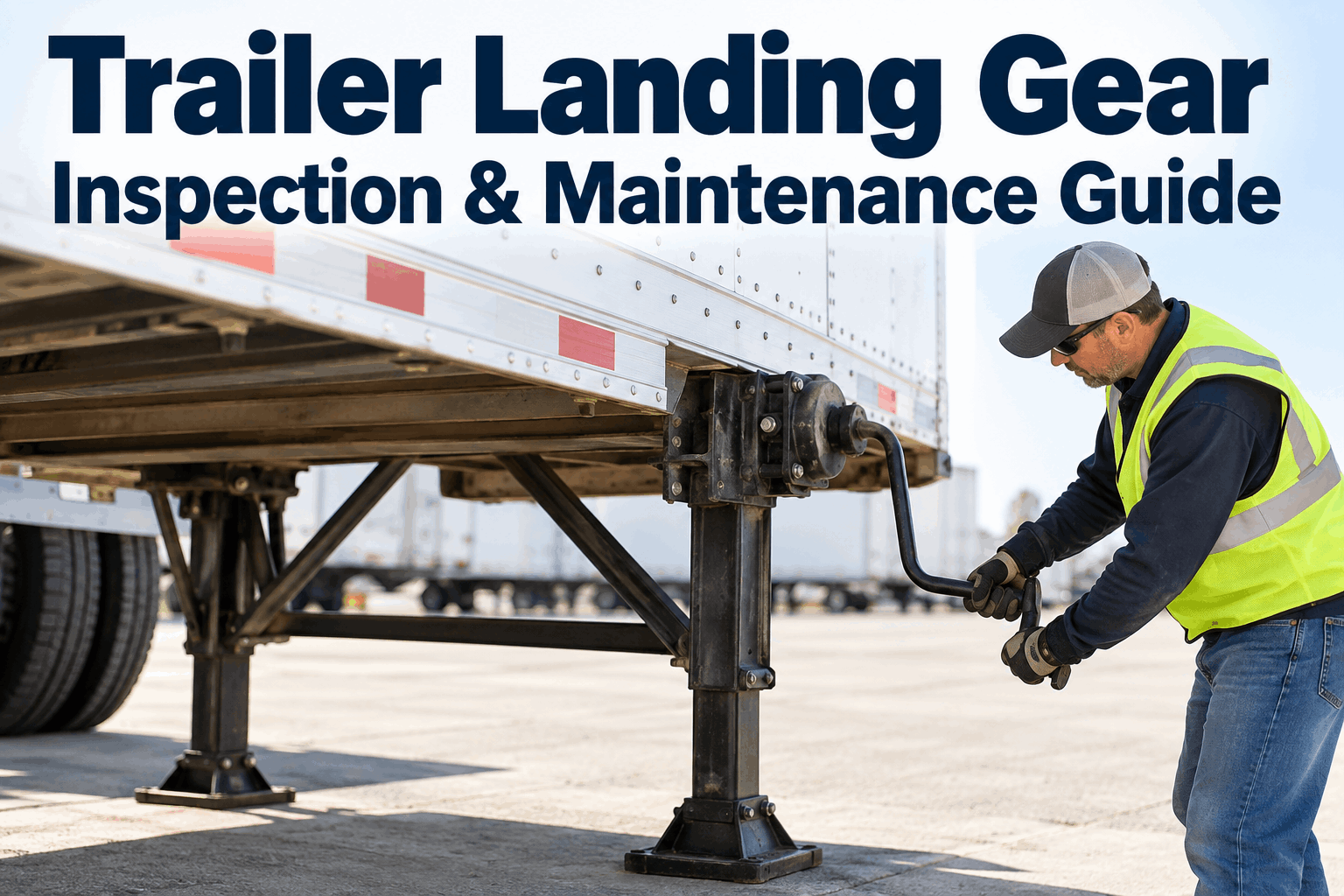
Walk the same path the force takes. Each part has its own failure signs, and every one is checkable by hand on a walkaround.
Crank handle & tuck-away
Check the handle isn't bent, the tuck-away holds it clear of the road, and it cranks without excessive play. A flopping handle is a hazard and a sign of wear upstream.
Gearbox & bevel gears
Feel for smooth engagement in high and low gear. Irregular, notchy or grinding cranking means the gearbox is worn — the number-one landing gear failure, and usually a leg replacement.
Cross shaft & connection
The cross shaft drives both legs together. Check it isn't bent and its attachment bolts are tight — a loose or twisted shaft lets the legs move unevenly and bind.
Legs, lift screw & cross braces
Look for bent or impact-damaged legs, a lift screw that runs clean, and cross braces and weldments free of cracks. Bent legs from a low dock or curb strike are common and get worse under load.
Foot pads / sand shoes
Confirm the pads or sand shoes are present, square and not worn through or crushed. They spread the dropped load — a missing or collapsed pad lets a leg punch into soft ground.
Mounting bolts & welds
Inspect mounting bolts for looseness or rust streaks and the mounting welds for cracks. Loose or rusted bolts often mean paint damage and water intrusion starting underneath.
Every one of these is a photo in HVI — a tech flags a bent leg or notchy gearbox, snaps it, and it's on that trailer's record before it ships, built right into your digital trailer inspection.
The landing gear lubrication routine
Nearly every landing gear failure traces back to running dry. Lubrication isn't a side task — it is the preventive maintenance. Here's the routine, grounded in OEM guidance.
Grease the fittings at the gearbox, the bevel gears and the lift screw — three points on each leg, not just the one you can see.
Roughly two ounces of grease per zerk. Use an extreme-pressure grease rated for cold so it doesn't stiffen in winter.
Run the legs up and down in both gear positions to carry the fresh grease through the gearbox and screw.
Base the cycle on how often the gear is raised and lowered — a drop-and-hook trailer needs it far more often than a dedicated one.
A greased gear cranks light and lasts years. A dry one wears the gearbox against itself until the crank goes notchy — and a worn gearbox usually means replacing the whole leg, not a quick fix.
Start free and schedule the lube cycle →HVI schedules this per trailer and reminds you by usage, not a guessed calendar date — see how it fits your broader dry van trailer maintenance. Book a demo to automate the grease interval.
Trailer landing gear inspection checklist
The walkaround as a pass/fail sheet. Run it per trailer and log it with the daily operator report so every defect ties to that unit's number.
On paper this gets a tick and nobody ties it to a trailer. In HVI each FLAG is a dated work order with a photo, logged against that unit — and a trailer with a notchy gearbox can't quietly stay in rotation. Book a demo to see the sheet on a device.
What a neglected landing gear actually costs
A stiff crank is annoying. What it turns into is not — and the jump from one to the other is a single skipped lube cycle.
Grease runs dry; crank starts getting stiff. Still works — so it gets ignored.
Metal wears on metal, cranking goes notchy — now it's a leg replacement, not a grease gun.
A leg that won't move — or collapses during coupling. Downtime, damage and a serious safety incident.
Every step on that chain was preventable at the first one, for the cost of a few pumps of grease and a two-minute crank test. Book a demo to stop the chain at step one.
A trailer tech on the crank that gives it away
Landing gear never surprises you if you're paying attention — it tells you for months. You feel the crank getting heavier, and that's your window. We used to run them until a driver couldn't move a leg in the yard; now every trailer gets a crank test and a grease schedule logged against its number. Replacing a leg is a few hundred dollars and half a day. A trailer that drops off its gear during a hook is a whole different conversation.
Marcus B.Trailer Technician · Regional dry van fleet · 180 trailers
Run landing gear PM on HVI
Configurable landing gear template
Build a landing-gear-specific inspection template — crank, gearbox, cross shaft, legs, feet — right into the trailer check.
Lube cycle by usage
Schedule preventive maintenance for the grease interval based on how often the gear is raised and lowered.
Photo evidence per trailer
A dated picture of a bent leg or worn gearbox attaches to that trailer's record for repair and warranty.
Defects routed to work orders
A flagged notchy gearbox becomes a tracked repair in maintenance management — before it seizes.
One connected record per trailer, built on the crank test your team already does by feel — so landing gear is never the component nobody scheduled. Start free and put landing gear on a program.
Trailer landing gear questions
Q1What does a trailer landing gear inspection cover?
It follows the force path: the crank handle and tuck-away, the gearbox and bevel gears, the cross shaft and its bolts, the legs, lift screw and cross braces, the foot pads or sand shoes, and the mounting bolts and welds. The single best check is the crank itself — how it feels to turn in high and low gear tells you most of what you need to know.
Q2How often should landing gear be greased?
Base it on how often the gear is raised and lowered rather than a fixed calendar — a drop-and-hook trailer needs it far more often than a dedicated one. The routine is to pump about two ounces (six to eight pumps) into the three zerks on each leg, at the gearbox, bevel gears and lift screw, using a cold-rated extreme-pressure grease, then work the legs in both gears to distribute it.
Q3Why is the landing gear hard to crank?
A stiff crank usually means the grease is gone or water has gotten into the gearbox, and it's the moment to re-lube and inspect. If cranking is irregular, notchy or grinding, the gearbox has likely worn out — which typically means replacing the leg rather than just greasing it. Either way, the crank effort is your earliest warning.
Q4What happens when landing gear fails?
A seized leg means a trailer you can't safely drop or hook, which strands the unit. Worse, a leg that collapses or a gear that lets go during coupling can drop the trailer nose — a serious safety incident and potential equipment and cargo damage. Most of these failures start as a stiff crank that was ignored over several cycles.
Q5How does HVI help with landing gear maintenance?
HVI lets you build a landing-gear inspection template, schedule the lubrication cycle per trailer based on usage, attach photo evidence to defects like bent legs or worn gearboxes, and route failures to work orders before they seize. It's an inspection and maintenance layer, not a replacement for the OEM service manual or a required inspection.
Put your landing gear inspections and PM on HVI
Build the force-path template, schedule the grease cycle by usage, capture photo evidence on every defect, and route repairs before a stiff crank becomes a dropped trailer. Live in weeks, not quarters.
No credit card · Per-trailer records · Lube cycle by usage