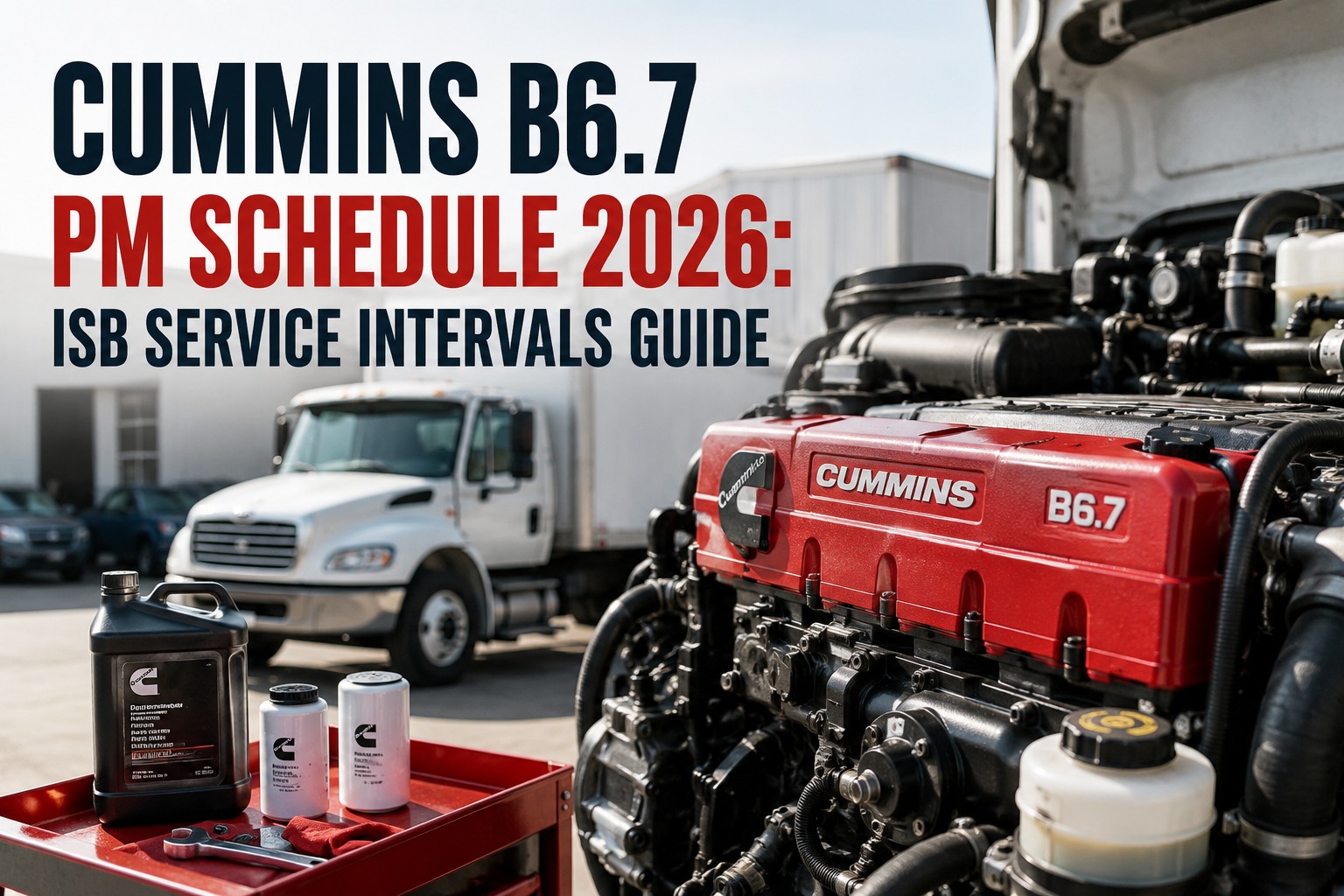
The cummins b6.7 pm schedule is engine-driven, not truck-driven — the same 6.7L inline-six powers the Freightliner M2, Ford F-650/F-750, International MV, and Kenworth T370, and Cummins keys the interval math to fuel economy rather than mileage alone. This guide walks the MPG-based duty cycle model, the 350-hour ceiling that overrides odometer readings, the full B6.7 interval matrix, and how mixed medium-duty fleets run one engine-centric PM strategy across four chassis brands. Book a demo to see B6.7 fleets tracked engine-first in HVI.
One Engine. Four Chassis. One PM Strategy.
The B6.7 is identical across the M2, F-650, MV, and T370. The four dealer networks, telematics systems, and service manuals around it aren't.
The Cummins B6.7 is a 6.7-liter inline-six diesel from the ISB engine family, rated 200-360 hp with peak torque of 520-800 lb-ft, and it's the dominant medium-duty diesel across North American Class 5-7 trucks. What makes the B6.7 pm schedule different from Volvo D13 or PACCAR MX-13 planning is the Cummins framework: interval math is driven primarily by fuel economy (a proxy for engine load), with an absolute 350-hour ceiling that overrides mileage in severe-duty applications. The Freightliner M2, Ford F-650/F-750, International MV, and Kenworth T-series all run the same B6.7 with the same PM math — but with four different chassis-side service manuals, four telematics platforms, and four dealer networks around it.
The MPG-Based Duty Cycle Model (Different from Class 8)
Class 8 engines like the Volvo D13 and PACCAR MX-13 key their duty cycle to idle percentage. The Cummins B6.7 doesn't. Cummins uses fuel economy directly as the duty cycle indicator, on the logic that fuel burn is the most accurate reflection of actual engine load in medium-duty applications. Book a demo to see MPG-based interval math applied per unit in HVI.
The 350-Hour Ceiling: When Time Beats Miles
The 350-hour rule is where the B6.7 breaks from mileage-only planning. Under severe-duty operation, 350 engine-hours is the absolute drain interval ceiling, regardless of whether the odometer has reached 12,000 miles. A refuse truck idling at collection stops or a dump truck running short-cycle site work can hit 350 hours long before it hits 12,000 miles — and the oil needs to change at the earlier of the two.
The Full B6.7 PM Interval Matrix
These are the Cummins-published intervals for the medium-duty commercial B6.7 — identical across all four chassis brands. Duty cycle classification (via MPG or hour threshold) is the driver.
Four Chassis, Four Telematics Platforms
The engine is one. The service ecosystems around it are four separate stacks — each with its own dealer network, telematics dashboard, and fault-code taxonomy. Mixed medium-duty fleets end up running the equivalent of four parallel maintenance operations for one shared engine.
Aftertreatment: DPF, DEF, SCR — The Medium-Duty Reality
Medium-duty aftertreatment operates on tighter tolerances than Class 8. Shorter routes, more cold-starts, and lower cruise duty mean regens complete less consistently — and the maintenance neglect surfaces as derates that a driver notices before a technician does.
Engine-Centric vs Chassis-Centric PM Tracking
The mixed-fleet trap: fleets default to tracking PM per chassis brand because that's how the dealer relationship is structured, and end up missing shared-engine patterns that would be obvious in an engine-centric view. Three data streams to normalize across brands.
How HVI Runs Engine-Centric B6.7 PM
Managing four chassis brands through one engine-centric PM strategy is where paper systems collapse. HVI closes the multi-chassis gap in four places.
Frequently Asked Questions
What is the Cummins B6.7 oil change interval?
The commercial B6.7 oil change interval is duty-cycle-dependent, keyed to fuel economy rather than mileage alone. Severe duty (less than 6 mpg): 12,000 miles or 350 engine hours, whichever comes first. Normal duty (6-10 mpg): 25,000 miles. Light duty (over 10 mpg): 30,000 miles. The 350-hour ceiling is the critical overlay for severe-duty applications — a refuse truck or vocational unit that accumulates 350 hours before 12,000 miles must drain at the hour threshold, not the mileage threshold. This medium-duty commercial interval applies to the 19.5-quart high-capacity oil pan used in Freightliner M2, Ford F-650/F-750, International MV, and Kenworth T-series applications — it is different from the 12-quart pickup pan interval used on Ram 6.7L Cummins trucks.
Is the B6.7 the same engine as the ISB6.7?
Yes — functionally and mechanically. The 6.7L Cummins is part of the ISB (Interact System B) engine family. Cummins re-branded the ISB6.7 as B6.7 starting with the 2017 model year, but the engine itself is the same platform with continued evolution. Older Freightliner M2 units built 2007-2016 will show ISB6.7 nameplates; 2017+ units show B6.7. PM intervals published for B6.7 apply consistently across the ISB6.7 generation for the same commercial oil-pan configuration.
Does the same B6.7 in a Freightliner M2 and Ford F-650 have the same PM schedule?
Yes for engine-side PM, and no for chassis-side PM. Every engine-side interval — oil, fuel filter, air filter, coolant, valve adjustment, DPF, DEF pump filter, crankcase breather — is identical across the M2, F-650, MV, and Kenworth T-series because it's the same Cummins B6.7 engine following the same Cummins publication. What varies by chassis: greasing points, HVAC access, cab tilt sequence, steer axle fittings, electrical routing, and telematics platform. The engine PM schedule is Cummins-driven; the chassis PM checklist is OEM-driven. Try HVI free to see both layers running in one view.
When does the B6.7 DPF need service?
DPF cleaning or replacement runs on the same MPG-based duty cycle as the oil interval. Normal duty (6-10 mpg) and light duty (over 10 mpg): 200,000 miles. Severe duty (under 6 mpg): 150,000 miles. Regardless of the scheduled interval, active regenerations occurring more frequently than the baseline are a leading indicator that duty cycle has drifted or upstream combustion is degrading — frequent regens shorten actual DPF life below the scheduled mileage. On medium-duty B6.7 units running urban stop-start routes, forced regens are common enough that regen frequency tracking is more useful than mileage tracking for actual DPF condition.
What is the 350-hour rule on the B6.7?
The 350-hour rule is the absolute severe-duty oil drain ceiling — if the B6.7 accumulates 350 engine hours before it reaches 12,000 miles under severe-duty operation, the oil must be changed at the 350-hour threshold. It exists because engine hours are a better indicator of oil life than miles in low-mpg applications where the engine runs long under load without accumulating road miles. Refuse trucks, dump trucks, cement mixers, and vocational applications routinely hit 350 hours at 3,000-5,000 miles — a mileage-only PM system will miss the drain by a factor of three or more. Every B6.7 unit in a mixed fleet needs to be tracked against both mileage and hour counters, with the work order triggering on whichever hits first.
Run One B6.7 Strategy Across All Four Chassis Brands
HVI ingests all four telematics platforms, tracks MPG and hours per unit, applies the shared Cummins B6.7 PM matrix with the 350-hour ceiling enforced, and keeps chassis-specific service overlays separate per truck brand — the engine-centric medium-duty PM strategy the OEM ecosystem doesn't deliver on its own. Live in under two weeks. No hardware. No IT project.
No credit card · No hardware · B6.7 PM dashboard ready on day one