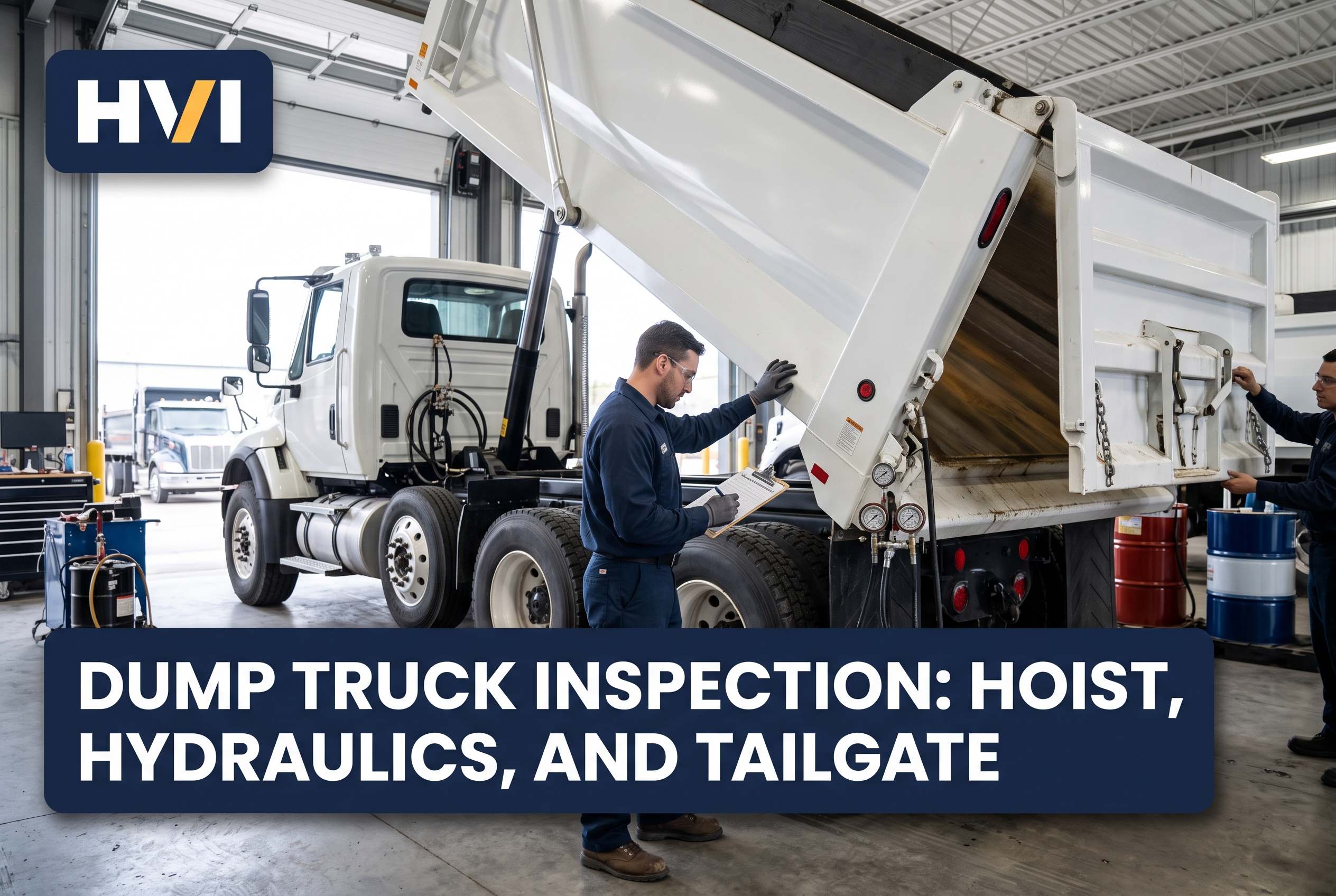
A dump truck that passes a level one DOT inspection can still kill someone on a job site the next morning. The hazards unique to these trucks — a 30-ton raised bed, pressurized hydraulic fluid, and a tailgate swinging open under a load — are rarely caught by a standard pre-trip DVIR. When a hoist cylinder fails or a hinge pin shears, the bed drops without warning, and OSHA explicitly prohibits anyone from working under an unsupported dump body. A proper dump truck inspection bridges the gap between on-road compliance and on-site safety, checking the standard brakes and tires alongside the hoist, hydraulics, and tailgate hardware. Start free with HVI to run a specialized dump truck checklist on every phone in your fleet.
Dump Truck Inspection: Hoist, Hydraulics, and Tailgate
The complete pre-trip and post-trip inspection workflow for dump trucks — covering DOT compliance, hydraulic pressure hazards, and job-site specific failure points that a standard DVIR misses.
- Bed LiftFull extension
- Hold Time5 min / 0 drift
- PTO EngageSmooth
- ResultSafe to Load
- $150k+
average cost of an unplanned dump truck breakdown, including towing, lost revenue, and job delays
Industry fleet maintenance estimates - 10 min
time required to run a structured 51-point digital inspection covering road and site safety
HVI field operational data - 2,000 psi
typical hydraulic pressure in a raised hoist system, enough to inject fluid through skin
OSHA hydraulic injection hazard bulletin - ~20%
of heavy vehicle roadside violations involve insecure loads or leaking hydraulic components
CVSA roadside inspection trend data
Why Dump Truck Inspections Require a Dual-Duty Checklist
Dump trucks live a double life. On the highway, they are regulated commercial motor vehicles subject to standard DOT enforcement. On the job site, they become heavy equipment operating on uneven, unstable ground. A standard pre-trip inspection focuses on the highway: brakes, lights, tires, and coupling. But the hazards that actually injure workers and destroy equipment are the hydraulic systems that lift the bed. If your drivers are only filling out a basic DVIR, they are missing the components that cause the most severe accidents. You can book a demo with HVI to see how a specialized dump truck checklist integrates both road and site safety into a single, guided workflow.
The physics of a raised dump bed are unforgiving. When a bed is fully extended, the center of gravity shifts dramatically. If the truck is parked on even a slight side slope, the risk of a rollover increases exponentially. If a hydraulic line bursts, a check valve fails, or an internal cylinder seal gives out, the bed falls. OSHA regulations are clear: no worker is allowed under a raised dump body without an independent, mechanically locked support prop. Yet every year, mechanics and laborers are crushed because they crawl under an unsupported bed to unstick a hung load or grease a hinge. The inspection process is the first line of defense to ensure the hoist system is strong enough to hold the load, and safe enough to fail gracefully if a component breaks.
The 4-Zone Dump Truck Inspection Workflow
Instead of a random walk-around, drivers and mechanics should follow a structured 4-zone workflow. This ensures every critical component is checked in order, from road compliance to high-pressure hydraulics. Start your free HVI trial to push this exact workflow to your drivers' mobile devices.
Chassis & Road Compliance
Before looking at the hydraulics, the truck must be road-legal. This is standard DOT territory but easy to skip when the truck never leaves a quarry. Check air pressure build rates, slack adjuster stroke, steer tire tread depth (minimum 4/32"), and all exterior lighting. A dump truck with a cracked frame rail or worn spring hangers is a ticking time bomb when loaded to 80,000 lbs. Inspect the frame for stress cracks near the suspension mounting points and fifth wheel (if applicable).
Hoist Cylinder & PTO System
Engage the Power Take-Off (PTO) and listen for grinding or hesitation, which indicates worn gears or low transmission pressure. Raise the empty bed halfway and hold. Watch the cylinder for drift — if the bed drops more than an inch in 30 seconds, internal seals are bypassing and the hoist must be flagged for repair. Inspect the cylinder rod for scoring, chrome flaking, or bent geometry. A scored rod will destroy the main seal immediately, leading to sudden pressure loss under load.
Hoses, Lines & Reservoir
Hydraulic fluid under 2,000 psi is a lethal injection hazard. Do not run bare hands along hoses to check for leaks — use a piece of cardboard. Look for blisters, abrasions, and kinked lines, particularly at the pivot points where the bed hinges. Check the reservoir fluid level with the bed down. Pull the dipstick and check the color: milky fluid means water contamination (often from winter operation), while a burnt smell means the fluid has overheated and lost viscosity.
Bed, Tailgate & Pivot Pins
The tailgate is a moving wall carrying tons of aggregate. Check the primary and secondary latch mechanisms — if the latch is worn, the gate will swing open on a highway, dumping rock into traffic. Inspect the bed pivot pins and bushings for excessive play. Grab the top rail of the bed and push — if you feel clunking, the pins are egg-shaped and need replacement. Finally, verify the bed is clear of debris and that the release cable or lever operates freely without binding.
Standard DVIR vs. Dump Truck Inspection: What Are You Missing?
A standard Driver Vehicle Inspection Report is designed for line-haul tractors. It assumes the cargo is sealed in a van trailer and the truck operates on paved surfaces. Applying a standard DVIR to a dump truck leaves massive blind spots. See the comparison below to understand why a specialized dump truck checklist is critical for both compliance and safety. To map your existing forms to a comprehensive digital standard, schedule a walkthrough with our team.
| Inspection Point | Standard DVIR | Dump Truck Checklist |
|---|---|---|
| Brakes & Air System | Checked | Checked |
| Tires & Lighting | Checked | Checked |
| Hoist Cylinder Drift | Not Included | Mandatory hold test |
| Hydraulic Hose Integrity | Not Included | Visual + cardboard wipe test |
| PTO Engagement | Not Included | Audible & pressure check |
| Tailgate Latch Security | Not Included | Primary & secondary check |
| Bed Pivot Pins & Bushings | Not Included | Play & wear measurement |
Critical Failure Modes in Dump Bed Safety
Understanding how components fail is key to catching them before they cause an incident. Dump bed safety relies on the integrity of the hydraulic system, but failures rarely happen in isolation. A leaking seal leads to pressure loss, which leads to cylinder drift, which leads to a dropped bed. Recognizing the early warning signs during the inspection prevents the catastrophic final event. Explore HVI's defect tracking to see how these failure modes are flagged automatically.
High-Pressure Injection
A pinhole leak in a 2,000 psi hydraulic line can inject fluid through skin and work gloves. The injury looks minor but requires immediate emergency surgery to prevent amputation. Never feel for leaks with hands; use cardboard.
Unexpected Bed Drop
If an internal cylinder seal fails or a hydraulic check valve sticks, a fully loaded bed can drop in seconds. Mechanical body props are the only safe way to work under a raised bed, yet many trucks lack them entirely.
Tailgate Spill
Worn latch pins or stretched chains cause the tailgate to open under vibration. This spills tons of material onto highways, causing severe accidents and massive environmental cleanup fines.
Rollover on Uneven Ground
Dumping on a side slope shifts the center of gravity. Even a 5-degree slope can cause a rollover when the bed is fully raised. The checklist must verify the ground condition and truck leveling before lifting.
Expert view from the shop floor
"The scariest thing on a dump truck isn't the brakes — it's a hoist cylinder that drifts down an inch a minute. A driver doesn't notice it until he's under the bed trying to unstick frozen asphalt. We stopped trusting paper DVIRs years ago. Now, if the driver doesn't snap a photo of the body prop engaged, the inspection won't close, and the truck doesn't roll.
-- Marcus T., Maintenance Director, aggregate hauling fleet
Frequently asked questions
What makes a dump truck inspection different from a standard truck DVIR?
A standard DVIR covers on-road safety components like brakes, lights, and tires. A dump truck inspection adds critical checks for the hoist cylinder, PTO engagement, hydraulic hoses, fluid levels, tailgate latches, and bed pivot pins. These components handle extreme pressures and heavy loads, and their failure can cause fatal job-site accidents that a standard inspection would never catch.
How do you safely inspect a hydraulic hoist system?
First, check the hydraulic reservoir level with the bed down. Engage the PTO and raise the bed halfway, checking for smooth operation and unusual noises. Hold the bed and watch for drift, which indicates internal seal failure. Inspect hoses using a piece of cardboard to detect pinhole leaks, never your bare hands, to avoid high-pressure fluid injection. Always ensure a mechanical body prop is installed before getting near the raised bed.
How often should dump truck hydraulic fluid be checked?
Hydraulic fluid level and condition should be checked daily during the pre-trip inspection. The fluid should be visually inspected for a milky color (indicating water contamination) or a burnt smell (indicating overheating). Full hydraulic fluid sampling and analysis should be performed during scheduled preventive maintenance, typically every 250 to 500 operating hours, depending on the severity of the duty cycle.
What is the OSHA standard for working under a raised dump bed?
OSHA requires that any worker must be protected from the unexpected lowering of elevated equipment. For dump trucks, this means a mechanically independent support prop (such as a safety strut or body brace) must be engaged before any worker goes under the raised dump body. Hydraulic pressure alone is never considered an acceptable lock-out/tag-out method.
Can a digital checklist prevent dump truck accidents?
Yes. A digital checklist like HVI forces drivers to follow a specific sequence, preventing skipped steps. It can require photo evidence for critical items like engaged body props or secure tailgate latches. If a defect is noted, the system can automatically lock out the vehicle from dispatching until a mechanic clears the repair, ensuring unsafe trucks never leave the yard.
Conclusion: Secure Your Fleet from Road to Job Site
A dump truck inspection is a dual-duty responsibility. You are verifying that the truck can survive the highway and the job site simultaneously. By expanding your checklist to include hoist cylinder drift tests, PTO engagement, hydraulic hose integrity, and tailgate latch security, you protect your drivers, your mechanics, and the public from the unique hazards of heavy hauling. The cost of implementing a thorough, 10-minute digital inspection is a fraction of the $150,000+ cost of a single unplanned breakdown or OSHA incident. Get started with HVI today to standardize your dump truck inspection process and book a demo to see the full workflow in action.
Put the complete dump truck inspection workflow on every phone
HVI runs the full hoist, hydraulic, and tailgate checklist with mandatory photo gates, defect alerts, and automated lock-outs. Stop pencil-whipped paper DVIRs and catch the failures that actually hurt people.
No credit card · No hardware · Live on your dump trucks in under two weeks