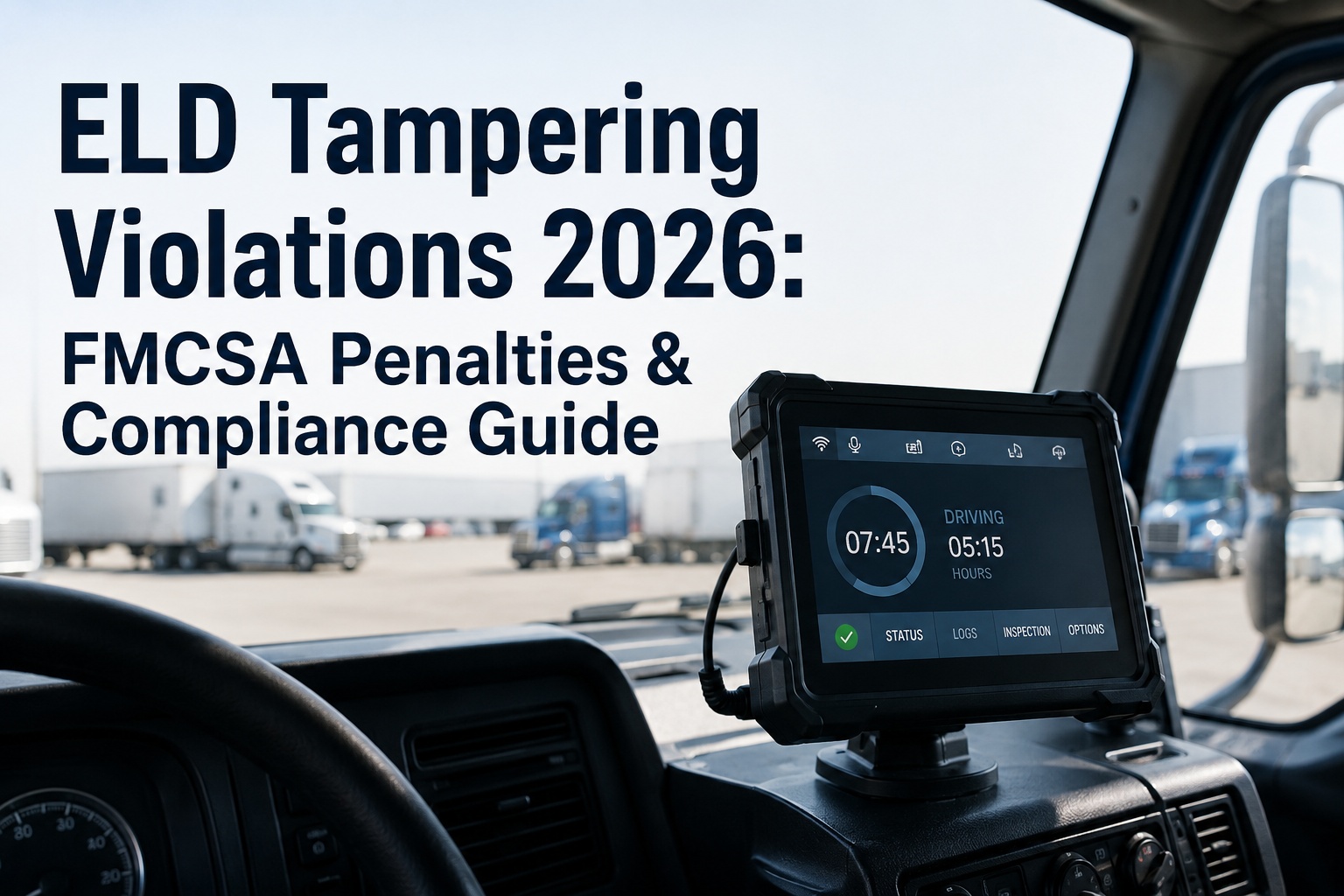
FMCSA's 2025 enforcement year closed with 58,382 falsification-of-duty-status violations — the second most-cited driver violation of the year, and the anchor stat behind CVSA naming ELD tampering as the 2026 Roadcheck driver focus area for the first time in the program's history. Combined with a 28% enforcement uptick heading into 2026, penalty ceilings that now reach $19,246 per violation, and the April 2026 CVSA rule making tampering an automatic 10-hour out-of-service order, the compliance math has moved. This eld tampering violations 2026 playbook walks the enforcement landscape, the five tampering patterns inspectors look for, and the four-layer compliance stack that keeps your fleet audit-ready. Book a demo to see HVI's ELD audit dashboard live.
58,382 Reasons FMCSA Is Watching Your ELD Data
The second most-cited driver violation of 2025. Enforcement up 28% into 2026. And the fines are the smallest part of the cost.
ELD tampering violations are FMCSA-enforced findings where a driver or carrier has altered, falsified, or obscured electronic records of duty status — and they carry the steepest penalty ceilings in the Part 395 regulatory scheme, with knowing falsification reaching $15,846 per violation, willful ELD tampering up to $16,000 per violation, and pattern violations triggering fines up to $125,000 plus out-of-service orders and operating authority revocation. The 58,382 falsification citations logged in 2025 aren't outliers; they're a five-year trend line pointing upward, and CVSA's decision to make ELD tampering the 2026 Roadcheck's named driver focus formalized what enforcement data has been showing for two years.
The Penalty Ladder: What ELD Violations Actually Cost
ELD-related citations sit on a five-rung ladder, escalating from device compliance to willful tampering. Every rung has its own regulatory citation and its own scoring impact under the FMCSA penalty schedule. Book a demo to see audit-ready violation tracking in HVI.
The Five Tampering Patterns Inspectors Are Trained to Find
Falsification isn't one violation type — it's five distinct patterns, each with its own inspection signature. CVSA-certified inspectors are trained to identify all five during Level I and Level III inspections.
What Roadside Inspectors Are Actually Checking
The 2026 Roadcheck data confirms what the enforcement uptick has been telegraphing: inspectors are running specific, repeatable checks — not fishing. Knowing the checklist is the first step to passing it.
The Four-Layer Compliance Stack That Prevents Violations
Fleets that hold falsification citations below industry average don't run one control — they run four, stacked. Skip any layer and violations eventually surface at the wrong moment.
Downstream Impact: The Real Cost of a Falsification Citation
The civil penalty is only the surface. Every falsification finding compounds through four downstream channels for 24 to 36 months.
How HVI Runs the Compliance Stack Automatically
The compliance stack on paper is straightforward. Running it consistently across every driver, every truck, every trip — that's where fleets break. HVI closes the operational gap in four places.
Frequently Asked Questions
What is considered ELD tampering under FMCSA rules?
ELD tampering is any action that alters, obscures, or falsifies electronic records of duty status — and it covers a wider range of behaviors than most drivers or fleet operators realize. It includes: knowingly misclassifying duty status (using off-duty or sleeper berth while actually driving), editing logs without a documented reason or without preserving the unedited original under 49 CFR 395.30, systematically misusing personal conveyance or yard move status, operating an ELD that has been removed from the FMCSA registered list, and physically disconnecting or manipulating the device or its ECM connection. Under the April 2026 CVSA update, tampering that obscures when driving and rest periods actually occurred now carries an automatic 10-hour out-of-service order in addition to the civil citation.
How much are ELD tampering and falsification fines in 2026?
The penalty ladder has six tiers. Uncertified or deregistered ELD in use: $1,000 to $3,000 per violation. Falsifying electronic records: $3,000 to $10,000 per violation plus possible criminal referral. Knowing falsification of records of duty status under 49 CFR 395.8(e)(1): up to $15,846 per violation. Willful ELD tampering under 49 USC 521(b)(2)(B): up to $16,000 per violation. Motor carrier maximum HOS civil penalty: up to $19,246 per violation, indexed for inflation. Serious pattern violations can reach $125,000 total, plus out-of-service orders and revocation of operating authority. Drivers face separate maximum penalties of up to $4,812 per violation on the driver side of the same citation.
Why was ELD tampering the 2026 CVSA Roadcheck focus?
CVSA named ELD tampering as the 2026 International Roadcheck driver focus area for the first time in the program's history because the enforcement data made it unavoidable. Falsification of records of duty status was the second most-cited driver violation in 2025 at 58,382 citations, HOS violations climbed from 410,000 in 2023 to over 500,000 in 2025, and FMCSA enforcement activity grew 28% between 2025 and 2026. The 2025 Roadcheck alone placed 1,076 drivers out of service for HOS violations in a 72-hour window. CVSA responded by centering the 2026 program on log integrity, and inspectors were specifically trained to detect the five tampering patterns during the May 12-14, 2026 event.
What are the most common ELD violations at roadside inspections?
Five patterns account for the majority of falsification citations: (1) personal conveyance abuse — PC status logged during loaded miles or at shipper docks; (2) yard move misuse — YM status recorded on public roads or at highway speed; (3) unassigned driving time — vehicle movement no driver has claimed, above trivial thresholds; (4) undocumented log edits — changes without a stated reason or without a preserved original per 49 CFR 395.30; and (5) operating on a revoked ELD — using a device dropped from the FMCSA registered list past the 60-day grace period. All five have distinct inspection signatures, and inspectors correlate GPS breadcrumb data with duty status timestamps to identify each. Try HVI free to see automatic pattern detection.
How long do ELD violations stay on a fleet's record?
Every HOS or ELD-related violation logged at a roadside inspection feeds into the FMCSA Motor Carrier Management Information System and counts toward CSA BASIC percentile scoring for 24 months under prior methodology, with the 2026 CSA overhaul reducing that window to 12 months for scoring purposes — though the inspection record itself remains visible on the carrier's report card for a longer period. Insurance underwriters and brokers frequently pull data going back 24 to 36 months, meaning downstream commercial impact (premium changes, broker delisting, shipper filtering) can persist beyond the CSA scoring window. Clean months following remediation clear the scoring impact, but the inspection history remains a matter of record.
Turn Every ELD Record Into an Audit-Ready Asset
HVI runs the FMCSA-registered ELD verification, pattern analytics for the five tampering signatures, audit-ready archive with edit documentation, and the weekly compliance review workflow — the exact stack fleets use to keep falsification citations off the CSA scoreboard. Live in under two weeks. No hardware. No IT project.
No credit card · No hardware · Compliance dashboard ready on day one