The CVSA out-of-service criteria are the pass-fail rules that decide whether your truck rolls away from a Level I roadside inspection or gets a red sticker on the windshield. The 2026 edition took effect April 1 with seventeen changes ratified last October — some technical, some that will materially change how your fleet gets inspected. The hardest number in the whole document hasn't changed: during the 2025 CVSA International Roadcheck, 22.6% of trucks inspected went out of service — roughly one in five. This guide walks the 2026 criteria the way an inspector does: what triggers OOS in each category, what specifically changed this year, and where the walk-around fixes it before enforcement gets the chance. Book a demo to see how photo-verified DVIRs catch the defects the OOS criteria are built to stop.
The CVSA 2026 Out-of-Service Criteria
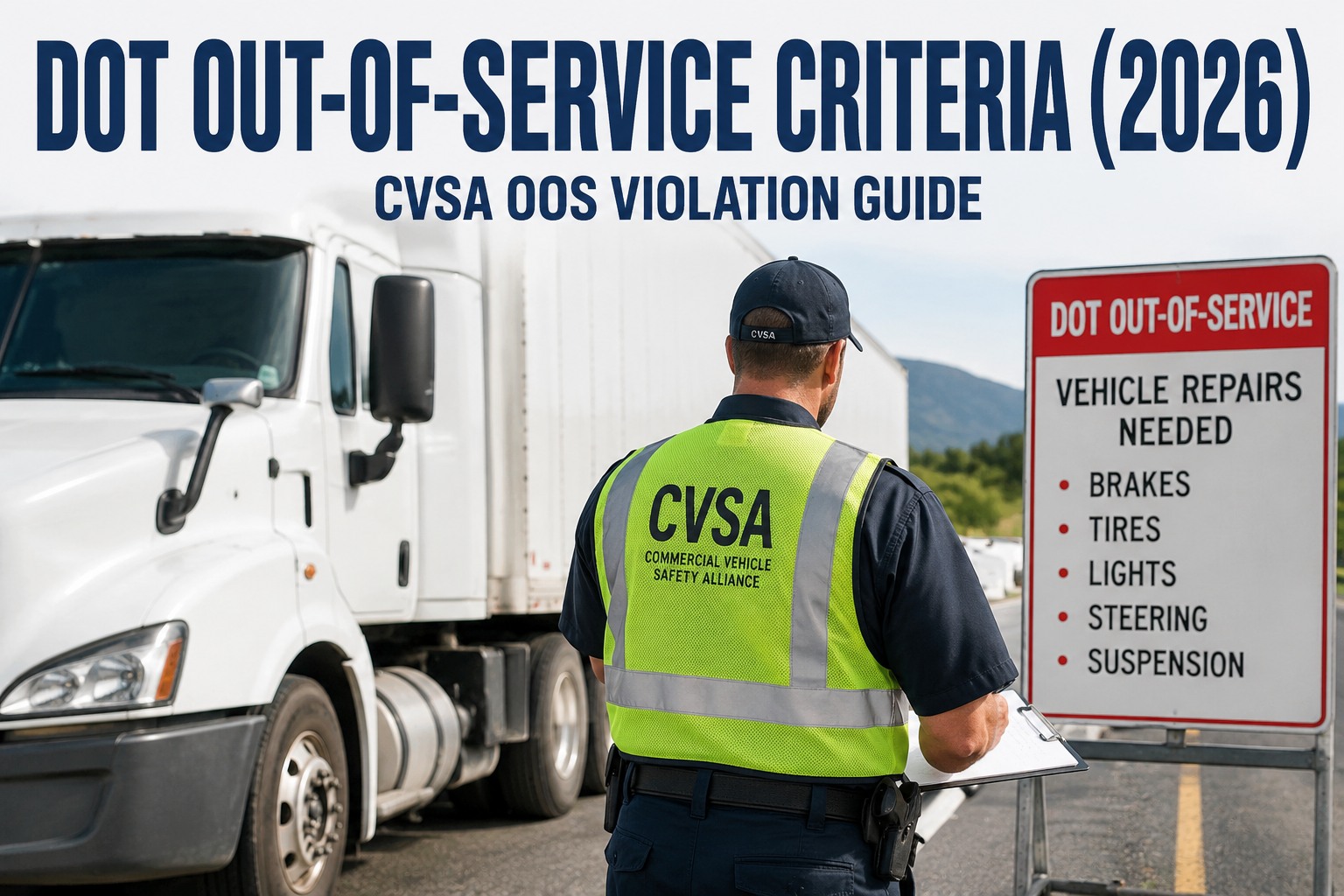
The 2026 North American Standard Out-of-Service Criteria decide what gets your truck a red sticker — and what changed this April. Here's the walk-through, with the 17 updates and the OOS categories that produce 4 out of 5 violations.
-
393.47
Defective brakes 20%+ threshold exceeded (3 of 10)
-
393.75
Tire below OOS depth Steer axle < 2/32″
-
393.9
Lighting inoperative Right turn signal
The out-of-service criteria are updated annually by the Commercial Vehicle Safety Alliance and take effect every April 1. They are the pass-fail standard that CVSA-certified inspectors apply during roadside inspections across the United States, Canada, and Mexico. Federal regulations tell you what to inspect. The CVSA OOSC tells you at exactly what point a defect stops being a citation and starts being a red sticker.
What changed in 2026 — the 4 updates that matter most
Seventeen changes were approved. Some are administrative language cleanup, some genuinely change how enforcement will treat your fleet. These four are the ones a fleet manager needs to brief drivers on this week.
Hydraulic & electric brake lining threshold
Updated to less than 1/16″ (1.6 mm) — aligns U.S. and Canadian standards. Eliminates prior discrepancies between the CVSA criteria and federal regulations for hydraulic and electric brake systems.
Disconnected service air connection
Now falls under the 20% defective-brake threshold rather than automatic OOS. A trailer with a disconnected gladhand is only OOS if the combination exceeds the 20% brake defect count — a softer, more consistent rule.
Missing rim material > 3″
Any missing piece exceeding 3 inches (76.2 mm) in the bead area is now OOS. Aligns with the existing 3-inch crack rule and distinguishes minor curb damage from real hazards.
Intoxicating beverages, expanded
Driver possession of wine or beer at 0.5%+ alcohol content, or any distilled spirit, is now an OOS trigger — not just consumption. Applies while on duty or operating the vehicle.
Other 2026 updates cover CDL endorsements and restrictions clarifications, an ExTe Com90 log-securement system addition, a wire-rope tiedown damage chart, countersunk-screw language on upper couplers, and hazmat placarding refinements. The four above are the ones that will show up in roadside enforcement most often. Start free and update your inspection templates to 2026
The 5 categories that produce 4 out of 5 OOS violations
The OOS criteria run to hundreds of pages. Your fleet doesn't have equal exposure across all of them. Five categories dominate every year's enforcement data — and they've dominated for a decade. Focus preventive attention here first.
-
01 Brake systems
-
02 Tires
-
03 Lighting & electrical
-
04 Cargo securement
-
05 Wheels, rims, hubs
Source: 2025 CVSA International Roadcheck — 56,178 inspections, 22.6% vehicle OOS rate
Brakes, tires, and lights alone are 70%+ of vehicle OOS. Every one of them is detectable during a competent pre-trip walk-around and preventable with photo-verified digital DVIRs. Book a demo — see the top-5 as a mobile inspection prompt
The 6 vehicle inspection zones and what triggers OOS
A Level I inspection walks the vehicle in a consistent order. Here is each zone, the OOS trigger a driver needs to know, and the 2026 threshold. This is the walk your operator should run at every pre-trip.
Brake systems
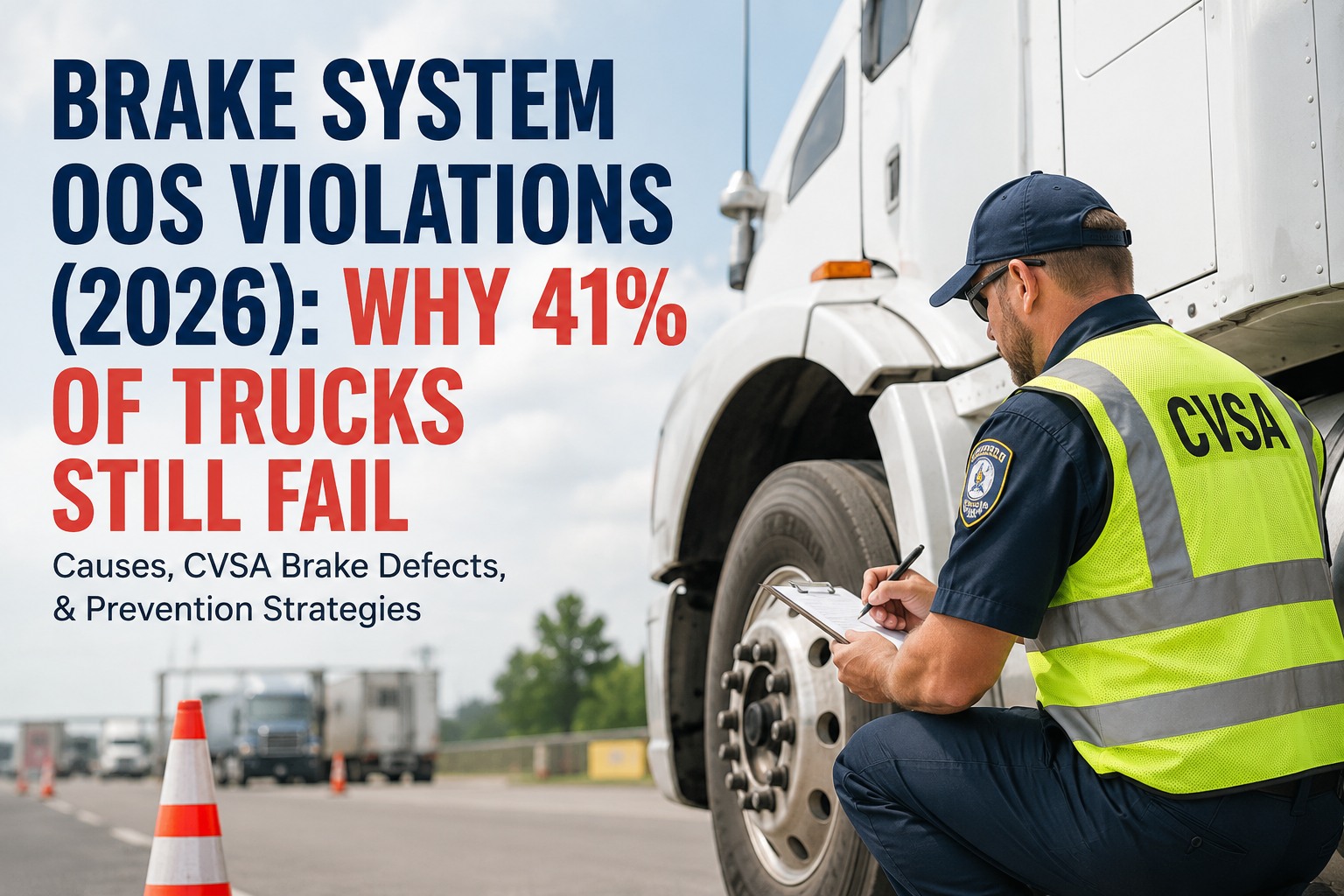
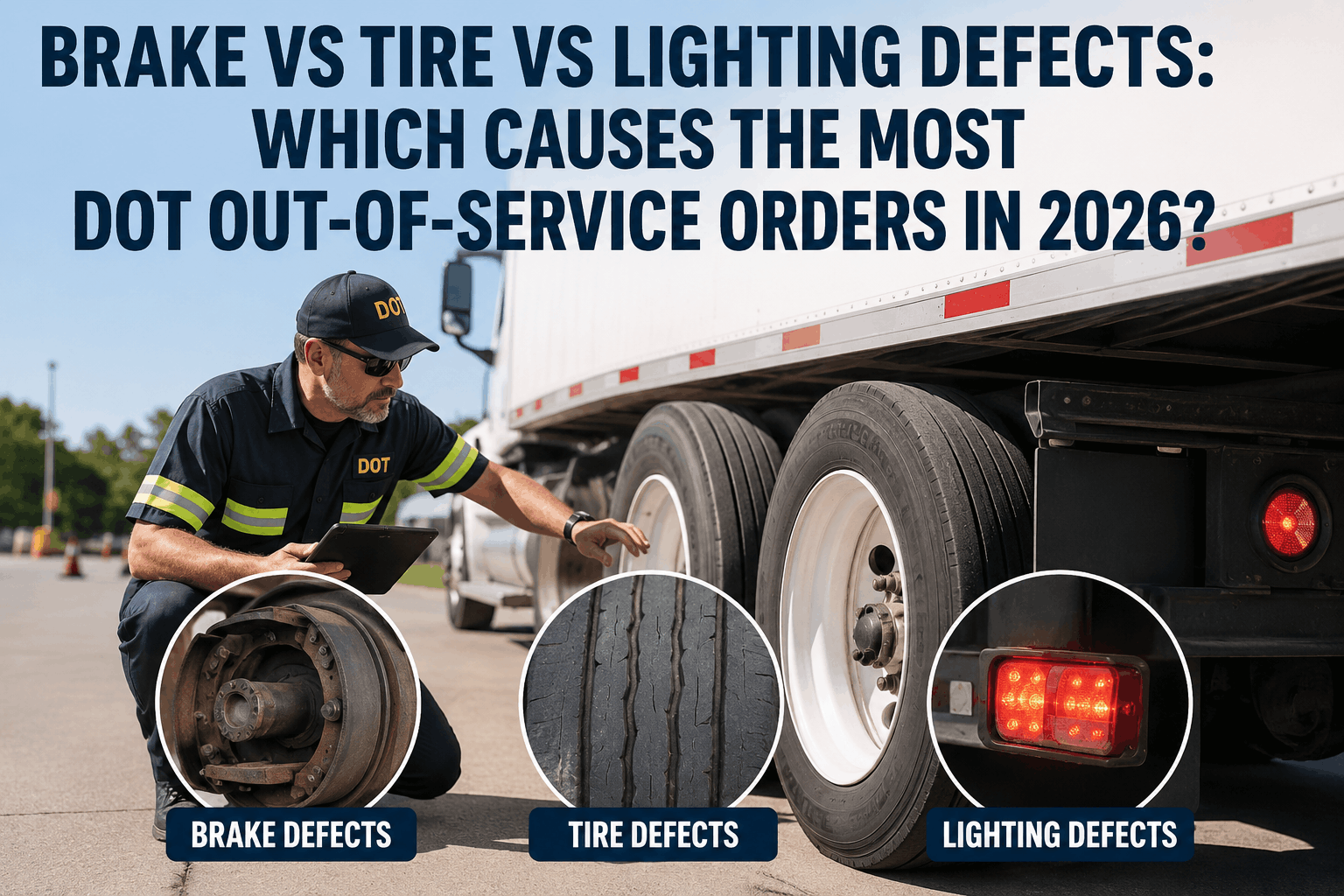
41% of OOSThe single largest OOS category. Enforcement operates on the 20% threshold — if 20% or more of the vehicle's brakes are defective or out of adjustment, the whole combination is OOS.
- 20% brake defect rule. On a 10-brake tractor-trailer, that's 2 defective brakes. On a 4-brake straight truck, one.
- Air loss. More than 3 psi/min single vehicle, 4 psi/min combination, with brakes fully applied and engine off.
- Pushrod stroke. Type 30 chamber maximum 2.0″. Any measurement past legal limit is OOS.
- 2026 update: hydraulic/electric brake lining now under 1/16″ (1.6 mm) OOS threshold.
Tires
21.4% of OOSCVSA thresholds are stricter than DOT minimums. A tire can be "legal" under DOT and still OOS under CVSA. Measure with a gauge, not by eye.
- Steer axle tread depth below 2/32″ at any point = OOS. Target replacement well above.
- Drive/trailer tread depth below 1/32″ = OOS.
- Exposed cord or belt. Any exposure through tread or sidewall = immediate OOS.
- Flat or audibly leaking. Inflation below 50% of max sidewall pressure = OOS.
Lighting & electrical
Called the "gateway violation" — inoperative required lighting frequently triggers a full inspection, and the inspector finds everything else while they're at it. Walk the truck and press every switch.
- Required lighting inoperative — headlights, tail lights, brake lights, turn signals, clearance/marker lamps.
- Missing reflective tape or damaged reflectors on trailers over 80″ wide.
- Cracked lenses or improperly colored lights (red where amber required, etc.).
Cargo securement
Load-dependent, but the general rules apply everywhere. Working load limits, tiedown counts, and edge protection are the frequent flyers.
- Insufficient tiedowns for cargo weight or length (aggregate WLL less than 50% of cargo weight).
- Damaged tiedowns. 2026 added a wire-rope damage chart to the tiedown defect table.
- Unsecured or shifting load. Any evidence of movement during inspection = OOS.
- 2026 update: ExTe Com90 log securement system added to the criteria.
Wheels, rims, hubs
Cracks and missing material are the OOS triggers. 2026 added specific language on missing rim material to prevent minor curb damage from being incorrectly cited.
- Crack through to the wheel window = OOS.
- 2 or more missing/loose lug nuts on the same wheel = OOS.
- 2026 update: missing rim material exceeding 3″ (76.2 mm) in the bead area = OOS.
Steering, suspension, coupling
Structural. Any of these compromised means the truck cannot move safely under load. Level I inspectors climb under the vehicle to check them all.
- Fifth-wheel defects — loose mount, cracked plate, worn kingpin lock jaws.
- Steering play beyond the manufacturer's spec, or damaged tie rod ends.
- Broken suspension components — leaf spring, shackle, U-bolt failure.
- 2026 update: countersunk screw language added to upper coupler / kingpin section.
Any single item in any of these six zones can trigger OOS at Level I. The good news is that photo-verified digital DVIRs cover every one of them structurally, and the trend visibility on repeat findings prevents them from returning. See a Level-I-ready inspection template
The 3 driver OOS triggers — and what changed for 2026
Vehicles get most of the coverage, but drivers can be placed OOS too. The 2025 Roadcheck driver OOS rate was 6.1% — smaller than vehicle at 22.6%, but disproportionately consequential because it strands the vehicle wherever it stops. Three categories dominate.
Credentials — CDL, medical card, endorsements
Expired CDL, expired or missing medical certificate, wrong endorsement class for the vehicle. 2026 update: endorsements and restrictions separated in the criteria to eliminate violation-code confusion. Intrastate restriction guidance added.
Hours of service & ELD compliance
Driving over 11-hour or 14-hour limits, missing logs, form-and-manner violations, ELD malfunction persisting past 8 days. Falsified logs and ELD tampering are their own escalated OOS category and directly feed CSA HOS Compliance BASIC.
Intoxicating beverages — expanded in 2026
The 2026 change made this harder: possession (not just consumption) of wine or beer at 0.5%+ alcohol, or any distilled spirit, while on duty or operating = OOS. Effectively zero tolerance on possession.
Driver OOS is often more expensive than vehicle OOS because it strands the load. A qualified relief driver has to be dispatched, hours mount up, and the shipper conversation is uncomfortable. All three categories are policy-and-documentation problems rather than mechanical ones — the same digital compliance system that runs your DVIRs can catch driver-qualification file gaps before they show up at a roadside stop. Start free and audit your DQ files this week
What the 20% brake defect rule actually looks like
The most-cited OOS rule in the whole document, and the one drivers most often misunderstand. Here is exactly what it means across common combinations.
- Straight truck 4 brakes 1 defective = OOS
- Tandem-axle tractor 6 brakes 2 defective = OOS
- Tractor + single-axle trailer 8 brakes 2 defective = OOS
- Tractor + tandem trailer 10 brakes 2 defective = OOS
- Doubles (tractor + 2 trailers) 14 brakes 3 defective = OOS
What counts as "defective" includes out-of-adjustment (pushrod stroke past legal limit), lining below thickness threshold, chamber leak, and hose damage exposing reinforcement. Slack adjusters that are seized on their internal clutch are the sneaky one — the brake feels fine at the yard test but is at or over legal stroke in the field. Book a demo to see stroke measurements captured on every DVIR
From a compliance officer who ran the 2026 briefing
We got hit with an OOS at a Level I in February. Same driver, same route he'd run for four years. His trailer had a chunk missing off a rim from a curb strike two weeks earlier — three-and-a-half inches long. Under 2025 criteria it wasn't clearly OOS. Under 2026 it is. That's the whole update in one experience.
What changed for us wasn't the rule — it was that we now walk every truck through the 2026 language on every DVIR. The app prompts a photo of any rim damage, and the shop trend view flags anything over an inch as a watch item. Two months of that discipline and we haven't had another wheel-and-rim finding.
Frequently asked questions
What are the CVSA out-of-service criteria?
The CVSA North American Standard Out-of-Service Criteria are the pass-fail standards that certified commercial motor vehicle enforcement officers use during roadside inspections to determine whether a driver or vehicle presents an imminent hazard and must be placed out of service. They are developed and maintained by the Commercial Vehicle Safety Alliance, updated annually, and enforced uniformly across the United States, Canada, and Mexico. Federal regulations describe what must be inspected and what safe operation looks like; the OOSC defines the specific defect thresholds at which a truck or driver is grounded until the condition is corrected. The 2026 edition took effect April 1, 2026, replacing all previous versions, with 17 changes ratified by CVSA voting members on October 17, 2025. A vehicle placed OOS cannot be moved except by tow, and a driver placed OOS cannot operate until the condition is resolved — for example, until an HOS rest period is completed or a valid medical certificate is produced.
What changed in the 2026 CVSA out-of-service criteria?
Seventeen changes were approved for 2026, with the highest-impact ones affecting brakes, wheels, cargo securement, and driver conduct. On brakes: hydraulic and electric brake lining thickness was updated to less than 1/16 inch (1.6 mm) to align U.S. and Canadian standards, "parking brake" was renamed "parking/emergency brake" to reflect both functions, and disconnected service air connections (gladhands) now fall under the 20% brake defect threshold rather than triggering automatic OOS. On wheels: missing rim material exceeding 3 inches (76.2 mm) in the bead area was added as an explicit OOS trigger. On cargo securement: the ExTe Com90 log securement system was added, and a wire-rope damage chart was added to the tiedown defect table. On drivers: driver possession of wine or beer at 0.5% or more alcohol content, or any distilled spirit, while on duty or operating became an OOS trigger, and CDL endorsement/restriction language was separated for clearer violation coding. Other 2026 changes address countersunk screws on upper couplers, hazmat placarding refinements, and administrative clarifications throughout the document.
How does the 20% brake defect rule work?
Under CVSA criteria, if 20% or more of a vehicle's brakes are defective or out of adjustment, the entire vehicle is placed out of service — even if the other 80% are functioning normally. The rule is applied to the total brake count across the whole combination, not per axle. On a standard 10-brake tractor-trailer, that means just 2 defective brakes trigger OOS. On a 4-brake straight truck, 1 defective brake hits the threshold. What counts as "defective" includes out-of-adjustment (pushrod stroke past the legal limit for the brake chamber type — 2.0 inches for Type 30), brake lining below the minimum thickness threshold, chamber diaphragm leaks, brake hose damage exposing the reinforcement layer, and mechanical component failures. Under the 2026 update, a disconnected service air connection between tractor and trailer only triggers OOS if the resulting count exceeds the 20% threshold — a softening from prior automatic OOS treatment. Roadside adjustment is not permitted after OOS; a certified mechanic or qualified inspector must perform and sign off the repair before the vehicle can be moved.
What is the difference between DOT tire minimums and CVSA out-of-service thresholds?
DOT regulations under 49 CFR 393.75 set the minimum operational standards — 4/32 inch tread depth on steer axles and 2/32 inch on drive and trailer positions. CVSA out-of-service criteria are stricter thresholds at which vehicles are immediately removed from service during a roadside inspection: 2/32 inch steer and 1/32 inch other positions. A tire can be technically "legal" under DOT minimums and still trigger an OOS order under CVSA criteria — because DOT sets the ongoing operational floor while CVSA defines the immediate-hazard threshold. In practice this means smart fleets target replacement well above both standards, giving themselves a margin against wear between planned replacements and roadside stops. Other tire OOS conditions include any exposed cord or belt material through tread or sidewall (immediate OOS regardless of depth), tire inflation below 50% of the maximum sidewall-rated pressure, flat tires with audible leaks, and improper repairs — plugs are prohibited on steer tires, for example.
How do OOS violations affect a fleet's CSA score?
Under the 2026 CSA overhaul now fully in effect, out-of-service violations carry a severity weight of 2 in the Safety Measurement System calculation — double the weight of non-OOS violations, which count as severity weight 1. That doubling applies immediately and compounds across the 12-month violation window (down from 24 months under the prior system) used to determine intervention prioritization. In practical terms, a single brake OOS violation has as much percentile impact as two moderate-severity non-OOS violations. On top of the severity weighting, OOS violations also feed directly into the newly split Vehicle Maintenance categories: the traditional Vehicle Maintenance BASIC covers shop-detected defects, and the new Vehicle Maintenance: Driver Observed category scores defects a walk-around should have caught. OOS violations for brakes, tires, and lighting that a competent pre-trip would have found land in the Driver Observed BASIC and directly reflect DVIR quality. The compounding effect makes preventing OOS-level defects roughly twice as valuable as preventing minor citations for the same amount of preventive effort.
Run the Level I checklist before the inspector does
HVI turns the CVSA 2026 out-of-service criteria into a guided mobile DVIR: brake stroke measurements captured with photos, tire tread checks, lighting verification, cargo tiedown documentation, and every 2026 update already built into the templates. Every flagged item routes to a work order, and the shop sees the OOS-adjacent trends before the next Roadcheck.
No credit card · No hardware · Live on your fleet in under two weeks