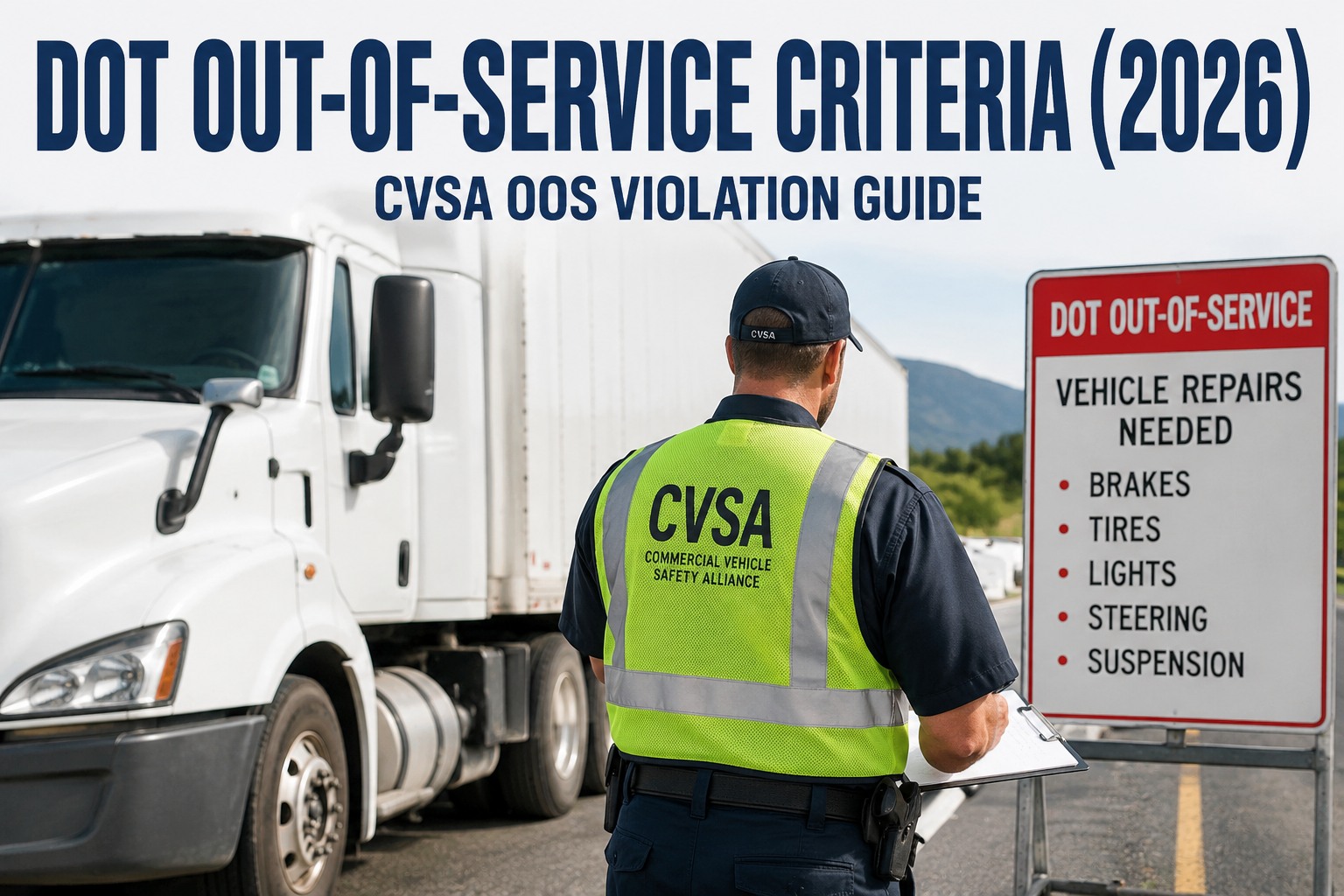
DOT Out-of-Service criteria define the exact measurement thresholds that separate a citation from a truck grounded on the shoulder. Published by CVSA and updated annually every April 1, the North American Standard Out-of-Service Criteria (OOSC) is the pass-fail rulebook for every roadside inspection across the United States, Canada, and Mexico. The 2026 edition includes 17 approved changes affecting brakes, cargo securement, wheels, HazMat placarding, and ELD tampering. Book an HVI demo to prevent OOS before roadside.
Six measurement thresholds. Zero interpretation room. One truck grounded.
OOS criteria aren't guidelines — they're specific numbers. Meet or exceed any threshold below and the truck stops until repaired. Every driver, mechanic, and fleet manager needs these values memorized.
Approved by 51 of 70 CVSA Class I jurisdictions. Impacts brakes, cargo securement, wheels & rims, HazMat placarding, ELD tampering, and driver qualifications.
What "out of service" actually means — and the CSA cost
An Out-of-Service violation isn't a citation you pay and move on from. It's a physical grounding of the truck. When a CVSA-certified inspector places a vehicle or driver OOS, an "Out-of-Service Vehicle" sticker gets affixed to the windshield. No motor carrier can require, and no person can operate, the vehicle until the specific defect is repaired and documented. If the driver ignores the sticker and moves the truck anyway, the violations stack into criminal territory.
Beyond the immediate operational impact, every OOS violation feeds directly into the FMCSA Safety Measurement System with severity weight 2 — double the weight of a non-OOS violation in the same category. That elevated weight sits on your carrier's CSA record for 24 months, increasing percentile scores across the affected BASIC, raising your inspection-selection frequency at every weigh station, and driving up insurance renewal costs. Fines under the FMCSA schedule reach up to $19,277 per violation. The true all-in cost of a single OOS event, including tow, mobile repair at emergency rates, lost load revenue, customer penalty, and CSA-driven insurance impact, typically runs $5,000 to $15,000. Book an HVI demo to see OOS prevention templates deployed against your fleet's actual defect patterns
The 17 changes taking effect April 1, 2026
On December 5, 2025, CVSA formally notified members of the approved 2026 updates following the fall issues ballot. Seventeen changes cleared the Class I jurisdiction vote and became enforceable across North America on April 1, 2026. Grouped by category:
Lining thickness measurements on hydraulic and electric brakes now aligned with federal regulations, eliminating prior discrepancies between US and Canadian standards. "Parking Brake" heading updated to "Parking/Emergency Brake" reflecting both possible applications. Disconnected service air connections moved under the 20% defective brakes rule — no longer automatic OOS by themselves.
Missing rim material greater than 3 inches (76.2mm) in the bead area now explicitly triggers OOS — aligned with existing 3-inch crack rule and distinguishes serious safety hazards from minor curb damage. Certain crack criteria removed after being determined not to pose imminent danger.
ExTe Com90 log securement system officially added to accepted securement methods. Visual damage chart for wire rope tiedowns added to the Tiedown Defect Table — reduces roadside disputes and improves inspection consistency across jurisdictions.
Countersunk screws section added to upper coupler and kingpin criteria. Driver qualification endorsements and restrictions clarified — a valid CDL with a restriction violation does not automatically invalidate the license; enforcement now relies on state authority for OOS action. HazMat placarding and ELD tampering enforcement language updated.
The 2026 updates lean toward measurement precision and consistency rather than adding new failure categories. For fleets already running clean compliance, the changes are largely favorable — several ambiguous or overly-broad prior criteria have been tightened to match actual safety risk. Try HVI free to deploy 2026-updated inspection templates aligned with the new criteria.
Top OOS violations — category-by-category measurement guide
Four categories generate roughly 80% of vehicle OOS events year after year: brakes, tires, wheels/rims, and lighting. Understanding the specific thresholds within each category lets fleets prevent OOS at pre-trip rather than discover it at roadside.
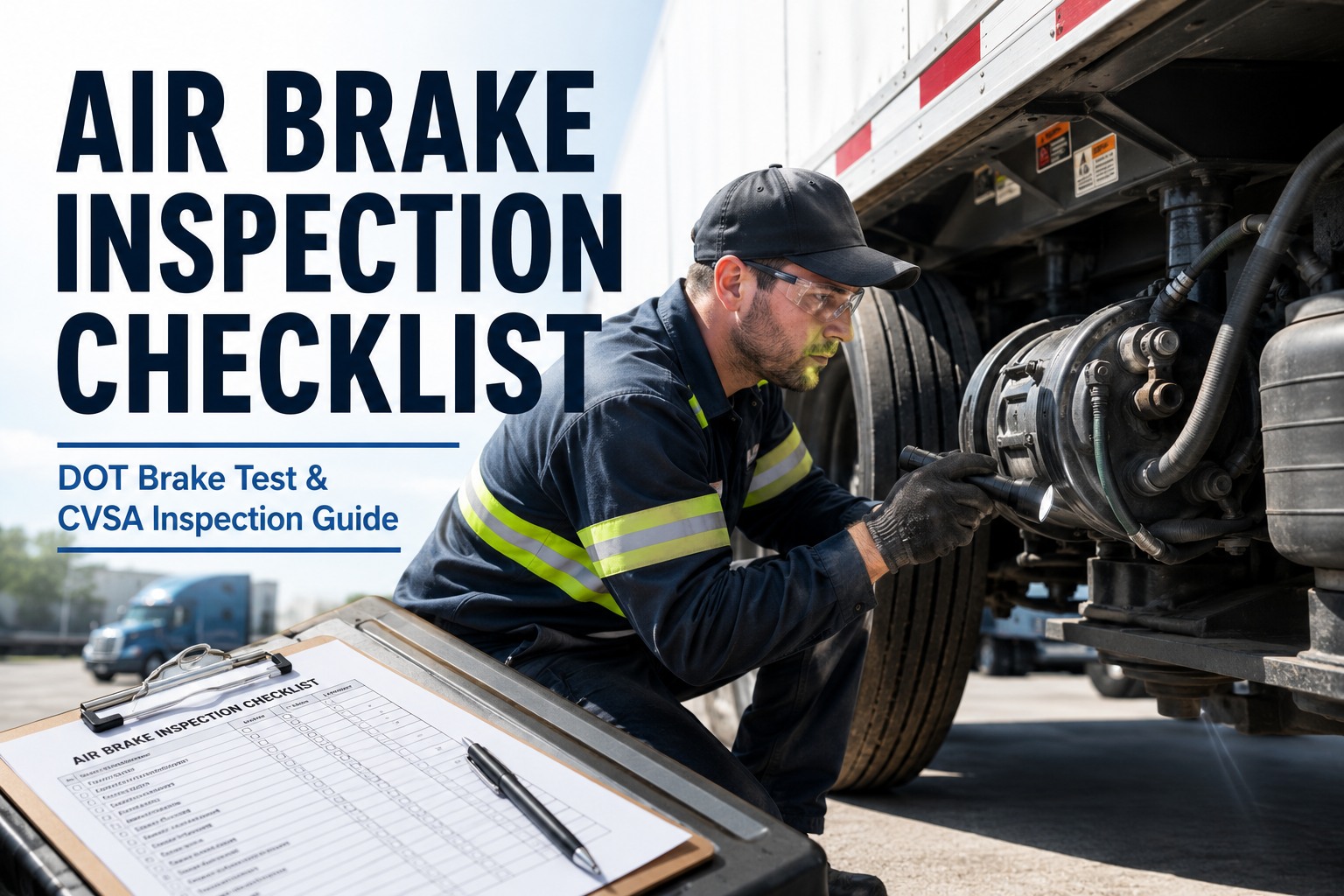
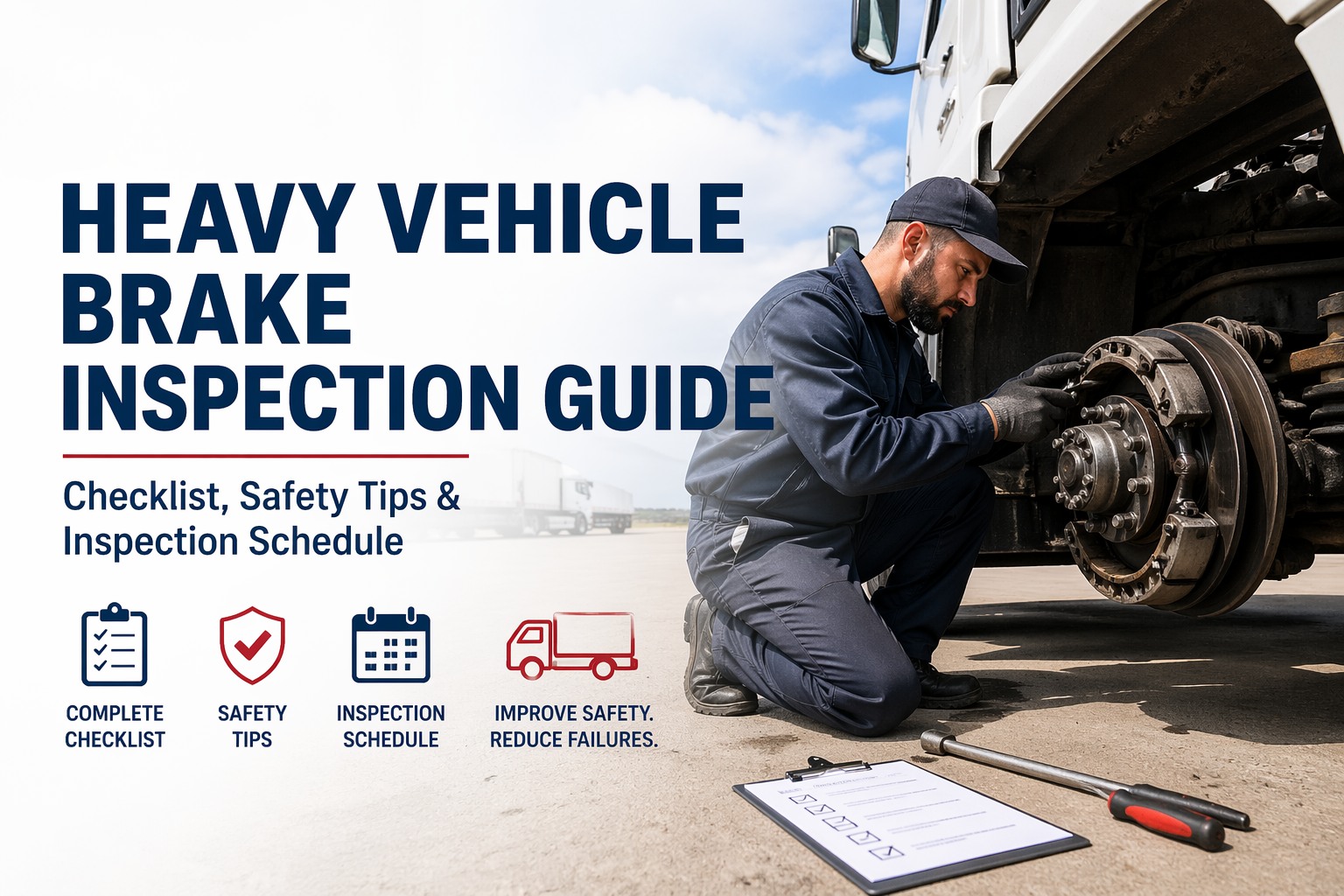
The 20% rule is CVSA's core brake OOS logic. If 20% or more of a vehicle's total brakes are defective, the vehicle is OOS. Fractions round UP: a 5-axle tractor-trailer with 10 brakes needs only 2 defective for OOS (2/10 = 20%). Individual defect triggers: brake stroke ¼" or more beyond adjustment limit, audible air leak at brake chamber, missing brake components, lining thickness below spec (continuous strip <3/16", segmented <1/4"). Steering axle brakes carry heightened scrutiny — any single defective steer brake or missing steer brake = automatic OOS regardless of the 20% count. Mismatched brake adjuster lengths on the same axle = defective. Air loss rate exceeding CVSA table values = defective.
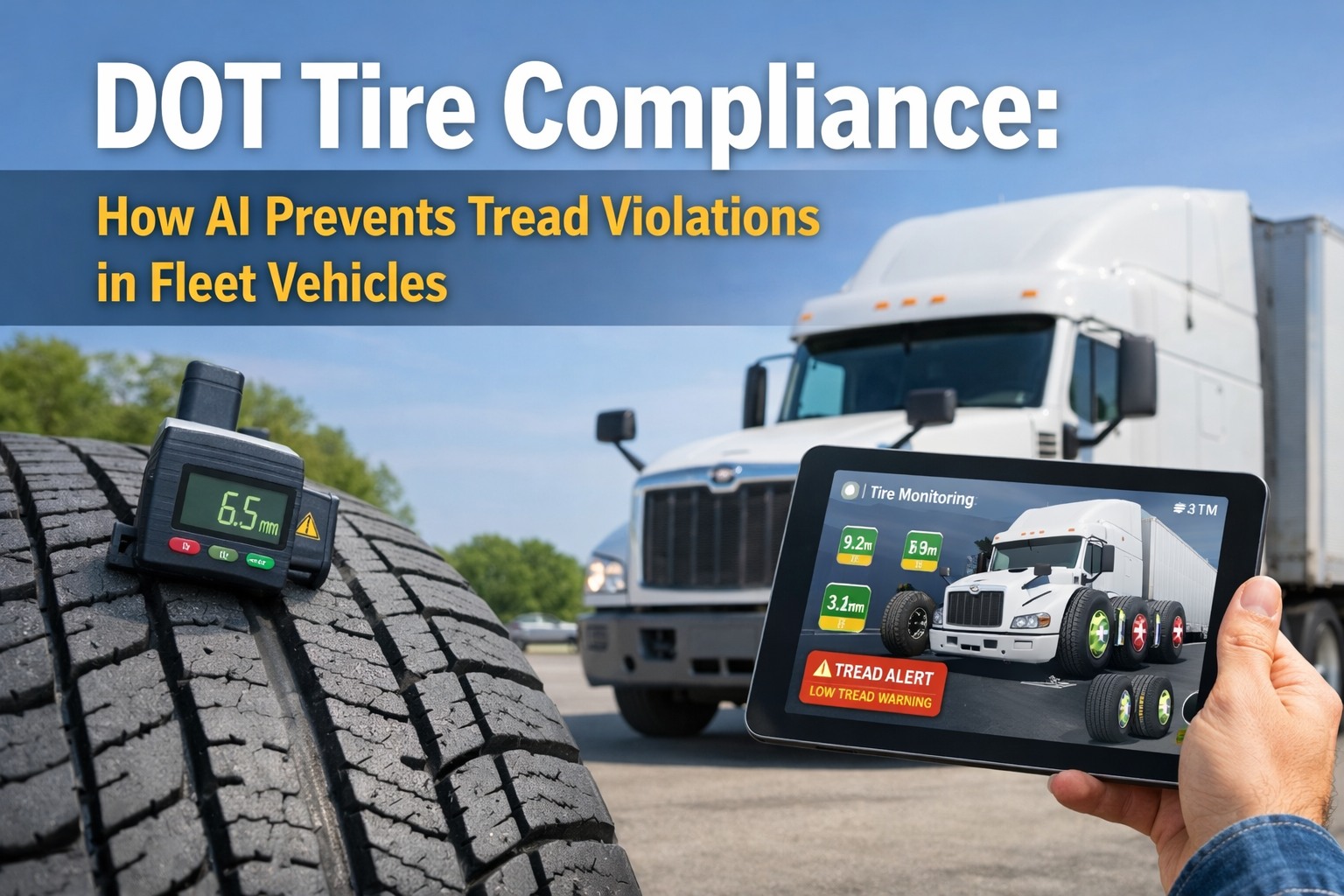
Steer tires require minimum 4/32" tread across the tire face. Drive and trailer tires require minimum 2/32" tread. Below these thresholds on any measured tire = OOS. Beyond tread depth, several other tire conditions trigger OOS: any tire flat or with audible air leak, sidewall damage exposing cord or fabric, tread separation, bulge or knot in sidewall from internal damage, cuts penetrating to cord on tread or sidewall, and mismatched tire construction (bias with radial) on same axle. Under-inflation below 50% of spec is also a defective condition. Tire OOS events are among the most preventable at daily walk-around when the driver actually kneels down to look.
Any single crack 3 inches (76mm) or longer anywhere on the wheel = OOS. Two or more cracks anywhere = OOS regardless of individual length. 50% or more elongated stud holes with fasteners tight = OOS. Two or more web areas with cracks = OOS. Cracks at three or more locations = OOS. New in 2026: missing rim material greater than 3 inches in the bead area = OOS explicitly. Wheels are among the highest-consequence failure categories — wheel separations at highway speed produce catastrophic outcomes, and inspectors know to look closely.
Required lamps not functioning at time of inspection = defect. Multiple lamp failures escalate to OOS depending on which lamps and how many. Lamps required by 49 CFR 393.11 include headlamps, tail lamps, stop lamps, turn signals, hazard warning lamps, side marker lamps, clearance lamps, and identification lamps. Reflective sheeting (conspicuity tape) required on trailers must be present, undamaged, and clean. Faded, missing, or damaged reflective sheeting can trigger OOS on trailers manufactured after specific dates. Lighting defects are the second-most-common visible category after tires and among the easiest to prevent at daily walk-around.
Each of these four categories fails at daily pre-trip when the driver actually measures rather than eyeballs. Book an HVI demo to see measurement-verified DVIR templates that force actual numerical capture on the exact thresholds above.
The real cost of a single OOS event
Fleet managers who track OOS impact only through the fine amount miss the majority of the cost. The full cost of a single OOS event stacks across multiple line items, most of which don't show up on the citation itself.
Insurance carriers now query FMCSA data directly at renewal. A fleet with 5-10 OOS events over 24 months sees premium increases in the 8-15% range on average, with worse outcomes for repeat offenders. On a mid-sized fleet, that insurance impact alone can exceed six figures annually — more than the direct OOS costs combined.
OOS prevention playbook — five moves that work
OOS prevention isn't a single intervention. It's a stack of five operational disciplines applied consistently. Fleets running this playbook typically post OOS rates 40-60% lower than industry average.
Digital DVIR with mandatory photo capture on brake components, tire condition, wheel visible cracks, lighting function, and cargo securement. Photo evidence catches what visual-only walk-arounds miss and creates an audit trail that satisfies both roadside inspection and post-incident claims investigation.
Brake stroke measured with actual gauge at PM intervals. Tire tread depth measured across all axles monthly with recorded values. Air loss rate tested with pressure gauge, not by feel. Measurements captured in the DVIR record, not just "OK" checkbox. Real numbers create real accountability.
Every defect noted on DVIR must trigger a work order and either corrective action or "not required for safe operation" authorization before the truck rolls again. Paper systems routinely break this chain; digital DVIRs enforce it automatically, preventing dispatch of trucks with known defects.
Preventive maintenance intervals aligned specifically to catch OOS-threshold defects before they reach the roadside. Brake shoes replaced at 3/16"+3/16" wear margin (not at 3/16" absolute). Steer tires rotated or replaced at 5/32"+ (not at 4/32"). Wheel inspections at every brake service.
Every driver briefed on the 17 April 2026 OOSC changes affecting their daily walk-around: parking/emergency brake language, wheel crack criteria, cargo securement additions. Trained drivers catch more at pre-trip. Ignorance of the criteria doesn't reduce enforcement.
Layered consistently, the five-move playbook typically reduces OOS rates from 25-30% baseline to 8-12% within the first two quarters — a 60%+ reduction that compounds across CSA scores, insurance costs, and operational reliability. Try HVI free to layer in all five moves without new hardware.
From a safety manager running 118 tractors across three service lanes
We averaged 28% vehicle OOS rate on roadside inspections through 2024 — brakes leading every quarter, tires close behind. Our maintenance shop swore vehicles were being sent out clean. Roadside data said otherwise.
Deployed HVI with measurement-verified DVIR templates: brake stroke captured in inches on every service, tread depth recorded per axle, wheel photos every PM cycle. Six months in: OOS rate dropped to 11%. Twelve months: 7%. CSA Vehicle Maintenance percentile went from 82nd to 38th. Insurance renewal this year came in flat instead of the 12% increase we'd budgeted for. The playbook works because it turns "did you check the brakes?" into "what did the brake stroke measure?"—the difference is everything.
Frequently asked questions
What is the DOT Out-of-Service Criteria?
The DOT Out-of-Service Criteria — officially the North American Standard Out-of-Service Criteria (OOSC) — is the pass-fail rulebook published by the Commercial Vehicle Safety Alliance (CVSA) that defines exactly which vehicle and driver conditions trigger an out-of-service order at roadside inspection. The criteria identify "critical violations" — specific defects considered serious enough that the vehicle or driver cannot continue operating until the defect is corrected. When a CVSA-certified inspector places a vehicle out of service, an "Out-of-Service Vehicle" sticker is affixed to the windshield. No motor carrier can require, and no person can operate, the vehicle until all defects meeting OOS criteria are repaired and documented. The OOSC covers all inspection levels and applies uniformly across the United States, Canada, and Mexico under CVSA jurisdiction. It's updated annually every April 1, with proposed changes going through a formal Class I jurisdictional voting process. The 2026 edition (effective April 1, 2026) includes 17 approved changes affecting brake measurements, cargo securement, wheels and rims, coupling devices, driver qualifications, HazMat placarding, and ELD tampering enforcement. Every OOS violation carries CSA severity weight 2 — double the weight of a non-OOS violation in the same category. That elevated weight sits on the carrier's Safety Measurement System (SMS) record for 24 months, driving up percentile scores, inspection-selection frequency, and insurance renewal costs. The OOSC is fundamentally about safety consequence: any condition in the criteria has been determined to create imminent hazard if the vehicle continues operating.
What is the CVSA 20% brake rule?
The CVSA 20% brake rule is the core Out-of-Service logic for brake systems: if 20% or more of a vehicle's total brakes are defective, the vehicle is placed out of service. Fractions round UP to the next whole number. Example: a 5-axle tractor-trailer combination has 10 brakes total; 20% equals 2 brakes; 2 or more defective brakes triggers OOS. A truck with 12 brakes total needs 3 defective (20% = 2.4, rounded UP to 3) for OOS. What counts as a "defective" brake toward the 20% count: brake stroke ¼" or more beyond the adjustment limit for the specific brake chamber type, audible air leak at the brake chamber (ruptured diaphragm or similar), missing brake components, brake lining or pad thickness below CVSA thresholds (continuous strip lining less than 3/16", segmented lining less than 1/4"), or lining worn beyond wear indicators. Mismatched brake adjuster lengths on the same axle count as defective. Air loss rate exceeding CVSA table values counts. Steering axle brakes carry heightened scrutiny — any single defective steer axle brake, or a missing steer axle brake where required, triggers OOS regardless of the 20% count. This is because steering axle brake failure creates asymmetric braking that produces loss of directional control during hard braking. The 20% rule is the reason brake violations remain the #1 OOS category year after year: a single missed slack adjuster inspection on a truck already at 15% defective pushes it to 20%+ and grounds the vehicle.
What are the tire OOS criteria in 2026?
Tire Out-of-Service criteria in the 2026 CVSA OOSC handbook cover multiple failure modes beyond tread depth. Tread depth thresholds: steer tires require minimum 4/32" tread across the tire face; drive axle and trailer tires require minimum 2/32". Below either threshold on any measured tire = OOS. Other tire conditions triggering OOS include: any tire flat or with audible air leak (loss of air from any cause), sidewall damage exposing cord or fabric ply, tread separation from the casing, bulge or knot in the sidewall indicating internal damage, cuts penetrating to cord on either tread or sidewall, tire fabric exposed through wear or damage, and mismatched tire construction on the same axle (bias-ply with radial). Under-inflation below 50% of the tire's spec pressure counts as a defective condition. Regrooved tires used on steer axles = OOS (regrooving permitted only on drive/trailer positions). Tires marked "not for highway use" installed on any position = OOS. Beyond the individual tire criteria, the 20% rule concept applies: multiple defective tires across the vehicle can trigger OOS through cumulative defect count. Practically, tire OOS events are among the most preventable at daily walk-around: the driver kneels down, looks at each tire, checks pressure, and identifies obvious defects before dispatch. Tread depth gauges cost under $10 and take 30 seconds to use per tire. Fleets that build tire inspection into standard pre-trip DVIR routine consistently reduce tire OOS rates 60%+ within the first quarter of implementation.
How much does an OOS violation cost?
A single Out-of-Service violation typically costs $5,000 to $15,000 all-in when accounting for the full cost stack. Direct fine: FMCSA penalty schedule permits fines up to $19,277 per violation, though most single violations run $500-$5,000 depending on category and prior history. Multiple violations from the same inspection stack. State enforcement fees add on top of federal. Immediate operational cost: mobile repair at OOS-response rates ($150-$400/hour labor plus parts), tow to shop if the defect prevents drive-in repair ($500-$2,000), driver hours at rest during repair (unrecoverable), lost dispatch time (revenue plus lane cost). Load impact: late delivery penalties from shippers (contractual, typically $200-$1,500), load re-work for time-sensitive cargo like reefer or expedited (potentially $2,000+), replacement truck dispatch to complete the load, and customer relationship damage that shows up in reduced future bookings. CSA cascading cost: every OOS violation feeds the FMCSA Safety Measurement System with severity weight 2, sits on the record for 24 months, and increases the carrier's percentile score. Elevated percentiles produce higher inspection-selection frequency at weigh stations (feeding the cycle), higher insurance renewal costs (typically 8-15% for repeat OOS carriers), and reduced eligibility for premium freight lanes with sustainability-focused shippers. Insurance impact often exceeds the direct OOS costs on a fleet-wide basis: a 100-truck fleet with 5-10 OOS events over 24 months can see six-figure annual insurance premium increases attributable to the OOS pattern. The economics of OOS prevention consistently outperform the economics of accepting occasional OOS events as a cost of doing business.
Can digital DVIR software help prevent OOS violations?
Yes — and fleets running digital DVIR programs with measurement-verified inspections consistently post OOS rates 40-60% below industry average. Digital DVIR platforms produce four structural advantages over paper systems for OOS prevention. First, measurement fields force actual numerical capture rather than "OK" checkboxes. Brake stroke recorded in inches, tread depth per axle in 32nds, air loss rate measured with gauge readings. This turns pre-trip from a rubber-stamp exercise into genuine measurement. Second, photo evidence on critical items (brakes, tires, wheels, coupling, cargo securement) creates a timestamped audit trail that catches defects paper walk-arounds miss and satisfies both roadside inspection questions and post-incident investigations. Third, defect-to-work-order automation prevents dispatch of trucks with known defects. When a driver notes a defect, the system generates a work order and either blocks dispatch or requires "not required for safe operation" authorization before the truck can roll. Paper systems routinely break this chain when handoffs get lost between drivers, dispatch, and shop. Fourth, PM cycle enforcement aligned to OOS thresholds catches defects before they reach the roadside. Brake shoes replaced when wear approaches the 3/16" defective threshold rather than at the threshold itself. Steer tires rotated or replaced when tread approaches the 4/32" OOS threshold. Wheel inspections at every brake service to catch cracks before they reach the 3" OOS length. Fleets transitioning from paper to measurement-verified digital DVIR typically report OOS rate reductions of 50-70% within the first two quarters, CSA Vehicle Maintenance percentile improvements within the first six months, and insurance renewal impact within the following annual cycle.
Every OOS threshold verified at pre-trip — deployed in 5-7 days.
HVI ships with 2026-updated OOS prevention templates. Brake stroke and tread depth measurement fields. Wheel and rim photo evidence. Cargo securement checkpoints aligned with the ExTe Com90 and wire rope updates. Real-time defect-to-work-order routing prevents dispatch of any truck with a 2026 OOS-triggering condition. Every measurement threshold in the OOSC handbook enforced by design. Live for your fleet in 5-7 days.
2026 OOSC aligned · FMCSA 49 CFR 396.11 compliant · USA + Canada + Mexico · SOC 2 Type II