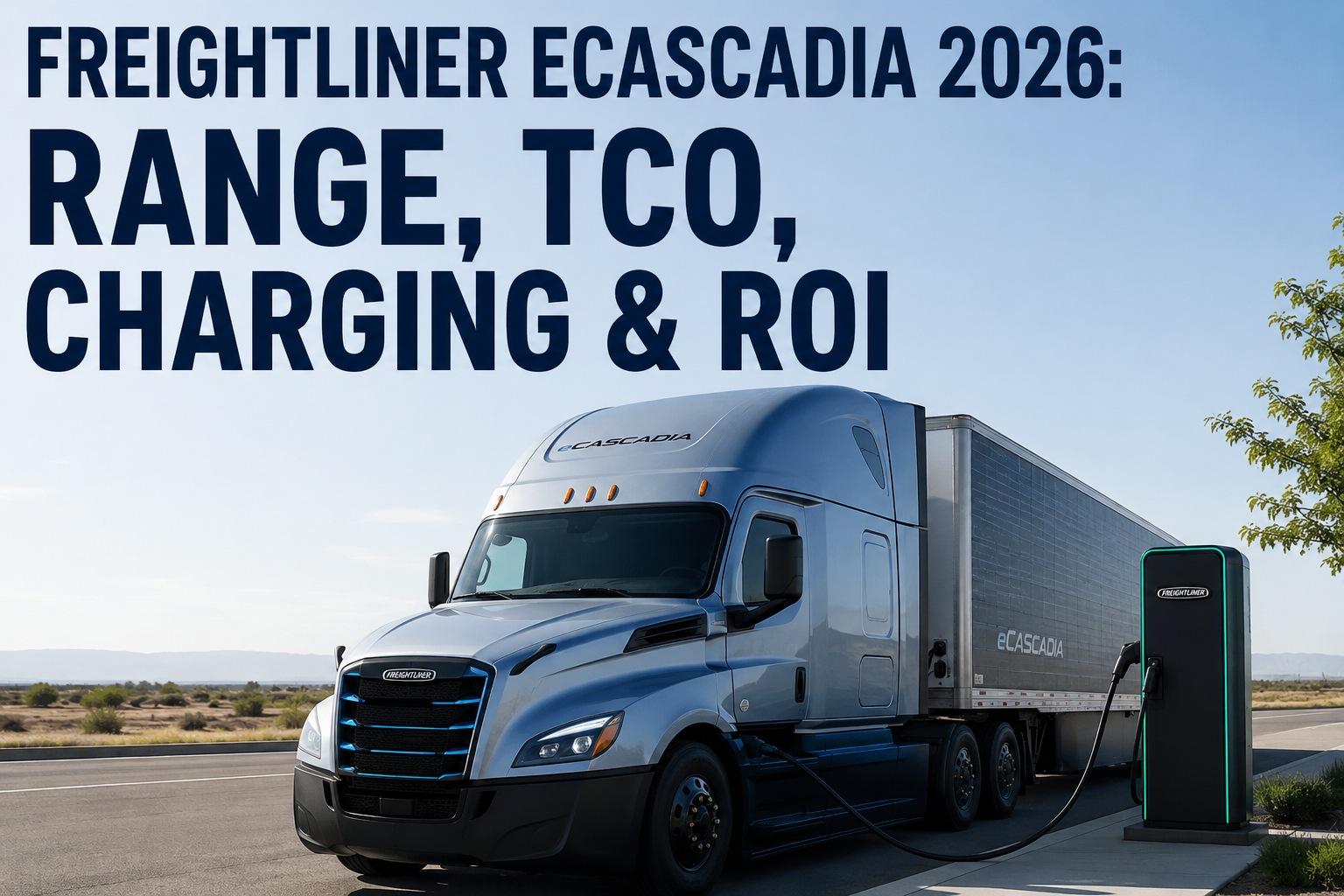
A diesel Cascadia costs about $180,000. A Freightliner eCascadia 2026 starts closer to $400,000 and can't drive coast-to-coast without a plan. But run the eCascadia on the duty cycle it was built for — return-to-base regional under 230 miles — and the fuel-and-maintenance math tilts hard the other way. This is the honest picture of where the truck earns its price tag and where it doesn't — book a demo to model eCascadia TCO on your fleet's real duty cycles.
Not Every Route Suits an Electric Cascadia
The truck is the same on paper. The economics change wildly depending on the route it runs. Here's the honest read across five common Class 8 duty cycles, scored on the four things that actually decide the business case.
The top three rows are where the eCascadia was designed to earn its keep. The bottom row is where headline range specs run out and diesel is still the right answer.
If your operation lives in the top three rows, the rest of this page is the math that turns "we should look at electric" into a defensible proposal. Book a 30-minute demo to see HVI model your actual duty cycles against eCascadia specs.
The specs, translated for a fleet manager
Freightliner's marketing sheet is dense. Here's what actually matters when you're pricing this into a route plan.
Small battery
Typical range 155 mi. Recharges 0–80% in about 90 min at 150 kW. Best fit for compact drayage or urban loops where the truck comes home mid-day.
Large battery
Typical range 220–230 mi (4×2 / 6×4 config). Supports dual-port charging up to 270 kW combined. The default choice for regional runs.
Tandem eAxle
Full Class 8 GCW at tandem drive. Single-drive tops out at 65,000 lb. 320–470 HP depending on axle configuration, with up to 23,000 lb-ft torque.
Charging protocol
Standard North American CCS1. Single port 180 kW, dual-port option 270 kW combined on the 438 kWh pack. Depot-based charging is the deployment assumption.
Every one of those numbers is a real constraint on your route plan — not a marketing bullet. The 230-mile range assumes gradually diminishing load, regen used consistently, and a full charge to start. Cold weather, heavy grade, or a refrigerated trailer trims it further. Plan routes at 80% of nameplate range and you'll rarely be wrong. Weight matters too: the eCascadia carries the battery pack as part of the tare weight, which shifts the payload window down by roughly 5,000–7,000 lb compared to the diesel equivalent depending on configuration. On weight-limited freight (paper, beverages, bulk commodities) that can mean a slightly smaller load per trip, which needs to be factored into the per-load cost calc rather than discovered on the first weigh-in. On volume-limited freight (dry van general freight, parcel), the weight delta is usually invisible in operations. Book a demo to see HVI overlay your actual daily route mileage against 155/220/230 mi range envelopes so the truck spec picks itself.
The five-year TCO math on one truck
Numbers below assume a mid-range depot-charged regional operation at 80,000 miles per year, US average electricity rate, national average diesel — adjust to your reality for a real number. This is the shape of the decision, not the final answer.
| Cost line | Diesel Cascadia | eCascadia 438 kWh | Delta over 5 yrs |
|---|---|---|---|
| Purchase price | ~$180,000 | ~$400,000 | +$220,000 |
| Federal / state incentives | — | up to −$100,000 (IRA 45W + HVIP where eligible) | −$100,000 |
| Fuel / energy | $0.15–0.25/mi = $60K–$100K/yr | $0.03–0.06/mi = $12K–$24K/yr | −$180,000 to −$380,000 |
| Maintenance | ~$0.22/mi (ICCT) | ~$0.14/mi (ICCT) | −$32,000 |
| Charging infrastructure | N/A | ~$25K–$40K allocated per truck | +$30,000 |
| 5-year net TCO delta | eCascadia typically $60,000–$260,000 lower | — | |
The spread is wide because your diesel price, your electricity rate (peak vs off-peak matters more than the sticker), and your incentive eligibility change the number by six figures. What holds across every scenario: the operating cost delta is real and it compounds fast. Fleets running high utilization on the right routes hit break-even in 3–5 years; fleets running low utilization on marginal routes don't. Two variables get overlooked in most first-pass TCO spreadsheets and are worth naming explicitly. Residual value: heavy-duty EV residuals are still being established, and the resale market for a used eCascadia in 2030 is a real number nobody can quote today. Building the TCO with conservative residual assumptions (essentially treating the truck as fully depreciated at end-of-life) is the safe default. Battery degradation: modern lithium packs typically retain 80–90% of usable capacity through the first million miles or so of operation, but that shrinking envelope needs to be factored into route assignments in years 8–10, or a route that fit at delivery slowly becomes marginal.
Charging is the deployment, not just the outlet
The truck is only half the project. The charging infrastructure decision is the one that determines whether the fleet actually runs on schedule and whether the operating-cost savings show up as designed. Three variables set the whole plan.
Depot power capacity
A 10-truck eCascadia depot needs roughly 1.5–2 MW of installed capacity for overnight charging. Utility interconnect studies and panel upgrades often run 6–12 months — longer than the truck lead time in some regions. Start the utility conversation before you place the truck order.
Time-of-use rates
Off-peak overnight electricity can cost half of peak-hour pricing. Smart charging that fills the pack between 11 PM and 6 AM is where the $0.03–0.06/mi energy cost actually gets achieved. Charge during peak hours and the fuel advantage narrows sharply.
Charger sizing & port count
Dual-port 270 kW hardware lets a 438 kWh eCascadia hit 80% in about 90 minutes. Single-port 180 kW takes closer to 2.5 hours. Plan port count for peak simultaneous demand, not average, or you'll be juggling truck rotation instead of running routes.
The incentive stack — and where it changes the deal
Commercial Clean Vehicle Credit (IRA 45W)
Up to $40,000 per qualifying commercial vehicle over 14,000 lb. Applies at purchase and doesn't require tax liability if the seller passes the credit through. This one alone can knock 10% off the eCascadia purchase price.
California HVIP (and equivalents)
Up to $60,000 per qualifying heavy-duty EV in California, with similar programs in NY, NJ, MA, WA and Colorado. Point-of-sale voucher — no waiting for tax filing. Stacks with the federal credit in most cases.
Alternative Fuel Infrastructure Credit (30C)
Up to $100,000 per qualifying charging port for depot installations in eligible areas. Combined with utility charging-infrastructure incentives, offsets a big portion of the upfront electrification bill for the site.
Make-ready programs
Many utilities cover a significant portion of the electrical infrastructure between the meter and the charging equipment as part of medium-and-heavy-duty EV programs. Terms vary by region — call your local utility's fleet-electrification desk early.
The four layers stack. In the strongest scenarios — a California drayage operator with HVIP eligibility and depot infrastructure in an incentive-heavy census tract — the combined incentive value can offset $150,000–$250,000 of the initial deployment cost per truck, sometimes more. In the weakest scenarios — a Midwest fleet outside any state EV program, with commodity-region electricity rates and limited utility support — only the federal 45W credit typically applies, and the effective purchase-price gap stays wide. Which scenario the fleet lives in matters more to the ROI than the truck spec itself, which is why the incentive audit needs to happen alongside the route audit. Book a demo to see how HVI tracks incentive eligibility and stacking by state and by asset — because incentives change annually, and the fleet that catches a program before it sunsets is the fleet that keeps its ROI intact.
Where the maintenance line actually shifts
The single biggest surprise in EV fleet accounting isn't the fuel line — it's the maintenance line. An eCascadia eliminates or dramatically reduces most of the wear items that dominate a diesel Cascadia's shop bill.
| Maintenance item | Diesel Cascadia | eCascadia |
|---|---|---|
| Engine oil changes | Every 25–50K mi | Eliminated |
| DPF / SCR / DEF service | $4K–$8K per aftertreatment event | Eliminated |
| Transmission service | AMT fluid + calibration cycle | Single-speed reduction (minimal) |
| Brake wear | Standard interval — friction only | Extended by regenerative braking |
| Cooling system | Standard | More complex (battery + motor + inverter cooling) |
| High-voltage battery inspection | N/A | New PM item — state-of-health monitoring |
| HV-trained technician requirement | N/A | Required for any HV component work |
Net of the eliminated diesel items and the added HV items, ICCT data puts eCascadia maintenance around $0.14/mi vs $0.22/mi for a comparable diesel — a ~35% reduction. The catch: your shop needs at least one HV Level 3–trained technician on staff, and shop procedures for battery isolation and lockout have to be in place before the first truck arrives. Start a free HVI trial to track EV-specific PM tasks alongside your diesel fleet's.
How successful fleets phase the rollout
The eCascadia deployments that hit their TCO targets have one thing in common: they didn't order 20 trucks on day one. They ran a disciplined pilot, learned where their assumptions were wrong, and scaled from validated data instead of a spreadsheet.
-
1Pick 1–2 trucks and 1–2 routesMonth 0
Choose routes with the best duty-cycle fit — under 200 miles daily, return-to-base, predictable schedules. Assign committed drivers who want the assignment. Baseline the diesel numbers on the same routes for at least three months before switching. Without a clean baseline, you cannot prove the ROI in year one.
-
2Start the utility conversation earlyMonth 0–2
Utility interconnect studies for depot charging routinely take 6–12 months in high-demand regions. Trigger this the same day you place the truck order, not after the truck arrives. Ask specifically about make-ready programs, time-of-use rates, and demand-charge structure — all three change your operating cost by five figures per year per truck.
-
3Train the shop before the truck arrivesMonth 2–4
At least one HV Level 3–trained technician on staff. HV safety protocols and lockout procedures documented. Diagnostic tools (Detroit DiagnosticLink and eDrive-specific modules) in the shop. A truck arriving before the shop is ready means either the truck sits or someone gets hurt.
-
4Run the pilot 12 months, measure everythingMonth 4–16
Track energy consumed per mile by route, battery state-of-health monthly, unplanned downtime events, driver-reported issues, and every maintenance event with parts and labor. Compare against the diesel baseline monthly, not annually. The point of the pilot is to catch bad assumptions early — a 12-month cycle covers seasonal range variation.
-
5Scale with data, not convictionMonth 16+
Successful pilot — expand truck-by-truck onto routes that match the validated envelope. Marginal pilot — investigate specifically what missed target (route mismatch, charging cost, uptime) and fix that before scaling. Fleets that scale from 2 to 20 trucks in one order without validating the pilot are the ones that write off the deployment two years in.
A fleet manager who ran the pilot honestly
We ran two eCascadias for 14 months on port drayage before we bought any more. First eight weeks I thought we'd made a mistake — the utility interconnect took longer than the trucks did to arrive, so we were dispatch-charging at a public station and paying full retail. Numbers looked terrible.
Once the depot install went live and we shifted charging to 11 PM to 5 AM, the energy line dropped by more than half. Second year, on those two trucks, we saved almost $80K on fuel plus about $22K in maintenance we didn't spend. Now we spec eCascadias for anything under 200 miles a day. Not because it's fashionable — because on the right route, the math works and I can prove it.
Frequently asked questions
What is the real-world range of a Freightliner eCascadia?
Freightliner publishes typical range of 155 miles on the 291 kWh battery (single-drive 4x2 configuration) and 220–230 miles on the 438 kWh battery (220 on 6x4 tandem, 230 on 4x2 single-drive). These figures come from over a million miles of Freightliner CX fleet operation and assume a gradually diminishing load, consistent regenerative braking usage, and starting the route on a full charge. Real-world range on your specific operation will vary with load weight, terrain, ambient temperature, cabin HVAC use, driver behavior, and whether the trailer draws power (a refrigerated unit will trim range noticeably). A safe planning rule is to size routes at roughly 80% of nameplate range to leave margin for cold days, unexpected detours, and the reality that battery state-of-health degrades slowly over the vehicle's life. Cold-weather operation in northern climates can reduce usable range by 20–30% on the coldest days, which needs to be planned into route assignments rather than discovered mid-shift.
How much does a Freightliner eCascadia 2026 cost?
Precise pricing varies by battery configuration, drive axle setup, and dealer, but eCascadia purchase prices generally run in the $350,000–$450,000 range — a substantial premium over a comparable diesel Cascadia at roughly $180,000–$210,000. That upfront gap is what makes the incentive stack essential to the business case: the federal Commercial Clean Vehicle Credit (IRA 45W) provides up to $40,000 per qualifying vehicle, California's HVIP voucher program adds up to $60,000 for qualifying heavy-duty EVs in that state (with similar programs in other jurisdictions), and utility make-ready programs frequently cover a large portion of the depot electrical infrastructure. Stack the available incentives against a well-utilized regional route and the effective purchase-price gap narrows significantly — often to $80,000–$150,000 before you factor in the fuel and maintenance operating-cost delta, which typically closes that remaining gap inside 3–5 years.
How long does it take to charge an eCascadia?
Charging time depends on the battery pack size and the power capability of the charging hardware. On a 150 kW DC fast charger, the 194 kWh pack reaches 80% in about 62 minutes, the 291 kWh pack in about 93 minutes, and the 438 kWh pack in about 138 minutes. The eCascadia supports CCS1 DC charging up to 180 kW per port, and the large 438 kWh pack can be spec'd with dual charge ports for combined input up to 270 kW — enabling 0–80% in approximately 90 minutes even on the biggest battery. Full charging to 100% takes longer than 0–80% because the charge rate tapers in the constant-voltage phase near the top of the pack to protect battery cells. Most fleets plan operations around 0–80% turnaround windows rather than full charges, which keeps the fastest-charging portion of the curve in use and preserves long-term battery health.
What duty cycles is the eCascadia best suited for?
Freightliner designed the eCascadia around short-haul, return-to-base operations that allow overnight depot charging. The strongest fits are port drayage (short trips, high volume, incentive-heavy regions), regional distribution under 200 miles per day with a fixed depot, warehouse-to-warehouse transfer routes, and last-mile logistics feeder operations. All of these have three things in common: predictable daily mileage inside the 155 or 230 mile range envelope, guaranteed return to a facility where depot charging can be installed, and duty cycles heavy enough to actually accumulate the fuel and maintenance savings that make the economics work. Long-haul sleeper operations are a poor fit today — the range is not there and public charging infrastructure for Class 8 trucks is still sparse. Regional runs in the 250–400 mile range sit in the marginal zone: doable with mid-route charging, but the operational complexity often outweighs the savings versus a diesel truck on the same route.
What incentives are available for the eCascadia in 2026?
The four main incentive layers for eCascadia purchases in 2026 are: the federal Commercial Clean Vehicle Credit (IRA 45W) providing up to $40,000 per qualifying vehicle over 14,000 lb GVWR; state-level heavy-duty EV voucher programs, most notably California's HVIP at up to $60,000 per qualifying truck, with similar programs in New York, New Jersey, Massachusetts, Washington and Colorado; the federal Alternative Fuel Vehicle Refueling Property Credit (30C) providing up to $100,000 per qualifying charging port in eligible census tracts; and utility make-ready programs that frequently fund a significant portion of the electrical infrastructure between the meter and the charging equipment. Program terms, funding levels, and eligibility change annually and by region, so the specific dollar figures should be confirmed with your dealer and tax advisor before finalizing a purchase decision. Fleets that miss an incentive deadline can see their ROI timeline stretch by a year or more, so tracking active programs in each operating region matters as much as picking the truck spec.
Turn the eCascadia decision from opinion into math
HVI ingests your fleet's real route data, applies local energy and diesel rates, layers on state and federal incentives, and produces per-asset TCO and payback for an eCascadia deployment — before you sign the PO. What used to require weeks of spreadsheet work turns into a defensible fleet-electrification plan you can hand to the CFO. Live in under two weeks. No hardware. No credit card.
Trusted by fleets across North America · Ready on day one