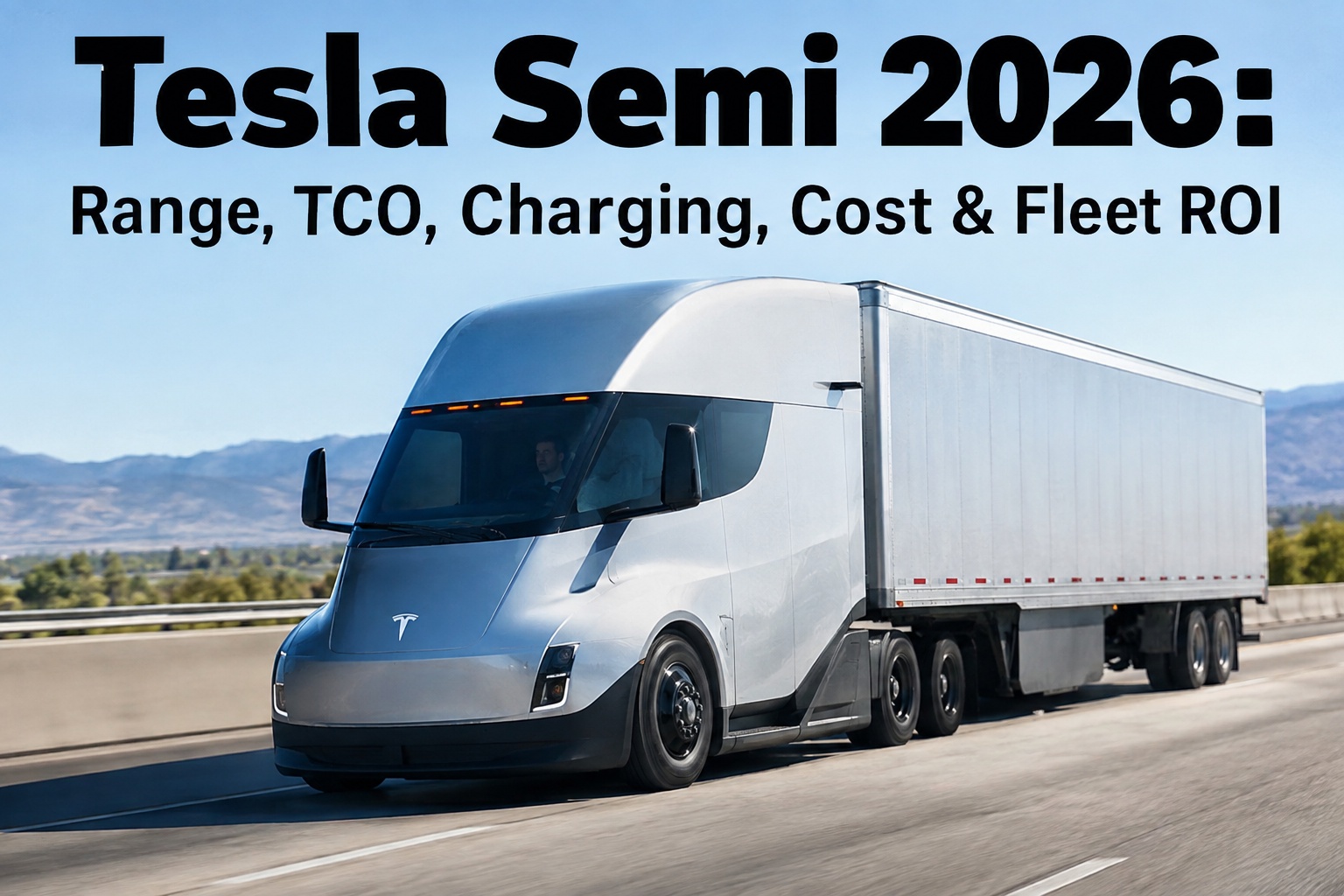
For seven years the Tesla Semi lived on stage at reveal events. On April 29, 2026 it rolled off a high-volume line in Nevada and the math stopped being theoretical. At around $290,000 for the 500-mile Long Range, a real-world 1.7 kWh/mi in fleet operation, and Megacharger sites opening on interstate corridors, the Tesla Semi 2026 conversation shifted from "will it work" to "which of my routes earn the premium" — book a demo to model Tesla Semi TCO on your fleet's real routes.
The Range Doesn't Land Where the Spec Sheet Ends
Two variants. Same 82,000 lb GCW. Completely different route economics. Here's how a real 500-mile day unfolds on each — because the "500 mi range" number means very different things depending on which trim you spec.
Full charge Arrive
~15% SOC
Full charge Megacharger
0→70% in 30 min Arrive
∼15% SOC
Same 500 miles. Long Range trades $60K–$100K of extra CapEx for zero-stop shift completion; Standard Range trades that CapEx for a charging stop that has to be routed around a real charger and a real driver break.
Everything below is the honest read on how the truck actually earns — and doesn't earn — against your existing diesel fleet. Book a 30-minute demo to see the model applied to your route data.
CARB-certified specs, translated for a fleet buyer
Tesla published enough marketing copy to fill a warehouse; what changed in 2026 is that a California Air Resources Board executive order made the production specs legally binding. These are the numbers your ROI model should use.
Long Range pack
NCMA chemistry, 4680 cells, 800 kW peak & steady motor power. Rated 500 mi at full 82K GCW — the highest single-charge range in Class 8 today.
Standard Range pack
Same NCMA chemistry, 525 kW peak & steady. Rated 325 mi. Lower CapEx entry point for regional operations that don't need the full corridor range.
Megacharger peak
MCS 3.2 connector, up to 1.2 MW. 0–70% state of charge in about 30 min — the number designed to fit inside a driver's mandated rest break.
Real-world efficiency
DHL logged 1.72 kWh/mi on a fully loaded 390-mi run. ArcBest recorded 1.55 across 4,494 mi. Mone Transport hit 1.64. Roughly 3× the energy efficiency of a diesel Class 8.
Weight matters as much as range: Tesla shaved roughly 1,000 lb off the production truck vs. the prototype (moving to 48V low-voltage architecture, optimized battery housing) and quotes ~23,000 lb curb weight. That leaves a payload envelope competitive with a diesel Cascadia on volume-limited freight and only mildly disadvantaged on weight-limited freight. On the highest-density loads (bulk liquid, paper, beverages), the payload delta still needs to be factored into per-load cost. Book a demo to see HVI overlay your route mileage against 325 mi and 500 mi range envelopes so the Standard vs Long Range decision picks itself.
The five-year TCO math on one truck
Independent analyses (Electrek, ITK Research, NACFE-observed operator data) converge on the same shape: the Tesla Semi's upfront premium over a diesel Cascadia recovers inside 3–4 years on the right duty cycle, and produces significant net savings after that. The numbers below assume 100,000 mi/yr, off-peak depot charging, current diesel around $4.50–$5.50/gal, and no incentives.
| Cost line | Diesel Class 8 | Tesla Semi Long Range | Delta over 5 yrs |
|---|---|---|---|
| Purchase price | ~$180,000 | ~$290,000 | +$110,000 |
| State incentives (where eligible) | — | CA HVIP: $84K–$351K/unit (Semi allocation ~$165M) | −$84,000 to −$351,000 |
| Fuel / energy | ~$0.67/mi @ 6 mpg & $4/gal | ~$0.31/mi @ 1.7 kWh/mi & $0.18/kWh | −$180,000 |
| Maintenance | ~$0.22/mi (ICCT diesel avg) | ~$0.14/mi (ICCT BEV avg) | −$40,000 |
| Charging infrastructure | N/A | Depot allocation, varies with fleet size | +$25,000–$50,000/truck |
| 5-year net TCO delta | Tesla Semi typically $140K–$400K lower | — | |
Independent operator data agrees on the shape: real-world Tesla Semi TCO has been reported at roughly $104,800/year in favor of the Semi over a diesel baseline in one 2026 analysis, delivering a ~3.2-year payback despite the 2.3× higher acquisition cost. Two things move this number by six figures either way: your electricity rate (depot off-peak vs public fast-charging retail) and your incentive eligibility (California-based fleets can effectively land a Long Range Semi below $200K net). Also worth naming honestly: heavy-duty EV residual values are still being established, so a conservative TCO model treats the truck as fully depreciated at end-of-life rather than assuming resale. Battery degradation is another line item worth planning for — modern lithium packs typically retain 80–90% of usable capacity through the first million miles, but that shrinking envelope needs to be factored into route assignments in years 8–10. And demand charges from the utility can meaningfully change the per-kWh delivered cost on high-power depot charging — a variable that rarely shows up in first-pass TCO spreadsheets but always shows up on the bill.
Megachargers: the network is real, the map is still filling in
The Semi's economic case relies on charging that can be scheduled — not hunted for. Tesla is building two things in parallel: private depot Megachargers for fleet customers, and public MCS sites on major freight corridors. Where each stands as of mid-2026 changes what routes are viable today versus 12 months from now.
66 public sites by early 2027
Tesla plans 66 Megacharger sites across 15 states, plus a Pilot Travel Centers partnership adding 4–8 stalls at select truck stops starting summer 2026. First public Megacharger opened in Southern California in 2026. Rollout is real but early — the map is denser in California and Texas than anywhere else.
Depot Megachargers
Larger fleets deploying dozens of Semis are installing private Megachargers at their own depots — the fastest path to reliable overnight charging without depending on public site rollout. Utility interconnect and site engineering are the long lead items; 6–12 months is typical.
30-minute rest-break math
The Megacharger's 1.2 MW peak was designed around FMCSA's 30-minute rest break every 8 hours of driving. 0–70% in about 30 minutes means an opportunity charge fits inside the mandated stop — if the site is where the driver would stop anyway. Route planning becomes the deciding factor.
Where the Tesla Semi actually fits (and doesn't)
Duty cycle decides ROI more than any spec. The 500-mile range opens routes the eCascadia and VNR Electric can't cover on a single charge, but "can cover" is not the same as "should be electrified today."
Regional line-haul, 300–500 mi single-shift
The core Tesla Semi use case. One truck, one driver, one charge, one shift — return to depot for overnight recharge. PepsiCo's Modesto–Sacramento lanes and ArcBest's California line-haul are the reference deployments.
Port drayage & heavy urban delivery
Short runs, high daily miles, heavy incentive availability (especially California), depot-based operations. Standard Range is often the right pack — you don't pay for range you'll never use.
Regional 500–700 mi with a mid-route stop
Doable if a Megacharger sits where the driver's 30-min break naturally falls. Adds route-planning complexity, but the 30-min charge fits inside the mandated rest break, so the operational hit is smaller than it looks on paper.
Team-driver long-haul on approved corridors
Where the corridor has Megacharger coverage (California↔Texas early, expanding). Charging becomes part of the trip plan. Still edge-of-viable — the network needs to keep expanding for this to be routine.
Solo long-haul off major corridors
Not because the truck can't do it — because the public MCS network isn't dense enough yet outside California, Texas, and select interstates. Revisit in 12–24 months as the 66-site network fills in.
Weight-critical heavy-haul on the payload limit
Battery pack tare weight eats into payload. On bulk liquid or dense commodity routes running right at 80,000 lb gross today, the Semi may leave payload on the table. Not disqualifying — but the per-load cost math has to include it.
The pattern in the "poor fit" rows above isn't the truck — it's the surrounding conditions (network density, payload physics). Both improve on measurable timelines, which is why fleets running mixed operations often start with the two "strong fit" categories and add capacity as their remaining lanes become viable. Book a demo to see HVI segment your existing routes by fit category so you can price out a phased Semi deployment against the specific routes that qualify today.
What real fleet data is showing
The Semi is one of the most publicly documented Class 8 trucks in history — PepsiCo, DHL Supply Chain, ArcBest, Mone Transport, and WattEV have all published operational data. A few numbers repeat across those reports and are worth committing to memory:
Rated range achieved
PepsiCo Frito-Lay fleet reports averaging 89.5% of rated range in commercial operation — roughly 447 mi of usable range on a 500 mi Long Range truck under real load and weather.
Route completion reliability
PepsiCo reports 95%+ route completion across their Semi deployment. Uptime figures published for prototype fleet operation reach 95% across 13.5M cumulative miles — strong data for a first-gen Class 8 EV.
kWh per mile in freight
ArcBest 1.55, Mone 1.64, DHL 1.72 — every published operator number sits under Tesla's 2 kWh/mi target. Cold weather, heavy grade, and full-load hauls push toward the top of that band; flat regional runs sit at the bottom.
Per-mile fuel savings vs diesel
Operators are reporting $0.50–$0.65/mi savings on fuel alone at current diesel prices. Over 500,000 mi of operation, that compounds to over $300K per truck — the delta that pays back the CapEx premium.
Two things stand out in the operator data. First, real-world numbers cluster tightly — different fleets in different geographies on different loads land within 10% of each other on kWh/mi. That's uncommon for a first-generation Class 8 truck and points to a mature powertrain rather than pilot-phase variability. Second, the fuel savings numbers repeat across every operator report at roughly the same magnitude, which is what makes the payback math defensible in front of a CFO instead of theoretical. Start a free HVI trial to log per-truck kWh/mile and route-completion reliability inside your own fleet dashboard — the same operational metrics PepsiCo publishes.
The 5-step Tesla Semi pilot playbook
Every fleet running Semis today ran a pilot first. The ones hitting their TCO targets ran a structured pilot — not "let's park two trucks in the yard and see." Here's the sequence the successful deployments have in common.
-
1Pick 2–5 trucks on validated duty cyclesMonth 0
Regional line-haul or heavy urban routes with predictable mileage. Baseline three months of diesel fuel and maintenance data on the same routes before switching. Without a clean baseline, the ROI story has no denominator.
-
2Reserve incentive allocation earlyMonth 0–1
California HVIP allocations are first-come, first-served, and applications close on specific dates each cycle. Fleets that get the paperwork in early lock in the voucher; those that wait watch the ROI window narrow.
-
3Site the Megacharger — utility conversation nowMonth 0–6
1.2 MW per stall is not a residential-scale hookup. Utility interconnect studies for depot Megachargers routinely run 6–12 months in high-demand regions. Trigger the utility conversation the same day the truck order is placed.
-
4Prep the shop, train the driversMonth 2–6
HV-certified technicians on staff before the truck arrives. Driver training covers regen behavior, one-pedal driving, and charging protocol. Tesla provides service support, but in-house capability is what keeps uptime numbers strong.
-
5Run 12 months, measure everything, then scaleMonth 6–18
Track kWh/mi by route, route completion rate, unplanned downtime, and every maintenance event with parts and labor. Compare monthly against baseline. Successful pilot — expand truck-by-truck onto matched routes. Marginal — investigate specifically what missed target before scaling.
From a fleet director who reserved units before the map filled in
We reserved four Semis in 2024 because our CFO wanted the incentive locked in before the Megacharger question was answered. Everybody thought we were early. Truth is we were on time — the utility interconnect for our depot Megacharger took 11 months, which meant the trucks arrived and the charging was ready within the same month.
First six months of real operation, our numbers matched PepsiCo's public figures almost exactly: 88% of rated range, kWh/mi around 1.7, one route-completion miss out of the first 200 runs. Fuel savings were roughly $58,000 per truck in year one alone. The number I didn't expect was maintenance — we're at about a third of what the diesel Cascadias in the same lane cost us for scheduled service. If your route is under 500 miles and depot-based, do the pilot.
Frequently asked questions
What is the real-world range of a Tesla Semi 2026?
The Tesla Semi comes in two variants confirmed by California Air Resources Board filing: a Standard Range with a 548 kWh battery rated at 325 miles, and a Long Range with an 822 kWh battery rated at 500 miles. Both operate at up to 82,000 lb gross combination weight — the maximum U.S. legal limit for freight. Real-world fleet data is consistent: PepsiCo's Frito-Lay fleet averages roughly 89.5% of rated range in commercial operation, DHL Supply Chain logged 1.72 kWh/mi on a 390-mile loaded run, ArcBest recorded 1.55 across nearly 4,500 mi, and Mone Transport clocked 1.64. Cold weather, heavy grade, and full-load conditions push consumption toward the top of that range; flat regional runs sit at the bottom. Planning routes at roughly 85–90% of nameplate range leaves a realistic safety margin for weather, traffic detours, and slow battery degradation over the vehicle's life. The 500-mile Long Range covers a full single-driver shift on the vast majority of regional lanes with no mid-route charging required.
How much does a Tesla Semi cost in 2026?
Tesla quoted approximately $290,000 for the 500-mile Long Range variant at the start of high-volume production in 2026, with the Standard Range priced lower. That puts the Semi at roughly $110,000 above a comparable diesel Class 8 tractor (about $180,000 new) — a smaller premium than the eCascadia or VNR Electric, which sit above $300,000. In California, HVIP vouchers for the Tesla Semi have been reported in the $84,000–$351,000 range per qualifying unit, with California setting aside approximately $165 million for Semi allocations — roughly double the next-largest recipient. A fleet qualifying for the mid-tier voucher can land an effective out-of-pocket cost below $200,000 per truck. Federal Commercial Clean Vehicle Credit (IRA 45W) adds up to $40,000 per qualifying vehicle over 14,000 lb, stackable in most cases. Pricing and voucher terms change annually — confirm current figures with Tesla and a tax advisor before finalizing purchase decisions.
How long does it take to charge a Tesla Semi?
The Tesla Semi charges via the MCS (Megawatt Charging System) 3.2 connector at up to 1.2 MW on Tesla's Megacharger network. At peak power, the Semi can recover roughly 70% of its charge in about 30 minutes — a target Tesla specifically designed to fit inside the FMCSA-mandated 30-minute rest break drivers must take every 8 hours of driving. That means an opportunity charge doesn't have to add trip time if a Megacharger sits where the driver would already be stopping. Full charging to 100% takes longer than 0–70% because the charge rate tapers in the constant-voltage phase near the top of the pack to protect battery cells. Standard depot charging at lower power (typically 350 kW or below) fills the pack overnight, which is the standard operating pattern for return-to-base fleets. Tesla's Megacharger network is expanding to 66 sites across 15 states, with a Pilot Travel Centers partnership adding stalls at select truck stops starting summer 2026.
Is the Tesla Semi cheaper to operate than a diesel truck?
On the right duty cycle, yes — and the operating cost advantage is substantial. Independent analyses converge on the same numbers: energy cost at $0.18/kWh depot charging and 1.7 kWh/mi works out to roughly $0.31/mi, compared to a diesel at 6 mpg and $4/gal running $0.67/mi — an energy saving of about $0.36/mi. Over 200,000 mi/yr, that's roughly $72,000/yr per truck in fuel alone. Maintenance cost per mile is roughly 35% lower on BEV Class 8 vs diesel per ICCT data, adding another $8,000–$15,000/yr per truck. Real-world fleet reporting has put the total operating cost advantage at roughly $104,800/yr per truck in some analyses, delivering payback on the ~$110K CapEx premium in about 3.2 years despite the higher acquisition price. The numbers move with your electricity rate (public fast-charging retail vs depot off-peak matters more than the sticker) and with local diesel prices, but the operating cost gap holds across almost every scenario except extremely low diesel prices or extremely high electricity rates.
What duty cycles does the Tesla Semi work best on?
Regional line-haul routes in the 300–500 mile range are the strongest single-charge fit for the Long Range variant — one truck, one driver, one charge, one shift, back to depot for overnight recharge. Port drayage and heavy urban delivery are equally strong fits for the Standard Range variant, particularly in California where HVIP incentive availability is heaviest. Routes in the 500–700 mile range work if a Megacharger site aligns with the driver's mandated 30-min rest break — the 0–70% charge fits inside the break with no added trip time. Team-driver long-haul on approved corridors (California, Texas, select interstates) is workable today and improving as the 66-site public Megacharger network fills in through 2027. The current poor fits are solo long-haul off major corridors (where public MCS density is still limited) and weight-critical heavy-haul running right at the 80,000 lb GCW limit on dense commodities (where battery tare weight cuts into payload). Both improve over time — the first as infrastructure expands, the second as battery energy density gains.
Turn the Tesla Semi decision into a defensible plan
HVI ingests your fleet's real route data, applies local energy and diesel rates, layers on state and federal incentives, and produces per-asset Standard-vs-Long-Range TCO and payback for a Tesla Semi deployment — before you commit. What used to take a spreadsheet week turns into a plan you can hand to the CFO. Live in under two weeks. No hardware. No credit card.
Trusted by fleets across North America · Ready on day one