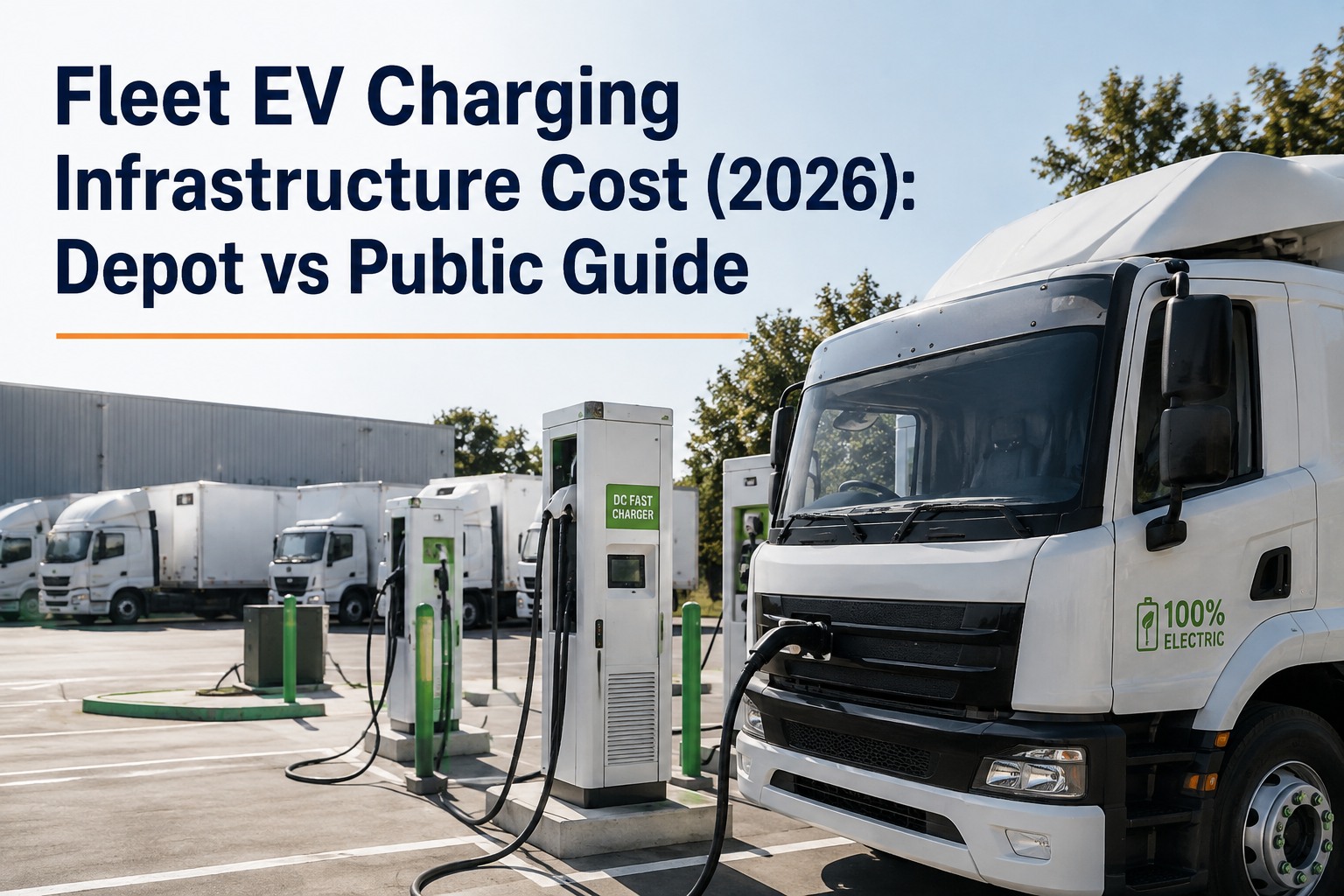
Every fleet electrification plan runs into the same crossroads: build the depot chargers, or pay to use somebody else's. The gap between the two paths isn't a marketing preference — it's a 2–3x difference in cost per kilowatt-hour, an 18-month utility timeline you can't wish away, and a demand-charge line item most operators don't see coming. This is the fleet EV charging infrastructure decision, laid out in the numbers that actually drive it in 2026. Book a demo
Cost per kWh — the number the whole decision hinges on
Depot charging is cheaper per mile. Public is cheaper to start. The math depends on how many miles and how long you plan to run them.
A truck running 40,000 miles a year burns roughly 12,000 kWh. Charging that unit on public DCFC at $0.50/kWh costs $6,000/year. Charging it on depot L2 at $0.15/kWh costs $1,800. The gap is $4,200 per truck, per year — and it compounds every year the fleet is on the road. That's the number the entire depot-vs-public capital decision revolves around.
The true cost stack — what a depot deployment actually costs
Every fleet EV charging infrastructure quote starts with hardware — and hardware is the smallest line on the bill. The real capital sits in electrical service, trenching, panel upgrades, and the utility interconnect. Here's what a 20-vehicle depot L2 build actually stacks up to, before and after incentives.
Two things about this stack matter more than the totals. First: hardware is 20–25% of the bill. The other 75% is electrical work, and it's what most first-pass quotes underestimate. Second: incentives are enormous but require paperwork discipline. Utility make-ready programs, the 30C infrastructure credit (30% up to $100K, subject to current 2026 IRS guidance), state programs like California HVIP (up to $60,000/truck), and NEVI corridor funding can stack to 50–70% of net cost off — but each has its own filing window and eligibility rules. Book a demo to see per-site cost stacks modelled by state and utility
The 3-question decision framework — depot, public, or hybrid?
Fleets that get charging strategy right don't pick a single answer — they pick the answer that fits their duty cycle. These three questions, in order, sort almost every fleet into the right lane.
Predictable overnight or long-dwell parking at a single location is the single strongest signal for depot L2 charging. If yes, depot L2 pays back quickly and produces the lowest cost per mile. If no — distributed drivers, multi-shift ops, no dedicated yard — skip to Q2.
High-utilization vehicles (delivery in tight windows, rideshare, airport ground support, multi-shift heavy equipment) can't afford to sit for 8 hours plugged in. Depot DCFC or a mix of L2 + DCFC becomes necessary — but demand charges go up sharply. Load management software becomes essential, not optional.
For small or pilot fleets, the capital cost of depot infrastructure (utility interconnect alone runs 12–18 months) can outrun the fuel savings for the first two years. Public charging on preferred-rate fleet accounts often makes more sense until scale justifies the depot build.
Most mid-to-large fleets end up hybrid: depot L2 as the primary strategy for the vehicles that come home each night, DCFC at the depot for the high-utilization units, and a public-charging fleet account as a safety net for range-extended days. The mix isn't a compromise — it's the optimum for a fleet that doesn't have a single duty cycle. Book a demo to model your fleet's optimal charger mix by duty cycle
The 18-month utility timeline — the constraint most plans miss
Charging hardware ships in weeks. Utility service upgrades don't. This is the single most-underestimated part of every fleet electrification plan — and it's the reason phasing your deployment matters more than sizing it perfectly on day one.
-
Month 0–2Load calculation & site assessment
Fleet duty cycle analysis, kWh demand modelling, charger mix and count sized to actual shift patterns — not vehicle count times charger rating.
-
Month 2–4Utility application submitted
Interconnect request filed with your utility. Larger loads (500 kW+) trigger transformer and substation studies. Timelines compound from here.
-
Month 4–10Utility engineering & make-ready
Utility completes engineering studies, confirms available capacity, and (in many territories) delivers make-ready work — trenching, transformer install, service extension to the property line.
-
Month 8–14Site construction & charger install
Conduit runs, panel upgrades, charger mounting, network commissioning, load management software configured. Overlaps with utility make-ready.
-
Month 14–18Energization, commissioning, first vehicles
Utility energizes service, chargers tested at full load, operational cutover. First EVs plug in. Demand-management policy live from day one.
The takeaway isn't "12–18 months is a long time." It's that the utility timeline runs in parallel with everything else, and it's the pacing constraint. Fleets that miss this build hardware they can't turn on, or take delivery of trucks they can't charge. The fix is starting utility engagement 12–18 months before your first EV arrives — not after. Book a demo to see the utility timeline mapped against your procurement plan
The demand-charge trap — what breaks the DCFC economics
Every fleet operator learns about demand charges the same way: the first electric bill after DCFC goes live is 40–60% higher than the kWh math predicted. Utilities bill both energy consumed (kWh) and peak demand (kW) — typically the highest 15-minute draw of the month, at $10–$25 per kW.
The economics fix here isn't better equipment — it's better software. Load management platforms that stagger charging sessions across the shift, throttle draw during utility peak windows, and prioritize by departure time can cut demand charges by 30–50%. On a DCFC-heavy depot, that's the difference between $0.20/kWh all-in and $0.35/kWh all-in — the difference between depot economics that beat public and depot economics that don't. Start free and get per-charger utilization & demand tracking on day one
From a Fleet Director who built out 45 depot chargers in Southern California
We scoped the project as an 8-month build. Chargers, trenching, panel — done. What we didn't scope was the 14-month utility interconnect, and it made every subsequent decision harder. We had trucks arriving on schedule with nowhere to plug them in for the last four months. Some of them ran on public DCFC at 60 cents a kilowatt-hour just to stay in service.
The bigger surprise was the first bill after we energized. Demand charges were 45% of the total — nobody warned us. We added load-management software in month two of operation and pulled the demand charge line down by 38% inside a quarter. The lesson wasn't about hardware. It was about running the operations layer from day one, not adding it after the surprise.
Frequently asked questions
How much does fleet EV charging infrastructure cost in 2026?
Costs vary widely by charger type, site conditions, and utility service capacity. For a 20-vehicle Level 2 depot deployment (the most common starting configuration), realistic all-in gross cost is $125,000 to $445,000 before incentives. That breaks down roughly as charger hardware $60,000–$140,000 (about 20–25% of the bill), installation labor and trenching $40,000–$180,000, panel and electrical service upgrade $5,000–$25,000, conduit runs at $50–$150 per linear foot, and utility interconnect and permits $5,000–$40,000. DC fast charger deployments run substantially higher — $40,000–$150,000+ per unit installed, with electrical service being the dominant cost driver rather than hardware. After stacking incentives (utility make-ready programs, the 30C infrastructure credit at 30% up to $100,000 subject to current IRS guidance, state programs like California HVIP up to $60,000/truck, and NEVI corridor funding where applicable), net capital cost commonly falls to $40,000–$180,000 for the same 20-vehicle L2 build — a reduction of roughly 50–70% versus gross. Hardware is the smallest line on the bill; the majority is electrical work, and it's what most first-pass quotes underestimate.
Is depot charging or public charging cheaper for fleets?
Depot charging is dramatically cheaper on a per-kilowatt-hour basis — typically 2 to 3 times lower than public charging. Depot Level 2 charging at off-peak utility rates costs $0.12–$0.18 per kWh all-in. Depot DC fast charging costs $0.20–$0.35 per kWh once demand charges are included (and can rise sharply without managed-charging software). Public Level 2 charging typically costs $0.25–$0.60 per kWh, and public DC fast charging costs $0.35–$0.80 per kWh. On a truck running 40,000 miles a year and consuming roughly 12,000 kWh, that translates to $1,800 per year on depot L2 versus $6,000 per year on public DCFC — a $4,200 per-truck, per-year gap that compounds every year of fleet operation. The catch is capital cost and lead time. Depot infrastructure requires significant upfront investment ($40,000–$180,000 net for a 20-vehicle L2 build after incentives) and a 12–18 month utility interconnect timeline. For fleets under 10 vehicles, in a pilot phase, or without a single home yard, public charging on a preferred-rate fleet account is often the right starting point until scale justifies the depot build. Most mid-to-large fleets end up hybrid: depot L2 primary, some depot DCFC for high-utilization units, and public charging as a range-extending safety net.
What are demand charges and why do they matter for DC fast charging?
Demand charges are the second half of the utility bill most fleet operators don't see coming. Commercial utilities bill both energy consumed (kWh) and peak demand (kW) — typically the highest 15-minute average power draw during the billing month, at rates commonly $10–$25 per kW per month. On a DC fast charging depot where several 150–350 kW chargers can hit simultaneously during shift changes, the peak-demand spike can add $3,500–$8,750 to a monthly bill that was budgeted based on kWh alone. On fleets running heavy DCFC utilization, demand charges commonly represent 30–50% of the total electricity bill — enough to close (or eliminate) the cost advantage of depot charging versus public. The fix is load management software that staggers charging sessions across dwell windows, throttles simultaneous draw during utility peak-rate periods, and prioritizes charger allocation by vehicle departure time. Managed charging typically reduces demand charge exposure by 30–50%. The economics fix isn't better chargers — it's better software running on top of them. This is why the operations layer (charge management, per-vehicle kWh tracking, per-charger utilization analytics) matters as much as the hardware selection for fleet EV charging infrastructure economics.
How long does depot charging deployment take from decision to energized?
Realistic timeline from initial site assessment to first vehicle plugged in is 12–18 months for most commercial depot deployments. The pacing constraint is the utility interconnect process, not construction. Typical phases: Months 0–2 for load calculation and site assessment; Months 2–4 to file the utility interconnect application; Months 4–10 for utility engineering studies, transformer and substation reviews, and (in many territories) utility-delivered make-ready work bringing service to the property line; Months 8–14 for on-site construction, conduit runs, panel upgrades, charger installation and network commissioning (which overlaps with utility make-ready work); Months 14–18 for energization, load testing, operational commissioning and first-vehicle plug-in. Fleets that miss the utility timeline commonly find themselves taking delivery of electric trucks with nowhere to charge them, or building hardware that can't be turned on. The lesson is universal: start utility engagement 12–18 months before your first EV arrives, run the utility workstream in parallel with vehicle procurement, and phase your deployment so early-arriving vehicles can charge on whatever's ready first — even if that means temporarily using public charging until the depot energizes. Larger loads (500 kW+) can trigger transformer upgrades, substation studies or line-extension work that push the timeline beyond 18 months.
How does HVI support fleet EV charging management?
HVI runs the operations layer on top of your charging infrastructure — the visibility, tracking and analytics that determine whether the capital investment actually delivers the cost savings on paper. On the visibility side, HVI tracks per-vehicle kWh consumption, per-session charge time and completion, per-charger utilization across the fleet, and demand-charge exposure by time of day and site. On the operations side, HVI handles facility inspections for chargers as physical assets (cabling condition, connector wear, ground faults, network health) on the same schedule and platform as vehicle PMs and DVIRs, so charger maintenance doesn't become a separate binder-based process. On the cost side, HVI's cost tracking assigns per-kWh spend, demand-charge allocation and incentive credits per vehicle and per site, so the true per-mile electricity cost is visible per unit rather than buried in a facilities-wide utility bill. On the reporting side, per-vehicle emissions calculations for Scope 1 (owned diesel units), Scope 2 (grid electricity for EVs) and combined fleet CO₂e reporting run automatically from the same underlying data. Fleets on HVI report ~25% lower annual maintenance cost and typical payback around 3 months — and the EV charging management module extends that operational discipline into the electrification stack rather than treating chargers as a separate silo.
The capital is the hardware. The savings are in the operations layer.
HVI turns per-vehicle kWh, per-charger utilization, demand-charge exposure and charger inspection status into one operational view — on the same platform running your maintenance, DVIRs and PMs. Live in under two weeks. Typical fleet payback around 3 months.
No credit card · No hardware · Charging dashboard ready on day one