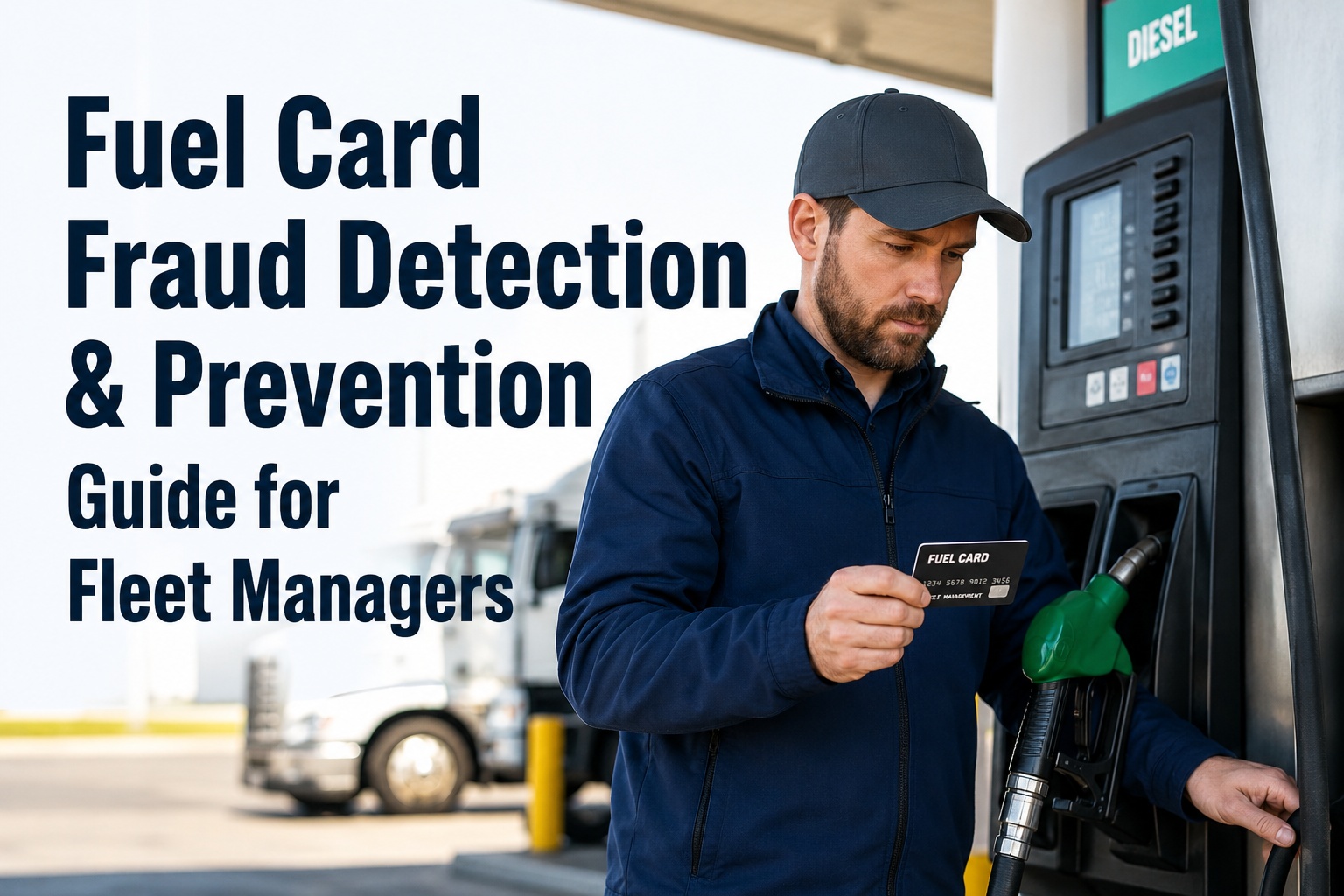
Fuel card fraud detection is one of the highest-value fleet management activities in 2026 — and one of the hardest, because fraudulent transactions look legitimate on their face. A card charged at an approved station, at a reasonable dollar amount, during business hours will pass every basic control. But if the truck was 40 miles away at that timestamp, or if the driver's spouse is filling their personal pickup at 8pm on a Sunday, the transaction is fraud. Effective detection requires closed-loop verification — matching every transaction against GPS location, odometer reading, tank capacity, and route data in real time. This fuel card fraud detection guide walks the six most common fraud schemes fleet managers face, the four detection methods that catch them, the card control stack that prevents them, and the response protocol when you spot one. Industry estimates put fuel card fraud losses at 5–10% of a typical commercial fleet's annual fuel budget. Book a demo after you see how integrated fuel card monitoring surfaces fraud the day it happens.
6 Most Common Fuel Card Fraud Schemes
Fuel card fraud isn't one behavior — it's a stack of six recurring patterns with six different fixes. Below is the taxonomy every fleet manager needs to recognize before building a detection strategy.
Personal vehicle fills
Driver uses fleet card to fuel personal car, truck, or lawnmower. Classic Sunday afternoon or weekend pattern. Highest single source of internal fuel card fraud.
Card + PIN sharing
Driver hands card and PIN to spouse, relative, or friend. Card gets used at driver's home area during off-hours. Undetectable without GPS verification.
Split-transaction fraud
One legitimate fill into truck plus one personal container fill at same pump on one transaction. Card charged 40 gallons but truck tank rose only 32.
Skimming device fraud
Physical skimmer at gas pump captures card data + PIN entry. U.S. Secret Service finds ~30 skimmers weekly at US gas stations, each capable of holding data for up to 80 cards.
Off-network purchases
Purchases at unauthorized stations, often at higher price than network rate. Sometimes indicates a kickback arrangement between driver and local station operator.
Odometer inflation
Driver enters false odometer reading at pump, or inflates mileage reimbursement claim. Mileage-based reimbursement is the systemic vulnerability — small inflations across many transactions.
The six schemes above are what fleet managers actually face. Below is what to do about them — the four detection methods that surface fraud in real time, the card control stack that prevents it, and the response protocol when you spot an incident.
4 detection methods that catch fuel card fraud in real time
Traditional monthly reconciliation catches fraud four to six weeks after it happened — by which time the pattern has repeated, evidence is gone, and recovery is impossible. Real-time detection requires four methods working together.
GPS location verification
Every fuel card transaction is compared against the vehicle's GPS location and timestamp. Transaction 40+ miles from truck position = automatic fraud alert. Catches personal vehicle fills, card sharing, and off-network purchases instantly.
Exception pattern reports
Automated pattern detection flags unusual transactions: off-hours purchases, small multiple transactions from one card, purchases just under transaction limits, unusual station patterns. Catches repeated fraud that any single transaction alone wouldn't reveal.
Real-time transaction alerts
Instant push notification to fleet manager on flagged transactions. Fraud caught minutes after the event, not weeks later at reconciliation. Enables card freeze while investigation begins.
Volume reconciliation
Card gallons purchased compared against tank fill sensor reading. Card charged 40 gallons but tank rose only 32? Split-transaction fraud caught automatically. Requires in-tank fuel sensors integrated with the card platform.
All four methods together surface every scheme in the hero taxonomy. Any one alone leaves gaps. The best-performing fraud detection systems in 2026 run all four in parallel and correlate the results automatically. Book a demo to see all 4 detection methods in one dashboard
The fuel card control stack — 6 preventive controls
Detection catches fraud that already happened. Prevention stops it at the pump. The six controls below don't require expensive hardware — they require policy discipline and card program configuration.
Unique PINs per driver
One card, one driver, one PIN. Never shared. Shared PINs eliminate accountability and destroy the audit trail every response protocol depends on.
Odometer entry at every transaction
Driver enters current odometer at pump. Odometer + GPS + timestamp gives three-factor verification. False odometer entry flags the transaction at the pump, not at reconciliation.
Station network whitelisting
Whitelist approved stations by ZIP code, network, or brand. Off-network purchases blocked at the pump — not caught weeks later. Fleet card networks (WEX, FleetCor, others) all support geographic and merchant restrictions.
Per-transaction gallon and dollar limits
Class 8 tractor never needs 250 gallons in one transaction. Cap at tank capacity + 5%. Passenger vehicles rarely need more than 25 gallons — suspicious card charges above that limit get blocked at pump.
Time-of-day + day-of-week restrictions
Long-haul cards active 24/7; local delivery cards restricted to shift hours. Sunday 8pm fill at a station 20 miles from driver's home is a fraud signal — block it at the pump instead of investigating it later.
Chip-and-PIN (EMV) card technology
Modern fleet cards use EMV chip technology that's dramatically harder to skim than magstripe. If your fleet's cards are still magstripe-only, skimming exposure is higher than it needs to be. Upgrade is typically free through the card issuer.
The control stack above deploys in a single week at zero capex. Combined with the four detection methods, it eliminates the majority of card fraud opportunity before it starts. Start free and configure card controls this week
The 4-stage fuel card fraud response protocol
The moment a fraud alert fires, four things need to happen in order. Skipping a stage risks destroying evidence, tipping off the perpetrator, or exposing the fleet to wrongful-termination liability if the investigation is mishandled.
Detect
Verify
Investigate
Act
Every card fraud incident handled correctly teaches the fleet something and closes a specific gap. Every incident handled poorly leaks intelligence to other bad actors and creates legal exposure. About 71% of fleets have terminated an employee for fuel card misuse at some point — getting the response protocol right is what determines whether that termination sticks. Book a demo to see the response protocol built in
5 mistakes fleet managers make with fuel card fraud
Every fleet that underperforms on fuel card fraud detection can trace the gap to one of five recurring mistakes. All five are preventable with the detection + control stack in this guide.
Relying on monthly reconciliation to catch fraud
Fleet reviews fuel card statements at month-end, spots anomalies, investigates them 4–6 weeks after the transaction. By then camera footage is gone, station memory is cold, and the fraud pattern has repeated multiple times.
Shared PINs and cards among drivers
Fleet issues one card per truck with a shared PIN among the drivers who rotate through that vehicle. When fraud is detected, there's no way to attribute the transaction to a specific driver. Every response falls apart at the "who did this" question.
No GPS verification of transactions
Fleet has fuel card platform + GPS platform but never integrated them. Card charged $180 at a station 40 miles from the truck's GPS position? Nobody notices until the driver's spouse's Facebook post accidentally reveals the connection.
Ignoring small anomalies because they seem trivial
Manager notices a $12 fuel card charge at 6:30am on Saturday. Doesn't chase it — too small to bother. Turns out it's the driver's teenage kid's first day with the card. Over six months the pattern grows to $2,400 in personal fuel with no red flag ever raised because the individual transactions stayed small.
No formal response protocol — fraud handled ad hoc
Manager spots fraud, immediately terminates the driver without documented investigation. Driver files wrongful-termination lawsuit. Fleet loses because the evidence chain wasn't preserved and HR wasn't involved. Legal cost exceeds the original fraud amount.
Every mistake above compounds silently until quarterly review reveals a bigger problem than anyone realized. Get the detection + control + response stack in place before the first incident, not after. Book a demo to see integrated fuel card workflow — or start free and configure card controls this week .
From a fleet controller after year one of GPS-verified card monitoring
We ran the numbers on our first full year of GPS-verified card monitoring. Baseline fuel card spend before integration was $2.1 million across 68 trucks. After twelve months of closed-loop verification, we recovered $94,000 — roughly 4.5% of the annual card spend.
Three drivers terminated for personal-vehicle fills. One card was compromised at a skimmer at a truck stop and we caught it inside four hours. Two drivers were quietly coached back into compliance without termination. And the deterrent effect on the rest of the fleet is real — nobody wants to be the next name on the exception report.
Frequently asked questions
What is fuel card fraud?
Fuel card fraud is the unauthorized use of a company-issued fuel card to obtain fuel or fuel-related products for personal benefit, or the deliberate manipulation of card transactions to conceal misuse. It ranges from an employee filling their personal vehicle with the company card (the most common internal scheme) to external skimming devices installed on gas pumps that capture card + PIN data. In 2026 the most common fuel card fraud patterns include personal vehicle fills, card + PIN sharing with a spouse or friend, split-transaction fraud (splitting one legitimate fill with a personal container at the same pump), off-network purchases at unauthorized stations, odometer inflation, and external skimming device fraud. Industry estimates put fuel card fraud losses at 5–10% of a typical commercial fleet's annual fuel budget — a scale that puts it on par with tire theft or fuel siphoning as a major loss category. About 71% of fleets have terminated an employee for fuel card misuse at some point.
How can I detect fuel card fraud in my fleet?
Effective fuel card fraud detection in 2026 requires four methods running in parallel. First, GPS location verification — every card transaction matched against the vehicle's GPS position and timestamp; transactions more than 40 miles from the truck's location automatically flag as suspicious. Second, exception pattern reports — automated pattern detection catches multi-transaction fraud that any single transaction wouldn't reveal (off-hours purchases, small repeated transactions, unusual station patterns). Third, real-time transaction alerts — instant push notifications to the fleet manager on flagged transactions, enabling card freeze within minutes rather than reconciliation catching fraud four to six weeks later. Fourth, volume reconciliation — card gallons purchased compared against in-tank fuel sensor readings to catch split-transaction fraud. All four methods together surface every major scheme; any one alone leaves gaps.
What's the most common type of fuel card fraud?
Employee use of the fleet card to fuel a personal vehicle is the single most common fuel card fraud pattern in commercial fleets. It typically presents as a Sunday afternoon or weekend fill at a station near the driver's home, or a mid-week off-hours fill when the driver's spouse or family member uses a shared card and PIN. The individual transaction is often small enough (10–25 gallons) to hide in monthly reconciliation, but repeated across weeks and months it becomes a five- or six-figure annual loss on a mid-sized fleet. Related patterns include split-transaction fraud (filling a personal container alongside the legitimate truck fill on the same pump transaction), card + PIN sharing, and inflated odometer entries. All are caught by GPS location verification combined with exception pattern reports. External skimming device fraud — where a criminal installs a skimmer on a pump to capture card + PIN data — is also increasingly common but represents a smaller share of total fleet card fraud loss than internal misuse.
How much money does fuel card fraud cost a fleet?
Industry estimates place fuel card fraud losses at 5–10% of a typical fleet's annual fuel budget. For a 50-truck fleet spending $500,000/year on diesel, that's $25,000–$50,000 in annual card fraud losses hiding across dozens of small transactions. Fleet card fraud averages about 5 gallons per vehicle per month according to industry data — small enough to hide in monthly reconciliation, large enough to add up across a fleet. Beyond direct fuel loss, the cost includes management time investigating incidents, legal exposure from mishandled terminations, insurance premium impact, and cultural erosion when fraud goes unaddressed. Real-time telematics-integrated fuel card monitoring typically surfaces $8,000–$22,000 in previously undetected losses within the first seven days of deployment. Payback on integrated monitoring is typically 60–90 days for any fleet with more than 20 vehicles.
What should I do if I discover fuel card fraud?
Follow the 4-stage response protocol: Detect → Verify → Investigate → Act. First, auto-capture transaction detail, GPS log, and camera footage immediately when the alert fires. Within 24 hours, rule out software error or legitimate exception, and freeze the card if fraud is likely (issue a backup card so the driver can continue working during investigation). Over the following week, cross-reference driver, transaction, GPS, odometer, and 30-day baseline data; interview the driver with documented evidence in hand and HR present. Finally, act based on findings: coaching + policy reinforcement for first-time minor incidents; termination + law enforcement referral for confirmed criminal fraud. Never skip stages — especially never terminate before investigation, because wrongful termination lawsuits typically cost more than the original fraud amount, and evidence chain integrity is what makes the termination legally defensible.
Turn every fuel card transaction into a monitored, verified event
HVI matches every fuel card transaction against GPS location and odometer in real time, flags exception patterns automatically, enforces card control policy at the pump, and generates the audit trail that protects your termination decisions when fraud is confirmed. Live in under two weeks — and typical fleets identify $8,000–$22,000 in existing losses in the first seven days.
No credit card · No hardware · Card monitoring dashboard ready day one