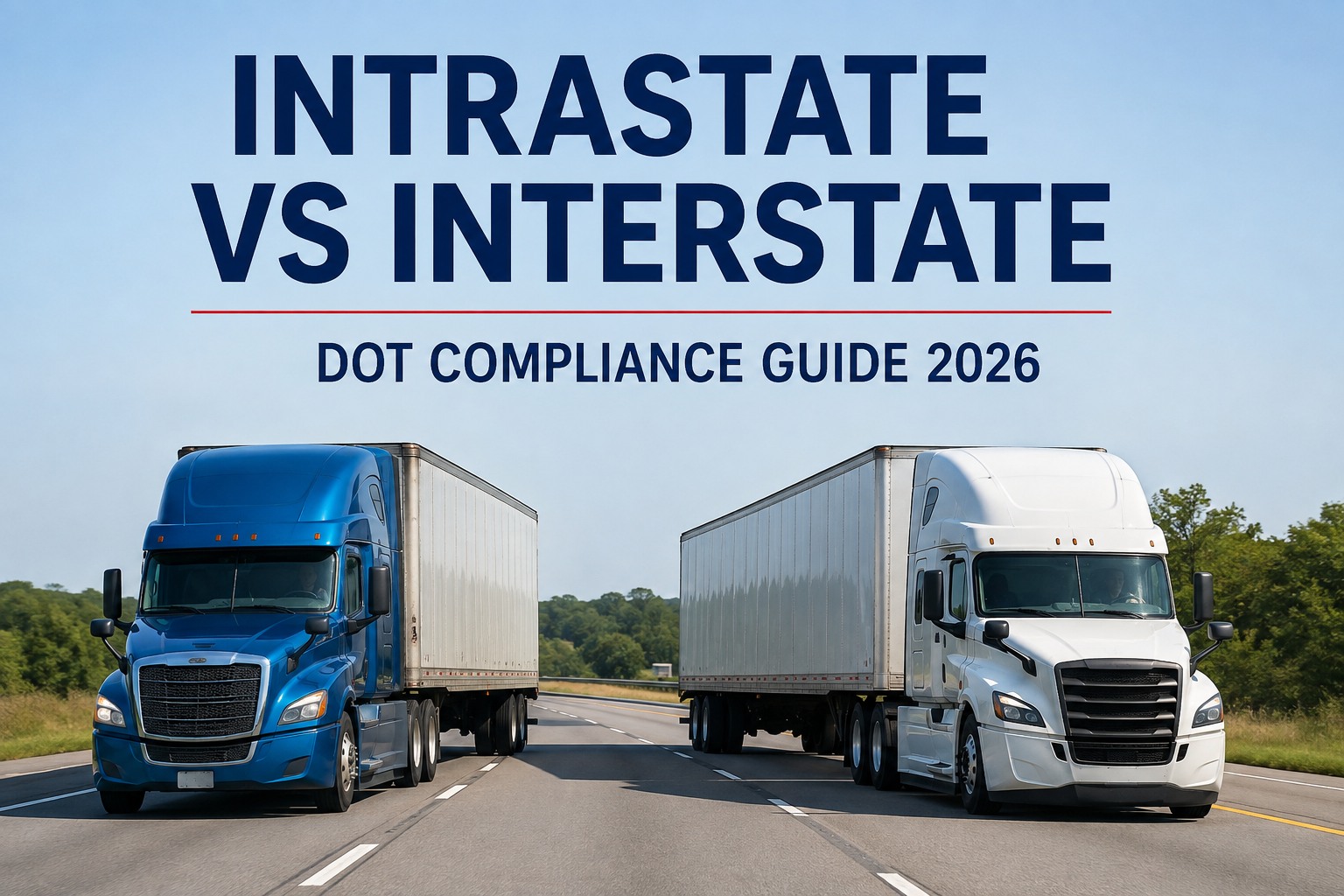
A fleet manager who thinks their carrier is intrastate because the trucks only cross town is often wrong — and finding out at a roadside inspection costs $11,000 per violation. The intrastate vs interstate DOT compliance question isn't answered by geography. It's answered by the freight, the origin, the destination, and whether the load is part of interstate commerce chain regardless of who's driving the last leg. A shipment that originates in Texas but was dispatched from a Florida distributor for delivery inside Texas is still interstate. The truck never leaves the state, and the FMCSA still has jurisdiction. This guide walks the distinction, the numbers you need, and the checklist for staying on the right side of the rule. Book a demo
Intrastate vs interstate — two sets of rules, one honest question
"Where does the freight actually originate and where is it going?" Answer that correctly and everything else follows.
The real cost of getting this wrong isn't the paperwork — it's the enforcement. A carrier operating in interstate commerce without proper federal authority can be fined up to $11,000 per violation under 49 USC §14901, plus placed out of service at the roadside, plus subject to CSA-scoring damage that affects insurance renewals for years. And the classification is not up to the carrier — it's determined by the FMCSA based on how the freight actually moves. That's why the questions in this guide matter more than the definitions.
The three numbers that decide what you can legally do
Trucking regulation runs on identifiers. Every fleet has to understand which numbers it needs, what they authorize, and which regulator issues them. Three numbers cover almost every scenario — and mixing them up is where new carriers most commonly get into compliance trouble.
The pattern is worth internalizing. A USDOT number is the ID card. Authority (MC federally, state intrastate authority at the state level) is the license to operate. You can have a USDOT number and still be operating illegally if you don't have the authority for the commerce type you're running. The two together are what make a carrier legitimate for the specific operation. Book a demo to see fleet compliance mapped against your specific operation type
The interstate commerce trap — when "in-state" still counts as interstate
This is where fleets most commonly slip up. Interstate commerce isn't defined by where your truck drives — it's defined by where the freight is moving. The FMCSA has jurisdiction over interstate commerce regardless of which vehicle carries which leg of the journey. Here are four common scenarios where a carrier that thinks it's intrastate is actually interstate.
Freight origin outside the state
A shipment originates in Georgia, arrives at a Florida distribution center by rail, and you deliver from the Florida DC to a Florida store. The freight is still in interstate commerce — your leg is part of the interstate movement.
Freight destined outside the state
You pick up product from a Kentucky manufacturer and deliver to a Kentucky warehouse for consolidation, where it will be shipped by another carrier to Ohio the following day. Your leg is interstate because the freight is destined out of state.
Cross-border commercial zone service
Federally designated commercial zones (like the Virginia/Maryland/DC area) have specific exemptions from interstate authority rules. Operating strictly within the commercial zone may qualify for exemption; crossing outside triggers full interstate requirements.
Interstate hazmat transport
Hauling hazmat that requires placarding in interstate commerce triggers USDOT number requirement even for intrastate hazmat operations in most states. Hazmat rules are stricter across the board and often override the intrastate/interstate distinction.
The pattern across all four: the freight movement determines the jurisdiction, not the vehicle movement. If in doubt, the safe assumption is that the operation is interstate — and the compliance overhead of running with interstate authority is much smaller than the fine for running without it when it turns out you needed it.
Federal vs state requirements — the practical comparison
Once you know whether you're operating intrastate or interstate, the requirements diverge across every operational domain. Here's the side-by-side comparison across the areas fleets most need to get right.
| Requirement | Intrastate | Interstate | Fleet action |
|---|---|---|---|
| USDOT number | Required by most states (thresholds vary) | Required for CMVs 10,001+ lbs GVWR | Register via URS; free application |
| Operating authority | State intrastate authority (~26 states) | Federal MC number (for-hire); $300 | Match authority to actual operation type |
| Liability insurance | State minimums (vary) | $750K federal minimum; $1M in practice | File BMC-91 with FMCSA; MCS-90 endorsement |
| Hours of service | State rules (often mirror federal but with exemptions) | Federal HOS (49 CFR §395) | Interstate ELDs required for most CMVs |
| CDL | Intrastate CDL allowed at age 18+; may vary | Federal interstate CDL at age 21+ (some 18–20 exceptions) | Verify driver eligibility for operation type |
| Drug & alcohol testing | State-mandated (usually mirrors federal) | Federal pre-employment, random, post-accident, reasonable suspicion (49 CFR §382) | Enroll in DOT random testing pool |
| DVIR | State rules (often mirror federal) | Federal DVIR (49 CFR §396.11); eDVIR authorized | Digital DVIR with photo evidence |
| Vehicle inspections | State annual inspection programs | Annual periodic inspection required | Track compliance calendar per unit |
| MCS-150 update | Follow state re-registration schedule | Biennial update required | Calendar reminders on next update due |
Two lines worth calling out. First: intrastate rules often "mirror federal" but with meaningful exemptions and different thresholds — never assume the state rule is identical to the federal rule without verifying. Second: HOS and CDL differences are where compliance most commonly slips when a fleet transitions from intrastate to interstate operations. Both catch drivers who were previously legal but suddenly aren't.
When intrastate carriers become interstate — the transition checklist
Growth is when this classification usually changes. A carrier that's operated intrastate for years takes its first cross-border load, or picks up a shipping contract with a distributor whose freight crosses state lines. The transition to interstate compliance isn't automatic — and running interstate without proper authority is a fast route to fines and CSA damage.
Apply for federal MC operating authority
File through FMCSA URS. $300 per authority type. Processing takes 20–25 business days. Don't run interstate before AUTHORIZED FOR HIRE status.
Increase liability insurance to federal minimum
$750,000 minimum per 49 CFR §387.9; $1M in practice. Insurer files BMC-91 to FMCSA; MCS-90 endorsement added to policy. Due within 20 days of FMCSA notice.
File BOC-3 process agent designation
Required under 49 CFR §366. Designates a process agent in each state where you'll operate. Filing companies typically bundle this into the authority application.
Enroll in federal DOT drug & alcohol testing pool
49 CFR §382. Pre-employment testing, random testing (50% drug, 10% alcohol), post-accident, reasonable suspicion, return-to-duty, follow-up. Clearinghouse queries per driver.
Verify driver CDL eligibility for interstate
Interstate CDL requires age 21+ generally; some 18–20 exceptions exist. Intrastate CDL drivers may need medical certification, endorsements, and Clearinghouse checks updated for interstate operation.
Deploy federal HOS & ELD compliance
Federal HOS (49 CFR §395) applies. ELDs required for most CMVs unless a specific exemption applies. Records retained per federal rules (6 months minimum).
Update DVIR & annual inspection programs
Federal DVIR under 49 CFR §396.11 — eDVIRs authorized per the February 2026 FMCSA final rule. Annual periodic inspections required per unit.
Set biennial MCS-150 update calendar
Federal MCS-150 update required every 2 years, plus any time significant carrier information changes. Missed updates can affect authority status.
The transition typically takes 4–8 weeks end to end, driven mostly by the FMCSA processing window and insurance filing coordination. Fleets should not accept interstate freight during the transition — a single load hauled before AUTHORIZED FOR HIRE status can trigger $11,000 in fines, and CSA-scoring damage that follows the USDOT number for years afterward. Start free and get transition compliance calendar per unit on day one
From a Compliance Officer who transitioned a 24-truck fleet from intrastate to interstate in 47 days
We'd operated intrastate in California for eleven years. When our biggest client asked us to start hauling their freight from LA to Phoenix, I gave myself a month to get the authority sorted. That was optimistic. The MC application processing alone was 22 business days. The BMC-91 insurance filing coordination with our underwriter took another two weeks. BOC-3 was fast but had to be done in the right sequence.
What kept us out of trouble was building the compliance workflow parallel to the paperwork. By the time the authority went AUTHORIZED FOR HIRE, we already had federal HOS templates, interstate DVIR forms, and the drug/alcohol testing pool set up. Day 47 we ran our first LA-Phoenix load fully compliant. If we'd tried to do it sequentially instead of in parallel, we'd have missed the client's start date. Compliance software that lets you stage federal and state templates side by side is what made the parallel work possible.
Frequently asked questions
What's the difference between intrastate and interstate DOT compliance?
Intrastate DOT compliance covers commercial motor vehicle operations that stay entirely within one state, with freight that originates and terminates in that same state and is not part of a broader interstate commerce movement. Intrastate carriers are regulated primarily by their state DOT, with rules that vary considerably state to state. Interstate DOT compliance covers CMV operations that cross state lines OR carry freight that is part of interstate commerce (originating in or destined to another state), regardless of whether the specific vehicle crosses a state line. Interstate carriers fall under FMCSA jurisdiction and must comply with the full body of federal regulations including 49 CFR Parts 380 through 399. The critical distinction: FMCSA jurisdiction is triggered by the freight movement, not the vehicle movement. A truck that never leaves its home state can still be operating in interstate commerce if the freight it carries originated in another state or is destined to one — and that operation requires federal interstate authority, not state intrastate authority. Getting the classification wrong is expensive: operating in interstate commerce without proper federal authority triggers fines up to $11,000 per violation under 49 USC §14901, plus immediate out-of-service at the roadside, plus CSA-scoring damage that affects insurance renewals for years. When in doubt, verify with FMCSA and your state DOT before dispatching.
What's the difference between a USDOT number and an MC number?
A USDOT number and an MC number serve completely different purposes. The USDOT number is FMCSA's federal safety identifier under 49 CFR 390.19, assigned to every regulated motor carrier for tracking inspections, crashes, audits, out-of-service orders, and Compliance Safety Accountability (CSA) data across the carrier's operating lifetime. It's free, permanent, non-transferable, and non-renewable — but requires biennial MCS-150 update. The USDOT number says WHO the carrier is. The MC number is federal operating authority under 49 USC §13902, required for for-hire interstate carriers to legally transport regulated freight across state lines. It costs $300 per authority type, takes 20–25 business days to process, and requires BOC-3 process-agent designation and BMC-91 liability insurance filing at $750,000 minimum before FMCSA moves the status from PENDING to AUTHORIZED FOR HIRE. The MC number says WHAT the carrier is authorized to do. Related identifiers include FF (freight forwarder) and MX (Mexican carrier) numbers, all part of the same federal authority family. Most for-hire interstate carriers need both USDOT and MC numbers. Private carriers hauling their own goods interstate may need only USDOT. Intrastate-only carriers typically need USDOT (in most states) plus state intrastate authority in approximately 26 states (like California MCP or Texas TxDMV Intrastate Carrier authority). Getting either wrong or over-applying creates unnecessary fees and compliance complexity.
Do intrastate carriers need a USDOT number?
Yes, in most cases. USDOT number requirements for intrastate operations are set by each individual state and vary considerably in threshold and applicability. Most states require intrastate CMV operators to obtain a USDOT number for vehicles meeting the federal weight threshold (10,001 lbs GVWR or above) or handling placarded hazmat, but specific triggers differ. California requires USDOT for most intrastate CMVs. Texas has separate intrastate authority through TxDMV that works alongside USDOT. Some states have their own intrastate identifiers that supplement or partially replace the USDOT number. Federal thresholds that generally trigger USDOT requirements include: CMVs with GVWR or GCWR of 10,001 lbs or higher; vehicles transporting hazmat requiring placards; and vehicles transporting 9 or more passengers for compensation (or 16 or more not for compensation). Even intrastate hazmat operations typically require USDOT numbers because hazmat rules override the standard intrastate/interstate distinction in most states. Verifying the exact intrastate requirement with your state DOT is the safest approach — and if you're operating even one CMV above the 10,001 lb threshold, applying for a USDOT number is essentially free ($0 fee, permanent identifier) and eliminates ambiguity about whether you should have one. Once assigned, the USDOT number requires MCS-150 update every 2 years or when significant carrier information changes.
How does an intrastate carrier become an interstate carrier?
The transition follows an 8-step compliance sequence that typically takes 4–8 weeks end to end, gated primarily by FMCSA processing time and insurance filing coordination. Step 1: Apply for federal MC operating authority through FMCSA URS ($300 per authority type; 20–25 business days processing). Step 2: Increase liability insurance to $750,000 federal minimum ($1M in practice); insurer files BMC-91 to FMCSA; MCS-90 endorsement added to policy within 20 days of FMCSA Register notice per 49 CFR §365.109T. Step 3: File BOC-3 process agent designation covering every state of intended operation, required under 49 CFR §366. Step 4: Enroll in federal DOT drug and alcohol testing pool under 49 CFR §382 (pre-employment, random at 50% drug and 10% alcohol, post-accident, reasonable suspicion, return-to-duty, follow-up; Clearinghouse queries per driver). Step 5: Verify driver CDL eligibility for interstate operation (generally requires age 21+ though 18–20 exceptions exist; medical certification current; endorsements appropriate). Step 6: Deploy federal HOS under 49 CFR §395 with ELDs where required. Step 7: Update DVIR and annual inspection programs to federal standards under 49 CFR §396 (eDVIRs authorized per February 2026 FMCSA final rule). Step 8: Set biennial MCS-150 update calendar. Do not accept interstate freight during the transition — a single interstate load hauled before AUTHORIZED FOR HIRE status can trigger $11,000 in fines and CSA damage that follows the USDOT number for years.
How does HVI help fleets manage intrastate vs interstate compliance?
HVI runs jurisdiction-based compliance templates — federal FMCSA rules on interstate operations, state DOT rules on intrastate operations, and hybrid coverage where a fleet operates in both modes. Every DVIR, HOS record, drug and alcohol testing event, driver qualification file, inspection, and work order is tagged by jurisdiction, so audit-ready exports match the specific regulator asking the question. When FMCSA and a state DOT request records covering the same period in different formats, HVI produces both without manual reformatting. For fleets transitioning from intrastate to interstate, HVI supports parallel compliance staging — federal templates for HOS, DVIR, drug testing, and inspection running alongside existing state templates during the 4–8 week transition window, so nothing gaps during the switchover. The compliance calendar surfaces MCS-150 biennial update deadlines, state intrastate authority renewals, annual periodic inspections per unit, and driver medical certification expirations in one view. Native integration with FMCSA SAFER and Clearinghouse APIs keeps carrier status and driver Clearinghouse queries current. Published customer data shows fleets on HVI report approximately 25% lower annual maintenance cost with typical payback around 3 months, and for fleets navigating jurisdictional complexity, the audit-readiness alone typically pays back the software during the first compliance review a state or federal auditor triggers.
Your fleet is running under one jurisdiction, or two, or transitioning between them. HVI runs a template for each.
HVI tags every inspection, DVIR, HOS record, and compliance event by jurisdiction. When FMCSA and your state DOT ask for the same records in different formats, HVI produces both. Live in under two weeks. Transition support for fleets scaling from intrastate to interstate operations.
No credit card · Federal & state templates ready on day one