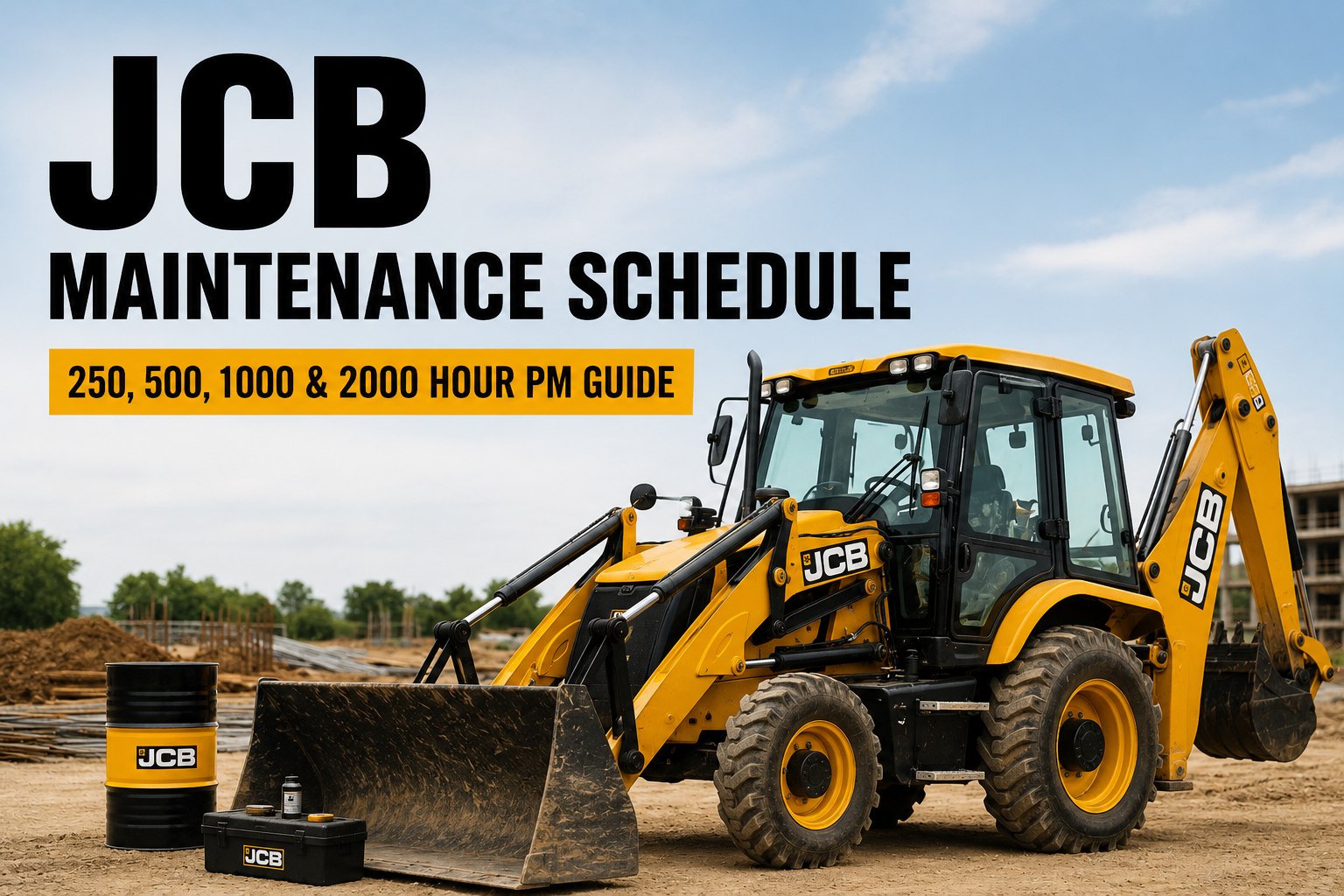
If you run a JCB fleet, the first thing to know is that JCB doesn't follow the same interval schedule as Cat, Komatsu, or Hitachi. There's no 250-hour service on a JCB. The JCB maintenance schedule runs on a 10 / 100 / 500 / 1,000 / 2,000-hour cadence — and that 500-hour engine oil interval is one of the reasons contractors buy JCB in the first place. Fewer stops means more productive hours, but it also means every interval carries more weight when it's missed. This guide walks through the complete JCB PM schedule across every core machine family — 3CX and 4CX backhoe loaders, JS-series tracked excavators, Loadall telehandlers, and wheel loaders — with the tasks that matter at each interval, the machine-specific quirks that stop breakdowns before they start, and how to run the whole thing without a spreadsheet. Book a demo when you're ready to automate it.
The 5 intervals every JCB machine hits
Same PM cadence — whether it's a 3CX backhoe, a JS220 excavator, a Loadall telehandler, or a wheel loader.
Two things about the JCB schedule that trip fleet managers coming from other brands: first, there is no 250-hour service — JCB extends engine oil intervals to 500 hours on its EcoMAX and Dieselmax engines because they don't run DEF or DPF regen. Second, intervals are additive — every 500 includes the 100-hour tasks, every 1000 includes 100 and 500, and 2000 includes everything. Skip an interval and you carry that risk into the next window.
The 10-hour daily JCB walkaround: ground-level checks that JCB designed for
JCB's cab and access design is built around the daily 10-hour check — most fluid gauges, drain points, and inspection covers on 3CX backhoes, JS excavators, and Loadall telehandlers are accessible at ground level. That's an intentional design choice to make sure the daily walkaround actually happens instead of getting skipped. Ten minutes, engine cold, level ground, six systems.
The daily check is also where the JCB weekly (50–100 hour) items get folded in every fifth or sixth shift — slew ring greasing, drive belt tension, battery electrolyte on non-sealed units, and a track tension check on JS excavators. Running a digital daily inspection with automatic hour-meter capture stops these weekly items from getting lost between 10-hour reports. HVI's daily operator reporting is built for exactly this cadence. Book a demo to see the JCB checklist configured live
The 500-hour JCB service: where the schedule actually starts costing money
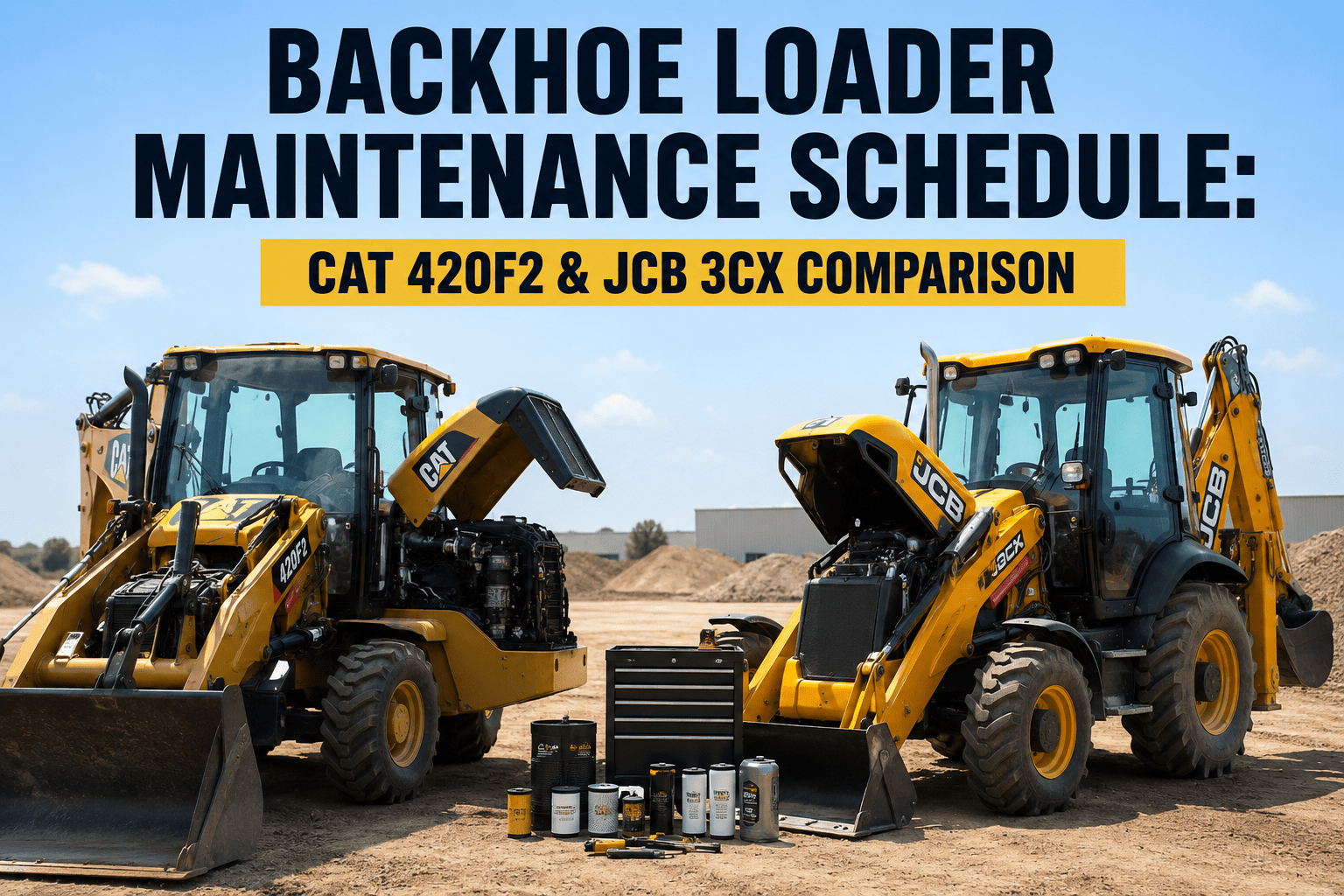
This is where the JCB PM schedule diverges most from other brands. On a Cat 420F2 backhoe, the 500-hour service is the second engine oil change. On a JCB 3CX it's the first. The gap matters because JCB owners plan the whole year around this cadence — roughly three engine oil changes per year at 1,500 hours annual use, versus six on a Cat. Miss one and you've collapsed the machine's oil interval to a worse-than-Cat pattern.
First major service — includes all daily & weekly items
4–6 hours- Engine oil & filter — use JCB Engine Oil Special or equivalent 15W-40 diesel oil meeting the machine's API spec
- Fuel filter (primary & secondary) — dirty fuel is the #1 killer of modern common-rail injectors on Dieselmax and EcoMAX engines
- Hydraulic return filter — inspect magnet for metallic debris before disposing
- Oil sampling — engine, hydraulic, axle, final drive samples to the lab for baseline
- Air filter primary — replace or clean per restriction indicator
- Grease all pin points — boom, arm, bucket, kingpost pivot, stabilizer pivots on backhoes
- Belt inspection — alternator, A/C, fan belt tension check on all machines
- Track / tire condition report — measurements documented against wear limits
The single most important addition at the 500-hour mark is oil sampling. A $25 lab sample from every fluid system creates the baseline that every future sample gets compared against — and it's the only reliable way to catch a developing bearing, seal, or contamination problem 500 to 800 hours before it fails. Start a free trial and get JCB PM triggers automated on your fleet this week.
The 1000-hour JCB service: the annual full audit
On most JCB machines at typical contractor utilization (~1,500 hours/year), the 1000-hour service lands roughly every 8 months and is the closest thing to an annual health check. Everything from 500 gets repeated, plus the coolant, transmission, and diagnostic items that need attention less often but matter more. A qualified diesel technician with a JCB ServiceMaster diagnostic tool is typically required — this is not a job for the operator or a generic mechanic.
Full audit — adds to all 500-hour items
Full day (8–10 hr)- Coolant replacement — drain, flush, refill with JCB-spec long-life coolant
- Transmission oil & filter — on backhoes (3CX/4CX torque converter) and wheel loaders
- Axle oil — front and rear axles including hubs on wheeled machines
- Full ECM diagnostic scan — via JCB ServiceMaster; review live and logged fault codes
- Hydraulic sample interpretation — against 500-hour baseline; extend or compress next interval based on results
- Turbocharger & charge cooler — shaft play, boot condition, wastegate function on Dieselmax units
- Alternator & starter load test — catch dying electrical components before they strand the machine
- Slew ring bolts — torque check on JS-series excavators (critical safety item)
- Complete undercarriage measurement — documented against JCB wear limits (JS excavators only)
The 1000-hour service is where preventive maintenance software stops being nice-to-have and becomes essential — there are too many parallel data streams (diagnostic codes, lab samples, wear measurements) to track manually across a mixed JCB fleet without something dropping. Book a demo
The 2000-hour JCB service: the deep service that decides the next 5 years
The comprehensive interval. Everything from every previous service is repeated, plus the deep-dive items that either confirm the machine is on track for a long service life or reveal that neglected earlier intervals have stacked up damage. A well-executed 2000-hour service on a JCB can extend useful equipment life by years; a rushed or skipped one often becomes the moment the fleet manager quietly starts pricing replacements.
Deep service — adds to all prior intervals
1–2 days- Hydraulic oil change — full drain, tank clean, refill with JCB-spec oil (roughly 110–130 L on backhoes, more on JS excavators)
- Structural inspection — boom, arm/dipper, loader arm, chassis, side frames for cracking or unauthorized welding
- Swing ring play measurement — JS-series excavators; radial and axial dial-indicator check
- Brake service — disc wear, immersed brake condition on backhoes and wheel loaders
- Injector spray pattern — check via diagnostic tool; replace as required
- Cab HVAC service — A/C pressure, evaporator condition, cabin filter
- Complete electrical harness inspection — chafing, corrosion at connectors, ground strap integrity
- Documentation reset — full service record signed off, LiveLink telematics data review
Where the JCB maintenance schedule changes by machine type
Universal intervals, but four different machines with four different failure modes. The tasks below are the ones that matter more on that specific JCB machine family — the ones a generic PM checklist misses.
Backhoe Loader
3CX · 4CX · 5CX · 3DX- Kingpost pivot pin — the highest-load pin on the machine; grease every 100 hr, inspect wear at 500
- Loader arm safety strut — check condition and mounting every 500 hr (OSHA-relevant)
- Torque converter oil — replace at 1000 hr on models with TC transmission
- 4-wheel steer alignment — check at 1000 hr on 4WS-equipped 3CX and 4CX
- Boom lock & stabilizer pins — wear and locking function every 500 hr
Tracked Excavator
JS130 · JS200 · JS220 · JS260- Slew ring bolt torque — critical safety check every 1000 hr; also after any structural incident
- Undercarriage measurement — shoe, sprocket, roller wear against JCB spec every 500 hr
- Breaker duty hydraulic samples — if the machine runs a breaker > 30% of hours, shorten hydraulic filter to every 250 hr
- Boom-cylinder pin bushings — measurement, not just visual, at 1000 hr
- LiveLink telematics review — hydraulic pump behavior and DPF regen frequency (if fitted)
Loadall Telehandler
531-70 · 535-95 · 540-140- Boom wear pads — the make-or-break Loadall maintenance item; measure and shim every 500 hr
- Extension chain tension — check and adjust every 500 hr; missed adjustment causes rapid pad and chain wear
- LMS (load moment system) calibration — verify at 1000 hr and after any hydraulic work
- Forks & fork carriage — wear, cracking, heel-thickness measurement every 500 hr
- Boom cylinder pin bushings — higher wear rate than backhoe boom pins; check at every service
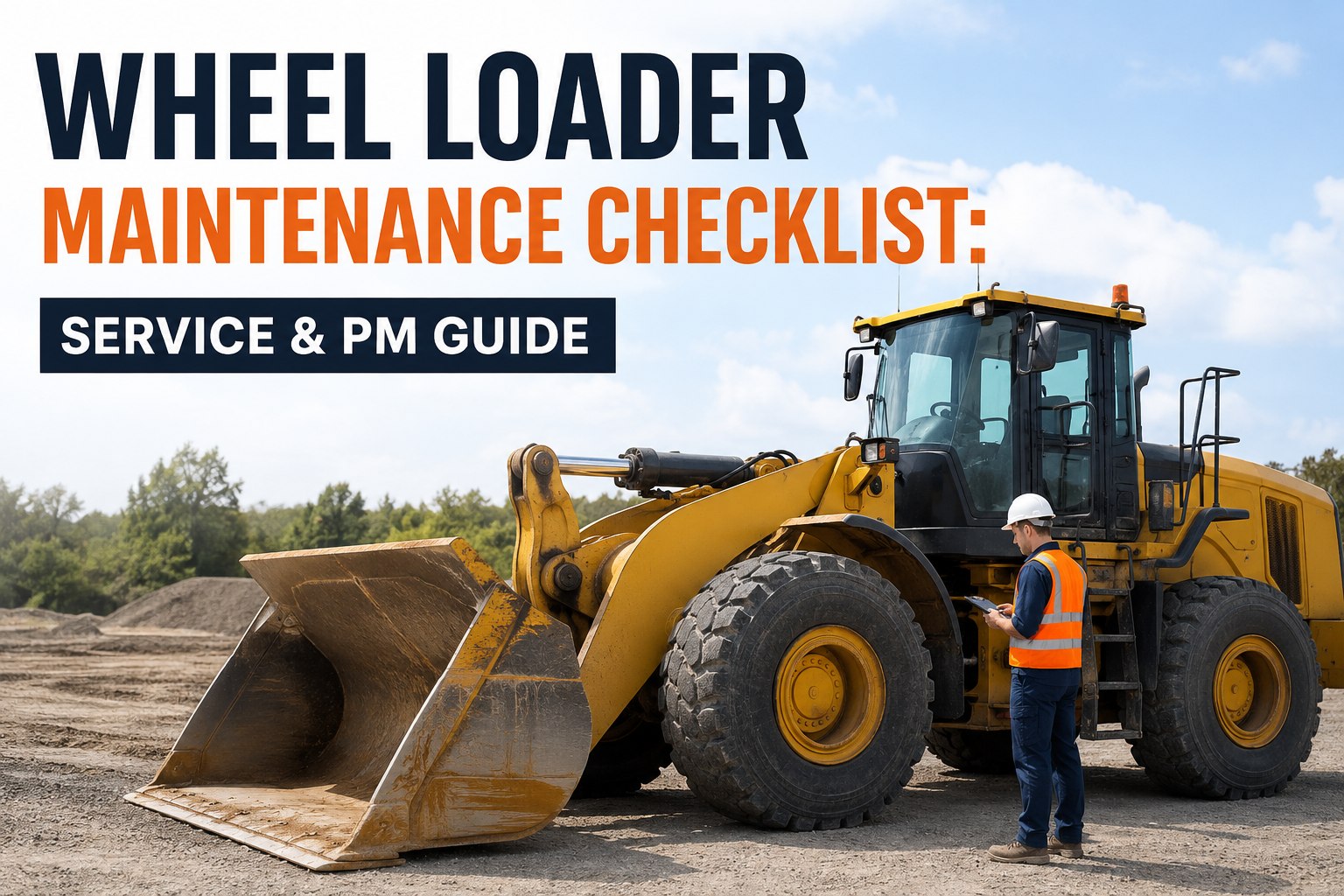
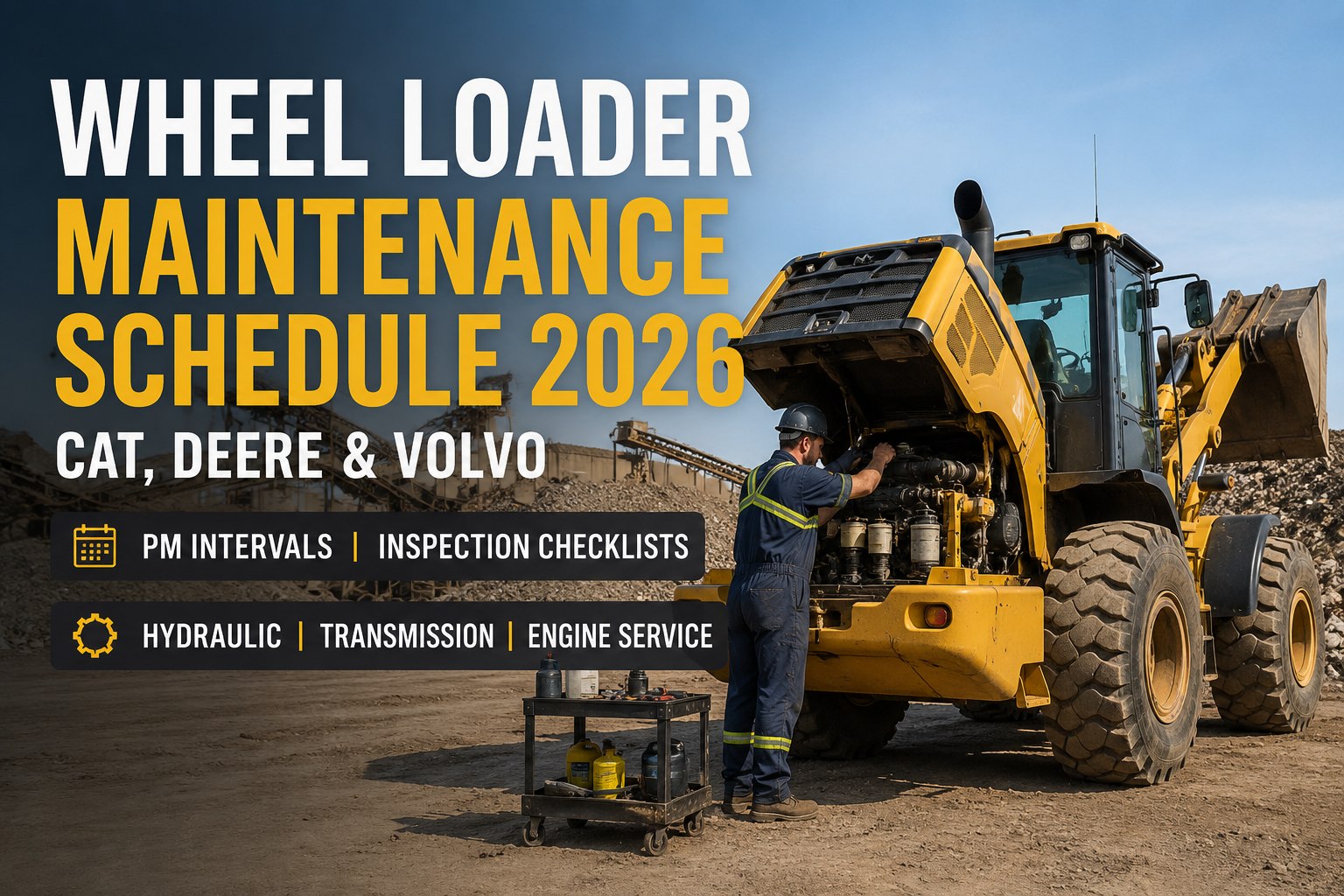
Wheel Loader
411 · 417 · 427 · 437- Center pivot & oscillation pin — grease every 100 hr; inspect wear every 500 hr
- Axle differential oil — front and rear including hubs, every 1000 hr
- Z-bar linkage pins & bushings — measurement at 1000 hr; wear here shows up as bucket droop
- Brake disc wear — immersed disc measurement every 1000 hr
- Loader arm cross-tube bolts — torque check every 2000 hr
These are the five items per family that a good JCB dealer technician always checks and a generic PM checklist usually misses. Building them into the machine-specific PM template is the difference between a schedule that runs on paper and one that actually protects the fleet. Book a demo to see machine-specific JCB templates
What each missed JCB interval actually costs you
The value of the JCB maintenance schedule is easiest to see backwards — from the cost of skipping it. Every missed interval has a specific dollar tail measured across the industry. The bars below show the cost multiplier when the interval is missed versus the cost of doing it on time. Not theoretical numbers — industry-observed averages on JCB and comparable heavy machines.
Total preventive spend on those five items across an average year is roughly $600. Total exposure if all are missed is over $250,000. That's the math the JCB maintenance schedule is built to protect against — and every hour of interval automation pays for itself several times over on the first prevented failure. Start free trial to get JCB PM tracking live this week.
Running the JCB maintenance schedule across a mixed fleet
One 3CX is easy to track. A mixed fleet with three 3CX backhoes, two JS220 excavators, four Loadalls, and a couple of wheel loaders across four sites is a different problem entirely. The failure isn't people not caring — it's that no single person has a live view of every hour meter, every open work order, and every PM window at the same time. That's what fleet-scale JCB maintenance software is designed to solve.
Fleets that run this stack consistently report roughly 25% lower annual maintenance cost and a payback period of about three months on the software itself — not because the software does the maintenance, but because it eliminates the missed windows that turn cheap interval work into expensive component replacement. Book a demo to see this configured for JCB
From a fleet manager running 22 JCB machines
We run a mixed JCB fleet — six 3CXs, three JS220s, eleven Loadalls, and two 427 wheel loaders across four sites. The 500-hour intervals used to sneak up on us constantly because the machines don't hit them evenly — a 3CX on utility work does 500 hours in three months, a Loadall on light yard work takes six.
What actually solved it was hour capture on the daily inspection and machine-specific PM templates. The system knew a Loadall's next PM meant boom wear pads and chain tension check, and a JS220's next PM meant slew ring torque. Once that ran automatically our unplanned downtime dropped roughly 35% in the first year.
The bottom line on the JCB maintenance schedule
The JCB maintenance schedule is the reason JCB machines have long resale value and low lifetime cost — when it's actually followed. Ten-hour daily walkarounds catch the immediate; 100-hour weekly items handle greasing and belt discipline; the 500-hour service is where JCB's engine oil interval advantage lives; the 1000-hour service confirms nothing is developing; the 2000-hour service resets the machine for another two-thousand-hour cycle. Every machine family — backhoe, excavator, telehandler, wheel loader — runs the same interval cadence with different machine-specific quirks layered on top. Follow it and a well-maintained JCB comfortably hits 15,000 hours before major overhaul. Skip intervals and the same machine can be on the used market at 6,000. The tooling that makes the schedule actually run is what closes the gap.
Frequently asked questions
Does JCB use a 250-hour service interval?
No — unlike Cat, Komatsu, and most other heavy equipment brands, JCB does not have a 250-hour service. JCB's engine oil and filter interval is 500 hours on Dieselmax and EcoMAX engines, which is a deliberate design advantage. The standard JCB PM schedule is 10-hour (daily), 100-hour (weekly), 500-hour (first major service), 1000-hour (full audit), and 2000-hour (deep service). At 1,500 annual operating hours, this means roughly three engine oil changes per year on a JCB versus six on a comparable Cat machine. The 500-hour interval is only valid if you use JCB-spec engine oil (JCB Engine Oil Special or equivalent 15W-40 meeting the required API classification) and change the oil filter at every oil change. Using non-spec oil or extending the interval further will accelerate cylinder wear and can void warranty coverage.
Is the JCB PM schedule the same for a 3CX backhoe and a JS220 excavator?
The interval cadence (10 / 100 / 500 / 1000 / 2000 hours) is the same across most modern JCB machines, but the tasks at each interval differ meaningfully by machine family. A 3CX backhoe needs kingpost pin inspection, loader arm safety strut checks, and torque converter oil changes that don't apply to a JS220. A JS220 excavator needs slew ring bolt torque checks, undercarriage measurement, and breaker-duty hydraulic sample adjustments that don't apply to a backhoe. A Loadall telehandler needs boom wear pad measurement and extension chain tensioning. A wheel loader needs center pivot pin greasing and Z-bar linkage inspection. The intervals are universal; the tasks inside them are machine-family-specific. Digital PM software that pre-loads the correct template per machine family is the cleanest way to handle this on a mixed JCB fleet.
How often should hydraulic oil be changed on a JCB machine?
The full hydraulic oil change on a JCB is typically scheduled at the 2000-hour interval, with the hydraulic return filter replaced every 500 hours and a hydraulic oil sample taken every 500 hours. On some newer JCB models with clean sample results, the hydraulic oil interval can be extended based on lab analysis. On machines running breakers, crushers, or pulverisers, JCB explicitly recommends shortening the hydraulic filter interval — if the breaker attachment is used for more than 30% of operating hours, drop the hydraulic filter to every 250 hours regardless of the total hour count. Always use JCB-spec hydraulic oil (JCB Hydraulic Oil or equivalent) and never mix hydraulic oil types — even topping off with the wrong specification can cause additive package conflicts and premature pump wear.
What happens if I skip a JCB scheduled service?
Every skipped JCB interval has a specific cost tail. Skipping the 500-hour hydraulic filter risks contamination that can destroy the hydraulic pump — a $30 filter becomes a $5,000 to $35,000 pump replacement. Skipping the 500-hour engine oil change accelerates cylinder wear and can cost $45,000 to $125,000 in an engine rebuild years earlier than expected. Skipping the 1000-hour slew ring torque check on a JS excavator can result in slew ring failure — a safety-critical event costing $25,000 to $60,000 to rebuild. Skipping the 500-hour boom wear pad inspection on a Loadall causes accelerated boom section wear that ends in $8,000 to $22,000 boom section rebuild. Beyond direct repair costs, skipped intervals can void warranty coverage and are visible via JCB LiveLink telematics to dealers reviewing warranty claims.
How do I track JCB PM intervals across multiple machines?
Spreadsheets and whiteboards work for one machine but break down at three or more, because hour meters have to be manually logged and the next-PM math done by hand every week — and JCB machines don't hit intervals evenly (a backhoe on utility work reaches 500 hours much faster than a Loadall on yard work). Purpose-built fleet maintenance software solves this by automating hour capture (via the daily inspection app or direct integration with JCB LiveLink telematics), meter-based PM triggers per machine family (each JCB gets its correct 500 / 1000 / 2000 template pre-loaded), and photo-verified completion (technician closes each PM with photos of the drain plug, filter, gauge, and hour meter). HVI is built exactly for this — each JCB is set up once with the right machine-family template and the interval schedule runs automatically from there.
Turn the JCB maintenance schedule into a system that runs itself
HVI ships with pre-built JCB templates for 3CX, 4CX, JS-series, Loadall, and wheel loader families. Hour meters captured on every daily inspection. PM windows auto-triggered at 90% of interval. Photo-verified work orders. LiveLink integration where available. Live for your JCB fleet in under two weeks — typical payback in about three months.
No credit card · Pre-built JCB PM templates · Works with LiveLink and manual hour capture