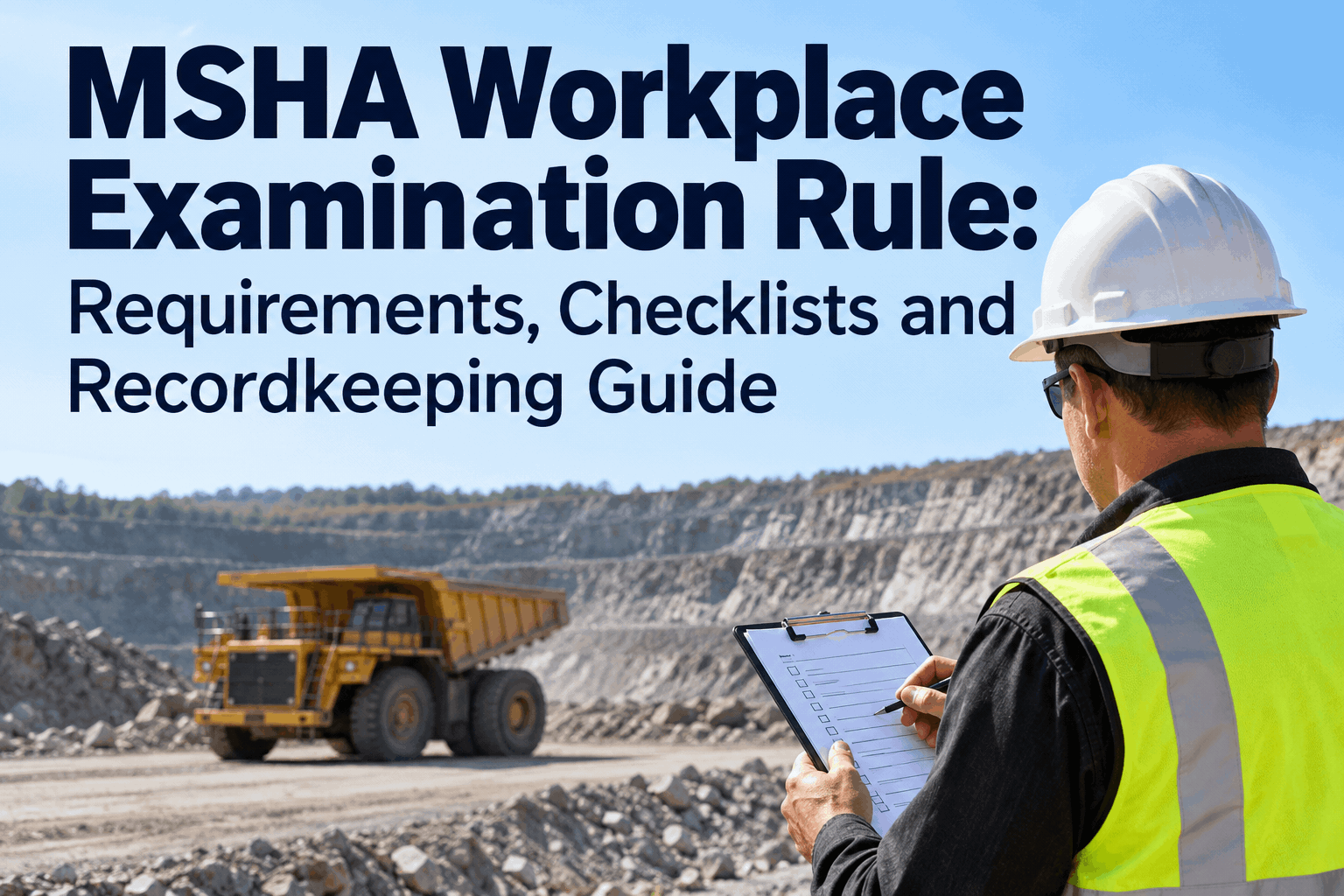
Here's the hard truth about the MSHA workplace examination rule: most citations come from a record that doesn't hold up, not a missed hazard. You examined the pit and fixed the berm — but the record can't prove it, isn't dated, or wasn't done before shift end. This guide covers the part that gets mines cited: what the exam record must contain, the pre-shift checklist, and the corrective-action trail. Book a demo to see audit-ready records.
The MSHA Workplace Examination Record, Done Right
The exam keeps miners safe. The record keeps the mine compliant. This is what MSHA wants written down — and how to make sure it's there before the shift ends.
Under 30 CFR 56.18002 (surface) and 57.18002 (underground), a competent person must examine each working place at least once per shift, before miners begin work there, for conditions that may adversely affect safety or health. That part most mines do well. Where compliance slips is the written proof — the record that has to exist, be complete, and be made before the shift ends. The rest of this guide is about getting that record right, every shift.
AWhat the examination record must contain
The reinstated 2017 rule (in effect since 2018) is specific about what goes in the record. Miss any one of these fields and you have an exam that happened but can't be proven — which, to an inspector, reads the same as an exam that didn't. Four required elements, plus the date-corrected supplement:
Name of the examiner
The competent person who conducted the exam — a real, identifiable name, not just "day shift."
Date of the examination
The date it was actually walked — tied to the shift, so timing can be verified.
Location of all areas examined
Every working place covered, named clearly — pit, roads, crusher, shop, not a vague "site."
Each adverse condition found
A description of every condition that may adversely affect safety or health — specific, not "all clear" when it wasn't.
Date of the corrective action
When a condition is found, the record must include — or be supplemented with — the date it was corrected. This is the field most often missing.
The record must be made before the end of the shift for which the examination was conducted, and the operator must keep it for at least one year and make it available to MSHA on request. A digital inspection record enforces these fields at entry, so a shift can't be closed with a blank where the examiner's name or the date-corrected should be. Book a demo to see required fields enforced automatically
BThe pre-shift examination checklist, by area
MSHA doesn't publish a universal checklist — "adverse conditions" depend on your site. But an effective workplace examination walks the same areas every shift so nothing is skipped. Use this as a starting framework and adapt it to your operation's real hazards.
Ground & highwall
- Loose or cracked material, overhangs
- Bench width and slope condition
- Signs of movement or sloughing
Roads & berms
- Berm height along drop-offs
- Road surface, potholes, washouts
- Visibility, signage, water/dust
Machine guarding
- Guards in place on moving parts
- Conveyor, crusher, tail-pulley guards
- No defeated or missing covers
Electrical
- Exposed wiring, damaged cords
- Panel covers, grounding
- Wet or blocked access to equipment
Mobile equipment
- Pre-op defects, leaks, brakes
- Lights, backup alarms, horns
- Seatbelts, mirrors, fire extinguisher
Housekeeping & access
- Walkways, stairs, handrails clear
- Spills, slip/trip hazards
- Material storage, blocked exits
When each area is a checklist item in a digital checklist, a skipped area is visible and a flagged condition becomes a tracked item automatically — not a note that lives on a clipboard until it's lost. Start free and build your site's exam checklist once, then run it every shift.
CFrom condition found to closed-out — the corrective-action trail
Finding a condition is only half the obligation. The rule requires you to promptly notify miners in affected areas and initiate corrective action — and the record has to show the date it was corrected. This is the chain MSHA follows when it reviews your records, so it's the chain your system should capture end to end.
Examiner records the condition and its location during the pre-shift walk.
Anyone in the affected area is promptly told, before work proceeds there.
Action is taken — or, for imminent danger, the area is cleared until abated.
The record is supplemented with the correction date and retained for a year.
On paper, step 4 is where it breaks — the condition gets fixed but the record never gets updated, so an inspector sees an open hazard with no closure. When a flagged condition becomes a work order that writes its completion date back to the exam record, the trail closes itself. Book a demo to see corrective actions close the loop
Paper record vs. digital record
The examination itself is the same either way. What changes is whether, months later, you can prove it happened, completely and on time — that's the whole ballgame for MSHA workplace examination recordkeeping. Book a demo to compare your current record against an audit-ready one
- Missing fields found only when the inspector does
- Corrections fixed but never written back
- Binders to dig through for a year of records
- No proof the record was made before shift end
- Required fields enforced before a shift closes
- Date-corrected written back from the work order
- A year of signed records retrieved in seconds
- Time-stamped, so timing is never in doubt
One note on the rule itself: the 2018 amendments were later vacated and the January 2017 version reinstated, so always verify the current text against 30 CFR 56.18002 / 57.18002 and MSHA guidance for your mine type — metal/nonmetal and coal follow different standards. HVI's MSHA examination requirements guide breaks the rule text down in more detail.
From a mine safety manager
Our exams were solid. Our records were the problem. An inspector would pull a date and we'd be flipping through a binder hoping the corrective-action line got filled in. It usually didn't — the fix happened, nobody closed the paper.
Moving the workplace examination onto a tablet fixed the thing we kept getting dinged on. The examiner can't close the shift with a blank field, and when a condition gets a work order, the date-corrected lands back on the record on its own. First MSHA visit after, records weren't the conversation for once.
Frequently asked questions
What does the MSHA workplace examination rule require?
Under 30 CFR 56.18002 for surface metal and nonmetal mines (and 57.18002 for underground), a competent person designated by the operator must examine each working place at least once each shift, before miners begin work in that place, for conditions that may adversely affect safety or health. If an adverse condition is found, the operator must promptly notify miners in the affected areas and promptly initiate corrective action. The operator must also make a record of the examination — and that record has specific required contents. The examination part is about keeping miners safe in real time; the recordkeeping part is about being able to prove, afterward, that the examination happened and that conditions were addressed. Both are enforceable, but in practice the record is where most mines get cited, because an exam that can't be documented completely and on time is treated much like one that didn't occur. Always confirm the current rule text and any mine-type differences directly with MSHA, as the standard has been amended and litigated in recent years.
What must the examination record contain?
Under the reinstated rule, the workplace examination record must contain: the name of the person who conducted the examination (the competent person); the date of the examination; the location of all areas that were examined; and a description of each condition found that may adversely affect the safety or health of miners. In addition, when an adverse condition is found, the record must include — or be supplemented to include — the date of the corrective action. The record must be made before the end of the shift for which the examination was conducted, the operator must maintain the records for at least one year, and they must be made available to MSHA (and miners' representatives) for review. The field that goes missing most often is the date of corrective action: the hazard gets fixed in the field but nobody updates the record, which leaves an inspector looking at an apparently open condition. A system that enforces each required field before the record can be closed is the simplest way to prevent that gap.
How often must workplace examinations be done?
At least once each shift, and the examination must be completed before miners begin work in that working place. "Working place" means any place in or around a mine where work is performed, so the examination has to cover the areas where that shift's crews will actually be operating — the pit and benches, haul roads, the crusher or plant area, shops, and so on. If your operation runs multiple shifts, each shift needs its own examination and its own record; one exam in the morning does not cover an afternoon or night crew working the same ground. The timing requirement — before work begins — is important and sometimes overlooked: an examination done partway through the shift, after miners are already working, does not satisfy the "before miners begin work" standard. Building the exam into the start-of-shift routine, with a record that time-stamps when it was completed, is the cleanest way to show the timing was met.
Who is a "competent person" for MSHA examinations?
MSHA defines a competent person (in 30 CFR 56.2 / 57.2) as a person having abilities and experience that fully qualify them to perform the duty to which they're assigned. For workplace examinations, that means someone who genuinely knows the operation's hazards and can recognize conditions that may adversely affect safety or health — and who is designated by the operator to do the exam. It is not a formal certification in the way some other mining roles are; it's about demonstrable capability and the operator's designation. Practically, that puts a premium on being able to show who your designated examiners are and that they're qualified. Recording the examiner's name on every exam record (a rule requirement) also creates the paper trail that backs up the "competent person" designation, because it ties each examination to a specific, identifiable, qualified individual rather than an anonymous shift entry. Keeping examiner training and qualification records alongside the exam records makes that connection easy to demonstrate during an audit.
How does software help with MSHA workplace examination compliance?
Inspection and compliance software addresses the exact point where mines get cited: the record. A digital workplace examination turns the rule's required fields — examiner, date, areas examined, conditions found, and date corrected — into a structured form that can't be closed with a blank where a required entry should be, so incomplete records stop leaving the field. Time-stamping shows the record was made before the shift ended. When a condition is flagged, it can become a tracked corrective action or work order, and its completion date writes back to the examination record automatically, closing the loop that paper so often leaves open. And because every signed record is stored and searchable, producing a year of examinations for an MSHA inspector takes seconds instead of a scramble through binders. HVI's audit checklist and inspection tools are built for this: structured exam records, enforced required fields, corrective-action tracking, and instant retrieval — turning the workplace examination you already perform into documentation that holds up. It supports compliance with the standard but does not replace your legal obligation to know and follow the current MSHA rule.
Turn your workplace examination into a record MSHA can't fault
HVI gives your competent persons a structured digital exam with the rule's required fields built in, corrective actions that close themselves out, and a year of signed records retrievable in seconds. Keep miners safe and keep the paperwork airtight — on the same walk.