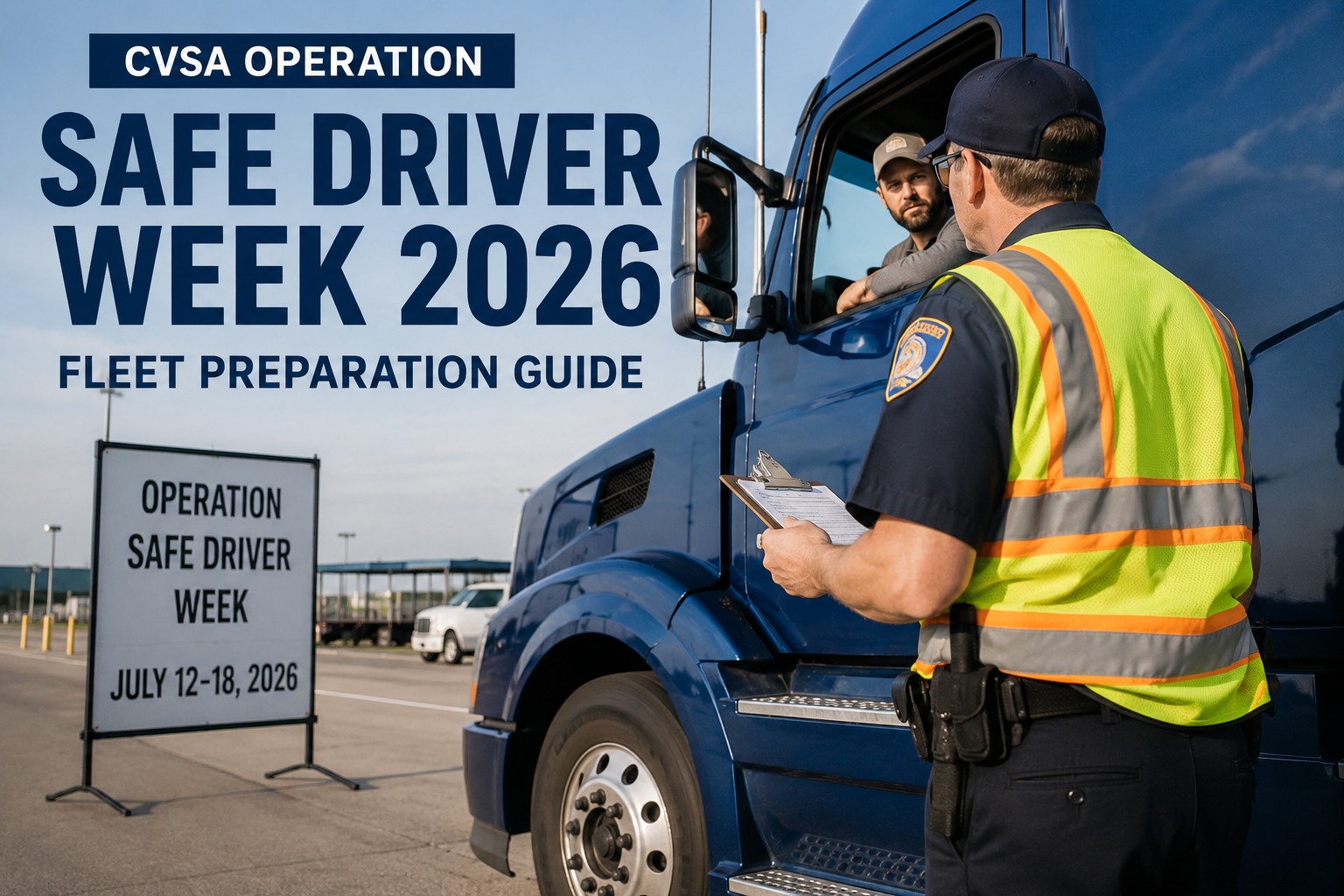
CVSA Operation Safe Driver Week 2026 runs July 12-18 across the United States, Canada, and Mexico — and the fleets that come out clean know something most carriers miss. The banner says reckless, careless, and dangerous driving. But the tickets say speeding, seatbelt, and handheld phone. Last year's enforcement data proves it: 2025 Operation Safe Driver Week produced 2,504 citations across North America, and only 20 of them were for the "reckless" category CVSA had named as the focus. 917 were for speeding. The carriers preparing for reckless driving this weekend are watching for the violation officers rarely write. This guide covers the actual 2025 ticket breakdown, the eight specific behaviors officers target, the 5-step prep checklist your drivers need before Sunday morning and the 24-month CSA record every citation writes. Book a demo to see driver behavior scored continuously against Unsafe Driving BASIC thresholds.
Operation Safe Driver Week 2026
The 2026 official focus is one thing. The tickets officers actually write are another. Here's the gap — and the eight behaviors that produce the citations.
Speeding, Seatbelt, Phone Use
Operation Safe Driver Week has been an annual CVSA campaign since 2007. Reckless, careless, and dangerous driving is the 2026 focus theme for the third straight year, because CVSA keeps returning to the crash data that points there. But at the roadside, reckless driving is a judgment call that's hard to charge cleanly, so officers write the specific behaviors instead. That's the gap between what carriers prepare for and what carriers actually get cited for — and the gap is the whole game.
The 4 numbers from last year's enforcement that shape this year's
CVSA's 2025 Operation Safe Driver Week enforcement data was released last October. These four numbers are the ones every fleet manager should know before Sunday morning.
- 8,739 Vehicles stopped in the 2025 campaign across US + Canada
- 2,504 Citations issued — each becomes a 24-month CSA data point
- 917 Speeding citations — the actual top infraction, not "reckless driving"
- 24 mo CSA record retention for every citation — a July ticket stays until 2028
A citation during Safe Driver Week isn't a Safe Driver Week event. It feeds the Unsafe Driving BASIC in FMCSA's Safety Measurement System, sits on the CSA record for 24 months, and shapes how often the fleet's vehicles get pulled in for inspection going forward. The seven-day enforcement window becomes a two-year data record. Book a demo to see Unsafe Driving BASIC trended per driver
The full 2025 breakdown — what actually got written
Here's the 2025 Operation Safe Driver Week outcome, category by category, drawn from CVSA's released enforcement report. The gap between "focus area" and "actual citations" is the reason preparation has to be behavior-specific, not banner-specific.
Speeding produced 30 times more enforcement actions than the "reckless driving" category CVSA has named as the focus for three consecutive years. This isn't a criticism of CVSA's focus — the theme is intentional, tied to the crash data. It's a practical reality: reckless driving is difficult to charge at the roadside, so it becomes a lens through which specific behaviors get cited. A fleet that trains against the eight targeted behaviors during Operation Safe Driver Week is training against the actual enforcement risk. Start free and get driver behavior scored on the specific categories that produce citations
The 8 targeted behaviors — what officers watch for
Each behavior below is both a specific roadside citation and an Unsafe Driving BASIC data point. Ranked in the order they're typically cited during Operation Safe Driver Week based on multi-year CVSA enforcement data.
Every citation from this list feeds the Unsafe Driving BASIC with a severity weight ranging from 1 (minor) to 10 (impaired driving, reckless driving, DUI). Multiplied across a fleet, a bad Safe Driver Week can shift a carrier's Unsafe Driving percentile by 5-10 points — and that pull toward FMCSA's intervention threshold takes months of clean subsequent inspections to reverse. Book a demo to see driver behavior scored automatically before roadside catches it
The 5-step weekend prep checklist — before Sunday morning
Operation Safe Driver Week begins Sunday, July 12. These five steps are what a compliance manager can realistically complete Friday and Saturday to reduce Monday's citation risk. Rough time: 3 to 5 hours across the weekend for a small-to-mid fleet.
-
01
Pull the roster and identify at-risk drivers
Pull an MVR and CSA score summary on every driver. Any driver with existing violations in the Unsafe Driving BASIC is a flagged target for increased scrutiny during Operation Safe Driver Week. Rank drivers by exposure and prioritize coaching contact with the top three names on the list this weekend.
-
02
Send a specific pre-week message to every driver
Don't send a generic "drive safely" email. Send the actual eight behaviors officers will target: speeding, phone use, seatbelt, following distance, lane discipline, signal compliance, fatigue signs, sobriety. Reference the 2025 numbers — 917 speeding citations, 248 CMV seatbelt citations — so drivers understand what they're watching for.
-
03
Verify credential accessibility in every cab
Every driver should have CDL, medical certificate, current MVR reference, registration, insurance card, and ELD records within reach without leaving the seat. A driver fumbling for documentation looks disorganized; a driver producing them in 15 seconds looks professional. Officers notice both.
-
04
Run a Sunday-morning pre-trip audit on visible items
Safe Driver Week is about driver behavior, but if a stop happens, secondary equipment inspection follows. Sunday morning: quick photo-verified pre-trip focusing on the highest-visibility items — lights, tires, seatbelt anchor points, mirrors, phone mount position. Fix anything visible before the truck leaves the yard.
-
05
Monitor the daily results and adjust
Sunday and Monday's roadside activity sets the pattern for the week. If your telematics or dashcam shows a driver picking up hard-brake events or speed alerts, that driver needs coaching contact Monday, not Friday. Real-time monitoring during the enforcement week is the discipline layer separating clean fleets from cited ones.
The fleets that come out of Operation Safe Driver Week cleaner than they went in aren't the ones that drove carefully for seven days — they're the ones already managing driver behavior as an everyday operation. The weekend prep is the annual checkpoint, not the annual test. Start free and build the everyday driver-behavior discipline that makes July invisible
From a fleet manager who watched the CSA math play out
Two drivers got tickets during last year's Safe Driver Week. One for speeding, one for handheld phone. Neither seemed catastrophic in the moment — two hundred bucks in fines each, nothing that felt like a fleet-level problem.
Six weeks later our Unsafe Driving BASIC jumped 8 percentile points. Insurance renewal in October added $22,000 to the premium. Both drivers had clean records before; they were on the CSA data for 24 months. What I understand now is that the July week isn't the risk. The two-year tail on it is. Since then we run continuous driver-behavior monitoring year-round because catching a speeding pattern in April is much cheaper than eating a July citation for two years.
Frequently asked questions
When is CVSA Operation Safe Driver Week 2026?
Operation Safe Driver Week 2026 runs Sunday, July 12 through Saturday, July 18, 2026 — a seven-day enforcement window across the United States, Canada, and Mexico. Law enforcement agencies in all three countries increase traffic-enforcement patrols during that window, watching both commercial motor vehicle drivers and passenger vehicle drivers for unsafe driving behaviors. The 2026 official focus area is reckless, careless, or dangerous driving — the third consecutive year CVSA has selected that theme. CVSA announced the dates and focus in an April 30, 2026 press release, and the Operation Safe Driver program has run annually since it was launched by CVSA in partnership with FMCSA in 2007. During the week, officers issue warnings and citations for observed behaviors, and citations issued to CMV drivers feed FMCSA's Compliance, Safety, Accountability (CSA) system through the Unsafe Driving BASIC, remaining on the driver and carrier's record for 24 months from the date of the violation.
What is the focus of Operation Safe Driver Week 2026?
The 2026 official focus area is reckless, careless, or dangerous driving — CVSA's third consecutive year selecting that theme. CVSA defines reckless driving as operating a vehicle in willful or wanton disregard for the safety of persons or property, and careless or dangerous driving as operating without due care and attention or without reasonable consideration for other road users. However, the practical enforcement reality is different from the banner. Reckless driving is a judgment call that is difficult to charge cleanly at the roadside, so officers write specific behaviors instead. In the 2025 Operation Safe Driver Week campaign, the "reckless driving" category itself produced only 20 citations and 53 warnings across all of North America — while speeding alone produced 917 citations and 1,249 warnings, making it the actual top infraction by a large margin. Additional heavily-cited behaviors in 2025 included seatbelt violations (248 CMV citations, 204 warnings) and handheld phone use (79 CMV citations, 107 warnings). Carriers preparing specifically for the eight targeted behaviors — speeding, distracted driving, fatigued driving, following too closely, impaired driving, seatbelt violations, unsafe lane changes, and traffic signal violations — are preparing for the actual enforcement risk, not the banner theme.
How can fleets prepare for Operation Safe Driver Week?
Effective preparation runs both before the campaign week and during it. Before the week: pull an MVR and CSA score summary on every driver, identify at-risk drivers with existing Unsafe Driving BASIC violations, and prioritize coaching contact with those drivers first. Send a driver communication that names the eight specific behaviors CVSA has identified for enforcement — speeding, distracted driving (phone use), fatigued driving, following too closely, impaired driving, failure to wear seatbelt, unsafe lane changes, and disregarding traffic signals — rather than a generic "drive safely" message. Verify credential accessibility in every cab: CDL, medical certificate, current MVR reference, registration, insurance card, and ELD records within reach. Run a photo-verified pre-trip audit focused on visible items officers observe during a stop — lights, tires, seatbelt anchor points, mirrors, phone mount position. During the week: monitor daily telematics and dashcam data, coach drivers picking up hard-brake events or speed alerts in real time rather than at a monthly review, and use in-cab alerts to change behavior in the moment. The fleets that come through Operation Safe Driver Week cleanly aren't the ones that prepared for that week specifically — they're the ones that manage driver behavior as an everyday operation and treat the CVSA campaign as a checkpoint rather than a test.
Do Operation Safe Driver Week violations affect CSA scores?
Yes, and the tail is longer than most drivers understand. Every citation issued to a CMV driver during Operation Safe Driver Week feeds FMCSA's Safety Measurement System, primarily through the Unsafe Driving BASIC. Each violation has a severity weight ranging from 1 (minor) to 10 (impaired driving, reckless driving, DUI). Citations remain on the driver's and carrier's CSA record for 24 months from the date of the violation. Higher CSA scores in the Unsafe Driving BASIC increase the likelihood of DOT compliance reviews, roadside inspections, and interventions from FMCSA. They also directly affect insurance premiums, load eligibility with major shippers and platforms like Amazon Relay, and operating authority evaluations. A single Operation Safe Driver Week citation is rarely catastrophic on its own, but multiplied across a fleet — or accumulated across drivers over the 24-month CSA window — the compound effect can meaningfully shift the fleet's Unsafe Driving percentile. If a violation is inaccurate, carriers can challenge it through FMCSA's DataQ system, but the process is documentation-heavy and success rates are modest. Prevention through driver behavior monitoring is meaningfully cheaper than post-citation dispute.
Does Operation Safe Driver Week apply only to commercial trucks?
No. Operation Safe Driver Week is unique among CVSA enforcement campaigns because it targets both commercial motor vehicle drivers and passenger vehicle drivers. That distinguishes it from Brake Safety Week and International Roadcheck, which focus specifically on commercial vehicle equipment. Officers during Operation Safe Driver Week may stop passenger vehicles for speeding, distracted driving, seatbelt violations, or other unsafe behaviors identified in the CVSA focus. However, the consequences for commercial drivers are significantly more severe. Citations issued to CMV drivers feed the FMCSA CSA system directly through the Unsafe Driving BASIC, remain on the record for 24 months, and affect the carrier's operating status, insurance rates, and eligibility with load platforms. Passenger vehicle citations produce state-level driver record consequences but do not feed a federal safety-measurement system. In 2025, of the 8,739 vehicles stopped and roughly 6,000 warnings and citations issued, the vast majority went to commercial drivers — CMV drivers are stopped at a higher rate proportional to their share of highway traffic during CVSA campaigns because the operation is coordinated in partnership with FMCSA and specifically targets freight corridors and known commercial vehicle traffic patterns.
Make July invisible by managing driver behavior in April, May, and June
HVI runs the pre-trip discipline, DVIR quality, and driver behavior monitoring that produces the clean CSA record Safe Driver Week can't touch. Every hard brake logged. Every speed event scored. Every credential expiration alerted. Live on your fleet in under two weeks — and the July enforcement week becomes just another week.
No credit card · No hardware · Driver behavior scoring live day one