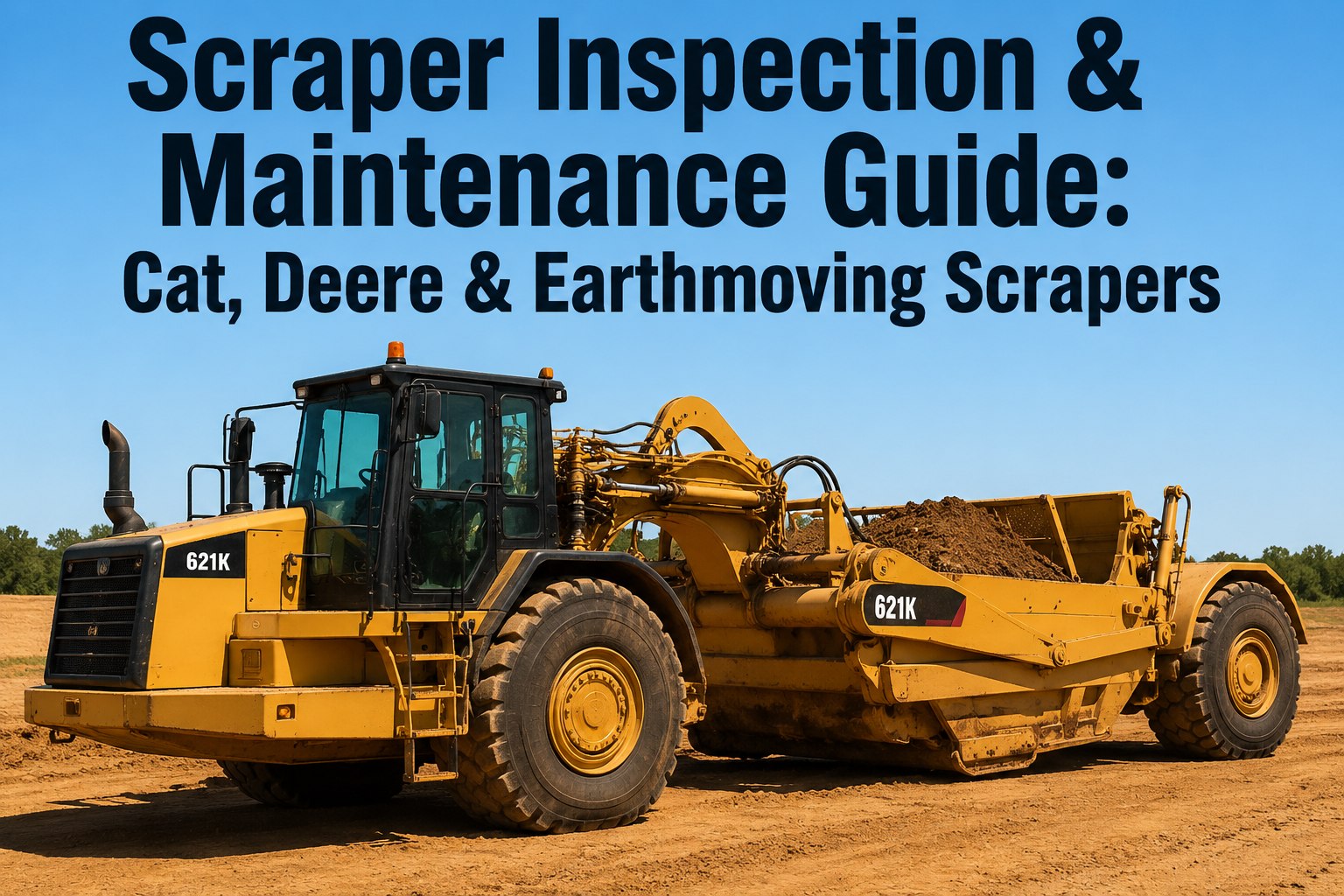
A wheel tractor-scraper is the only machine on a jobsite that cuts, loads, hauls, and spreads in one continuous motion — and it's the only earthmover where a worn cutting edge doesn't just cost fuel, it costs the load. On a Cat 627K, 33 tons of payload sit behind an apron that has to open and close in under 4 seconds every cycle. When the cutting edge is off-spec, the apron leaks material, or the ejector hesitates, the machine's productivity falls off a cliff. Scraper inspection isn't about compliance — it's about protecting the cycle time that makes the machine profitable. This guide walks the inspection discipline for Cat and Deere scrapers, station by station. Book a demo
The scraper anatomy — five systems that carry every yard of earth
Every scraper failure traces back to one of these five component groups. Know them cold.
Scrapers occupy a specialty niche on modern jobsites — earthmoving where haul distances make dozer work inefficient and dump trucks impractical. That specialization means they typically sit for weeks at a time, then run hard for months on a mass-earthworks project. That cycle pattern is exactly the one where inspection discipline pays back most. Sitting equipment develops hydraulic seal set, bowl-pivot rust, and battery drain; hard-running equipment accelerates cutting edge wear, cushion hitch fatigue, and ejector seal failure. Both ends of the cycle need attention.
The 4 scraper families — and which one you're inspecting
Not all scrapers work the same way. The type of scraper determines which components matter most on the walkaround. Here's the operational reality across the four families you'll actually encounter in the field.
The takeaway isn't which family is best — it's that the inspection points shift depending on which family you're on. A single-engine scraper has one cooling system to check; a twin-engine has two. An elevating scraper adds a chain-and-flight assembly that open-bowl scrapers don't have. Reading the inspection checklist that matches the machine matters. Book a demo to see OEM-specific templates for Cat and Deere scraper families
The 6-station walkaround — scraper edition
Same six-station discipline as any heavy machine, adjusted for the scraper's specific systems. Each station is roughly 3 minutes when digitized; longer if you're catching photos on paper.
Stations 3 and 5 — the cushion hitch and the cutting edge — are where scraper-specific value lives. Every other station is generic heavy-equipment inspection. These two are where the machine either earns its productivity or leaks it. Book a demo to see photo-required stations tied to hour-meter readings
Cutting edges & GET — the wear consumable that decides cycle time
Cutting edges are the single largest consumable on a scraper. They wear from the leading edge back, take the punishment of every load, and directly determine how much material enters the bowl per cycle. Get the spec wrong or the wear check wrong, and productivity drops 10–20% before anyone notices — because the operator adapts to the diminished performance instead of flagging it.
Flat / level edge
Straight cutting profile. Best for finish work and hard-packed material where a clean cut matters more than penetration.
Center stinger (drop-down)
Center tooth extends forward. Penetrates hard material and initiates the cut. Ideal for tough loading conditions.
Serrated edge
Toothed profile increases penetration in tough material. Trades some finish quality for load efficiency. Common in mixed conditions.
Abrasion-Resistant Material (ARM)
Hardened alloy for extreme wear. Higher upfront cost, dramatically longer service life in abrasive conditions like decomposed granite or shot rock.
Most Cat cutting edges are reversible — when the leading edge wears, flip and use the second edge for effectively double the service life. That single discipline — catching the wear point and flipping the edge instead of running it to failure — typically doubles cutting-edge budget efficiency and adds 15–25 hours of usable life per set. A photo-required cutting edge check every 100 hours is what catches the flip point on time. Start free and get cutting edge wear tracking per unit on day one
Load-cycle failure telegraphs — where each stage breaks down first
A scraper's job breaks into four stages: load, haul, dump, return. Each stage stresses a specific component group, and each has a signature failure pattern that starts telegraphing before catastrophic breakdown. Reading the telegraph is what separates fleets that hit their production targets from fleets that get surprised.
Cutting edge & bowl fill
The cut. Cutting edges bite in, apron opens, material flows into the bowl. Failure telegraph: slower load times, incomplete bowl fill, uneven wear pattern on the edge.
Powertrain & cushion hitch
The haul. Loaded machine transporting to spread area. Failure telegraph: fuel burn spikes, cushion hitch shock at transitions, transmission temperature climbing on grades.
Ejector & apron cycle
The spread. Apron opens, ejector extends, material spreads uniformly. Failure telegraph: uneven material spread, apron cycle time climbing past 4 seconds, ejector hesitation.
Empty haul & return-to-cut
The empty run. Return to load area at speed. Failure telegraph: brake heat on grades, retarder function, steering response with empty bowl.
Track cycle time per stage on a running average and you'll see failure telegraphs weeks before catastrophic breakdown. A 4-second apron cycle drifting to 5.5 seconds isn't a maintenance emergency — but it's the leading indicator of a hydraulic seal that will fail in the next 200 hours. Catching the drift proactively is a $1,500 seal replacement; missing it is a $12,000 cylinder rebuild plus a week of downtime on a production job.
From a Site Supervisor running 5 Cat 627Ks on a mass-earthworks site
We were losing about 40 minutes per shift per machine on cycle time drift. Nobody could tell me why. Operators would say "she's just running a little slow today" and keep working. Multiply that by five machines and a 22-day production month, that's 73 hours a month of unbilled cycle time. On this job that's roughly $58,000 a month of production not delivered.
When we started tracking apron cycle time and load cycle time per shift as part of the digital walkaround, the patterns showed up immediately. Two machines had drifting apron cycles (hydraulic seals), one had a cushion hitch showing pin wear, and one had a cutting edge past the flip point. Fixed all four in two weeks. Cycle times back to spec, production back to bid rate. My PM asked me what changed. It wasn't the maintenance — it was the visibility.
Frequently asked questions
What is a scraper inspection and how is it different from other heavy equipment inspections?
A scraper inspection is a systematic pre-shift and interval-based check of a wheel tractor-scraper — the earthmoving machine that cuts, loads, hauls, and spreads material in one continuous motion. Unlike dump trucks or excavators, scrapers integrate the loading and hauling functions into a single machine with a bowl that lowers to cut earth as the machine moves. This unique operation means scraper inspection focuses on five component systems that don't exist on other machines: the bowl (load container, 18–44 yd³ depending on model); the apron (front gate that must cycle in under 4 seconds); the ejector (rear wall that pushes material out during spread); cutting edges and Ground Engaging Tools or GET (the wear consumables that determine load efficiency); and the cushion hitch (shock-absorbing linkage between tractor and scraper). Scrapers are off-highway machines regulated by OSHA 29 CFR 1926.602 on construction sites, requiring pre-shift inspection with penalties up to $16,550 per serious violation. A thorough walkaround takes 15–20 minutes and follows a six-station path: cab and controls, tractor and engine bay, cushion hitch, bowl and apron, cutting edge and GET, and ejector and rear. Because scrapers are productivity machines with tightly-measured cycle times, inspection discipline translates directly to production output — a 4-second apron cycle drifting to 5.5 seconds costs 30 minutes of productivity per shift before anyone flags it.
What are the most critical inspection points on a Cat or Deere scraper?
Two components dominate scraper inspection value: the cutting edge and the cushion hitch. The cutting edge is the wear consumable that determines how efficiently the machine loads. Cat and Deere scrapers offer several edge types: standard flat (finish work, hard-pack); center stinger or drop-down (tough penetration); serrated (mixed material); and Abrasion-Resistant Material or ARM (rock, decomposed granite, high-abrasion). Most Cat cutting edges are reversible — catching the wear point at the right hour and flipping the edge instead of running it to failure typically doubles service life and saves 15–25 hours of usable life per set. Wrong edge type or missed flip point drops load efficiency 10–20% before operators notice. The cushion hitch is the shock-absorbing pivot between tractor and scraper — it damps the ride and lets the scraper track behind the tractor smoothly. Wear points include the pins and bushings, the rubber cushion elements, and the hitch-lock mechanism. Failure telegraphs through a hard "bang" at load transitions, uneven ride, and eventual steering cylinder overload. Beyond these two, other critical points include: apron cycle time (should stay under 4 seconds), ejector seal condition, bowl liner and wear plates, hydraulic lift cylinder condition, and on twin-engine scrapers, both cooling systems and both engines. Cross-reference physical checks against fault codes from the machine's telematics platform to catch developing electronic and sensor-visible faults the walkaround can't see.
How often should a scraper be inspected?
Scraper inspection follows a stacked cadence with four intervals. Daily / pre-shift: the 15–20 minute six-station walkaround before the first load, plus fluid level check, fault code review from telematics, and cycle-time observation on the first three cycles (apron time, ejector time, load fill). This is required under OSHA pre-shift rules on construction sites. Weekly / 50 hours: deep tire pressure and wear check, grease points across the bowl, apron, ejector, and cushion hitch (scrapers have 20+ grease fittings), hydraulic hose visual, cutting edge wear measurement, battery and electrical connections. 250–500 hours: full hydraulic system check with pressure test on bowl lift, apron, and ejector cylinders; pin and bushing measurement at cushion hitch and bowl pivots; cutting edge flip or replacement (varies with material abrasion); oil sampling and filter change per OEM specification (S·O·S for Cat, JDLink program for Deere). 1,000–2,000 hours: rubber cushion element replacement, elevator flight and chain inspection (elevating scrapers), frame crack detailed inspection, drivetrain deep analysis, full component wear measurement per OEM service manual. Cycle time tracking should happen every shift as part of the operator report — a drifting apron or ejector cycle is a leading indicator of hydraulic issues that appears weeks before component failure. Scrapers that sit for weeks between projects need a "wake-up" inspection covering hydraulic seal set, tire condition, battery state, and fluid quality before returning to service.
Why are digital inspection checklists valuable for scrapers specifically?
Scrapers benefit disproportionately from digital inspections for four reasons. First: cycle-time tracking. A scraper's productivity is directly measured in apron cycle time (target: under 4 seconds), ejector cycle time (5–7 seconds normal), and load fill time. Paper inspections don't capture the trend; digital inspections track these times per shift and per operator, catching drift weeks before component failure. A 4-second apron drifting to 5.5 seconds is a $1,500 seal replacement caught early or a $12,000 cylinder rebuild caught late. Second: cutting edge wear tracking. Photo-required cutting edge checks every 100 hours catch the flip point on time and can double edge life. Fleets on paper checklists typically miss the flip point on 30–40% of edges, running them to failure. Third: OEM-specific templates. Cat single-engine (621K), Cat twin-engine (627K), Cat elevating (623K), and Deere elevating (862G) scrapers have meaningfully different inspection points — the second engine on a twin-engine adds a whole cooling system and fuel system; the elevating scraper adds a chain-and-flight assembly with its own wear signature. Pre-built OEM templates prevent operators from running the wrong checklist. Fourth: OSHA documentation. Pre-shift inspection records with GPS verification, timestamps, and photo evidence satisfy 29 CFR 1926.602 audit requirements cleanly, while paper records with variable legibility create audit exposure. Fleets moving from paper to digital scraper inspections typically recover 8–15% in cycle-time productivity within the first month and 25–40% in unplanned downtime reduction within the first quarter.
How does HVI support scraper inspection and PM programs?
HVI ships pre-built digital inspection templates for the major Cat and Deere scraper families — Cat 621K/623K/627K/631K/637K/657 and Deere 800/862/862G — with model-specific inspection points, required photo capture at critical stations (cushion hitch, cutting edge, bowl liner, apron, ejector, hydraulic cylinders), and hour-meter integration. Every inspection is tied to the specific machine, operator, and location with GPS verification and timestamped photo evidence, meeting OSHA pre-shift documentation requirements at 29 CFR 1926.602. Cycle-time tracking captures apron cycle time, ejector cycle time, and load fill percentage per shift, surfacing drift trends that reveal hydraulic seal wear weeks before failure. On the PM side, HVI schedules the full interval matrix (daily, weekly/50-hour, 250–500-hour, 1,000–2,000-hour) per machine with automatic due-date alerts, parts inventory integration (cutting edges, GET, cushion hitch bushings), and mechanic sign-off with certification of return-to-service. Native integration with Cat Product Link/VisionLink and Deere JDLink pre-populates overnight fault codes and hour-meter readings before the walkaround starts, cutting inspection time and improving fault coverage. Cycle-time productivity typically recovers 8–15% within the first month of digital inspection rollout, and published customer data shows fleets on HVI report approximately 25% lower annual maintenance cost with typical payback around 3 months. For earthworks contractors running scrapers as production machines, the recovered cycle time alone typically pays back the software within the first two shifts.
A 1.5-second apron cycle drift costs 30 minutes of productivity per shift. Track it. Fix it. Bill it.
HVI ships pre-built templates for Cat 621K, 627K, 637K, and Deere 862G scrapers — with cycle-time tracking, cutting-edge wear alerts, and photo-required stations. Live in under two weeks. Cycle-time productivity typically recovers 8–15% in the first month.
No credit card · Cat & Deere scraper templates ready on day one