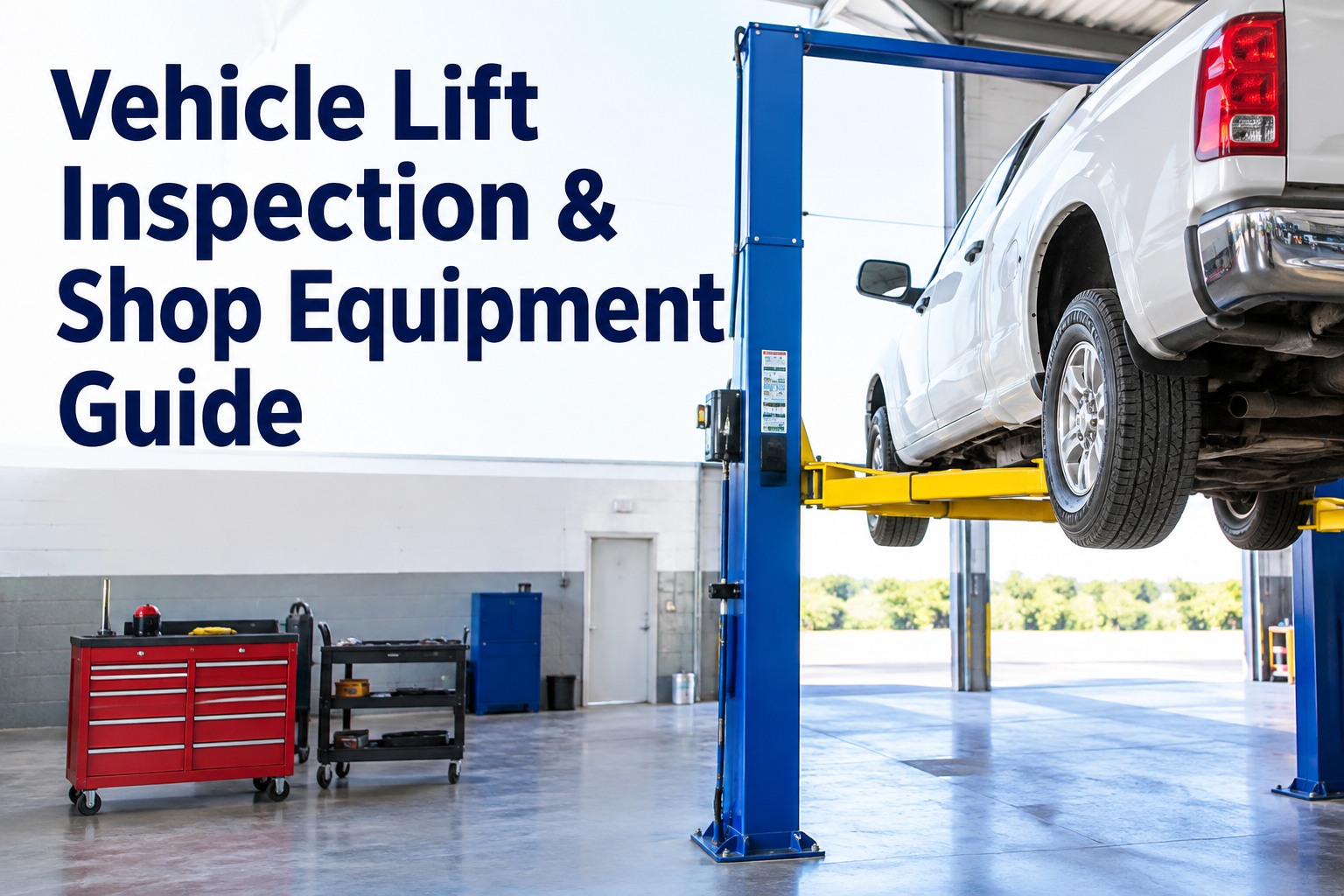
Vehicle lift inspection is the check your shop skips while inspecting everything else. Your techs walk under thirty thousand pounds held up by two steel columns and a pair of safety locks — while the thing holding it up runs on nobody's schedule. Every truck in the fleet has a PM record; the lifts, jacks and stands that service them usually have none. Here's what lift inspection requires and how to put your workshop gear on the same program as your trucks. See mixed assets in one system
You Inspect the Truck. Who Inspects What's Holding It Up?
Every vehicle has a service record. The lift under it, the jack beside it, and the stands it sits on usually don't — until an inspector, an insurer, or an accident asks for one.
- Daily, monthly & annual lift checks on one schedule
- Annual certification record stored per asset
- Lifts, jacks & hoists beside the trucks they hold up
A lift failure isn't a breakdown — it's a person under a load that lets go. That's why lift inspection is one of the few pieces of shop equipment with a real, documented safety standard behind it, and why "we've never had a problem" is exactly the sentence that precedes the problem. Below is what the standard actually requires, how the three inspection tiers stack, what to check on the jacks and stands nobody certifies, and how the whole workshop lands on one maintenance system alongside the trucks.
What vehicle lift inspection actually requires
Here's the part most shops get wrong: OSHA has no standard written specifically for automotive lifts. That doesn't mean lifts are unregulated — it means OSHA enforces them through the General Duty Clause, holding you to the recognized industry consensus standard. For vehicle lifts, that standard is ANSI/ALI ALOIM, and it's unambiguous about the schedule.
"Safety Requirements for Operation, Inspection and Maintenance." Requires every installed lift be inspected by a qualified lift inspector — ideally an ALI Certified Inspector — at least once every 12 months, regardless of the lift's age, type, or brand.
OSHA Section 5(a)(1) requires a workplace free of recognized hazards. A poorly maintained lift is a recognized hazard, and inspectors treat ALI and manufacturer guidelines as the benchmark. No lift-specific rule — but full accountability.
The annual inspection has to produce a formal written report kept as part of the equipment record. Globally the framing echoes: PUWER inspection duties in the UK, IS 15900 in India. Different names, same demand — documented, current, on file.
The through-line across every region is the same: a lift that can't produce a current inspection record is a liability whether or not it's ever failed. Storing each lift's inspection date and report per asset is what turns that from a scramble into a lookup.
The three tiers of vehicle lift inspection
The annual certified inspection gets all the attention, but it's the floor, not the whole program. ALI structures lift safety as three stacked tiers, and the two everyday ones — the daily and monthly checks — are the shop's own responsibility, not the outside inspector's. Skip those and you're relying on a once-a-year visit to catch a fault that developed in month two.
A fast look before the first lift of the day: listen for unusual noises, watch for erratic or jerky motion, confirm the safety locks engage audibly, check for hydraulic leaks under the columns, and verify controls respond. Any lift that doesn't pass gets tagged out, not "watched."
A deeper monthly look at wear points: arm-restraint locks, cables and chains, hydraulic hoses and fittings, anchor bolts and floor condition, and the contact pads that engage the vehicle. This is the tier that catches the slow developing fault long before the annual inspector shows up.
The full ALOIM inspection covering structure, mechanical locking systems, the complete hydraulic system, and electrical controls — ending in a signed, written report. A lift that fails, or is beyond its service life or modified from spec, comes out of service until corrected.
Three tiers, three owners, one record trail. The trouble is that the daily and monthly checks are the easiest thing on earth to let slide when the shop is slammed — which is exactly why they need to live in a system that schedules and logs them, not a clipboard that walks off. Running all three tiers as scheduled tasks per lift keeps the everyday checks from vanishing between annual visits.
The shop equipment inspection nobody certifies
Lifts at least have a standard forcing the issue. The rest of the load-bearing gear on your floor — the jacks, the stands, the shop crane — usually has none, which is precisely why it's more dangerous. A jack stand with a hidden crack doesn't get an annual inspector; it just fails one day under a technician. Here's the everyday shop equipment that belongs on the same inspection program, and the one thing that matters most on each.
Locks must engage audibly and hold; columns must be straight, crack-free, and properly anchored. The capacity plate must be legible and never exceeded.
A jack that won't hold under load is drifting down as you work. Check for seal leaks, that it lifts and holds to rating, and that the rated capacity is stamped and respected.
Never trust a jack alone — stands take the load. Inspect welds for cracks, the ratchet or pin for wear, and the base for bends. A stand is only as rated as its worst weld.
Inspect the chain or cable for wear and kinks, the hook for a working safety latch and no spreading, and slings for cuts. Load rating clearly marked and never guessed at.
Check the head mount and rotation lock on engine stands, and the saddle and safety chain on transmission jacks. Loose or worn mounts drop expensive, heavy components.
Seized casters and bent frames turn a routine wheel move into a dropped load. Check wheels roll freely, locks work, and the frame and capacity rating are intact.
Every one of these has a capacity rating that matters and a wear pattern that's invisible until it isn't — which makes them ideal candidates for a scheduled inspection instead of a "looks fine" glance. Adding shop equipment as inspectable assets means the jack and the truck it lifts live in the same record.
One system for a mixed workshop
The reason the shop floor becomes a blind spot is almost never carelessness — it's that fleet software tracks vehicles and shop gear falls outside it, so the lifts and jacks end up on a separate binder, a wall calendar, or one veteran mechanic's memory. Split systems are how the annual lift certification quietly lapses and how nobody notices a jack stand hasn't been looked at in two years.
The fix is to stop treating workshop equipment as a different category. A lift is an asset with intervals and a record, exactly like a truck — it just runs on a mix of hour-based and calendar tiers instead of mileage. When the lifts, jacks, stands, and hoists sit in the same maintenance system as the fleet, the equipment manager sees the whole floor on one dashboard, the annual certifications get the same countdown alerts as vehicle inspections, and an audit or insurance question is answered from one place. Seeing the lifts and the trucks on one dashboard is usually the moment the blind spot closes for good. Keeping mixed assets in one maintenance system is the difference between a workshop that's managed and one that's merely assumed to be fine.
We ran a tight PM program on 90 trucks and couldn't have told you when our lifts were last certified. Found out during an insurance review that two of our four two-post lifts were past their annual. That's a conversation you do not want to have with an underwriter.
We put the whole shop — lifts, jacks, the overhead crane, even the engine stands — into the same system as the trucks. Daily and monthly checks are scheduled tasks now, the annual certs throw alerts months out, and everything's in one place when someone asks. The shop stopped being the part of the fleet we were quietly guessing about.
Frequently asked questions
How often does a vehicle lift need to be inspected?
The recognized standard, ANSI/ALI ALOIM, requires every installed vehicle lift to be inspected by a qualified lift inspector — ideally an ALI Certified Inspector — at least once every 12 months, regardless of the lift's age, type, or brand. High-use lifts may need it more often. Beyond that annual certification, ALI also calls for a daily operator check before use and a monthly inspection by a trained in-house qualified person. So a proper lift inspection program is three tiers: daily, monthly, and annual, with only the annual one requiring an outside certified inspector. The other two are the shop's own responsibility and are the ones most often skipped.
Is vehicle lift inspection an OSHA requirement?
Not directly — OSHA has no standard written specifically for automotive lifts. But that does not mean lifts are unregulated. OSHA enforces lift safety through the General Duty Clause, Section 5(a)(1) of the OSH Act, which requires employers to keep a workplace free of recognized hazards. A poorly maintained or uninspected lift is a recognized hazard, and OSHA inspectors use the ANSI/ALI ALOIM standard and manufacturer guidelines as the benchmark for what a shop should be doing. In practice that makes the documented annual inspection a legal obligation, not just best practice. Outside the US the framing is similar: the UK enforces inspection duties under PUWER, and India references IS 15900 for hydraulic vehicle lifts.
What gets checked in an annual lift inspection?
A thorough annual inspection for most above-ground lifts examines four areas and ends in a written report. Structural integrity: columns, arms, and carriages checked for cracks, deformation, corrosion, and weld condition. Mechanical locking systems: safety latches and locks checked for wear, proper engagement, and function. Hydraulic system: cylinders, hoses, fittings, and fluid checked for leaks, deterioration, and pressure integrity. Electrical systems: control panels, wiring, switches, and contactors checked for damage, grounding, and function. The inspector also verifies the capacity plate and the condition of the vehicle contact points. A lift that fails, is beyond its service life, or has been modified from original specification may not be certifiable and should be taken out of service until corrected.
Do jacks and jack stands need to be inspected too?
Yes, and arguably they need it more than lifts precisely because no standard forces an annual certification on them. A floor jack that won't hold hydraulic pressure drifts down under load; a jack stand with a cracked weld or a worn ratchet pin can collapse without warning. Every jack and stand should be checked for structural cracks, seal leaks, worn locking mechanisms, and a legible capacity rating that is never exceeded, and any that fail should be removed from service immediately rather than kept in the corner "for light jobs." The safest shops treat jacks, stands, shop cranes, engine stands, and wheel dollies as inspectable assets on a scheduled program, the same way they treat lifts, rather than relying on a technician noticing a problem mid-use.
Can shop equipment and fleet vehicles be managed in the same system?
Yes, and doing so is what closes the shop-floor blind spot. The reason workshop equipment gets neglected is usually that fleet software tracks vehicles while lifts and jacks end up on a separate binder or wall calendar, so their inspections quietly lapse. A maintenance system that handles mixed assets treats a lift, a jack, or a crane as an inspectable asset with its own intervals and record, exactly like a truck — it simply runs on hour-based and calendar tiers rather than mileage. That puts the daily, monthly, and annual lift checks on the same scheduled-task footing as vehicle PM, gives the annual certifications the same advance alerts as vehicle inspections, and lets an equipment manager answer an audit or insurance question about the whole floor from one place instead of hunting through binders.
Stop guessing about the gear that holds your fleet up
HVI manages lifts, jacks, stands, hoists, and cranes as inspectable assets right beside your vehicles — daily, monthly, and annual checks as multi-interval scheduled tasks, certification records stored per asset, defects logged with photos, and full offline use on the shop floor. One system for the truck and the lift under it. See your whole workshop in it.
No credit card · Works offline · Mixed fleet & shop-equipment assets