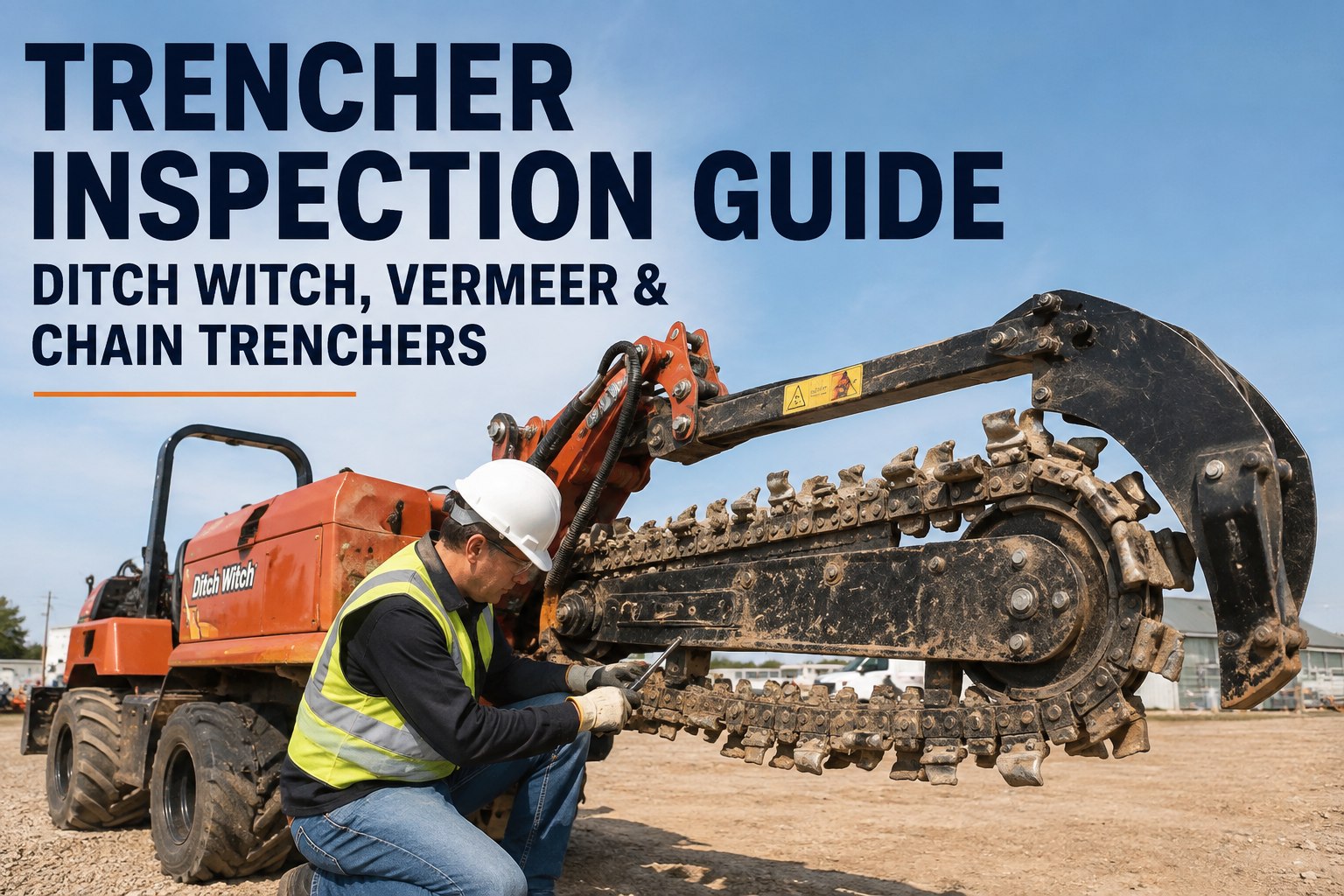
A trencher's productivity lives inside three components: the chain, the teeth, and the sprocket. Ditch Witch calls them CTS — and when one wears out, the other two are already halfway there. Running a worn sprocket with new chain destroys the chain; running new sprocket with worn chain destroys the sprocket. Miss the wear signals and productivity drops 20–40% before anyone notices. Trencher inspection is really CTS inspection, done systematically. This guide walks the discipline for Ditch Witch, Vermeer, and utility trenchers. Book a demo
The CTS triangle — three components, one lifecycle
Chain, Teeth, Sprocket. Wear as a system. Fail as a system. Inspected as a system.
Trenchers occupy a specialty niche: fiber, water, sewer, and electric utility installation where trenches run 100+ feet and productivity is measured in feet per hour. Unlike excavators, they only do one thing — and they need to do it fast. Which means every hour of downtime hurts disproportionately, and every 10% productivity drop from a worn CTS system shows up on the daily production report. Trencher inspection isn't about compliance; it's about protecting the feet-per-hour that make the machine pay for itself.
The 3 trencher families — different machines, shared inspection anchors
Trenchers come in three practical categories. Which one you're inspecting determines which components matter most, but the CTS discipline is universal across all of them.
The takeaway across all three: CTS wear happens fastest and matters most. Track system, hydraulics, and engine also need inspection, but the wear economics of a trencher live in the digging chain. Getting the CTS inspection cadence right is the single highest-leverage discipline in trencher maintenance. Book a demo to see OEM-specific templates for Ditch Witch and Vermeer
The 2-finger chain tension test — the most important 15 seconds of a trencher walkaround
Ditch Witch and Vermeer both publish the same practical rule for standard trenchers: two to three fingers should fit between the chain and the lowest part of the boom when the boom is parallel to the ground. That's roughly 1.5–2 inches of sag. This one check, done every morning, prevents most CTS failures.
Chain vibrates during operation. Rollers wear on the sidebars. Chain may skip off the sprocket entirely under load, stopping production mid-trench.
Chain flexes naturally through the soil. Even load distribution across links, teeth, and sprocket. All three components wear together at expected rates.
Chain runs bar-tight. Uneven wear patterns emerge on sprocket teeth and sidebars. Sprocket teeth thin faster than expected, ending sprocket life prematurely.
Larger trenchers use bigger chains and need more sag — check the operator's manual for the specific figure on RT125 Quad, RTX1250, and other heavy-class machines. But the principle holds across all sizes: the chain should neither hang loose nor run bar-tight. Fifteen seconds, every morning, per machine. Book a demo to see the tension check turned into a photo-required daily task
The 6-station walkaround — trencher edition
Same disciplined 6-station approach as any heavy machine, tuned for trencher-specific systems. On a ride-on trencher, this runs 12–15 minutes.
Stations 3 and 4 — the digging chain and the teeth/sprocket — are where 80% of the productivity story lives. Every other station is standard heavy-equipment inspection. Rubber-track machines require an extra minute at station 6 to clear mud, rocks, and debris that will otherwise premature-wear the embeds and sprockets. Book a demo to see photo-required stations tied to hour-meter readings
Teeth-to-soil matching — the wrong tooth costs you every trench
Digging teeth aren't universal. Running the wrong tooth profile in the wrong soil hurts productivity every foot of every trench — and it's a mistake operators make daily because manufacturers offer many tooth options and the choice looks academic until you see the production numbers side by side.
Cup tooth (utility standard)
Scooped shape. The standard tooth for most soil conditions. Designed for soft and medium-density soils — sand, loam, ordinary dirt.
Carbide-tipped
Tungsten carbide tip bonded to steel body. Massively extended wear life in abrasive material. Higher cost per tooth, dramatically lower cost per hour.
Rock & frost teeth
Aggressive geometry and hardened tip. Built for shot rock, frozen ground, and utility work in cold-region winter conditions. Sacrifices speed for penetration power.
Shark-fin / high-speed
Streamlined profile for maximum feet-per-hour in cooperative soil. Highest production rate in the right conditions; wears fast in the wrong ones.
Match the tooth to the soil and productivity climbs immediately. Run cup teeth in gravel and you'll replace them daily and still get 30% less production than carbide would deliver. Run rock teeth in loam and you'll cut half as fast as cup teeth would. The tooth choice matters more than most operators realize — and the CTS budget can double or halve based on this single decision. Track tooth type per unit, per soil condition, and the annual CTS spend becomes controllable. Start free and track CTS consumables per machine on day one
From a fiber contractor running 8 Ditch Witch RT70s across urban buildouts
We were burning through digging chains at about half the rated life. Nobody could figure out why — the machines were maintained, the operators were good, the ground was normal residential soil. When we finally started tracking CTS wear per unit through digital inspections, the pattern showed up in a week. Three of our operators were plunging the boom into the ground instead of letting it pull through. That single behavior was destroying the chains.
Coaching those three operators, plus tightening our morning tension checks and getting the tooth spec matched to soil per project, we roughly doubled chain life across the fleet. On 8 machines running full-time, that's about $32,000 a year in CTS parts alone, before counting the downtime we don't lose anymore. The digital walkaround didn't fix anything mechanical — it just made the pattern visible. That's what changed.
Frequently asked questions
What is a trencher inspection and what should it cover?
A trencher inspection is a systematic pre-shift and interval-based check of a trenching machine — walk-behind, ride-on mid-size, or ride-on heavy — with special focus on the digging chain, teeth, and sprocket (CTS) that determine machine productivity. Unlike excavators or dozers, trenchers do one job continuously (cut and lift soil in a narrow trench), meaning CTS wear directly translates to productivity in measurable feet per hour. A thorough walkaround takes 12–15 minutes on a ride-on machine and covers six stations: cab and controls (including boom, chain, and steering test); engine bay (coolant, oil, fuel, air filter); digging chain (2-finger tension test, roller and sidebar wear); teeth and sprocket (wear pattern match, broken teeth, sprocket thinning); boom and hydraulics (pivot pins, cylinders, hoses); and tracks or tires (rubber embed condition on tracked units, tire wear on wheeled units, and critically, debris clearance from track system). Because trenchers are typically used by utility contractors for fiber, water, sewer, and electric line installation, they operate on tight production schedules where downtime directly impacts contract profitability. OSHA construction pre-shift inspection requirements apply under 29 CFR 1926.20 and 1926.602 with penalties up to $16,550 per serious violation. Beyond compliance, the practical value of trencher inspection is protecting the CTS system that determines every foot of trench the machine produces.
What is CTS and why does it matter for trencher maintenance?
CTS — Chain, Teeth, and Sprocket — is the industry shorthand for the three interdependent components that determine trencher productivity, popularized in Ditch Witch's own maintenance documentation. These three parts work together: the chain carries the teeth through the soil while riding on the sprocket, the teeth cut and lift the material, and the sprocket drives the chain. Because they operate as a system, they wear as a system. Running a new chain on a worn sprocket dramatically accelerates chain wear because the sprocket teeth don't mesh cleanly with the new chain links. Running a new sprocket on a worn chain does the same in reverse — the elongated chain hammers the new sprocket teeth. Both scenarios waste money and shorten component life. The correct discipline is to replace chain and sprocket together as a matched set, and to replace teeth as soon as they show significant wear or breakage. Teeth themselves should be replaced in matching sets on the chain (not one tooth at a time) so wear distributes evenly. The economics matter: a properly matched CTS system running in the right soil with the right tooth profile can deliver 800–1,500 hours of production life. A poorly matched system with wrong tension and wrong tooth choice can degrade in a fraction of that. Digital inspection tracking that captures wear photos per machine per week reveals the wear pattern in time to intervene, typically extending CTS life 20–35% compared to reactive replacement schedules.
How do you check chain tension on a Ditch Witch or Vermeer trencher?
The standard test, published in Ditch Witch's own maintenance documentation and echoed by Vermeer, is the 2–3 finger rule: with the boom parallel to the ground, you should be able to fit two to three fingers between the chain and the lowest part of the boom. This translates to approximately 1.5–2 inches of natural sag on a standard walk-behind or mid-size ride-on trencher. Larger trenchers (Ditch Witch RT125 Quad, Vermeer RTX1250, and similar heavy-class machines) use bigger chains that require more sag — check the operator's manual for the specific figure per model. Three tension conditions each produce different failure modes. Too loose (4+ fingers of gap): the chain vibrates during operation, wearing rollers on the sidebars, and may skip off the sprocket under load, stopping production mid-trench. Correct (2–3 fingers): the chain flexes naturally through the soil, load distributes evenly across links/teeth/sprocket, all three components wear together at expected rates. Too tight (0–1 fingers, bar-tight): the chain generates uneven wear patterns on sprocket teeth and sidebars, thinning sprocket teeth faster than expected and shortening sprocket life. The tension check takes fifteen seconds per machine and should happen every morning before starting work. It is the single highest-value maintenance discipline on a trencher.
Which digging teeth should I use for my soil conditions?
Digging tooth choice depends primarily on soil hardness and abrasion characteristics, and running the wrong tooth in the wrong soil hurts productivity every foot of trench. Cup teeth (the utility standard, scooped shape) are designed for soft to medium soils — sand, loam, ordinary residential dirt. They deliver excellent production rate in cooperative conditions and are the default choice for general fiber, water, and sewer installation in typical residential and commercial ground. Carbide-tipped teeth (tungsten carbide bonded to steel body) are for harder or more abrasive conditions — hard-packed soil, gravel, decomposed granite. Higher cost per tooth but dramatically longer wear life in abrasive material, resulting in significantly lower cost per hour. Rock and frost teeth use aggressive geometry with hardened tips for shot rock, frozen ground, and cold-region winter utility work. They sacrifice speed for penetration power. Shark-fin or high-speed teeth have a streamlined profile for maximum feet-per-hour in cooperative soil, ideal for high-production fiber-optic installation on long runs in sandy loam — but they wear fast in tougher material. Practical rule: match the tooth to the toughest soil condition on the specific project, then track feet-per-hour and CTS consumables per unit to validate the choice. Replace teeth in matching sets so wear distributes evenly; replacing individual teeth creates uneven load that accelerates chain and sprocket wear. When teeth become dull or show breakage, replace immediately — running dull teeth destroys chain life.
How does HVI help fleets manage trencher inspections and CTS lifecycle?
HVI ships pre-built digital inspection templates for the major trencher families — Ditch Witch RT45/RT70/RT125 Quad and Vermeer RTX130/RTX1250, plus configurable templates for Barreto, Tesmec, Toro, and other brands — with model-specific inspection points, required photo capture at critical stations (digging chain, teeth, sprocket, boom, tracks), and hour-meter integration. Every inspection is tied to the specific machine, operator, and location with GPS verification and timestamped photo evidence, meeting OSHA pre-shift documentation requirements at 29 CFR 1926.602. The chain tension check, tooth wear check, and sprocket wear check are photo-required at each morning walkaround, creating a visual trend per machine that reveals CTS wear patterns weeks before component failure. On the PM side, HVI schedules CTS inspection cadence (daily, weekly, and 250–500 hour intervals), tracks CTS consumables per unit (chain, teeth, sprocket type and hours), and alerts on replacement thresholds — including the critical "replace chain and sprocket together" rule that many fleets miss. Fleets typically report chain life extending 20–35% and CTS spend dropping meaningfully within the first quarter of digital tracking rollout. Downtime typically drops 25–40% within the first month of digital inspection rollout. Published customer data shows fleets on HVI report approximately 25% lower annual maintenance cost with typical payback around 3 months. For utility contractors running 5+ trenchers, the recovered CTS life alone typically pays back the software within the first two months.
Fifteen seconds of chain-tension check every morning. Doubles chain life. That's the math.
HVI ships pre-built templates for Ditch Witch RT45/RT70/RT125 and Vermeer RTX130/RTX1250 — with required CTS photos, tension diagnostics, and full PM interval scheduling. Live in under two weeks. CTS life typically extends 20–35% in the first quarter.
No credit card · Ditch Witch & Vermeer templates ready on day one